
The author of this article believes that such initiatives prove that either John R. Bolton spent some time in some kind of a space-time loop and has no idea of what happened afterwards, or he is just an extremely cynical old-school hawk [...]
On March 23, 2018, the US media published an interview with the newly-appointed National Security Advisor John R. Bolton, where he stated that the only solution for North Korea is complete disarmament – following the example of Libya under Muammar Gaddafi. This scenario is exactly what Donald Trump and Kim Jong-un need to discuss during their negotiations.
John R. Bolton is well-known as a hardliner regarding Pyongyang. During his work for the Department of State in the 2000s, he was one of the most furious opponents of any dialogue with North Korea, and more recently he advocated a preventive strike against it. According to him, North Korea and its nuclear program are a direct threat to the US and “given the incomplete US intelligence data on North Korea we should not wait until it’s too late.” On the contrary, “it seems justified that the US should respond to the North Korean nuclear weapon threat with a pre-emptive strike.” Apart from that, Bolton does NOT consider the Iraq War a mistake, he is a proponent of reforming the UN, taking the hard line with Russia and increasing aggression towards Iran.
The author of this article believes that such initiatives prove that either John R. Bolton spent some time in some kind of a space-time loop and has no idea of what happened afterwards, or he is just an extremely cynical old-school hawk.
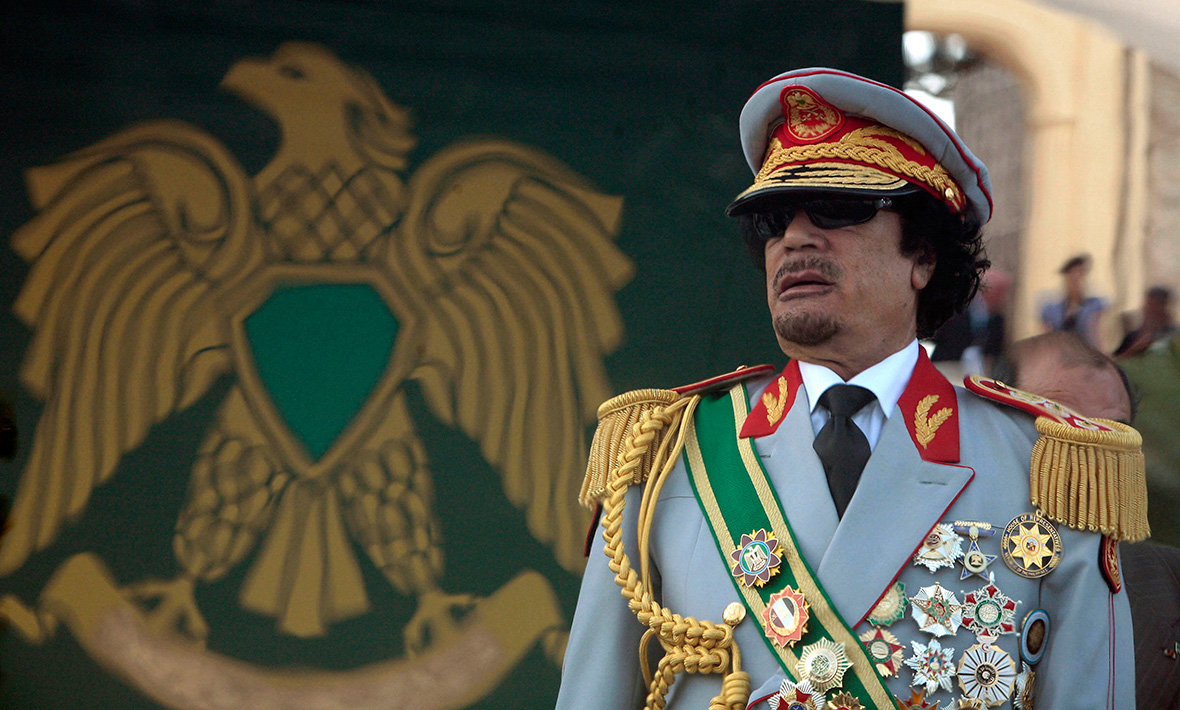
Let us remind you that Libya announced abandoning its weapons of mass destruction development program in December, 2003. John R. Bolton took part in the negotiations, but when 2011 saw the beginning of the Arab Spring, he was one of the first to call for a war in Libya, justifying it by “Gaddafi’s desire to get hold of nuclear weapons”. However, many representatives of the George W. Bush Administration, in particular, Colin Powell, are still convinced that “the Libyan experience of abandoning nuclear weapons is positive and has led to the country’s integration in the world community.”
Nevertheless, in exchange for giving up the nuclear program (which was at a much earlier stage than the North Korean one), Gaddafi got way more than Kim Jong-un was ever promised. It included total absolution – even the Lockerbie jet bombing was “ascribed to Iran”.
Then the “Arab Spring” came and the fate of Gaddafi was very sad, after which many wondered what kind of fate he would have had, had he not given up the bomb eight years ago. No, it is, of course, highly probable that the “Green Book” author could have “earned” the Iraq scenario with the official US military invasion to fight the evil regime. But history has no “subjunctive mood”, and since then the Libyan scenario that used to be considered an example of a successful nuclear deal has not been mentioned without the ironic quotation marks.
First, this is about taking irreversible actions in exchange for reversible ones. A disassembled nuclear reactor and blown-up missiles cannot be assembled back as they were. Meanwhile, any diplomatic relations can be broken, any shipments can be discontinued and, as experience shows, the pretext for that can be not even the change in the outcast country’s policy, but the change in the leadership of its counterpart: our ex-president could have signed anything, now our policy line is different.
And North Korea relies heavily on its nuclear missile program as an efficient tool not only in maintaining its sovereignty, but also in raising the quality of life of the people. Today, some people fail to realize that the nuclear missile block is not the most precious and valuable thing. Conventional weapons equipped with expensive cutting-edge technologies cost more, but people are used to believing the following understandable idea: “the people are hungry and the government spends all the money on nuclear weapons.” Meanwhile, should North Korea search for a proportionate response, it would not end well for it. The South Korean military budget is 23-25 times as big as that of North Korea. And it has not only to do with the high salaries of the military personnel and equipping them with hand cream.
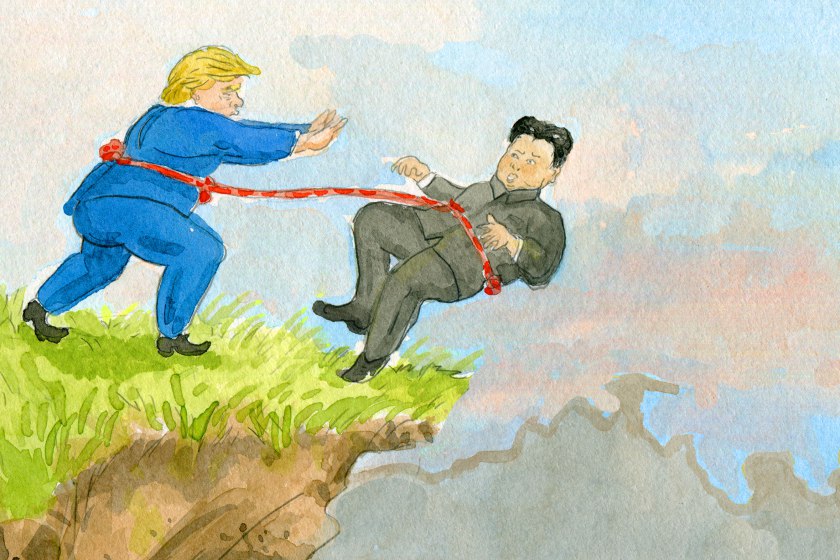
Second, any nuclear deal of the kind is the question of guarantees. The existing world order has a distinct characteristic of the degradation of the existing norms. Relatively speaking, if one can still try making North Korea comply with its obligations by imposing international sanctions on it, then an attempt to call Washington, DC to order is, let us face it, much more problematic. That is why it seems that, speaking of the Libyan scenario, John R. Bolton means not only the events of 2003, but also those of 2011. According to old-school hawks, it is quite logical to disarm the enemy and then finish him off based on “the newly-found evidence”.
The author would also like to draw the reader’s attention to why people like Bolton are in principle worse than the hawks like McMaster, Mattis or Pompeo, whose outlook is little defined by the military past. The thing is that, despite the stereotype about the military, in crisis situations that have to deal with the question “to strike” or “not to strike”, they usually choose the second option, as they start calculating possible casualties rather than possible political advantages. The first option is most often backed by the “pure” politicians who have no military or administrative experience and who are used to imagining war as some kind of a TV broadcast. If we consider John R. Bolton’s work record, he fits this category perfectly.
In this context, we shall note the widespread opinion among the US conspirologists that the US is going to start a war on the Korean peninsula, but unlike the situation that took place 15 year ago, this time it is going to take a more competent approach. Unsubstantiated accusations may not do the trick this time. That is why the strategy has to be more subtle and include 2 elements. The first one is to provoke an inadequate action which could be regarded as a casus belli. In this case, the US acts not as an aggressor, but as a defender at the same time lowering the probability that Pyongyang should receive any help. Thus, it is well known that Beijing corridors of power many times heard the message that the 1961 treaty military assistance article will only be in effect if North Korea suffers an unprovoked attack. Then many things may be expected. And if the North is the first to attack the South, then China will surely call for a peaceful resolution of the problem and will express its great concern, but nothing more.
The second element of the strategy is that the decision to start a war is made at the last minute and due to the circumstances. And until that moment, we keep talking a blue streak about the dialogue and peace actually only to throw our hands up in despair at the eleventh hour and say in front of the camera: “We honestly did our best. We were even ready to make concessions, but these scoundrels were so bad that we just have no other choice than to launch an air strike.” Even more so, as the Skripal poisoning case shows, to put a label justifying international sanctions “well-founded suspicions” are enough. Everyone knows that the terrible Putin has special invisible ninja agents, who leave no trace and evidence behind, and that is why the absence of traces and evidence is the main proof incriminating Putin. Naturally, he is the only one who has invisible ninjas.
Yes, another anti-American conspirologist branch thinks that the illustrative flagellation, called to remind the world that the US remains the world hegemon and can trample anyone else, may be in fact aimed at Iran, not North Korea. And, getting ready to start a war in a new area, one has to take precautions with the old one, to avoid getting in two conflicts at the same time. Yes, despite its higher population and better-developed industry potential, in terms of cynical policy, Iran is a more acceptable target. First, it has a nuclear program, but no nuclear bomb. Second, there is no Seoul analogue that would ensure that the outcast country deals unacceptable damage to a strategic ally in case of a “pre-emptive strike”. Third, despite the fact that Russia and Iran share no border, it would harm the Russian interests no less than an attack in the North. Fourth, given the Iranian society structure and occasional mass protests, unlike North Korea, the US has more reason to rely on the success of its propaganda machine in terms of possible sabotage or treason. In this context, we cannot exclude that at the end of spring – in early summer the US will terminate the “nuclear deal” with Iran and then search for a casus belli after finding the Iranian trace in some outrageous act of terrorism.
Originally published on 2018-04-16
About the author: Konstantin Asmolov, Ph.D. in History, Leading Research Fellow at the Center for Korean Studies of the Institute of Far Eastern Studies of the Russian Academy of Sciences.
Origins of images: Facebook, Twitter, Wikimedia, Wikipedia, Flickr, Google, Imageinjection, Public Domain & Pinterest.
Read our Disclaimer/Legal Statement!
Donate to Support Us
We would like to ask you to consider a small donation to help our team keep working. We accept no advertising and rely only on you, our readers, to keep us digging the truth on history, global politics, and international relations.
Did you know that Hamas, the Islamist terrorist organization whose militant wing has rained rockets on Israel, has the Jewish state of Israel to thank for its existence? Israel first encountered Islamists that would later form Hamas in Gaza in the 1970s. Back then they seemed focused on studying the Quran, not on confrontation with Israel. Israel realized that it could use the organisation to help splinter Palestinian society in the Gaza strip and hurt the Palestinian Liberation front which dominated Palestinian politics. So Israel helped and even gave funds to Hamas in the 1980s so it could establish itself ...
For the first time since WW II, overt fascists hold real power in Europe. Radicalized ultranationalists. Anti-Semites. Hate-mongers.Cold-blooded killers. Whitewashing high crimes. A puppet regime. America’s newest colony.Mocking democratic values. Violating fundamental rule of law principles. Unaccountably.Western leaders won’t explain. Nor will the media. Hard truths are buried.Ukraine’s government usurped power forcibly. Putschist rule has no legitimacy.Especially regimes waging war on their own people. Murdering them in cold blood. Committing horrendous human rights abuses.Tolerating no opposition. Ruling by intimidation. Force-feeding neoliberal harshness on impoverished people. Making life unbearable overall. More on this below.On December 4, Wall Street Journal editors published ...
World War II started, at least as far as the “European Theatre” was concerned, with the German army steamrolling over Poland in September, 1939. About six months later, even more spectacular victories followed, this time over the Benelux Countries and France. By the summer of 1940, Germany looked invincible and predestined to rule the European continent indefinitely. (Great Britain admittedly refused to throw in the towel, but could not hope to win the war on its own, and had to fear that Hitler would soon turn his attention to Gibraltar, Egypt, and/or other jewels in the crown of the British ...
Peter M. Tase (PMT): Cuales son algunos proyectos de gran importancia para la región que usted ha facilitado durante vuestra trayectoria como representante de la CAF (Development Bank of Latin America)?Dr. Rubén Ramírez Lezcano (RRL): Conozco en profundidad a la organización desde distintas perspectivas habiendo sido Viceministro de Economía y Canciller Nacional del Paraguay y, luego, funcionario de la CAF (Development Bank of Latin America) por muchos años, en los cuales tuve la oportunidad de desempeñarme como Asesor del Presidente primero, posteriormente como Director – Representante de CAF en la oficina de Panamá, con responsabilidades para Centroamérica, El Caribe y México, y ...
History of NATO enlargementIn 2009, Russian President Medvedev (President from May 7th, 2008 to May 7th, 2012) called for a new European security policy known as “Fourteen Points” as a new security treaty to be accepted to maintain European security as the ability of states and societies to maintain their independent identity and functional integrity (this Russian draft European security treaty was originally posted on the President’s website on November 29th, 2009). This treaty proposal was passed to the leaders of the Euro-Atlantic States and the executive heads of the relevant international organizations such as NATO, EU, the Collective Security ...
The American people should, in the words of Vietnam War Veteran Brian Willson “place themselves in the position of people living in targeted countries. That North Korea, a nation of 24 million people, i.e., one-twentieth the population of the U.S., many of them poor, a land slightly larger in area than the U.S. state of Pennsylvania, continues to be one of the most demonized nations and least understood, totally perplexes the Korean people.”What most people in America do not know –and which is particularly relevant when assessing the “threats” of the DPRK to World peace– is that North Korea lost thirty percent ...
40 yrs after Prez Teddy Roosevelt gave Korea to brutal Jap Empire in return for its recognition of Philippines as US Territory, US invaded Korea long AFTER Jap surrender, overthrowing its Korean gov., cutting it in two parts, installing a US dictatorship in its south now documented to have murdered 100,000 of its own citizens.What Western media calls ‘Communist China,’ is a China governed by its Communist Party since 1949, and lying just across the Yalu River from a Korea, which between 1950 and 1953, was merciless bombed by the US, both north and south, all cities and towns of ...
“I hate the gooks,” Sen. John McCain (R-AZ) doubled down when asked on the 2000 presidential campaign trail about his continued use of the racist slur for Vietnamese people. “I will hate them as long as I live.” In the mind of the settler-colonialist, the white invader is always the victim and the people he invades, occupies, expels or exterminates are always the aggressors, going all the way back to the Native American genocide. McCain was never able to understand that in Vietnam, as in just about everywhere else they went, Americans were the invaders, not the victims. Even as McCain ...
Universal Periodic Review reveals longstanding unwillingness to fully commit to obligations of pertinent human rights treaties.On 11 May 2015, the United States of America participated in its second Universal Periodic Review (UPR). The Universal Periodic Review is meant to be a mechanism by which all UN Member States are periodically assessed on their human rights record. The process allows countries to present a report of their efforts to promote and improve human rights within their country. It also affords the Working Group of the UPR, comprised of member countries of the Human Rights Council, the opportunity to assess the human ...
Historical research into the Nazi era rarely throws up many surprises any more. German historian Stefan Ihrig, however, is an exception to this rule. By studying long-published sources, he has uncovered the fascination that Ataturk's modern Turkey held for the German far right, which has been seriously underestimated until now and which set an example for Hitler and the National Socialists.From a right-wing viewpoint, what Ataturk had achieved was an unattainable goal for Weimar-era Germany. Using force of arms, he had managed to reverse the Treaty of Sevres, which had been forced on his country by the Entente in 1920, ...
Professor Vladislav B. Sotirović, Ph.D. is a Senior Lecturer of: “Middle East Studies” at the Mykolas Romeris University, Vilnius, Lithuania; “Mediterranean Studies;” “Ethnicity, Multiculturalism and Globalisation;” “Balkan Nationalism and Ethnic Conflicts” and “Europeanisation: Process and Results.”Prof. Dr. Sotirović is a distinguished expert on the History of the Early Byzantine Empire, 330–846”, Comparative History of Central and South-Eastern Europe and Ottoman History, History of Lithuania and Ukraine. He is well known abroad for his influential books and popular lectures about Lithuania, the Russian Federation, the Balkans, and Baltic Nations, and Multiculturalism.Professor Sotirović has studied at the Central European Summer University, Budapest, ...
NATO has expanded dramatically after the collapse of its primary rivals, the USSR and the Warsaw Treaty Organization, Canadian Professor Michael Jabara Carley notes, posing the question whether NATO was founded as a defensive or an offensive alliance.The North Atlantic Treaty Organization (NATO), a military alliance aimed against the Soviet Union, was established on April 4, 1949; and only seven years after the formation of NATO the Warsaw Treaty Organization was established bringing together eight nations (versus 15 NATO member-states).So, who was the real “aggressor”? What alliance was an offensive one?“There has been much discussion recently of NATO in the mainstream and alternate media. Why was ...
The paradox of the current global crisis is that for the last five years, all relatively responsible and independent nations have made tremendous efforts to save the United States from the financial, economic, military, and political disaster that looms ahead. And this is all despite Washington’s equally systematic moves to destabilize the world order, rightly known as the Pax Americana (“American peace”).Since policy is not a zero-sum game, i.e., one participant’s loss does not necessarily entail a gain for another, this paradox has a logical explanation. A crisis erupts within any system when there is a discrepancy between its internal ...
On March 29 Latvia, Lithuania and Estonia will celebrate 15 years of becoming NATO member states. The way to the alliance membership was not simple for newly born independent countries. They have reached great success in fulfilling many of NATO demands: they have considerably increased their defence expenditures, renewed armaments and increased the number of military personnel. In turn, they get used to rely on more powerful member states, their advice, help and even decision making. All these 15 years they felt more or less safe because of proclaimed European NATO allies’ capabilities.Unfortunately, now it is high time to doubt. The ...
In light of Sergey Lavrov’s recent statements reflecting Russia’s disappointment with the West and the country’s intention to “stop judging ourselves on the basis of marks given by the collective West or individual Western countries”, it might have been expected that the Russian foreign minister’s mid-December Balkan mini tour would be a good chance to see how this new Russian awakening was going to be reflected in practice. Especially in Bosnia and Herzegovina (B-H), perhaps the most famous hamlet in the Potemkin village built by Western “humanitarian interventionism” during the, thankfully, relatively brief unipolar moment lasting approximately two decades after ...
The amount of bombs dropped by Americans on the innocent citizens of tiny French Indochina was more than twice the amount of bombs dropped in Europe, Africa and Asia during the Second World War, and this includes bombs dropped on the cities of Hanoi and Haiphong by American hero Senator John McCain, who proudly ran for president on his military record in spite of Nuremberg Counsel for Prosecution General Telford Taylor having said he would have been proud to have prosecuted US flyers shot down while bombing in Vietnam.[3] What mastery of fake news, blacked out news, selected news and outrageously ...
In whose interest did the creation of the Cold War serve and continues to serve? Cynthia Chung addresses this question in her three-part series.In 1998, the Nazi War Crimes and Japanese Imperial Government Records Interagency Working Group (IWG), at the behest of Congress, launched what became the largest congressionally mandated, single-subject declassification effort in history. As a result, more than 8.5 million pages of records have been opened to the public under the Nazi War Crimes Disclosure Act (P.L. 105-246) and the Japanese Imperial Government Disclosure Act (P.L. 106-567). These records include operational files of the Office of Strategic Services ...
In June and July 1941, detachments of German Einsatzgruppen, together with Lithuanian auxiliaries, began murdering the Jews of Lithuania. Groups of partisans, civil units of nationalist-rightist anti-Soviet affiliation, initiated contact with the Germans as soon as they entered the Lithuanian territories. A rogue unit of insurgents headed by Algirdas Klimaitis and encouraged by Germans from the Sicherheitspolizei and Sicherheitsdienst, started anti-Jewish pogroms in Kaunas (Polish: Kovno) on the night of 25–27 June 1941. Over a thousand Jews perished over the next few days in what was the first pogrom in Nazi-occupied Lithuania. The most infamous incident occurred in what was ...
Last week, the Turkish Armed Forces entered Afrin in Syria’s Aleppo. According to the Syria-based Kurdish Hawar News Agency, Turkey also intends to deploy troops near the Raju area and place its armored vehicles there.Many Syrian experts believe that Ankara cooperates with the U.S.-backed Harakat Nour al-Din al-Zenki. Earlier, Spokesman of the armed opposition group Abdulsalam Adbulrazaq reported that Harakat Nour al-Din al-Zenki had reached an agreement with the Turkish troops over the deployment of Turkish soldiers at monitoring positions in Western Aleppo.According to preliminary estimates, Turkey will provide opposition militants with all necessary weapons, and Harakat Nour al-Din al-Zenki ...
The WarmongersThe war, which began in August 1914 – to contemporaries the Great War, to posterity the First World War – marked the end of one period of history and the beginning of another. Starting as a European war, it turned in 1917, with the entrance of the US into a world war. The spark that triggered it off was the assassination of the Austrian heir-presumptive, Archduke Franz Ferdinand (1864−1914), by a Bosnian nationalist of Serb origin – Gavrilo Princip[1], a member of the Young Bosnia (Mlada Bosna) movement, in Sarajevo on June 28th, 1914 on his official visit to ...