
This Remembrance Day will doubtless see strenuous efforts by some to justify the fruitless bloodbath that was the First World War. Revisionist commentators have long attempted to rehabilitate the conflict as necessary and just, but the arguments do not stand up. It does no service to the memory of the dead to allow any illusions in the justice or necessity of war, particularly so when the precedents will be used to argue for the next ‘necessary’ conflict. From the causes of the war, to its prosecution and its results, here are the counter-arguments to ten common pro-war ploys.
1. The war was fought in defence of democracy
This is contradicted by the basic facts. Germany had universal manhood suffrage while in Britain, including Ireland, some 40% of men still did not qualify for the vote. In Germany also, there were attempts to justify the war on the grounds that it was being fought to defend civilised values against a repressive, militaristic state, in the form of Russian autocracy.
2. Britain went to war due to a treaty obligation to defend the neutrality of Belgium
There was no clear and accepted obligation on Britain to do this, and, in fact, before the Belgian issue appeared, the war party in the cabinet was already pushing for British intervention on the entirely different ground that there were naval obligations to France. These obligations had been developed in secret arrangements between the military of both countries, and were never subject to any kind of democratic accountability. The Germans even offered guarantees over Belgian integrity, which the British government refused to consider at all.
3. German aggression was the driving force for war
However aggressive the German leadership may have been in 1914, the British establishment was at least as determined to take the opportunity to go to war with its imperial rival. At one point the Foreign Office even seized on imaginary German incursions into France to justify a British declaration of war on Germany. The declaration letter had to be retrieved from the German ambassador and rewritten when it was discovered that the stories were false. The enthusiasm of the British ruling class for war undermines any justification for it based on German aggression.
4. Germany had started a naval arms race with Britain
Imperialist competition between the two states over markets and resources preceded the arms race in the fifteen years before the war. Britain’s naval power was the vital element in its ability to restrict German access to markets and resources across the world. Unless Britain was willing to allow Germany to expand economically, the logic of capitalist competition meant that Germany was bound to challenge British naval supremacy. The latent violence of the leading imperial nation is always the context for aggressive challenges to the status quo on the part of rising powers.
5. German imperialism was uniquely vicious and had to be challenged
The atrocities committed against the Herrero people in Namibia were indeed terrible crimes, but were hardly unique compared to the horrors committed by all those involved in the rubber industry in the Belgian Congo, to take but one example. Also, European opinion had only a few years before 1914 been horrified by the brutality of another colonial power when it was engaged in ruthlessly expanding its dominance over independent states in Africa. This was Britain in its wars of aggression against the Boer states in South Africa, during which concentration camps were first used in order to control a civilian population.
6. Public opinion was united in favour of the war, as shown by images of cheering crowds in 1914
It is now usually admitted that the degree of enthusiasm for the war was strictly limited, and the evidence is that the crowds who gathered at the outbreak of war were by no means united in martial enthusiasm. In fact sizeable and widespread anti-war demonstrations occurred in both Britain and Germany. Had the leaderships of Labour and Socialist parties across Europe not caved into demands to support their national ruling classes in going to war, it is quite possible that the conflict could have been stopped in its tracks.
7. The morale of British troops fighting on the Western Front remained intact to the end of the war
While Britain may not have suffered quite the same scale of mutinies as in the German and French armies, at times there were whole stretches of the front where troops became so unreliable that generals did not dare order them into combat. The evidence for widespread cynicism about war strategies, contempt for the military leadership, and grave doubts about the purpose of the war, cannot be wished away by the revisionists. In so far as soldiers carried on willingly fighting the war, the explanation needs to be sought in the habituation to obedience, as well as the threat of court-martial executions. There is no need to invoke either fervid nationalism or any kind of deep psychological blood-lust as explanations.
8. The military leadership, notably General Haig, was not a bunch of incompetent ‘donkeys’
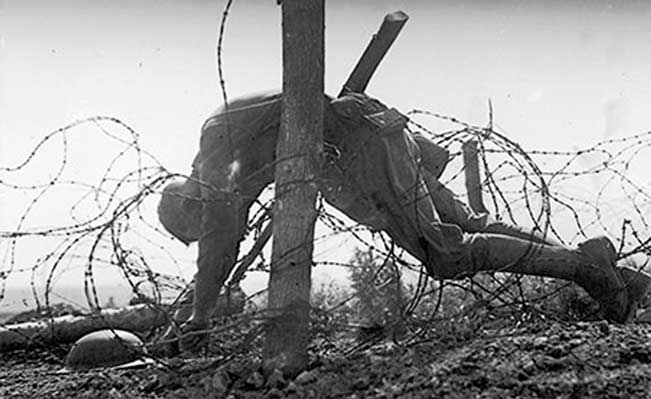
Attempts to rehabilitate the likes of General Haig founder on some of the basic facts about the tactics he relentlessly employed. Repeated infantry attacks on opposing trenches consistently failed to gain any clear advantage, while causing colossal casualties. On the first day of the battle of the Somme, 1st July 1916, 57,000 troops out of 120,000 were killed or wounded. Despite continuing carnage on an incredible scale, Haig carried on ordering further attacks. When any hope of a breakthrough against the German lines was clearly lost, the purpose of the battle was shifted to attrition pure and simple. The plan now was to kill more German troops than the British lost. Since there was no way of reliably measuring the casualties on the other side, Haig relied on estimating it through the losses of his own side. On this basis he began to be angered when the army suffered too few losses, as when he complained that one division in September had lost under a thousand men. There can be no defence for this kind of disregard of human life.
9. The end of the war saw the triumph of liberal capitalism, against collapsing autocratic Empires
In fact all states involved in the war were deeply destabilised. Even the United States, whose involvement was the most limited, experienced the ‘Red Summer’ of 1919, with unprecedented labour revolts, such as the Seattle general strike, alongside savage repression of socialists and black Americans. Britain saw the beginning of the Irish war of independence, and increasing unrest in India, which marks, in effect, the point at which the Empire began to unravel. Domestically, there was also a wave of radical working-class unrest, particularly in the ‘Red Clydeside’, which culminated in troops being sent into Glasgow to impose martial law.
10. The war achieved anything worthwhile whatsoever
The war opened up a period of endemic economic dislocation, and outright crisis. In Britain there was a decade of industrial decline and high unemployment even before the Great Depression. In effect, it was only the Second World War which brought the major capitalist powers out of the slump. The First World War saw the point at which capitalism became addicted to war and to a permanent arms economy. The war demonstrated the capacity of capitalism to create industrialised waste, carnage and destruction on a colossal scale. The remembrance of the war is appropriately a time for mourning the horror, the loss and the waste of it all, but it should also provoke a determination to resist our rulers’ insistence on promoting war to further their interests. War can achieve nothing other than to create the conditions for further wars.
Popular opinion has, ever since its ending, remembered the First World War as a time of horrendous and futile misery and slaughter, as epitomising political and military leaders’ incompetence and callous disregard for human life. That popular judgement, which has helped turn common opinion against war in general, was correct, and we must not let the war mongers dismiss this instance of the wisdom of ordinary people.
Originally published on 2014-11-09
About the author: Dominic Alexander is a member of Counterfire, for which he is the book review editor. He has been a Stop the War and anti-austerity activist in north London for some time. He is a published historian whose work includes the book Saints and Animals in the Middle Ages, a social history of medieval wonder tales.
We would like to ask you to consider a small donation to help our team keep working. We accept no advertising and rely only on you, our readers, to keep us digging the truth on history, global politics, and international relations.
The interviews with three snipers of Georgian nationality, conducted by the Italian journalist Gian Micalessin and aired last week as a breathtaking documentary on Milan-based Canale 5 (Matrix program), still have not paved its way to the international mainstream media. That is hardly surprising taking into account the bombshell evidence against the real perpetrators and organizers of the 2014 coup d’etat in Kiev, generally known as the “revolution of dignity“.The documentary features Alexander Revazishvili, Koba Nergadze and Zalogi Kvaratskhelia, Georgian military officers who were recruited to carry out a “special mission” in Kiev by Mamuka Mamulashvili, a close aid of ...
The origins of Megali IdeaEleftherios Venizelos and a Greater Greece (1910)Greece became the independent state (from the Ottoman Empire) in 1829−1833 with the crucial diplomatic, political, financial and military assistance by the UK and Russia. It was a very fact that the Kingdom of Greece incorporated at that time only around 25% of the Greeks who were living at the Balkans and Asia Minor (the Near East). Such situation created tensions between Greece and the Ottoman Empire as the Greeks wanted their total national unification what was possible only under the conditions of the destruction of the Ottoman Empire. Therefore, ...
Recommended alternative reading list on the Yugoslav studies not used by mainstream corporative Western mass-media and top Western universities dealing with global security, world politics and international relations. Reading proposed readers below you can complete picture on the Yugoslav studies out of the official Western approach.March Pogrom 2004 Book and Photo EvidenceKOSOVSKA GOLGOTA Intervju 198820 Principal Misconceptions on Kosovo IssueThe Srebrenica Massacre Evidence Context Politics Edward S Herman Phillip CorwinLista Diane Budisavljevic 1941 Do 1945 by Владислав Б. Сотировић/Vladislav B. SotirovićJosip Broz Tito Bez Maske! by Владислав Б. Сотировић/Vladislav B. SotirovićHayden Mass Killings and Images of Genocide in Bosnia by ...
May 19, 1919 has different and even opposing meanings in Turkey and Greece, just as May 15, 1948, marks both the establishment of Israel and, for Palestinians, the start of the Nakba (“catastrophe”).In Turkey, this date marks the first step that led to the establishment of the Turkish Republic, while for descendants of Ottoman Greeks and Greece it marks the end of the centuries-long Pontic Greek presence on the shores of the Black Sea. Whereas Turks celebrate May 19, Greeks mourn it. Researcher Tamer Çilingir summarised the issue in a 2016 interview with the Turkish-Armenian daily Agos:“The Pontic Genocide is the ...
“The Palestinians face the last bastion of the legalized racial rule on the planet.”The great nakba, or “catastrophe,” began in 1492, when Christopher Columbus proclaimed the lands of the “Indies” for Spain. Within half a century of his voyage, 95 percent of the inhabitants of the America’s had been killed by European-borne diseases, war, famine and enslavement: 100 million dead, or one out of every five human beings on the planet, the most catastrophic loss of life in recorded history.But, the nakba had just begun. For the next half a millennium, Europeans would inflict countless “catastrophes” on the world’s darker ...
VIDEO: German documentary film about the false pretext and German propaganda used to exert and sustain public support for illegal NATO aggression against Serbia and Montenegro.Read our Disclaimer/Legal Statement!Donate to Support UsWe would like to ask you to consider a small donation to help our team keep working. We accept no advertising and rely only on you, our readers, to keep us digging the truth on history, global politics and international relations.Origins of images: Facebook, Twitter, Wikimedia, Wikipedia, Flickr, Google, Imageinjection, Public Domain & Pinterest.
Most veteran observers, including Israeli security authorities and Palestinian leadership, were dumbfounded by recent events in Jerusalem, where tens of thousands of Palestinians mobilized non-violently in response to the Israeli closure of the Old City and placement of metal detectors at the entrance of the Dome of Rock and Al-Aqsa Mosque. What was the secret ingredient that made such a mass action take place and be a successful example in Palestinian non-violent resistance to the 50 years of Israeli military occupation? How did it happen so spontaneously, non-violently and with seemingly no leadership?A new report by the group, titled, Relations Between Palestinians Across ...
Tito’s policy in the 1970s of the so-called “encourage and suppress” for the sake to struggle against politically undesirable and threatening ethnic nationalisms especially the Croat and the Serb ones appeared to be incoherent one. In another words, while some ethnic nationalisms and their ideologies were considered to be dangerous to the system and, therefore, were suppressed and their advocates were jailed or banned from employment[i] (the case, for instance, of the Serbian dissident professors from Belgrade University), other nationalisms, supposed to be non-dangerous for the regime were encouraged by the local Communist elites (for instance, the Albanian nationalism in ...
Will the election of Republican George W. Bush as President usher in changes in foreign policy with regard to Serbia, Yugoslavia, and the Balkans? Will there be a continuation of „humanitarian interventionism“, „military humanism“, „economic globalism“ and „globalization“?The Bush Administration foreign policy team has rejected the selective humanitarian interventionism of the Bill Clinton/Al Gore Administration, as espoused by Madeleine Albright and James Rubin. John Hulsman, Balkans adviser to Bush, announced that Bush was concerned about „imperial overstretch“ and has rejected a foreign policy that uses the US military in „nation building“. Hulsman has announced a „philosophical sea change“ in Balkans ...
Noel Malcolm – Kosovo – A Short HistoryA history written with an attempt to support Albanian territorial claims in the BalkansHistorical Institute of the Serbian Academy ofSciences and ArtBelgrade, 2000Response to the Book of Noel MalcolmKosovo – A Short HistoryMilorad Ekmecic, AcademicianSerbian Academy of Sciences and ArtsBelgradeHistoriography By the Garb OnlyReading, from necessity, the books by some Western, particularly American scholars, dealing with the past of the Serbs and the Balkans, I recall the impressions that are in my memory, for some reason, related to the socially committed painter Georg Grosz. Today the flashes of those recollections of my college ...
Conservatives have had a very hard time getting over President Trump’s much-repeated response to Fox News anchor Bill O’Reilly’s calling Russian president Vladimir Putin “a killer”. Replied Trump: “There are a lot of killers. We have a lot of killers. You think our country is so innocent?”One could almost feel a bit sorry for O’Reilly as he struggled to regain his composure in the face of such blasphemy. Had any American establishment media star ever heard such a thought coming from the mouth of an American president? From someone on the radical left, yes, but from the president?Senator John McCain on the ...
Maybe it is the best agreement ever signed… Maybe by applying it, Greece and the Former Yugoslav Republic of Macedonia, will enter an era of great friendship and enormous prosperity…Maybe… The only small detail is the majority of the deputies of the Greek Parliament do not know the agreement is so good. Their parties declared they are opposing the agreement and they won’t ratify it. Even the An.Ell. party, which is the junior partner of SYRIZA in the government, does not know how profitable is this agreement. They said they would vote No to the agreement when introduced in the ...
Read more about the magazine at:IMPRESSUMPublish and AdvertisePublish your articles on global politics online & advertise your website for a moderate fee on our website.Donate to Support UsWe would like to ask you to consider a small donation to help our team keep working. We accept no advertising and rely only on you, our readers, to keep us digging the truth on history, global politics, and international relations.Join the debate on our social platforms.
The United States of America has sunk to a new low in diplomacy and civilized relations between nation states with its demand that Russia close its consular missions in San Francisco, Washington and New York, quickly followed by its order that the consular staff leave the premises while the FBI conducted a search of the premises and staffers personal apartments. To order the closure of a mission, or to order the withdrawal of a member of diplomatic staff, is within its right but a search of consular property is not. It is a flagrant violation of the Vienna Convention on ...
On November 27th, Germany's Spiegel magazine, which is a reliable propaganda organ for America's NATO military alliance against Russia, headlined (in German but autotranslated here) "Explosive reform proposals for NATO: There is life after 'brain death'", and made only passing mention there of NATO's plan ultimately to 'defend Europe against China' (and not only against Russia); but, on December 1st, Russia's Tass News Agency headlined more informatively and honestly, "China to become NATO's second main enemy after Russia in next 10 years, report says". So: NATO's coming second coming, or life after 'brain death' (which was Macron's phrase for NATO), ...
We hear that Kosovo and Metohija’s frozen conflict is not conducive to Serbia’s interests, but nobody notes that Serbia stands to lose even more if negotiations under EU auspices continue under the same pattern and trend. Judging by the ongoing course wherein Serbia has been only delivering concessions and Prishtina’s clique only gaining control over the whole Province, Serbia may end up delivering irrevocably all her rights and interests and receiving nothing in return.Except promises of EU membership by 2027 as “indicative” year! Rarely is heard that such a EU/USA deal “territory (of Kosovo and Metohija) for EU membership” would ...
Albanian terror in Kosovo against the Serbs from June 1999 up to the end of 2000The current problems in Libya and Ivory Coast are complex and clearly the opposition has different aspirations. After all, both sides are involved in a bloody conflict and the use of violence is being used by each faction in these divided nations. Therefore, it appears that the “new democratic warriors” of peace and freedom carry guns and kill their enemies, just like their enemies would kill them.This article is not about defending the leaders of either nations and clearly the leader of Libya is known ...
Since terrorism’s tragedy is again in the news, it is timely to revisit perhaps one of the biggest acts of terrorism in modern history – the illegal invasion and destruction – ongoing – of Iraq.March 20th marked the thirteenth anniversary of an action resulting in the equivalent of a Paris, Brussels, London 7th July 2005, often multiple times daily in Iraq ever since. As for 11th September 2001, there has frequently been that death toll and heart break every several weeks, also ongoing.America and Britain have arguably engaged in and generated the legacy of one of the longest recorded attacks ...
Šį straipsnį paskatino parašyti JAV specialiųjų tarnybų bei Lietuvos politinio elito sukelta ir eskaluojama plataus masto karo su Rusija propaganda ir tautinės nesantaikos kurstymas visame pasaulyje ir ypač Lietuvos viešoje erdvėje. Masinės Vakarų informacinės agresijos prieš Rusiją pretekstu tapo globalinė JAV-NATO karo nusikaltėlių gaujos klastotė 2014-03-16 Krymo pusiasalio gyventojų referendumo rezultatai ir jų pagrindu įvykęs Krymo prisijungimas prie Rusijos, savo istorinės, etninės Tėvynės. Vakarų reakcija į šį absoliučiai teisėtą Krymo gyventojų pasirinkimą, Vakarų inicijuotas ekonominis karas prieš Rusiją yra absoliučiai neteisėti tarptautinės teisės požiūriu – Vakarų sankcijos Rusijai už Krymo prisijungimą yra tik dar vienas globalinis JAV-NATO valstybių tarptautinis nusikaltimas. ...
In his Orwellian September 28, 2015 speech to the United Nations, President Obama said that if democracy had existed in Syria, there never would have been a revolt against Assad. By that, he meant ISIL. Where there is democracy, he said, there is no violence or revolution.This was his threat to promote revolution, coups and violence against any country not deemed a “democracy.” In making this hardly-veiled threat, he redefined the word in the vocabulary of international politics. Democracy is the CIA’s overthrow of Mossedegh in Iran to install the Shah. Democracy is the overthrow of Afghanistan’s secular government by ...