
From Cyprus to Syria: Turkey’s Continued Invasions
On January 20, the Turkish military began an invasion of the Kurdish-controlled Afrin region in northern Syria. Turkey’s government has declared that its operation aims “to preserve Syria’s territorial integrity,” remove “terrorist elements,” and protect civilians [...]
On January 20, the Turkish military began an invasion of the Kurdish-controlled Afrin region in northern Syria. Turkey’s government has declared that its operation aims “to preserve Syria’s territorial integrity,” remove “terrorist elements,” and protect civilians.
TheIndependent, however, published the first Western media report from Afrin, and Robert Fisk reports that the list of dead includes infants. “One-year old Wael al-Hussein, a refugee…was killed on 21 January, six-year old Moussab al-Hussein from Idlib (clearly from another refugee family) on the same day,” he writes.
Many journalists in Turkey, in the meanwhile, are rubbing their hands. Necati Doğru, a columnist with one of the most read Turkish newspapers, Sözcü, for example, proudly declares that Afrin “should be Turkey’s second Cyprus.” He writes: “You can’t say ‘I will enter Syria, strike them, cleanse the area and return. You should stay there permanently. We are having our second Cyprus.”
The Turkish invasion of Cyprus is considered a “victory” in Turkey and is celebrated every year. For the Republic of Cyprus, however, it was and still is a horrific crime that has completely changed the country ever since.
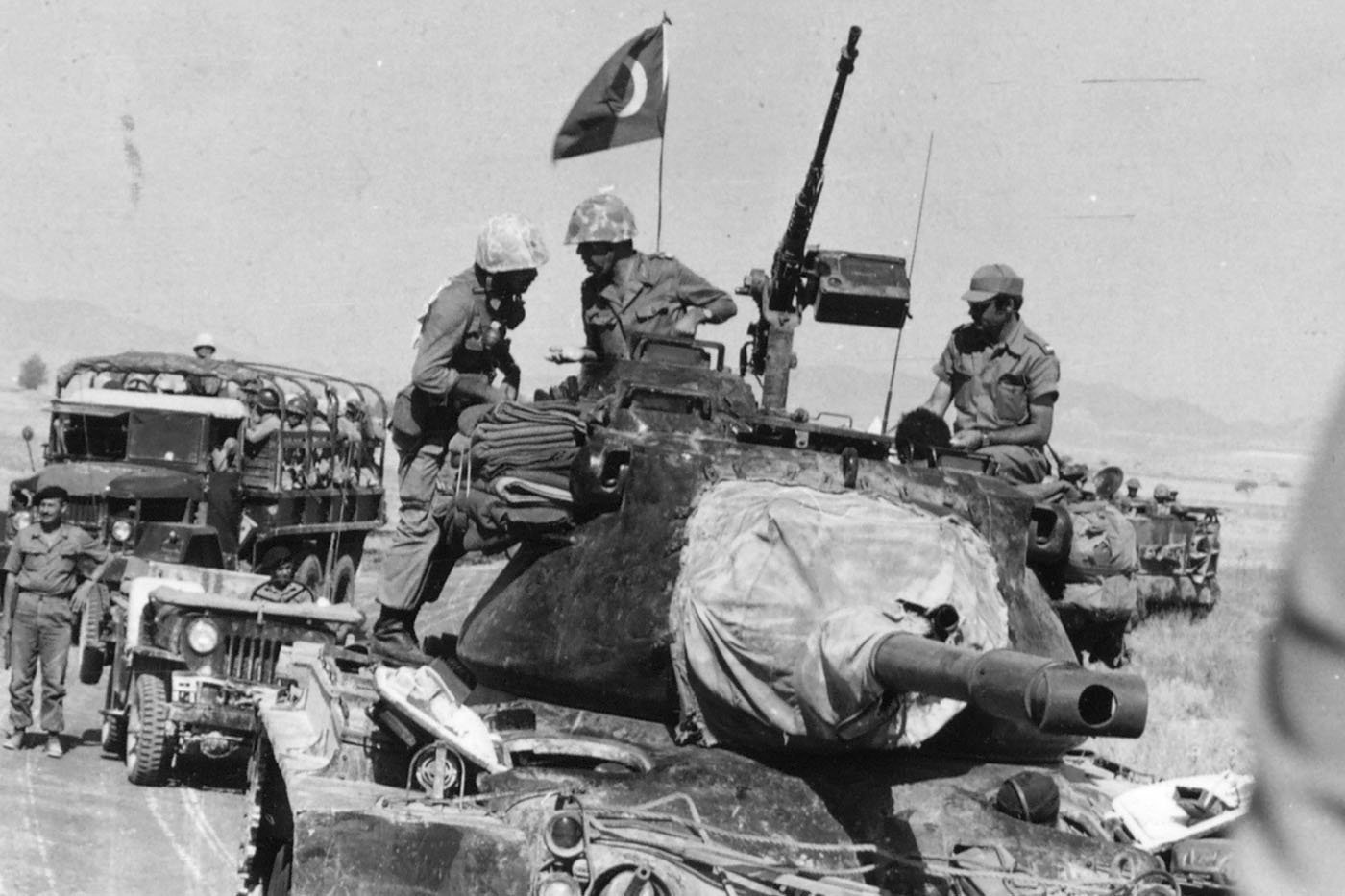
In 1974, Turkey claimed it was bringing “peace” to Cyprus, which it invaded with a brutal military assault that it calls the “Cyprus peace operation.” The Turkish military code-named the invasion “Operation Attila,” named after Attila the Hun (reigned 434-453 CE). A Turkic military leader from Central Asia, he is known for his ruthless and destructive campaigns and invasions, including those targeting Western and Eastern Roman (Byzantine) Empires, and at one time he invaded Italy, devastating its northern provinces.
Following the invasion of the Republic of Cyprus in 1974, Turkey deployed around 40,000 of its soldiers in the northern part of the island, which has turned Cyprus into the most militarized turf in the world. Since the invasion, some 37 percent of Cypriot territory has been under Turkish occupation. Bülent Ecevit, Turkey’s prime minister at the time of the invasion, is still hailed by many in the country as “the conqueror of Cyprus,” although others have recently claimed that it is Necmettin Erbakan, the then deputy PM, who actually deserves the title.
The campaign was accompanied by mass murder, abduction, and rape of Greek Cypriots by Turkish troops. The European Commission on Human Rights has documented the rape of women and children aged 12 to 71.
In their article titled “Gender and Genocide: Armenian and Greek Women Finding Positive Meaning in the Horror,” scholars Artemis Pippinelli and Ani Kalayjian detail the sexual assaults by Turkish troops against Greek Cypriot women and children, which they call the “Cyprus gendercide.” They write:
Rape victims suffered severe gynecological problems as well as psychological trauma. In some cases, women were forced into prostitution. Many were collected from different villages and held in separate rooms of empty houses where they were repeatedly raped by Turkish soldiers. In other cases, members of the same family were repeatedly raped, some in front of their children. Rapes also occurred in public before spectators. The brutality of these violent sexual attacks was followed by extreme physical trauma, including near suffocation. Children and pregnant or mentally retarded women were not spared.
In 1983, Turkey proceeded to issue the unilateral declaration of independence of a new “state” in Cyprus which they call “the Turkish Republic of Northern Cyprus” (TRNC). Only Turkey recognizes the TRNC, which has transformed northern Cyprus into a Turkish province.
Turks have applied the same methods used to de-Hellenize and Turkify Asia Minor (today’s Turkey), which had a Greek majority until the 1453 Turkish sack of Constantinople (Istanbul), to Turkify northern Cyprus.
For example, the Greek geographical names of the occupied north have been changed to Turkish names. And the violent destruction of the cultural heritage of the area at the hands of its Turkish regime is still ongoing. Hundreds of historic and religious monuments have been destroyed, looted, and vandalized. Many churches have been converted into stables, casinos, nightclubs, warehouses, barracks, and mosques, among other things.
And worshippers in those mosques in the occupied area are now reciting the Koranic verse Surah al Fath (verse of conquest) “for the victory of Turkey’s military operation on Afrin” every day until the invasion ends—as instructed by the government-funded Presidency of Religious Affairs (Diyanet).
Turkey also rejects the Greek identity of Cyprus. According to the official website of the Turkish Ministry of Foreign Affairs, “Cyprus has never been a Greek island,” and “there has never been in Cyprus a ‘Cypriot nation.’”
The Turkish ministry is wrong. Not until the Turkish invasion in 1974 did the northern part of the island have a Turkish majority. The occupation forced around 170,000 indigenous Greek Cypriot inhabitants of northern Cyprus out of their homes and flee to the free, southern part of the island. The Turkish government then replaced Greek Cypriot natives with illegal settlers from Turkey, thus forcibly changing the demographic status-quo of the island. That is how a Turkish majority was created in the northern part of Cyprus, which had always had a Greek majority until 1974.
Similarly, Erdogan refuses to recognize Kurdish rule in Afrin, declaring his plan for changing the demographic status-quo there.
“Fifty-five percent of the population of Afrin is Arab, 35 percent is Kurds, who were settled there later, and 6 or 7 percent is Turkmen. The entire issue is to give Afrin back to its real owners. Our aim is to immediately send the 3.5 million Syrians in Turkey back to their homeland,” he said in a public speech.
In recent years, Turkish expansionism has become alarmingly popular within pro-government groups. Turkey’s new maps, published by the pro-government media, have even reclaimed the Ottoman Empire, including Greece and Iraq.
In parallel to that, many Turkish politicians from both the government and opposition have publicly expressed their desire to invade and capture Greek islands in the Aegean Sea. Most recently, Yigit Bulut, one of Erdogan’s principal advisers, has threatened Greece over the islet of Imia, which Turks call “Kardak.” He said:
Athens will face the wrath of Turkey worse than that in Afrin. We will break the arms and legs of officials, of the Prime Minister [Alexis Tsipras] and any minister who dares to step on the Kardak islet in the Aegean. There is not an armed force in this region that could contend against the Turkish armed forces. So, everyone will know their place. All imperialists will accept that the people in this land are Turks and the nation in this land is Islamic ummah [nation] and they will kiss the hand that they cannot bend.
In the meanwhile, the Greek Defense Ministry announced that Turkey violated Greek airspace 138 times in one day alone, on February 1.
Since 1974, Turkey has been a proud and unapologetic occupier in Cyprus. Now Turkish authorities are targeting Afrin, knowing from past experience that they will not be held accountable. They can kill and torture civilians and commit campaigns of ethnic cleansing wherever they wish. Yesterday, their target was northern Cyprus; today it is northern Syria. What country will be the next target? Before even greater catastrophes occur in the region, Turkey has to be reminded that the Ottoman Empire is dead and will never be resurrected.
Originally published on 2018-02-21
About the author: Uzay Bulut, a journalist and political analyst born in Turkey is currently based in Washington, DC. She is an associate fellow of the Philos Project. Her journalistic work focuses mainly on Turkey’s ethnic and religious minorities, political Islam, and the history of Turkey. Follow her on Twitter: @uzayb.
Origins of images: Facebook, Twitter, Wikimedia, Wikipedia, Flickr, Google, Imageinjection, Public Domain & Pinterest.
Read our Disclaimer/Legal Statement!
Donate to Support Us
We would like to ask you to consider a small donation to help our team keep working. We accept no advertising and rely only on you, our readers, to keep us digging the truth on history, global politics, and international relations.
“Just rubble, a ruin, completely destroyed.” - @lindseyhilsum reveals the full scale of destruction in Palmyra.— Channel 4 News (@Channel4News)Video: April 2, 2016Read our Disclaimer/Legal Statement!Donate to Support UsWe would like to ask you to consider a small donation to help our team keep working. We accept no advertising and rely only on you, our readers, to keep us digging the truth on history, global politics and international relations.[wpedon id="4696" align="left"]
Historical backgroundAfter the failure of the interwar League of Nations to prevent international crises and military conflicts of the 1930s which finally culminated in the next global war, the major Allied states (the USA, the USA, the UK, and China) agreed in Moscow in October 1943 to create a new, more functional, and improved international peace-keeping organization after the war under a new name of the United Nations Organization (the UNO). In other words, the UNO has evolved from a wining coalition of countries fighting against European Nazism and fascism in WWII. Following further negotiations at Dumbarton Oaks and Yalta, ...
The Serbs stepped again onto the historical scene in the years of the European wars that swept the continent from the forests of Ireland to the walls of Constantinople in the late 17th century. The Turks finally withdrew from Hungary and Transylvania when their Ottoman hordes were routed outside Vienna in 1683. The disintegration of Ottoman rule in the southwest limbered up the Serbs, arousing in them hope that the moment was ripe for joint effort to break Turkish dominion in the Balkans. The neighboring Christian powers (Austria and Venice) were the only possible allies. The arrival of the Austrian ...
In his latest interview for Serbia’s National Public Service Radio, Srdja Trifkovic discusses the geopolitical significance of the Balkan Peninsula, through the centuries, in the context of today’s complex strategic equation in Southeastern Europe.Q: The Balkan Peninsula is an area where empires, cultures and religions have clashed for centuries. For starters, can we define the geostrategic significance of the Balkans, or at least to outline some of its permanent features?ST: Those permanent features are primarily geographic. The peninsula is the land bridge between Central Europe and the Middle East. At the same time, it is the point of encounter and ...
In recent years, both the Western as well as the liberal Russian press have had a lot to say about Russian “barbarianism,” as if to contrast it with European “civilization.” But a closer inspection – through the prism of the heroic pages of Russian history – of the two groups’ moral ideals and actual lives presents us with quite a different picture.For example, in pagan times, ancient Russians never worshipped a god of war, although their contemporaries in Europe were transfixed by their own martial deity, constructing an entire epic narrative around the concepts of war and conquest.After defeating the ...
Iraq and Kosovo may be thousands of miles apart, but they share the dubious distinction of contamination with radioactive residue from depleted uranium (DU) bullets used in American air strikes. After several years of silence, US officials finally admitted that 340 tons of DU were fired during the Gulf war. In Kosovo, American delays in providing details of quantities and target points have frustrated international efforts to assess health risks. Despite repeated requests, NATO waited almost a full year after the start of bombing in March 1999 to say that 31,000 DU bullets–a fraction of the number fired in Iraq–were ...
The Balkan Peninsula together with the region of South-East Europe historically has been one of the most important focal points of the Russian foreign policy, cultural influences and attempts to spread an ideology of the Orthodox solidarity and the Slavic reciprocity.[1] These ideas are common to almost all trends of the Russian public life in the past and today.After Russia lost the Great Crimean War of 1853–1856 she intensified its cultural influence in the region of the South-East Europe for the purposes of beating the Habsburg (the Roman-Catholic) rivalry and to spread an idea of the Pan-Slavism in this part ...
For the second consecutive year in a row, Estonia once again rang in the New Year by having one of its senior officials bring up a debunked border scandal with Russia, which is nothing more than a desperate attempt to generate attention from its distracted American ally and promote ultra-nationalist narratives at home.The most senior official in Estonia's legislative assembly rang in the New Year by provocatively claiming that 1920 Treaty of Tartu between his nation and Russia “is still valid today, according to international law”, which echoed a statement almost exactly a year prior by its Foreign Minister who ...
America is a country in which dollars count far more than voters do, and that’s what all of the data shows. And that’s a dictatorship by the richest.This kind of country, this kind of country, and this kind of country, get this kind of President. And the rulers blame it on the public, instead of on the billionaires, the actual rulers themselves (the behind-the-scenes rulers). These rulers selected the politicians and offered those to the public to select from in ‘elections’ — and they then blame the public for the choices that the public make, from amongst these bad final ...
October 20th, 2017, marks the sixth anniversary of the martyrdom of Muammar Qaddafi, revolutionary Pan-Africanist and champion of the Global South. This day also marks the sixth anniversary of the historic battle of Sirte, where Qaddafi, along with an heroic army, including his son Mutassim Billal Qaddafi, and veteran freedom fighter, Abu-Bakr Yunis Jabr, fought until their convoy was bombed by French fighter planes. Wounded and demobilized, they were captured by Qatari scavengers and executed by Al-Qaeda operativesThecourageous men of the original Free Officers’ Union, who were guides and leaders of the then 42 year-old Al-Fatah Revolution, demonstrated extraordinary revolutionary ...
Origins of images: Facebook, Twitter, Wikimedia, Wikipedia, Flickr, Google, Imageinjection, Public Domain & Pinterest.Read our Disclaimer/Legal Statement!Donate to Support UsWe would like to ask you to consider a small donation to help our team keep working. We accept no advertising and rely only on you, our readers, to keep us digging the truth on history, global politics, and international relations.[wpedon id="4696" align="left"]Save
From the very historical perspective, the Middle East has been marked by diversity being a crossroads of civilizations. Nevertheless, at the time of Antique, the region was referred to as Mesopotamia (in Greek, the land between, i.e. between two rivers: Tigris and Euphrates), the Fertile Crescent (from Egypt via Palestine to Mesopotamia) where from originally both agriculture and rural/urban settlements started to be developed. At that time, what is today known as Libya, the land was rich in olives, wine, and livestock, and neighboring Egypt was a marshland with wildlife and cane forests. The farming and techniques of irrigation systems ...
Origins of images: Facebook, Twitter, Wikimedia, Wikipedia, Flickr, Google, Imageinjection, Public Domain & Pinterest.Read our Disclaimer/Legal Statement!Donate to Support UsWe would like to ask you to consider a small donation to help our team keep working. We accept no advertising and rely only on you, our readers, to keep us digging the truth on history, global politics and international relations.[wpedon id="4696" align="left"]Save
It has been 200 years since the birth of Otto von Bismarck, the Iron Chancellor who unified Germany.Otto von Bismarck emphasized the importance of good relations with Russia. "The secret of politics? Make a good treaty with Russia", he said. Bismarck was convinced that a European security system without Russia would be impossible and war with Russia would be disastrous. Bismarck had been Prussia's ambassador to the Russian Empire. He was no Russophile, but he had an understanding of the geopolitical situation that almost no politician today possesses.Let's imagine that Bismarck left a letter to the following rulers of Germany, ...
The Kingdom of Belgium as a multilingual and multicultural society is today a federal type of experimental laboratory of European integration within the framework of the European Union (the EU). This is also a country in which the capital of the European Union is located and a country as one of the original six establishing countries of the present day the EU. The question of the destiny of the Belgian multicultural federalism is of crucial importance for the future process of European integration or disintegration.The Belgian multicultural society: Long united and long dividedThe population of the Kingdom of Belgium is ...
Pakistan as a countryPakistan is a country located in the northwest of the Indian sub-continent. It is bordering Iran on the west, Afghanistan on the north-west, China on the north-east, and India on the east with the direct exit to the Arabian Sea.Physically, from the rest of Asia, Pakistan is separated on the north by the Hindu Kush, Karakoram, and Himalaya high ring of mountain chains. Other mountain ranges are going down on its western side to the Arabian Sea. Below them is the long and broad valley of the Indus River. The Province of the North-West Frontier is containing ...
We have to keep in mind that a term and notion of security usually implies a kind of sense of protection and safety from different possible harms coming from „outside“. Therefore, it can be generally acceptable and understandable that the states want to protect their own territories by expanding great resources in making their territorial safe. Security topics are of very different kinds, ranging from the causes of conflict between states to deterioration in the global climate or women’s rights in global politics.The Conception of a SystemThe conception of international systems of states is crucial as an explanatory mechanism of ...
Backdrop To The BalkansThe tiny South-Central Balkan country of the Republic of Macedonia is in dire straits right now, but most of Europe – let alone the rest of the world – has no idea that this is the case because the Mainstream Media narrative is that the state’s two-year-long political crisis was “resolved” when the patriotic VMRO-DPMNE government of Nikola Gruevski was replaced in a “constitutional/electoral coup” that followed Color Revolution and even Hybrid War provocations. The author wrote about this in a Sputnik piece at the time from May 2017 titled “The Macedonian Crisis Isn’t Over, and a ...
According to news reports and to this appeal by Kristoferis Voishka, the pro-American government installed in Lithuania is persecuting Lithuanians who dissent from the anti-Russian propaganda that is driving Washington’s NATO puppets to war with Russia. Unlike their puppet government, Lithuanians understand that war with Russia means that Lithuania on the front line will be utterly destroyed, a result that would not bother Washington in the least, just as Washington is undisturbed when its forces obliterate weddings, funerals, and children’s soccer games.What is Lithuania? To Washington it is a nothing.Kristoferis Voiska runs an alternative Internet news site in LIthuania. Not ...
My work documenting how the law was lost began about a quarter of a century ago. A close friend and distinguished attorney, Dean Booth, first brought to my attention the erosion of the legal principles on which rests the rule of law in the United States. My columns on the subject got the attention of an educational institution that invited me to give a lecture on the subject. Subsequently, I was invited to give a lecture on “How The Law Was Lost” at the Benjamin Cardozo School of Law in New York City.The work coalesced into a book, The Tyranny Of ...