
Donetsk People’s Republic – Story Untold by Western Media
Despite Kiev’s total blockade, the city of Donetsk proper seems to have a reasonable assortment of goods and foodstuffs. Much of this seems to come from ever growing trade and cooperation with Russia, a bordering neighbor and largest trade partner of the “former”, pre-war Ukraine [...]
My refusal to believe ongoing Western media reports of “Russian aggression” makes me a “Kremlin troll”. My punishment for not towing the “party line” – simple, effective “shunning” by Western media – has not, however, diminished my ongoing commitment to seeing the other side.
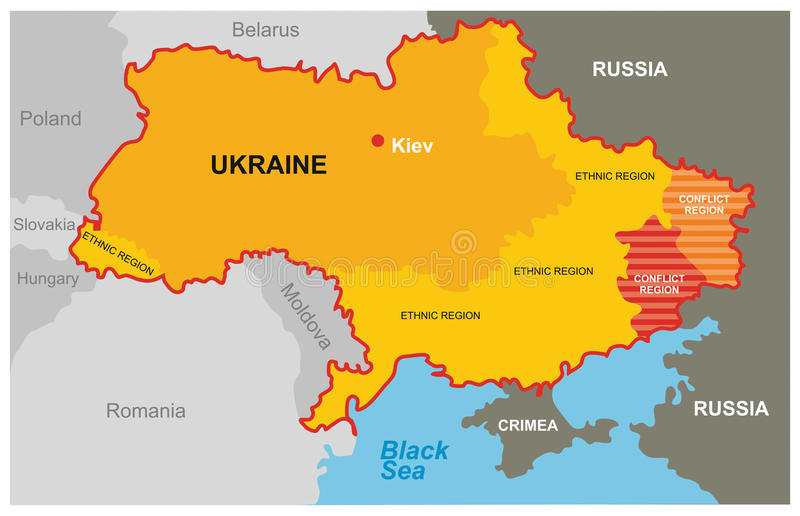
Having previously investigated the Crimean reunification with Russia, this May I turned my attention to the birth of two new government formations in Eastern Ukraine, the Donetsk People’s Republic (DNR) and the Lugansk People’s Republic (LNR). Americans only hear either what Kiev “reports”, or the US propaganda machine puts out – these are puppet regimes born of “Russian aggression” and forcibly kept in place by “occupation”. Not being a brave “war correspondent”, I admittedly undertook my journey with some trepidation – not from fear of “Russian aggression”, but the Kiev regime’s ongoing shelling of civilian targets.
I am eternally grateful to my newfound colleague Konstantin Dolgov for showing me the sad “Alley of Angels” – a deeply touching memorial to children killed to date by Kiev-regime forces. Further, my virtual contact with Patrick Lancaster, an American journalist who now resides there, and Alexander Sladkov, a Russian correspondent who largely lives there, but, more importantly, “run toward the sound of gunfire” have allowed me to counteract the information-war blockade by Western media.
As I approached the larger city of Donetsk (previously over 1 million residents, now much smaller due to the initial flood of refugees to Russia (the paradox of people fleeing into the arms of the “aggressor”), I feared I would see a city center damaged by Kiev shelling, and people cowed and deprived of the most basic needs. Contrary to Ukrainian “patriots” on Russian TV, I was relieved to find an active, bustling city, with a very charming downtown, and thrilled to see a populace that, far from being cowed, harbors a firm belief in a better future, one outside the Ukraine.
Despite Kiev’s total blockade, the city of Donetsk proper seems to have a reasonable assortment of goods and foodstuffs. Much of this seems to come from ever growing trade and cooperation with Russia, a bordering neighbor and largest trade partner of the “former”, pre-war Ukraine. In fact, while I was there, a conference on enhancing this cooperation took place, and due to Kiev’s economic blockade, the ruble has displaced the Ukrainian grivna. Western media will no doubt hold this up as further proof of “Russian aggression”.
My most important “resource” during my all too brief stay was Ekaterina Pavlenko, a young, local deputy in the DNR parliament. Ekaterina herself is certainly no “Russian aggressor” or “occupying force”. Quite the contrary, she is very typical of local residents whose largely Russian-heritage ancestors have lived on these lands for generations. Ekaterina, having previously engaged in “social” issues is not even a “typical politician”. As I became more acquainted with her, her eyes explained it all – they showed the unique combination of a burning desire to further the life of the new, independent republic and an underlying kindness and loving regard for those around her. Ekaterina most eloquently summed up the belief of the new republic – these are the ancestral lands of the actual residents, not some bargaining chip in a larger geopolitical conflict, or “subject” for Kiev domination. This is admittedly hard for the average American to understand given our very transient nature.
I quite accidentally ended up in Donetsk for their “Republic Day” – their 4th of July. As Ekaterina’s guest, I was invited, without any control or oversight whatsoever, to watch, film, and ultimately join in a massive, celebratory parade of literally tens of thousands representing all aspects of life and all regions of the DNR. Western media will be disappointed to learn there were no machine gun-toting, heavily- armed Russian occupation forces forcing people to participate. In fact, beyond the day of the parade, contrary to Kiev’s “little boy who cried wolf” shrieks of massive Russian invasions, there were no signs of any regular army Russian presence to be seen anywhere.
For my gullible fellow Americans who might say “they simply hid them from you”, I would simply ask how hides – according to Kiev – 10s of thousands of troops, vast support infrastructure, and heavy weaponry from prying satellite “eyes”, not to mention smart phones in an area the size of Connecticut. The only conclusions one can draw are either there is in fact no Russian dominance (the simplest and most accurate assessment), the Russians have invented startling new “stealth” technology for tanks and troops, or, assuming some Russian presence, the locals are truly grateful for the support and defense it provides. None of which are good for the West…
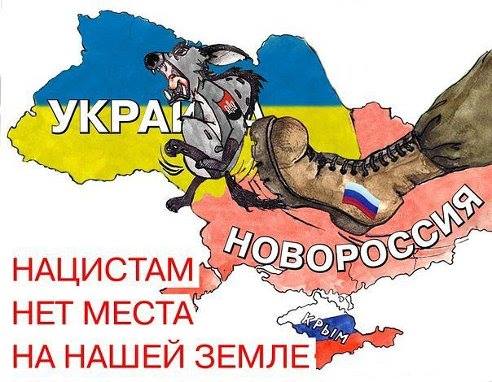
As I studied local maps, walked and rode public transport (3 rubles…about $.05), street names and numerous monuments spoke further not only of the majority Russian-heritage population whose ancestors lived here for centuries (in 1922, the fledgling Ukrainian Republic grew by 25% in size after Lenin “ceded” it the larger Russian “Novorossiya” – including all of the Donbass, Kharkov, and Odessa), but one which still honors and reveres those who gave their lives to defeat fascism. As is happening throughout the rest of the Ukraine, were Kiev able to somehow regain control, Russian-oriented names of streets would certainly be changed, and any and all monuments would be toppled – especially those relating to the Soviet victory over Hitler. In other words, Kiev’s so-called “decommunization” is clearly “derussification – a sad, largely unreported 21st century ethnic cleansing.
Since I was “self-funded”, I had to choose a more “thrifty” hotel than the superior “Donetsk Palace”. When I happened upon the hotel and went in, I found not simply a palace, but Organization for Security and Cooperation in Europe (OSCE) observer living quarters. Hard to blame these brave folks for preferring staying put in their rooms vs. doing their job of exposing the ongoing Kiev shelling of civilian targets.
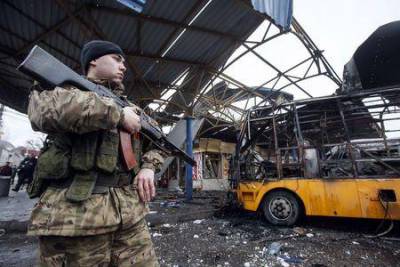
While avoiding front-lines, I nonetheless hopped on a streetcar out to the main rail station shut down by Kiev shelling early on in the war – quite close to areas currently being shelled. As the car slowly but surely wound its way to the station, I looked around with apprehension, expecting riders to get off well before. Instead, I found folks of my own (mature) age traveling to the very end. After wandering around the now abandoned station and nearby modern shopping complex – still showing signs of shelling— I headed over to what initially appeared to be several smaller kiosks. I was shocked, however, to find these were simply the “front lines” of a huge market with all manner of goods and quite appetizing-looking locally grown produce. When I asked various vendors if they were not afraid to be this close to the front, the very typical Russian stoic nature emerged – “life goes on”, with a wistful, sad sigh of “of course, we wish they (Kiev) would leave us to live in peace and quiet.”
In summary, were the West to send unbiased, knowledgeable correspondents to the DNR, they would indeed find not Russian “occupation” and “aggression”, but Russian-heritage people determined to move ahead to a future based not on hatred and rejection of their Ukrainian “Slavic brothers”, but on positive, life-affirming values such as liberty, justice, and self-determination. Given that the US started off this way centuries ago, it is tragically ironic that today it supports Kiev-regimes efforts to rid itself of “undesirable” Russians.
Originally published on 2017-06-14
About the author: Stephen Ebert is the American political analyst writing for Russian media.
Origins of images: Facebook, Twitter, Wikimedia, Wikipedia, Flickr, Google, Imageinjection, Public Domain & Pinterest.
Source: Oriental Review
Read our Disclaimer/Legal Statement!
Donate to Support Us
We would like to ask you to consider a small donation to help our team keep working. We accept no advertising and rely only on you, our readers, to keep us digging the truth on history, global politics and international relations.
A project for Greater Albania – conspiracy or legitimate? According to a 2010 Gallup Balkan Monitor report, 83% of Albanians in Albania supported the idea of a Greater Albania, with 81% and 53% of Albanians in Kosovo and North Macedonia respectively supporting such an ambition.The ultimate goal? To have Kosovo and the Preševo Valley in Serbia, southern Montenegro, Epirus in Greece and western North Macedonia into a single Greater Albanian state. Although this may not be official policy of the Albanian Republic, it is ingrained into the Albanian mythos. The very idea of a Greater Albania has roots in the 1913 Treaty of London that left roughly 40% ...
When we use the genocide label for other kinds of killing (e.g. death through neglect, or bureaucratic elimination) do we diminish the weight of the word genocide? Many non-Indigenous Canadians bristle at the notion that a label like genocide applies to Canada.As early as November, 1907, the Canadian press was acknowledging that the death rate within Indian residential schools exceeded 50% (see Appendix, “Key Newspaper Articles”).And yet the reality of such a massacre has been wiped clean from public record and consciousness in Canada over the past decades.Small wonder; for that hidden history reveals a system whose aim was to ...
When the civil war in Ukraine started, the question that arised is whether there are similarities between Ukrainian and Yugoslavian civil wars. So let’s compare these two countries, one that is falling apart – Ukraine and the other one that doesn’t exist anymore – Yugoslavia.Multinational countryYugoslavia was a multinational country with different national and ethnic groups coexisting together and two dominant nations Serbs and Croats. Ukraine is also quite a diverse country with Ukrainians, Russians (around 20% of Ukrainian population) and few minorities (Rusyns, Romanians, Hungarians) living together. Once the Yugoslavia collapsed, in a newly created ex-Yugoslav republic Croatia and ...
Origins of images: Facebook, Twitter, Wikimedia, Wikipedia, Flickr, Google, Imageinjection & Pinterest.Read our Disclaimer/Legal Statement!Donate to Support UsWe would like to ask you to consider a small donation to help our team keep working. We accept no advertising and rely only on you, our readers, to keep us digging the truth on history, global politics and international relations.[wpedon id="4696" align="left"]
Due to the international media’s continued claims about the «annexation of Crimea», it’s been difficult for the citizens of the US and Europe to make sense of the details of the peninsula’s recent history. Exactly three years ago, on March 16, 2014, the Crimeans were offered a choice: to rejoin Russia or to return to the constitution of 1992 that proclaimed Crimea a legal, democratic, secular state whose relationship with Ukraine was based on bilateral agreements. That constitution was unilaterally abolished by Kiev on March 17, 1995, and here’s what’s surprising: no one at that time in the West demanded that the Ukrainian ...
In the Balkans truth generally lacks a transcendent or ontological dimension, it tends to be purely tribal.July 11 this year will mark the 26th anniversary of the tragic events that took place in 1995 in the east Bosnian district of Srebrenica. With each passing year the ceremony loses some of its luster and pomp, as genocide fatigue sets in. The inquirer into these matters will get radically different answers and interpretations, mainly depending on the ethnicity of the local informant. As Diana Johnstone accurately observed, in the Balkans truth generally lacks a transcendent or ontological dimension, it tends to be ...
A Serb from Bosnia, General Mladic, protected Muslims civilians and gave them buses, food and water for to leave fighting zones (as you can see). There was no genocide over Muslim population in Srebrenica like main stream media want you to believe – there was no genocide over Bosniaks because all Bosnian Muslims victims were jihad fighters who had been killed during fight (in war). Even the so called „tribunal“ in The Hague for ex-Yugoslavia admitted that there was no genocide!Now, you can see here how djihadistes have treated the Serbian population – the content is very hard, not for ...
The so called "Croatian scenario", is something that has been periodically brought up after the start of the armed conflict in Donbass. (Among other instances, yours truly noted this in articles from this past December 17 and August 24, 2015.) Promoted at Johnson's Russia List, the December 28 Euromaidan Press article "What Ukraine Can Take from the 'Croatian Scenario' of Conflict Resolution", omits some key factors for being apprehensive about the probability for success of an Operation Storm like strike against the Donbass rebels.In 1995, the Serb Yugoslav leader Slobodan Milosevic, had essentially dropped the Krajina Serbs, with the hope that he could improve his relationship with the West. At ...
There are more questions than answers to the Crimean ‘question’.After more than two decades belonging to an independent Ukraine, the Crimean peninsula has become part of Russia, which has thereby gained an extra 27,000 km2 of territory and over two million new citizens. Ukraine and the West see this unprecedented event as annexation and a sign of the Kremlin’s neo-imperial ambitions. To countries not directly involved in the Ukrainian crisis, it is a dangerous violation of the Eurasian status quo that could cause widespread destabilisation in the area, while in Moscow’s eyes it is ‘the return of Crimea and Sevastopol ...
Israel’s Maariv newspaper has revealed that the government of the Zionist state is planning to drop a political bombshell in the coming weeks by presenting a bill in the Knesset (parliament) calling for the annexation of land occupied since 1967. It is likely to have the support of the majority of Knesset members. The newspaper added that the right wing has chosen this time for the move ahead of the US presidential election; America, it is believed, will be too preoccupied to care about what is happening in the occupied Palestinian territories.Preliminary talks about a first stage have been held, ...
Once NATO’s 1999 war on Yugoslavia came to an end, units of the Kosovo Liberation Army (KLA) poured across the border. The KLA wasted little time in implementing its dream of an independent Kosovo purged of all other nationalities. Among those bearing the brunt of ethnic hatred were the Roma, commonly known in the West as Gypsies. Under the protective umbrella of NATO’s Kosovo Force (KFOR), the KLA was free to launch a pogrom in which they beat, tortured, murdered and drove out every non-Albanian and every non-secessionist Albanian they could lay their hands on.Not long after the war, I ...
Paris vs. DonbassOrigins of images: Facebook, Twitter, Wikimedia, Wikipedia, Flickr, Google, Imageinjection, Public Domain & Pinterest.Read our Disclaimer/Legal Statement!Donate to Support UsWe would like to ask you to consider a small donation to help our team keep working. We accept no advertising and rely only on you, our readers, to keep us digging the truth on history, global politics and international relations.[wpedon id="4696" align="left"]Save
The December 17 UN Security Council meeting, on the announced creation of a Kosovo armed forces, featured some noticeable contrasts.In accordance with Kosovo not being a UN member state and the Serb position on UN Security Council Resolution 1244 (recognizing Kosovo as a continued part of Serbia), the disputed former Yugoslav territory wasn't formally represented at the discussion as a nation. Kosovo's leader, Hashim Thaci, sat with a nameplate having his name, as opposed to Kosovo. Countries recognizing Kosovo's independence made it a point to state Thaci as the president of Kosovo and Aleksandar Vučić as president of Serbia. Nations not ...
For several decades, the Turkish government and its propagandists have been announcing that the state documents, particularly the Ottoman archives, are fully open and available to any researcher from around the world.What Turkish officials and their supporters do not say is that many documents of the Ottoman archives have been removed, destroyed, sold, or otherwise disposed of. In addition, some of the most sensitive archives are still closed to outsiders.Last month, Turkish journalist Uzay Bulut wrote a revealing article, “Turkey Uncensored: A History of Censorship and Bans,” published on the Philos Project website, regarding the status of Turkish archives and ...
Dr. Steven Leonard Jacobs holds the Aaron Aronov Endowed Chair of Judaic Studies and is Associate Professor of Religious Studies at the University of Alabama-Tuscaloosa. An ordained rabbi, Professor Jacobs is a specialist on the Holocaust and Genocide, Biblical Studies, Jewish-Jewish Christian Relations, and is one of the foremost authorities on Raphael Lemkin (1900-1959), who coined the term “genocide” and devoted his life to the enactment of an international law on the punishment and prevention of genocide.Among his numerous publications, Prof. Jacobs is the author of the chapter entitled, “Lemkin on Three Genocides: Comparing His Writings on the Armenian, Assyrian, ...
North from Nazareth’s city limits, a mile or so as the crow flies, is an agricultural community by the name of Tzipori – Hebrew for “bird.” It is a place I visit regularly, often alongside groups of activists wanting to learn more about the political situation of the Palestinian minority living in Israel.Tzipori helps to shed light on the core historic, legal and administrative principles underpinning a Jewish state, ones that reveal it to be firmly in a tradition of non-democratic political systems that can best be described as apartheid in nature.More than a decade ago, former U.S. president Jimmy ...
Since World War II most of the world’s conflicts have revolved around struggles for independence against Western and Japanese colonial/imperial regimes.Following formal independence, a new type of imperial domination was imposed – neo-colonial regimes, in which the US and its European allies imposed vassal rulers acting as proxies for economic exploitation. With the rise of US unipolar global domination, following the demise of the USSR (1990), the West established hegemony over the East European states. Some were subject to fragmentation and sub-divided into new NATO dominated statelets.The quest for a unipolar empire set in motion a series of wars and ...
There is less talk about the rump-Ukraine in the news these days, especially in the western corporate media, and there is a good reason for that: that short-lived Urkonazi “Banderastan” is falling apart. This is hardly surprising since the entire concept was never viable in the first place. Let’s remember how it all began.It is crucial to remember that there was no spontaneous revolution or insurrection in the Ukraine, the Euromaidan had nothing to do with Europe and everything to do with the USA. Oh sure, the Ukrainian people were told that it was about “joining the EU”, but that ...
What is the most horrible crime against humanity in history? To Henry Morgenthau Sr., who served as the US ambassador to the Ottoman Empire between 1913 and 1916, it was the Armenian genocide. Morgenthau wrote in 1919:“I am confident that the whole history of the human race contains no such horrible episode as this. The great massacres and persecutions of the past seem almost insignificant when compared to the sufferings of the Armenian race in 1915.”Up to 1.5 million Armenians were wiped out in their native lands in Ottoman Turkey in a genocidal campaign organized by the Party of Union ...
Clinton/NATO Intervention In Balkans Revealed As Half-Witted DhimmitudeFebruary 26, 2007- San Francisco, CA - PipeLineNews.org - Twelve years after the alleged Srebrenica massacre, the International Court of Justice [ICJ] has found that charges alleging that a systematic policy of ethnic cleansing by the Bosnian Serb government was used against the Bosnian Muslims are baseless, yet the court adamantly maintains a belief in the myth of Srebrenica, much in the way that Islamists worldwide hold on to the Jenin hoax because both serve to stoke anti-Western, anti-Israel sentiment.From the beginning it should have been clear that the Clinton administration's decision to ...