
On January 19th, 2016 on the bilateral meeting between Russia’s President Vladimir Putin and the official representatives of the European Jewish Congress [...]
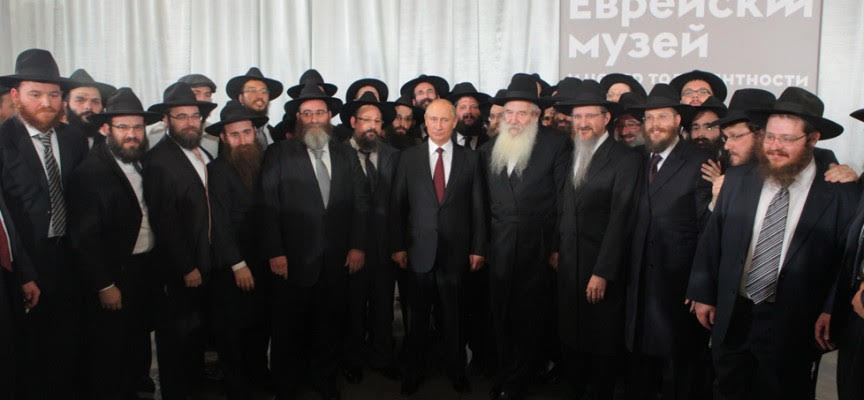
On January 19th, 2016 on the bilateral meeting between Russia’s President Vladimir Putin and the official representatives of the European Jewish Congress the latter applied to Putin to take necessary steps for the sake to improve the generally bad position of the Jewish community on the Old Continent. Surprisingly, the President, not so much as a joke, invited both all the present-day European Jews and those Jews who left the USSR simply to immigrate to Russia.
At the first glance, one can say – very gentle and even democratic move by the President. However, lets a little bit to analyze the case.
According to the Jewish representatives, there are at least two reasons for the „unbearable“ position of the European Jews: 1) Anti-Semitism, and 2) the influx of Muslim immigrants from the Middle East to Europe. Therefore, at least for the Jews, these two reasons are quite enough to emigrate from Europe, and for the President, the same reasons are also quite enough to invite all the European Jews to immigrate to Russia. Here, we will not discuss the question of why the European Jews do not want to emigrate to their own national state – Israel (and the USA as well), but the question is why the President is inviting one nation to be settled in Russia without any ethnic, racial, linguistic, cultural or national connection with his country?
Nevertheless, a more serious question arose in this matter: do only the EuroJews has such right (as „chosen people“?) as a privilege to emigrate to („promised land“?) Russia from the Euroterror or such President’s invitation is democratically equally open for all people, ethnic groups, confessional minorities, etc. who are experiencing the same or even (much) harsher „unbearable“ living conditions and terror in their home countries and social environments? For instance, Kosovo Serbs.
If we compare living conditions of the EuroJews with Kosovo Serbs today the conclusion can be only that those two cases have simply nothing in common with each other at least for the next four reasons and facts:
1. The European anti-Semitism today is not direct, brutal, or open but rather hidden and of a soft nature. It exists but it is nothing to be a real reason for the Jews as a group or as individuals to emigrate somewhere. At least in comparison with many other ethnic groups or minorities across the same continent, but above all, we would say, with Kosovo Serbs. The Euro-Jews are not at least forced to wear yellow strips on their clothes but some Kosovo Serbs do that voluntarily as a matter of protest.
2. The Jews in present-day Europe are not living in any kind of ghettos as it was before (the first ghetto for the Jews was created in Venice in 1535 followed by Dubrovnik) differently from the Serbs in Kosovo southern from Kosovska Mitrovica or the Roman Catholics in Belfast. The Serbs in central and southern Kosovo, totally different from the EuroJews, are living in a real ghetto situation and even in the home imprisonment with everyday fear to be killed by the local Muslim Albanians if they leave the home or village without escort by the international „peacekeeping“ forces. Many Kosovo Serbs are transported even by the armors to the shops, health centers, etc.
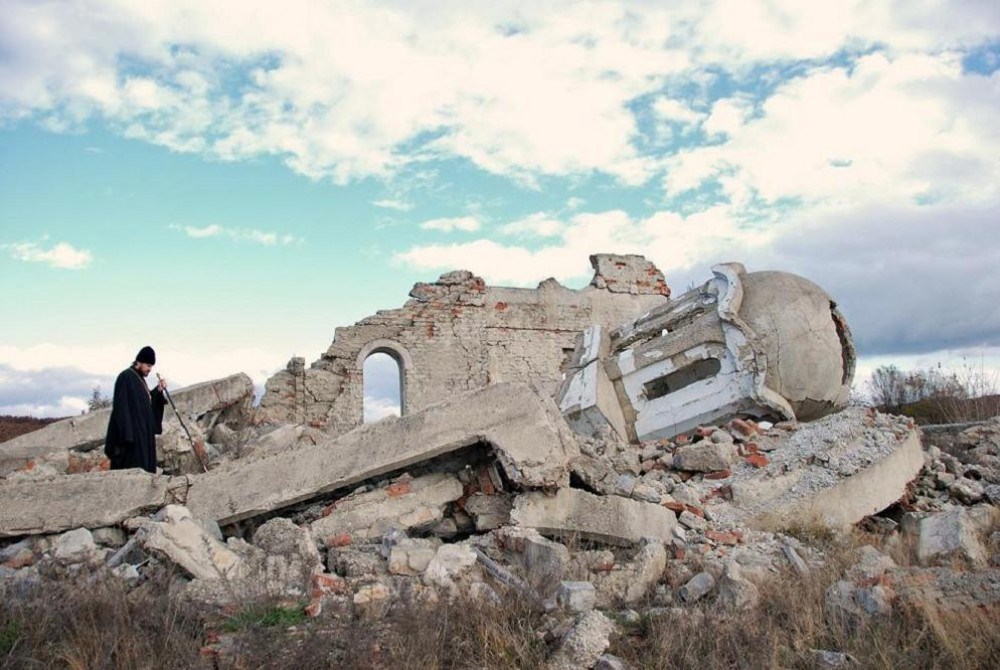
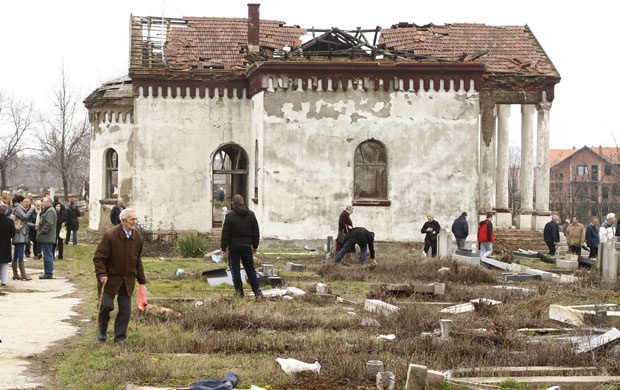
3. The Jewish shrines (synagogues) in Europe are not attacked, destroyed, burnt, or desecrated as is exactly the case with the Serbian shrines (Christian Orthodox) in Kosovo. The Muslim Albanians are systematically cleaning Kosovo from all Christian elements during the last 16 years (from June 1999) when the NATO’s occupation of Kosovo started. The destruction of Kosovo Christianity is at the same time followed by the brutal Islamization of the land: for instance (like in Bosnia-Herzegovina after 1995) there are three times more erected mosques in Kosovo after June 1999 in comparison with 400 years of the Ottoman occupation.
4. The Jews in Europe are not exposed today to any kind of pogroms, differently to Kosovo Serbs who are in fact experiencing not only the ethnic cleansing by the Muslim Albanians but even a genocide. The most brutal pogrom against the Serbs was done in Kosovo on March 17-19th, 2004 with three days and three nights of the „Kristallnacht“ as a part of the policy of Islamic terror in the Balkans [see, Sh. Shay, Islamic Terror, and the Balkans, Transaction Publishers, 2006; Ch. Deliso, The Coming Balkan Caliphate: The Threat of Radical Islam to Europe and the West, Westport, CT: Praeger Security International, 2007]. As a consequence, there are today only about 100.000 Serbs in Kosovo of whom the overwhelming majority (about 90.000) are living in the northern part of the region which is not under the administration by a (quasi)government in Prishtina composed by the ex-Kosovo Liberation Army’s criminals.
Here we came to the crux of a matter. In 2011 Kosovo Serbs launched a campaign to apply for Russian citizenship and even to emigrate to Russia. However, Putin’s administration was at that time „deaf“ to such an idea. Are the living conditions of Kosovo Serbs were (and are) not enough „unbearable“ in comparison to those of the Euro-Jews? Obviously no. Contrary, the Serbs in Kosovo can only dream to be in the Jewish position in Europe. Finally, Russia and Russians have much more in common with the Serbs than with the Jews. Why the President discriminates Kosovo Serbs in comparison with the EuroJews is not known but as a good example of Russian-Serbian solidarity and brotherhood he can take from the Empress Catherine the Great who even established a separate territory for the Serbs in Russia – Nuova Serbia (more or less covering the present-day territory of Novorossija).
Prof. Dr. Vladislav B. Sotirović
www.global-politics.eu/sotirovic
sotirovic@global-politics.eu
Personal disclaimer: The author writes for this publication in a private capacity which is unrepresentative of anyone or any organization except for his own personal views. Nothing written by the author should ever be conflated with the editorial views or official positions of any other media outlet or institution.
Origins of images: Facebook, Twitter, Wikimedia, Wikipedia, Flickr, Google, Imageinjection, Public Domain & Pinterest.
Read our Disclaimer/Legal Statement!
Donate to Support Us
We would like to ask you to consider a small donation to help our team keep working. We accept no advertising and rely only on you, our readers, to keep us digging the truth on history, global politics, and international relations.
Noel Malcolm – Kosovo – A Short HistoryA history written with an attempt to support Albanian territorial claims in the BalkansHistorical Institute of the Serbian Academy ofSciences and ArtBelgrade, 2000Response to the Book of Noel MalcolmKosovo – A Short HistoryMilorad Ekmecic, AcademicianSerbian Academy of Sciences and ArtsBelgradeHistoriography By the Garb OnlyReading, from necessity, the books by some Western, particularly American scholars, dealing with the past of the Serbs and the Balkans, I recall the impressions that are in my memory, for some reason, related to the socially committed painter Georg Grosz. Today the flashes of those recollections of my college ...
I. Comment by Jared IsraelThe two media reports from 1993, posted below, refer to Ibrahim Rugova as “President of the Republic of Kosovo,” when in fact: a) no such republic existed; b) Kosovo was a province of the Republic of Serbia and c) Rugova was not any kind of government official, let alone a president. Rather, he was the leader of a faction, supported and sponsored by outside powers, which faction had already played a key role in launching the attack on Yugoslavia, and which was now boycotting all official Kosovo institutions as part of a strategy of creating a ...
Tito’s policy in the 1970s of the so-called “encourage and suppress” for the sake to struggle against politically undesirable and threatening ethnic nationalisms especially the Croat and the Serb ones appeared to be incoherent one. In another words, while some ethnic nationalisms and their ideologies were considered to be dangerous to the system and, therefore, were suppressed and their advocates were jailed or banned from employment[i] (the case, for instance, of the Serbian dissident professors from Belgrade University), other nationalisms, supposed to be non-dangerous for the regime were encouraged by the local Communist elites (for instance, the Albanian nationalism in ...
Of the 22 Nazi concentration camps operating in the clerical fascist state of Croatia during World War II, nearly half were under the command of Roman Catholic priests.They were responsible for the grisly slaughter of hundreds of thousands of men, women and children. Serbs, Roma, and Jews were specifically targeted for extermination.Catholic clergy was especially keen to eradicate the Serbian Orthodox Church. This led to the murder of Christian Serbian Priests, forced conversions of Serbian Christians, and the destruction of 450 Christian Orthodox Churches during World War II.“Kill all Serbs. And when you finish come here, to the Church, and ...
It is true that every story about the Balkan Peninsula begins with the ancient Illyrians.[1] Historians believe that these Indo-European people were one of the largest European populations to inhabit the western portion of the Balkans from the coasts of the Ionian Sea and the Adriatic Sea to the Alps about 1000 B.C. Their eastern neighbours were also Indo-European peoples – the Thracians. The demarcation line between their settlements and their cultural and political influence was the Morava river in present-day Serbia (in Latin Margus, located in the Roman province of Moesia Superior) and the Vardar river in present-day FYR ...
The interviews with three snipers of Georgian nationality, conducted by the Italian journalist Gian Micalessin and aired last week as a breathtaking documentary on Milan-based Canale 5 (Matrix program), still have not paved its way to the international mainstream media. That is hardly surprising taking into account the bombshell evidence against the real perpetrators and organizers of the 2014 coup d’etat in Kiev, generally known as the “revolution of dignity“.The documentary features Alexander Revazishvili, Koba Nergadze and Zalogi Kvaratskhelia, Georgian military officers who were recruited to carry out a “special mission” in Kiev by Mamuka Mamulashvili, a close aid of ...
Dietmar Hartwig, former head of the EU (EEC) Monitoring Mission in Kosovo and Metohija (ECMM) in his 2007 warning letter:“MERKEL RESPONSIBLE FOR KOSOVO PRECEDENT AND DIVIDING SERBIAN PEOPLE”It seems that the recent developments in Europe, and in particular the push of secessionism (Catalonia), rings a bell, or rather is reminiscent of certain events. The ensuing ones are shedding more light on the roles of the EU (EEC), the USA and Germany. To what extent have they been guided by the principles of the international law and democracy in the Kosovo crisis? How much did they appreciate the reports of their ...
Kosovo is to set up a regular standing army, officially defying everyone, including NATO, although the bloc’s objections are only half-hearted. The alliance would prefer that the illegal entity of Kosovo change its constitution in order to create an army. Just amend it, and then you’re free to have one. This stance looks more like connivance than any real opposition to the move.Washington’s position is more or less the same. It supports "the gradual, transparent transformation of the Kosovo Security Force into a multiethnic force in line with NATO standards" as long as it complies with the provisions of Kosovo’s constitution, reflecting that “entity’s multiethnic ...
IntroductionThe goals of this article are: 1) to investigate the role of the revived Patriarchate of Peć in Serbian and Balkan history?; and 2) to explore and present the results of investigation of the problems with respect to: a) the role of the Serbian Church during the first decades of the Ottoman occupation of Serbian lands in the process of the creation of a Serbian national identity; b) Serbian-Turkish relations in the second half of the 16th century; and c) the reasons for Serbian disloyalty towards the Ottoman government at the turn of the 17th century.The article addresses the reasons ...
For centuries, the strategic Balkan Peninsula has featured as a slice of Europe over which wars have been fought, treaties made and broken. It became a vital pawn in the carve-up of nations after World War i, had the boundaries of its ethnic enclaves confused under Tito’s regime, then its various nationalist feelings taken advantage of and played against each other in the latest push for its colonization by the EU.In this latest process, one nation has been demonized in the mind of the public: Serbia.In the words of British political economist Rodney Atkinson, “The grossest calumny in the continuing ...
Noel Malcolm – Kosovo – A Short HistoryHistory is written with an attempt to support Albanian territorial claims in the BalkansA Short History of Kosovo by Noel Malcolm is usually considered as one of the prime historical sources on the history of the province. In fact, this book is an example of History with a political attitude because it is not by chance that Malcolm who attacks the “myths” of Serbian history is at the same time a president of the Anglo-Albanian Association and one of the strongest supporters of independence of Kosovo. Being far from an objective scientific work ...
“Kosovo: Can You Imagine?” is a documentary film by Canadian film maker Boris Malagurski, about the Serbs that live in Kosovo and the lack of human rights that they have today, in the 21st century.Most of the Kosovo Serbs have been ethnically cleansed by the Albanians who make up the majority of Kosovo.Kosovo has been under UN administration since 1999 when NATO bombed Serbia for 78 days to halt a crackdown on ethnic Albanian separatism in its province of Kosovo.In the years following the war, thousands of Serbs were expelled from their homes, kidnapped and killed. Their houses, cultural and ...
President Bill Clinton’s favorite freedom fighter just got indicted for mass murder, torture, kidnapping, and other crimes against humanity. In 1999, the Clinton administration launched a 78-day bombing campaign that killed up to 1500 civilians in Serbia and Kosovo in what the American media proudly portrayed as a crusade against ethnic bias. That war, like most of the pretenses of U.S. foreign policy, was always a sham.Kosovo President Hashim Thaci was charged with ten counts of war crimes and crimes against humanity by an international tribunal in The Hague in the Netherlands. It charged Thaci and nine other men with ...
Top personalities of the Croatian Revival MovementPreface This text investigates the question of relations between the Croatian national revival movement and the Serbs from 1830 to 1847. Special investigation attention is put on the problem of how the language influenced ethnonational group identity among the Croats and Serbs in Dalmatia, Croatia and Slavonia (the so-called Triune Kingdom) during the period of the Croatian national revival movement that was officially and not only formally named as the Illyrian Movement. This investigation is an attempt to reconstruct the mainstream of the politics by the leaders of the movement and their outlines on how ...
Ridvan Haqifi (left) and Lavdrim Muhaxheri (right), two ISIS Kosovo Albanian commanders. | Photo: ISIS propaganda videoAlbert Berisha, a former Kosovar jihadist who travelled to fight in Syria, appeared before a Pristina court on Monday to recount his version of the story and maintain his innocence.Berisha, who graduated in political sciences from the University of Pristina and holds a Masters degree from the University of Tirana, was arrested in 2014 and is charged with participating in terrorist organisations. This crime is punishable with a minimum of five years in prison.Berisha said he went to Syria from October 6 to 20, ...
The crumbling “liberal” West is in a desperate hurry in the Balkans. More than a quarter century since the first Western states, pushed by Germany, unilaterally recognized the secession of the former Yugoslav federal republics of Slovenia, Croatia and Bosnia-Herzegovina and about 19 years since NATO’s air and land attack against what had remained of the country (the Federal Republic of Yugoslavia, comprising Serbia and Montenegro) resulting in NATO’s occupation and subsequent forced amputation of Serbia’s Kosovo and Metohija province (by way of recognition of its unilaterally declared independence of February 2008 by the main Western powers, some – but not all Muslim ...
Kosovo Ethics, which are implanted in the national consciousness of the Serbian people, have not changed for 600 years – nor will they ever change. The basic values of those ethics, bequeathed to Serbians on Vidovdan in 1389, have not been chiseled on 2 stone tablets, but are impressed in the inmost being of every Serb.Every nation has 1 date in its history which it considers more important than any other. For the Serbs, the most important date in their history is June 15, by the old calendar – June 28, by the new calendar (Vidovdan). On that day, in ...
The current Ukrainian crisis and in fact civil war which stared at the very end of 2013 are grounded in for decades lasting internal interethnic antagonisms primarily on the Ukrainian-Russian relations including above all the “Crimean Question” as an apple of discord from 1954 between Ukraine and Russia.[1] The crisis came from Lithuania’s capital Vilnius were in November 2013 an Association Agreement between the EU and Ukraine had to be signed. Lithuania at that time (July 1st−December 31st, 2013) presided the European (Union) Council and formally had full political responsibility for the breaking out of the crisis as being the ...
The 2004 “March Pogrom” in Kosovo: A book of photo evidence! (Making ISIL of a Greater Muslim Albania). Such books you will not find at any kind of the Western mass-media or university teaching programme's reading list.Origins of images: Facebook, Twitter, Wikimedia, Wikipedia, Flickr, Google, Imageinjection, Public Domain & Pinterest.Read our Disclaimer/Legal Statement!Donate to Support UsWe would like to ask you to consider a small donation to help our team keep working. We accept no advertising and rely only on you, our readers, to keep us digging the truth on history, global politics, and international relations.Save
The Western power centers use the “Republic of Kosovo” as a testing ground for working out the ways to create a quasi-state that could be defined as an abnormal criminal case of global scope. The final goal is reshaping the whole of South East Europe. (www.strategic-culture.org)The states below the «first echelon» are subject to the formula «back to slavery and barbarity». This is a model of authoritative outside governance entailing devastation of natural environment, extraction of resources and creation of disastrous economy and ‘stillborn» state structures along with extreme pauperization of population. And this is not all. Control over vast ...