
A peaceful dissolution of the USSR according to the agreement between Mikhail Gorbachev and Ronald Reagan in 1988 in Reykjavik brought a new dimension of global geopolitics in which up to 2008 Russia, as a legal successor state of the USSR, was playing an inferior role in global politics when an American Neocon concept of Pax Americana became the fundamental framework in international relations [...]
A peaceful dissolution of the USSR according to the agreement between Mikhail Gorbachev and Ronald Reagan in 1988 in Reykjavik brought a new dimension of global geopolitics in which up to 2008 Russia, as a legal successor state of the USSR, was playing an inferior role in global politics when an American Neocon concept of Pax Americana became the fundamental framework in international relations. Therefore, for instance, Boris Yeltsin’s Russia capitulated in 1995 to the American design regarding an outcome of the USA/EU policy of the destruction of ex-Yugoslavia in November 1995 (the Dayton Agreement) followed by even worse political capitulation in the case of Washington’s Kosovo policy that became ultimately implemented in June 1999 (the Kumanovo Agreement). Russia in the 1990s was geopolitically humiliated by the USA and its West European clients to such an extent that we can call the period of Boris Yeltsin’s servile policy toward the West a Dark Time in the history of Russian international relations when the main losers became the Serbs who were and still are (since February 2022 together with Russians) extremely demonized by the Western mass-media and academic institutions.[i]
An ideological-political background of Boris Yeltsin’s foreign policy of Russia was Atlanticism – an orientation in foreign policy that stresses the fundamental need to cooperate (at any price) with the West, especially in the area of the politics and economy. In other words, the integration with the West and its economic-political standards became for Boris Yeltsin’s Russia, governed by the Russian Liberals, an order of the day. This trend in Russia’s foreign policy in the 1990s had its roots in the 19th century’s geopolitical and cultural orientation of Russian society by the so-called Russian „Westerners“ who became the opponents to the Russian „Slavophiles“ for whom the ultimate aim of the Russian foreign policy was to create a Pan-Slavonic Commonwealth with the leadership of Russia.
The actual outcome of the Russian Liberals „in the years following Yeltsin’s election was catastrophic as, for instance, Russia’s industrial production dropped by nearly 40%, over 80% of Russians experienced a reduction in their living standards, health care disintegrated, life expectancy fell along with the birth rate, and morale overall collapsed“.[ii]
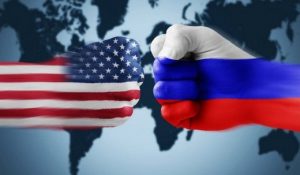
However, the political influence of the Russian Liberals became drastically weakened by Vladimir Putin’s taking power in Russia from 2000 onward and especially from 2004. A new global course of Russia’s foreign policy after 2004 became directed toward the creation of a multipolar world but not a unipolar Pax Americana one as the American Neocons wanted. Therefore, the Caucasus, Ukraine, and Syria became currently directly exposed to the Russian-American geopolitical struggle while Kosovo is up to now still left to the exclusive US sphere of interest.
Nevertheless, after 2022−? the special military operation in East Ukraine (Russia Minor) by Moscow, it can be expected in the nearest future that post-Yeltsin’s Russia will take decisive geopolitical steps concerning Kosovo as from the year 2000 the Russian exterior policy is constantly becoming more and more imbued with the neo-Slavophile geopolitical orientation advocated by Aleksandar Solzhenitsyn (1918−2008) as a part of a more global Eurasian geopolitical course of the post-Yeltsin’s Russian Federation supported by many Russian Slavophile intellectuals like a philosopher Aleksandar Dugin.
Ivan L. Solonevich, probably, gave one of the best explanations of Russia’s geopolitical situation and peculiarity in comparison to those of the USA and the UK focusing his research on the comparative analysis of geography, climate, and levels of individual freedoms between these countries:
„The American liberties, as well as American wealth are determined by American geography. Our [Russia’s] freedom and our wealth are determined by Russian geography. Thus, we’ll never have the same freedoms as the British and Americans have, because their security is guaranteed by the seas and oceans, but ours could only be guaranteed by military conscription“.[iii]
Dr. Vladislav B. Sotirović
Ex-University Professor
Vilnius, Lithuania
Research Fellow at the Center for Geostrategic Studies
[i] As a very example of such moral, cultural and civilizational demonization of the Serbs by the Western academic writings is [John Hagan, Justice in the Balkans: Prosecuting War Crimes in The Hague Tribunal, Chicago−London: The University of Chicago Press, 2003].
[ii] John Baylis, Steve Smith (eds.), The Globalization of World Politics: An Introduction to International Relations, Second edition, New York: Oxford University Press, 2001, 124.
[iii] Irina Isakova, Russian Governance in the Twenty-First Century: Geo-strategy, Geopolitics and Governance, London−New York: Frank Cass, 2005, 12.
Originally published on 2022-12-16
Origins of images: Facebook, Twitter, Wikimedia, Wikipedia, Flickr, Google, Imageinjection, Public Domain & Pinterest.
Read our Disclaimer/LegalStatement!
DonatetoSupportUs
We would like to ask you to consider a small donation to help our team keep working. We accept no advertising and rely only on you, our readers, to keep us digging the truth on history, global politics, and international relations.
War is evil; permanent war is permanent evil. It is evil to humans but also to other species and the planet; the weapons used destroy us but also contaminate and destroy nature.Despite a general knowledge of the evils of war and acceptance of peace and the rule of law, war has become a permanent feature of the 21st century -destructive, cruel, dehumanizing and vindictive. Its message: those who can kill and destroy the most have the upper hand. Major General Smedley Butler said it in a speech in 1933: “war is a racket.” Butler, who had joined the Marine Corps ...
The only discussion of principle emerging from the debates over Kosovar and Crimean independence is that initiated by Woodrow Wilson towards the end of World War One, about whether national minorities have the right to self-determination. Can a smaller group be compelled to be part of a larger state, or should they be permitted to secede? To what extent do minority rights amount to a freedom to determine one’s own sovereignty?In June 1999 an international military force led by the United States annexed Kosovo, then a province in southern Serbia with a population of perhaps 1.6 million people. Virtually all ...
Serbia today is a member-State of United Nations (U.N.), after the Socialist Federal Republic of Yugoslavia was split into several nations during the early 1990’s when war broke out between Serbian General Milosevic and neighboring nations. After partition, Serbia is still the most powerful “state” of the former Yugoslavia.“Kosovo”, the term used for the territory of southern Serbia, is de-jure recognised as a “state” by over 110+ “states”, but is not a “state” itself, as per the Montevideo Convention on the Rights and Duties of States (1933), and is not a “state” at the U.N. where 2/3rd positive vote is ...
A strange spy affair broke out in Balkan Casablanca, aka Serbia, on Wednesday. Were NATO “advisers” and liaison personnel embedded in the Serbian army command finally caught red-handed by vigilant Serbian counter-intelligence operatives, purloining secrets? Not this time. (Something along those lines actually did happen in 2002; it was when former armed forces chief of staff Momcilo Perisic was caught on camera in a Belgrade restaurant handing over secret information for cash to CIA’s Johnny-on-the-spot, John Neighbor.) But what allegedly occurred this time was not a boring rerun of the Perisic affair, although the basic contours of the unimaginative scenario ...
"Welcome to Nulandistan: Propaganda and the Crisis in Ukraine" (2014)This full length GRTV documentary looks at the fictitious land of Nulandistan that has been constructed out of Ukraine.The GRTV documentary deconstructs Nulandistan and the propaganda of the Obama Administration [...], the US Department of States, US officials, and their allies about the crisis in Ukraine and takes a look at their growing frustration towards the Russian media, particularly RT, for challenging their account of the events on the ground in what they have declared is an intensifying information war.The full length documentary starts by looking at the self-benefiting description of ...
“If the Nuremberg Laws were applied, then every post-war American President would have been hanged” Noam ChomskyEurasiaHenry Kissinger, one of the fundamental figures in creating and maintaining the US policy of global hegemony during the Cold War,[1] was quite clear and precise in his overviewing the issue of the American geopolitical position, national goals, and foreign policy. His remarks can be summarized in the following points:The US is an island off the shores of the large landmass of Eurasia.The resources and population of Eurasia far exceed the resources and population of the US.Any domination by any single state from Eurasia (either ...
Belarus is a land known also as Belorussia (White Russia, Weißrussland) in East Europe which was for centuries occupied by a Polish-Lithuanian common state until it became included in Tsarist Russia in the late 18th century.[1] Belarus is facing many identity problems but the most important is the ethnolinguistic challenge to a separate Belarussian[2] national feature.National identityA common national identity is a focal element for the creation of a national state as without a common identity that is based on a fundamental element of group’s identity a psychological sense of common solidarity cannot be developed. However, such solidarity is a ...
What we are seeing today in the fight over birth control is a revival of a very old, and very dangerous kind of Catholicism. It is not one supported or practiced by most Rank and File Catholics. It is a kind of Catholicism which has done irreparable harm. It is a kind of Catholicism unfit for existence in the modern world.It was the underpinning of the regimes of Mussolini in Italy, The National Catholicism of Francisco Franco, in Spain; The Parti Rexiste in Belgium; The Irish Blueshirts; The Croatian Ustaše, the Nazi puppet government in Croatia, and ultimately, was the ...
The leak of a secret BND dossier on Hachim Thaci which reports that the newly-elected Kosovan President had links to a contract killer and was involved in the trafficking of people, arms and drugs is more confirmation that Western politicians have chosen to support Thaci in the knowledge of his criminal past.Wikileaks has leaked a secret German Federal Intelligence Service (BND) dossier on Hachim Thaci that dates back to 2005, after the former Kosovo Liberation Army (KLA) leader had served the first of his two terms in office as Kosovan Prime Minister.The dossier reports that Thaci, who has recently been elected president of Kosovo, was one of the leaders of organized ...
Prof. Djordje Jankovic, Ph.DFaculty of PhilosophyBelgrade UniversityMiddle Ages in Noel Malcolm’s Kosovo: A Short History and Real FactsBefore presenting the interpretations of the mediaeval past of Kosovo and Metohija in Noel Malcolm’s work, one should be aware of the tasks set by the author before writing the book. That way, the acrobatic handling of the evidence which he uses or does not use will become clearer. In the introductory text, ten pages long, he clearly presents his political and ideological position. They are as follows (p. XXXIV-XXXV): “Kosovo” is one of the cultural crossroads of Europe – which is wrong; ...
As heavily-armed US and NATO troops enforced the peace in Bosnia, the press and politicians alike portrayed Western intervention in the former Yugoslavia as a noble, if agonizingly belated, response to an outbreak of ethnic massacres and human rights violations. In the wake of the November 1995 Dayton peace accords, the West was eager to touch up its self-portrait as savior of the Southern Slavs and get on with “the work of rebuilding” the newly “sovereign states.”But following a pattern set early on, Western public opinion had been skillfully misled. The conventional wisdom exemplified by the writings of former US ...
In Kukavica village near Rogatica (nowadays Bosnia and Herzegovina), today was marked 27 years since crimes against Serbian civilians committed by Bosnian Muslims, members of the so-called Army of Bosnia and Herzegovina on August 27, 1992.In an attack on a column of Serbian civilians, involving about 1,000 elderly people, women and children on tractors and passenger vehicles, Bosnian Muslim extremists killed 26 and injured 80 Serbs.Rogatica Mayor Milorad Jagodic called this a monstrous crime as among the victims are a child of 11 and 82 years old man.“This was a column of innocent people who were looking for refuge and ...
The current political process of acceptance of the quasi-independent state of Kosovo to the full UN’s UNESCO’s membership opened once again a question of NATO’s military intervention against the Federal Republic of Yugoslavia (the FRY) in March−June 1999 as a foundation for Kosovo’s secession from Serbia and its unilateral proclamation of a quasi-independence in February 2008. Kosovo became the first and only European state up today that is ruled by the terrorist warlords as a party’s possession – the (Albanian) Kosovo Liberation Army (the KLA). The aim of this article is to investigate the nature of NATO’s war on Yugoslavia ...
Since NATO’s intervention in 1999, Kosovo has been the subject of an unprecedented degree of international supervision. UNMIK, EULEX and K-FOR were afforded extensive, and essentially unaccountable, powers to maintain law and order and regulate Kosovo’s economy, judiciary and political system. In per capita terms, Kosovo has received the largest flow of aid ever distributed to a developing country: the international community put twenty-five times more money and fifty times more troops on a per capita basis into post-conflict Kosovo than into post-conflict Afghanistan.Regularly heralded as a success story, Kosovo is championed by some as proof that not all projects ...
What has happened is that NATO provides cover for these transgressions of the United States government’s policy. In other words, it absolutely legitimizes what effectively is NATO aggression. Moreover, what one needs to bear in mind and what one needs to be mindful about is the fact that in Western Europe you no longer have rulers with the independence of Charles de Gaulle.It seems that Washington, and we can use Washington, America and NATO interchangeably because NATO is dominated by the United States. It is a command structure, which ultimately is based on American military power and American military precedence. ...
The Serb holocaust during the WWII in the Independent State of Croatia is not a misnomer, an accusation, and even less a speculation. It is an historical fact. Rabid nationalism and religious dogmatism were its two main ingredients. During the existence of Croatia as an independent Catholic State, over 700,000 men, women and children perished. Many were executed, tortured, died of starvation, buried alive, or were burned to death. Hundreds were forced to become Catholic. Catholic padres ran concentration camps; Catholic priests were officers of the military corps which committed such atrocities. 700,000 in a total population of a few ...
This essay is inspired by Professor James Petras’s article, describing that the US never wins wars despite trillions of investments in her war budget and obvious military superiority.Professor Petras is of course right, the United States is currently engaged in seven bloody wars around the globe (Afghanistan, Iraq, Pakistan, Syria, Yemen, Somalia, Libya) and has not been winning one, including WWII. The question is: Why is that?To these wars, you may want to add the totally destructive and human rights adverse war that literally slaughters unarmed civilians, including thousands of children, in an open-air prison, Gaza, the US proxy war ...
The Balkan political environment is shaped-amongst other- by the existence of two political strains of Islam, the Wahhabis, related to the Saudis & Gulf states and the Muslim Brotherhood ones, related to the Turkish-Qatar axis.In both cases networking developed under a series of upturns since the 1990’s and is inexorably related to wider events of interest such as the ongoing wars in the Middle East and the culminations in countries such as Turkey, Egypt but also EU , Western European ones; including direct security affairs.Nowadays we are witnessing a massive buyout of land and corporations by mostly UAE, Kuwait and ...
A former U.S. President Bill Clinton's: Past, Present, Future:Origins of images: Facebook, Twitter, Wikimedia, Wikipedia, Flickr, Google, Imageinjection, Public Domain & Pinterest.Read our Disclaimer/Legal Statement!Donate to Support UsWe would like to ask you to consider a small donation to help our team keep working. We accept no advertising and rely only on you, our readers, to keep us digging the truth on history, global politics and international relations.[wpedon id="4696" align="left"]
Having just returned from a trip to Russia, I am pleased to report that the Russian people and the officialdom that I encountered displayed none of the vitriol towards Americans that I half expected as a response to the vilifying of Moscow and all its works that pervades the U.S. media and Establishment. To be sure, many Russians I spoke with were quick to criticize the Trump Administration for its hot and cold performance vis-à-vis the bilateral ties to Moscow while also expressing mystification over why the relationship had gone south so quickly, but this anger over foreign policy did ...