

Views: 2776

Is it necessary to prove that Vladimir Putin is poorly regarded by the western press? He’s so despised that the review L’Express wrote about a report addressed to the Pentagon that asserts that « Putin’s neurological development was significantly interrupted in infancy » and that « the Russian President carries a neurological abnormality. » The authors of the report say that “ his behaviour and facial expressions reveal someone who is defensive in large social settings.”
The implicit conclusion of such a report that was acted on by the Pentagon, is that Putin can’t communicate, that he is unable to have an open and constructive dialog with the others and also that he could be dangerous, declare a war without prior judgment. The credulous reader is frightened and wonders how such a man can be the leader of Russia. He has a glance at what has happened in the past few years and suddenly understands why Putin invaded Georgia in 2008, why he annexed Crimea, why he supported the separatists in Donbas and why he’s bombing the Islamic fundamentalists in Syria right now to support the torturer Al-Assad! What’s the difference between mentioning this report and spreading propaganda?
What if Putin weren’t the man they describe? Just suppose there were some kind of logic in his foreign policy
 According to the geographer George Friedman, nations are like chess players who act in the narrow limits of a series of rules that reduce the range of good moves. The more logic a player is, the more predictable he is because he’s able to chose the best tactics “until that one brilliant unexpected stroke”. George Friedman believes nations don’t act irrationally. “Nations are constrained by reality. They generate leaders who would not become leaders if they were irrational” (Friedman, p.29). He thinks leaders “understand their menu of next moves and execute them”. When they fail it’s not because they are stupid but just because the circumstances didn’t provide them the right possibilities.
Then following George Friedman’s approach to Geopolitics, let’s ask ourselves: is it possible to understand the initiatives taken by Vladimir Putin on the international chessboard?
In his book The Next 100 Years, George Friedman insists on the fact that Russia is landlocked while the United States has “easy access to the world’s oceans”. During the Cold War, the United States – which wanted to “contain and thereby strangle the Soviets” – created a “massive belt of allied nations” extending from the North Cape of Norway to Turkey to the Aleutian Islands” (Friedman, p.45). “Blocked by geography”, the USSR couldn’t win the Cold War and finally collapsed in 1991. Friedman forecasts that in the 21st century, after a second Cold War, Russia will collapse again for the same geographical reason.
But being landlocked is not the only drawback of Russian geography. To understand this, the journalist Tim Marshall invites us to take a look as this map of Europe where the European plain have been darkened.
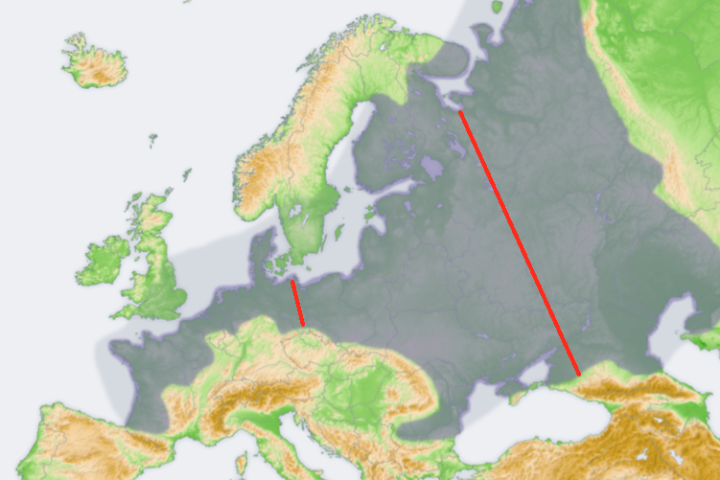
This plain that goes from the Atlantic coasts to the Ural Mountains and from Finland to the Black Sea and the Caucasus is a huge and open corridor through which all the invasions have passed in the last 500 years: the Poles in 1605, the Swedish in 1707, the French in 1812 and finally the Germans in 1914 and 1941. Such invasions were made possible because the plain offers no resistance to invaders. There you will find “no mountains, no deserts, and few rivers” to cross. In order to face this problem, the Russian leaders decided to attack first. The only way to avoid insecurity was to move their borders to places easier to control and defend where they could reach natural obstacles to invasions. Ivan the Terrible was the first to move outward. “He extended his territory east to the Ural Mountains, south to the Caspian Sea, and north toward the Arctic Circle”. He “gained access to the Caspian, and later the Black Sea, thus taking advantage of the Caucasus Mountains as a partial barrier between itself and the Mongols”. He also “built a military base in Chechnya to deter any would-be attacker”. Then came Peter the Great and after him Catherine the Great. They “expanded the empire westward, occupying Ukraine and then reaching the Carpathian Mountains”. They took control of Lithuania, Latvia and Estonia to defend themselves “against attacks from the Baltic Sea”. And after WWII, Stalin occupied eastern Europe and put there allied regimes, just to create a buffer zone to close off the European plain, pushing westward until they reach a narrow area, easier to control against the enemies. We can see actually that the border between West and East Germany is easier to defend than the current Russian border. And this data doesn’t depend on the personality of a leader, whether he is an emperor, a dictator or an elected president. This point of view is largely shared by Alexander Dugin.
Alexander Dugin is a geographer but not only that. He’s also a fervent Russian moved by a love for his country. For him, Russia is more than a landlocked and vast country, more than a flag. It’s a besieged civilization that must be defended. “Russia is not the Federation of Russia, Russia is the Russian world, a civilization, one of the poles of a multipolar world” he says in an interview given to Katehon.com under the title: “War in Ukraine Will Resume Soon”.
Like Tim Marshall, Alexander Dugin leans on geography to justify, and even prolong, President Putin’s foreign policy. According to him, the war against Georgia, the Crimea annexation and the bombing campaign in Syria – where Russia has a naval base in Tartus (the western readers don’t know that Syria is, like Crimea or Transcaucasia, an outpost that allows Russia not to get imprisoned in his own borders) – were actions dictated by a geopolitical necessity that transcends the personality of its leaders. According to him, Russia should have annexed the Russian-speaking provinces of Ukraine and he believes that sooner or later it will have to do this. Not because Russians are avid of territories or imperialistic. By doing that, Russia will guarantee its own survival. “If we loose the Donbas, then we’ll lose Crimea and then all of Russia” he says. Annexing Ukraine is not an objective. Ukraine doesn’t need to become a vassal state. “I’m not against a sovereign Ukraine, if only it would be our ally or partner or, in the least, a neutral, intermediate space” he says. And he adds: “What shouldn’t be allowed is an Atlanticist occupation of Ukraine”. Here, Dugin speaks from the realm of necessity. That’s what he means when he says that it is “geopolitical axiom”. “Our enemies perfectly understand that Russia can become great again only together with Ukraine”. According to him, “There is no other way. The Russian Spring is impossible without a Eurasian pivot in Ukraine, no matter what form, peaceful or not, that it takes”. Dugin thinks that keeping independent the Donetsk and Lugansk republics between Ukraine and Russia is a categorical imperative. “He who controls the borders of the DPR and LPR with Russia controls everything” he says, imitating Mackinder’s famous slogan.
 Syria is part of the same issue. Alexander Dugin thinks Syria « is a more distant goal, but not less important». He assures that the existence of ISIL is «a plan of the Americans». According to him, «The Islamic State is a special operation directed against the opponents of American hegemony in the Middle East and in particular against us [Russians]» and he adds that “Islamic fundamentalism has traditionally been an instrument of American and Atlanticist geopolitics”. I suggest that those who might consider Alexander Dugin a conspiracy theorist read the confessions of Zbigniew Brzezinski who, when he was Jimmy Carter’s Security Adviser received, on July 3rd, the presidential authorization to finance battalions of mujahedeen in order to offer the Russians their own “Vietnam War” in Afghanistan.
Dugin thinks that to confront the American threat, Russia has to show its own force and stop using the diplomatic solution.
War seems unavoidable for Russia, this vast and landlocked country that the American oligarchy wants to chase away from everywhere, from the Baltic Coasts, from the Caucasus, from the Black Sea and from the Mediterranean, expecting to chase it away from Siberia during the next step. And this war won’t be the consequence of President Putin’s personality but the result of a geopolitical turmoil deliberately organized by the western oligarchs.
Nevertheless, no doubt the idiots will keep on braying that Putin is a bloodthirsty dictator and that Russia is a dangerous and barbarian country.
Those idiots are not only the enemies of Russia. They’re also the enemies of Truth and their omnipresence in the media landscape and in the political world has made Europe a big diseased body whose members are gradually being eaten by the Atlanticist gangrene.
Author: Bruno Adrie
Sources:
George Friedman, The Next 100 Years, Allison & Busby, London, 2009
Tim Marshall, « Russia and the Curse of Geography » , The Atlantic Monthly, October 31st 2015
Tim Marshall, Prisoners of Geography, Scribner Book Company, October 27th 2015
Alexander Dugin, « War in Donbass will be imposed on us by Washington and Kiev » , Katehon.com, November 2nd 2015 (reblogged here)
Bruno Adrie, « Brzezinski, Obama, Islamic fundamentalism and Russia » (Part I), brunoadrie.wordpress.com,October 26th 2015
Bruno Adrie, « Brzezinski, Obama, Islamic fundamentalism and Russia » (Part II), brunoadrie.wordpress.com, November 2nd 2015
Origins of images: Facebook, Twitter, Wikimedia, Wikipedia, Flickr, Google, Imageinjection, Public Domain & Pinterest.
Read our Disclaimer/Legal Statement!
Donate to Support Us
We would like to ask you to consider a small donation to help our team keep working. We accept no advertising and rely only on you, our readers, to keep us digging the truth on history, global politics and international relations.