
Wednesday, May 30th, was Memorial Day in the United States. The commemoration began in 1868 shortly after the American Civil War, when townsmen in several communities came together to decorate the graves of the fallen on the last Monday in May [...]
Wednesday, May 30th, was Memorial Day in the United States. The commemoration began in 1868 shortly after the American Civil War, when townsmen in several communities came together to decorate the graves of the fallen on the last Monday in May. The practice began in the northern states but soon spread to the south and the annual remembrance ceremony soon took on the name Decoration Day. As wars proliferated in the twentieth century the commemoration eventually lost its association with the Civil War and was increasingly referred to nationally as Memorial Day, eventually becoming a federal holiday.
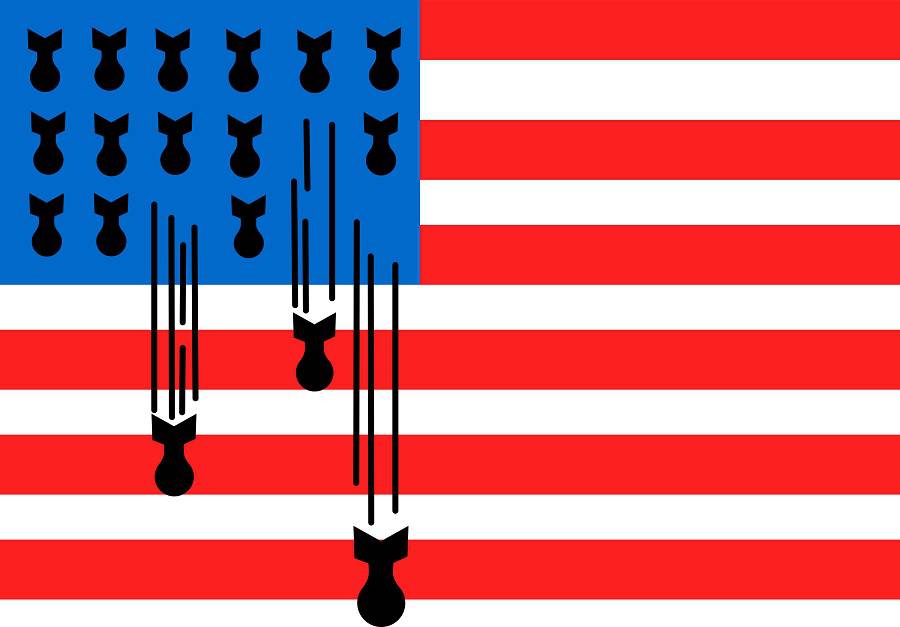
The American Civil war killed 655,000 soldiers, more than all other U.S. wars before or since combined. It was the first modern war in that it relied on railroads and steamships. The North also destroyed the livelihoods of and deliberately starved civilian populations to reduce the South’s will to resist. It was a war fought on U.S. soil and experienced first hand by the American people.
Today Memorial Day has largely lost its connection with dead soldiers and is instead best noted for being regarded as the first day of summer for recreational purposes. Beaches open up, the lifeguards come out and the smell of barbecued meat fills the air. The declining number of veterans of World War 2, Korea and Vietnam work hard to remember the dead but there is little interest from a public that has become increasingly detached from its non-conscripted professional army.
There is a certain irony in how a holiday commemorating a war fought 150 years ago that had devastating impact, a memento mori to honor the dead and warn the living about the reality of war, is now little more than a bump in the road on the way to the beach as the United States government is openly contemplating new military initiatives in Asia and possibly even in Europe.
The truth is that Americans have forgotten about the War Between the States and, protected by two broad oceans, have no idea whatsoever about the horrible reality that war represents. They have become addicted to war pari passu without any perception of what that might mean if an adversary were to develop the capability to strike the homeland. For most Americans war is little more than a video game, seen in snippets on the nightly news. It is a peculiar form of cultural blindness, an exercise that involves foreign people in faraway places and is not to be taken seriously. The rest of the world, which has experienced far too much of war’s devastation first hand has quite a different viewpoint, however.
For the past three weeks I have been traveling in Asia and Europe, to include stops in America’s two enemies du jour Iran and Russia. World War 2, ended 73 years ago, is still clearly visible in the ruins and shattered lives. St Petersburg in Russia is still restoring palaces vandalized and burnt by the Germans. In Germany, the historic Medieval Hanseatic port of Rostock was 80% reduced to rubble by U.S. and British bombers. It was a war in which cities burned and 80 million soldiers and civilians died, only one half of one per cent of which were Americans. Russia lost 27 million alone. The continental United States alone among major belligerents was untouched by the fighting.
Iran too bears the scars of the Iran-Iraq War of 1980-88, in which Washington supported Baghdad. Half a million Iranians and Iraqis died. In the deliberately never-ending War on Terror 8,000 Americans have lost their lives in places few would be able to find on a map but, by some estimates, so have nearly 4 million Muslims directly and as collateral damage. Three foreign governments have been overthrown and Washington is seeking to add Damascus to that toll, with suggestions that even Moscow is being targeted for change.
All of which led on my recent travels to discussions in which many non-Americans wondered openly “What has happened to the United States?” Most went so far as to opine that Washington is the world’s greatest threat to peace, not China, Russia or Iran. Sadly, I had to agree.
So it behooves all Americans if good will to band together to end the madness. When Memorial Day comes around next year let it again be a commemoration of the horror of war, the death and destruction. With that in mind, all thoughts of confrontation should vanish to be replaced by demands for negotiation and accommodation. And as for the soldiers, sailors, Marines and airmen, give them a Memorial Day gift and bring them home. Every one of them.
Originally published on 2018-05-31
About the author: Philip M. Giraldi, PhD is an Executive Director of the Council for the National Interest.
Origins of images: Facebook, Twitter, Wikimedia, Wikipedia, Flickr, Google, Imageinjection, Public Domain & Pinterest.
Read our Disclaimer/Legal Statement!
Donate to Support Us
We would like to ask you to consider a small donation to help our team keep working. We accept no advertising and rely only on you, our readers, to keep us digging the truth on history, global politics and international relations.

Louis XVI needed a revolution, Napoleon needed two historic military defeats, the Spanish Empire in the New World needed multiple revolutions, the Russian Czar needed a communist revolution, the Austro-Hungarian and Ottoman Empires needed World War I, Nazi Germany needed World War II, Imperial Japan needed two atomic bombs, the Portuguese Empire in Africa needed a military coup at home, the Soviet Empire needed Mikhail Gorbachev … What will the American Empire need?I don’t believe anyone will consciously launch World War III. The situation now is more like the eve of World War I, when great powers were armed and ...
Crimea’s breakaway from Ukraine and rejoining Russia is treated in the US-and-allied world as being justification for the explosive re-emergence in 2014 of America’s Cold War NATO alliance as being a restored war against Russia; and, so, whether or not that ‘justification’ is truthful is the paramount geopolitical issue in our era; and it will therefore be discussed and (via the links here) documented in this article.Though international law is generally an unenforced mess that is interpretable far more by partisanship than by any clearly applicable principles, the US Government does quite blatantly violate it on a routine basis, by ...
The official end of the Cold War era in 1989 brought during the first coming years a kind of international optimism that the idea of the „end of history“ really could be realized as it was a belief in no reason for the geopolitical struggles between the most powerful states. The New World Order, spoken out firstly by M. Gorbachev in his address to the UN on December 7th, 1988 was originally seen as the order of equal partnership in world politics reflecting „radically different international circumstances after the Cold War“.[1]Unfortunately, the Cold War era finished without the „end of ...
The Bulletin of the Atomic Scientists published a study, on 1 March 2017, which opened as follows:“The US nuclear forces modernization program has been portrayed to the public as an effort to ensure the reliability and safety of warheads in the US nuclear arsenal, rather than to enhance their military capabilities. In reality, however, that program has implemented revolutionary new technologies that will vastly increase the targeting capability of the US ballistic missile arsenal. This increase in capability is astonishing — boosting the overall killing power of existing US ballistic missile forces by a factor of roughly three — and ...
“In the event of a nuclear war, there will be no chances, there will be no survivors – all will be obliterated… nuclear devastation is not science fiction – it is a matter of fact. The world now stands on the brink of the final abyss. Let us all resolve to take all possible practical steps to ensure that we do not, through our own folly, go over the edge.” Former First Sea Lord, Lord Louis Mountbatten (1900-1979) Strasbourg, 11 May 1979.”As US threats ratchet up towards North Korea, the latest hinging on the accusation that the country attempted a ...
“The earthly Kingdom is for earthly people, but the heavenly Kingdom is forever” Serbian national epic about the Kosovo Battle against the Ottoman Turks in 1389[1]The American gangsters and the destruction of ex-YugoslaviaSouth-East Europe, and especially the Balkan Peninsula as the main part of it, have traditionally been the object of numerous geopolitical, geostrategic and publicist analyses, as well as the subject of debates among the Balkan, European and global experts in international relations. The new Iron Curtain between western and eastern Europe was not the end of the Balkan’s importance for the US administration and the NATO as well. At ...
Originally, the Bush Doctrine was a political phrase with the aim to describe the US foreign policy goals during the 43rd US President George W. Bush (Bush Junior), 2001−2009. The doctrine had four basic standpoints. All of them were centered around American military superiority after the Cold War 1.0 as the US being the only global hyperpower in international relations.The Bush Doctrine's fundamental standpoints The fundamental standpoints of the Bush Doctrine are: 1) Unilateralism; 2) A logic of “either with us or with the terrorists”; 3) Pre-emption; and 4) Regime change.It must be noted that the Bush Junior administration turned ...
U.S. jets are bombing Syria again this month, part of an overall pattern of military expansion during the Obama administration that’s seen military involvement in dozens of conflicts.As the United States renews a bombing campaign against ISIS forces in Syria, it seems like America’s penchant for waging war knows no bounds. During the first seven years of Barack Obama’s presidency, the U.S. bombed seven countries while supporting other destabilizing military actions throughout the Middle East.Here’s a look at these seven countries and the effects of bombing: Afghanistan — Despite the announced “end” of the Afghanistan War, significant U.S. military presence ...
Thanksgiving recalls for many people a meal between European colonists and indigenous Americans that we have invested with all the symbolism we can muster. But the new arrivals who sat down to share venison with some of America’s original inhabitants relied on a raft of misconceptions that began as early as the 1500s, when Europeans produced fanciful depictions of the “New World.” In the centuries that followed, captivity narratives, novels, short stories, textbooks, newspapers, art, photography, movies and television perpetuated old stereotypes or created new ones — particularly ones that cast indigenous peoples as obstacles to, rather than actors in, ...
Was Serbia attacked in 1999? To answer that question, Milica-Hänsel Radojkovic draws on period documents (including Willy Wimmer’s letter to Chancellor Gerhard Schröder). He highlights the unacceptability of the Rambouillet proposals, designed to justify a war that had already started. Fourteen years ago, after the negotiation conferences in Rambouillet and Paris between 6th and 23rd February 1999, the global media informed the general public that “the Serbian delegation did not accept the offered agreement and rather qualified it as null and void”, while indicating that allegedly the so-called Contact Group for Yugoslavia stood behind the agreement. This body consisted of ...
One of the most hyped “events” of American television, The Vietnam War, has started on the PBS network. The directors are Ken Burns and Lynn Novick. Acclaimed for his documentaries on the Civil War, the Great Depression and the history of jazz, Burns says of his Vietnam films, “They will inspire our country to begin to talk and think about the Vietnam war in an entirely new way”.In a society often bereft of historical memory and in thrall to the propaganda of its “exceptionalism”, Burns’ “entirely new” Vietnam war is presented as “epic, historic work”. Its lavish advertising campaign promotes its ...
North Korea cheered this month when a man with a knife and a history of violent behavior slashed the face of Mark Lippert, the U.S. ambassador to South Korea. The attack in Seoul was “a knife shower of justice,” North Korea said, praising it as “deserved punishment for warmonger United States.”If that sounds mean-spirited, consider this: For years, North Korea has taught schoolchildren to bayonet effigies of U.S. soldiers. Under its young dictator, Kim Jong Un, the government has suggested it was prepared to nuke Washington, Austin and Southern California. More than 40 years ago, Kim Il Sung, the “Great ...
America’s hegemonic project in the post 9/11 era is the “Globalization of War” whereby the U.S.-NATO military machine –coupled with covert intelligence operations, economic sanctions and the thrust of “regime change”— is deployed in all major regions of the world. The threat of pre-emptive nuclear war is also used to black-mail countries into submission.This “Long War against Humanity” is carried out at the height of the most serious economic crisis in modern history. It is intimately related to a process of global financial restructuring, which has resulted in the collapse of national economies and the impoverishment of large sectors of ...
In the current context, the US is threatening to wage a preemptive nuclear war against Russia, which possesses a vast arsenal of nuclear weapons. Hillary Clinton has confirmed that “nukes are on the table” and she intends to use them if she becomes president. We need to defend ourselves against Russia, Iran, North Korea and China. Her solution is to blow up the planet.World War II ended in Mushroom Clouds.If Hillary decides to wage a preemptive nuclear war on Russia, World War III would commence with mushroom clouds.How would World War III end. Would it have an ending?In the words ...
In Kill Anything that Moves: The Real American War in Vietnam (Metropolitan Books. New York. 2013), Turse writes that the US military’s official position, and the popular understanding in the US, is that leadership “has never condoned wanton killing or disregard for human life.” (2) On the rare occasions when atrocities are brought to light, they are blamed on low-level individuals and are said to be aberrations having nothing to do with official policy. The My Lai massacre, for example, was blamed on Lieutenant William Calley, who is said to have gone “crazy” (4,5) – although he and his unit ...
Many innocent civilians were killed in American military interventions around the world – from Vietnam and Serbia to Iran and Afghanistan, because of the alleged “errors” or “collateral damage” – without consequences for civil and military leadership. In addition to political, military and every other power, Americans secured itself with legal mechanisms.Twenty-two civilians, wounded and doctors, among them three children, were killed in the American bombing of a hospital in the Afghan city of Kunduz. Americans acknowledged the error and apologized. The President of the United States expressed his condolences, the military leadership announced three independent investigations. “Doctors without borders” ...
Unfathomable as that may appear, yes, it was quite possible for the second-ranking slaughterhouse in Europe in recent memory to have slipped off the radar screen. Even such a renowned authority as Professor Gideon Greif is having an exceptionally difficult time of it in trying to put it back on.Precisely because it has not been the theme of any Hollywood spectaculars, Jasenovac does not attract any school excursions and textbooks are largely silent about it. Some background information on Jasenovac therefore seems like a good place to start.The Jasenovac death camp (1941 – 1945) is inextricably bound up with the ...
"We are a peaceful nation," claimed Republican presidential candidate Ben Carson in an interview with Katie Couric late last year.Carson voiced a view that is held by many in our society. Like most people around the world, we naturally like to think of ourselves as a peace loving country.Unfortunately, the record does not bear this out. It, in fact, indicates something quite opposite: The United States has had a long and bloody history of aggression and war making.A survey of history shows that America has either been involved in armed conflict or conducted some form of military operations during 223 ...
Early in 1989, China was stirring. A decade of groundbreaking reforms inspired by Deng Xiaoping had brought the moribund economy to life and freed the nation from the ideological shackles imposed by radical Maoists during the cataclysmic Cultural Revolution. Almost everything seemed possible, as Deng proteges Hu Yaobang and then Zhao Ziyang led policymaking on a day-to-day basis.But the changes sweeping China had its dark undersides. Large-scale economic reforms also meant expanded corruption opportunities, which many officials exploited. And Chinese who “got rich first,” under the Dengist dispensation, opened a rapidly expanding wealth gap with fellow citizens. Discontent simmered dangerously.The ...
Few people know that, in fact, in those years, overseas aircraft inflicted an unpunished blow on the Soviet territory. It happened in the Far East in October 1950.On October 8, 1950, at 4.17 p.m. local time, two Lockheed F-80C Lockheed "Schutting Star (Meteor)" violated the state border of the USSR and, having deepening into the territory for almost a hundred kilometers, attacked the Soviet military airfield Suhaya Rechka 165 kilometers from Vladivostok, in the Hasan district. As a result of firing by the US Air Force seven Soviet squadron aircraft were damaged, one completely burnt in the parking lot.That autumn ...