

Views: 2680

The U.N. Organization was established in 1945 for the very security reason – to preserve the peace in the world. We believe that the governmental bodies and administrative structures of the U.N. have to be composed by the proved democratically oriented politicians and magistrates but above all this requirement has to be applied to the post and function of the U.N. Secretary-General. Nevertheless, in the history of the U.N. there is at least one (extremely) problematic appointment to the post of the U.N. Secretary-General: Kurt Waldheim from Austria.
On the official website of the U.N. about its fourth Secretary-General one can read his biography as:
KURT WALDHEIM (AUSTRIA)
FOURTH UNITED NATIONS SECRETARY-GENERAL
Kurt Waldheim was appointed Secretary-General of the United Nations for a five-year term beginning on 1 January 1972. The Security Council had recommended the appointment on 21 December 1971 and the General Assembly approved it by acclamation on the following day.
The Secretary-General was born at Sankt Andra-Wordern, near Vienna, Austria, on 21 December 1918. He graduated from the University of Vienna as a Doctor of Jurisprudence in 1944. He is also a graduate of the Vienna Con sular Academy.
Mr. Waldheim joined the Austrian diplomatic service in 1945, and from 1948 to 1951 he served as First Secretary of the Legation in Paris. He was head of the personnel department of the Ministry for Foreign Affairs in Vienna from 1951 to 1955 In 1955 he was appointed Permanent Observer for Austria to the United Nations and later that year became head of the Austrian Mission when Austria was admitted to the Organization.
From 1956 to 1960, Mr. Waldheim represented Austria in Canada, first as Minister Plenipotentiary and later as Ambassador. From 1960 to 1962 he was head of the Political Department (West) in the Austrian Ministry for Foreign Affairs, subsequently becoming Director-General for Political Affairs until June 1964.
From 1964 to 1968, Mr. Waldheim was Permanent Representative of Austria to the United Nations. During that period he was Chairman of the Committee on the Peaceful Uses of Outer Space; in 1968 he was elected President of the first United Nations Conference on the Exploration and Peaceful Uses of Outer Space.
From January 1968 to April 1970, Mr. Waldheim was Federal Minister for Foreign Affairs of Austria. After leaving the Government, he was unanimously elected Chairman of the Safeguards Committee of the International Atomic Energy Agency, and in October 1970 he again became the Austrian Permanent Representative to the United Nations, a post he held until he was elected Secretary-General of the Organization.
In April 1971, he was one of the two candidates for the Federal Presidency of Austria.
During his first three years as Secretary-General, Mr. Waldheim made it a practice to visit areas of special concern to the United Nations. In March 1972 he travelled to South Africa and Namibia in pursuance of a mandate given him by the Security Council in order to assist in finding a satisfactory solution for the problem of Namibia.
The Secretary-General paid three visits to Cyprus, in June 1972, August 1973 and August 1974, for discussions with government leaders and to inspect the United Nations Peace-keeping Force in the island. During his visit in August 1974, in the wake of the hostilities, Mr. Waldheim arranged for talks to begin between Acting President Glafcos Clerides and Rauf Denktash.
The Secretary-General also made a number of trips to the Middle East in the continuing search for peace in the area. In August 1973 he visited Syria, Lebanon, Israel, Egypt and Jordan; in June 1974 he met with the leaders of Lebanon, Syria, Israel, Jordan and Egypt; and in November 1974 he went to Syria, Israel and Egypt in connection with the extension of the mandate of United Nations Disengagement Observer Force (UNDOF). On these visits he also inspected the United Nations peace-keeping operations in the area – the United Nations Truce Supervision Organization (UNTSO), the United Nations Emergency Force (UNEF) and UNDOF.
In February 1973, during an official trip to the subcontinent, the Secretary-General discussed with the Governments of India,Pakistan and Bangladesh the problems created by the war between India and Pakistan and ways and means to overcome its consequences. He also inspected the United Nations Relief Operation in Bangladesh, the largest relief operation ever undertaken under United Nations auspices.
In February and March 1974, the Secretary-General visited a number of countries in the Sudano-Sahelian area of Africa where the United Nations had undertaken a major relief operation to assist the victims of a prolonged drought.
The Secretary-General also opened and addressed a number of major international conferences convened under United Nations auspices. These include the third session of the United Nations Conference on Trade and Development (Santiago, April 1972), the United Nations Conference on the Human Environment (Stockholm, June 1972), the Third United Nations Conference on the Law of the Sea (Caracas, June 1974), the World Population Conference (Bucharest, August 1974) and the World Food Conference (Rome, November 1974).
The Secretary-General participated in Security Council meetings held away from Headquarters, in Africa (Addis Ababa, January 1972) and in Latin America (Panama, March 1973).
He addressed and attended meetings of the Organization of African Unity (OAU) in Rabat (June 1972 on the occasion of the tenth anniversary of the OAU, in Addis Ababa (May 1973) and in Mogadiscio (June 1974). He also addressed the Organization of American States (OAS) in Washington (March 1972).
In February 1973, the Secretary-General took part in the Paris International Conference on Viet-Nam; in December of the same year he presided over the first phase of the Geneva Peace Conference on the Middle East.
In July 1973, Mr. Waldheim addressed the Conference on European Security and Co-operation in Helsinki.
On the invitation of their respective Governments, the Secretary-General paid official visits to a number of countries in Africa, Asia, Latin America, the Middle East and Europe.
Married and the father of three children, Mr. Waldheim is the author of a work on Austria’s foreign policy, The Austrian Example, which has been published in German,English and French.
Source: http://www.un.org/Overview/SG/sg4bio.html
However, the crucial part of the Mr. Waldheim’s biography, as an appropriate person for the post of the U.N. Secretary-General is totally missing from his official U.N. bio. This crucial and mostuly problematic part of his biography, nevertheless, one can find at the Wikipedia’s website:
Military service in World War II
In early 1941, Waldheim was drafted into the Wehrmacht and posted to the Eastern Front where he served as a squad leader. In December of that year, he was wounded but he returned in 1942 to service. His service in the Wehrmacht from 1942 to 1945 was the subject of international review in 1985 and 1986. In his 1985 autobiography, he stated that he was discharged from further service at the front and, for the remainder of the war, finished his law degree at the University of Vienna, in addition to marrying in 1944.[4] After publication, documents and witnesses came to light that revealed Waldheim’s military service continued until 1945, during which time he rose to the rank of Oberleutnant.
Service in Yugoslavia and Greece
Waldheim’s functions within the staff of German Army Group E from 1942 until 1945, as determined by the International Commission of Historians,[5] were:
-
Interpreter and liaison officer with the 5th Alpine Division (Italy) in April/May 1942, then,
-
O2 officer (communications) with Kampfgruppe West in Bosnia in June/August 1942,
-
Interpreter with the liaison staff attached to the Italian 9th Army in Tirana in early summer 1942,
-
O1 officer in the German liaison staff with the Italian 11th Army and in the staff of the Army Group South in Greece in July/October 1943, and
-
O3 officer on the staff of Army Group E in Arksali, Kosovska Mitrovica and Sarajevo from October 1943 to January/February 1945.
By 1943, Waldheim was serving in the capacity of an ordnance officer in Army Group E which was headed by General Alexander Löhr.[6] In 1986, Waldheim said that he had served only as an interpreter and a clerk and had no knowledge either of reprisals against local Serb civilians or of massacres in neighboring provinces of Yugoslavia. He said that he had known about some of the things that had happened, and had been horrified, but could not see what else he could have done.[4]
 Much historical interest has centered on Waldheim’s role in Operation Kozara in 1942.[7] According to one post-war investigator, prisoners were routinely shot within only a few hundred meters (yards) of Waldheim’s office,[8] and just 35 kilometres (22 mi) away at the Jasenovac concentration camp. Waldheim later stated that “he did not know about the murder of civilians there”.[8]
Waldheim’s name appears on the Wehrmacht ’s “honor list” of those responsible for the militarily successful operation. The Nazi puppet state, the Independent State of Croatia, awarded Waldheim the Medal of the Crown of King Zvonimir in silver with an oak branches cluster.[9] Decades later, during the lobbying for his election as U.N. Secretary General, Yugoslav President Josip Broz Tito, who had led anti-German forces during the war, awarded Waldheim one of the highest Yugoslav orders.[10]
Waldheim denied that he knew war crimes were taking place in Bosnia at the height of the battles between the Nazis and Tito’s partisans in 1943.[11] According to Eli Rosenbaum, in 1944, Waldheim reviewed and approved a packet of anti-Semitic propaganda leaflets to be dropped behind Soviet lines, one of which ended: “Enough of the Jewish war, kill the Jews, come over.”[12]
Surrender
In 1945, Waldheim surrendered to British forces in Carinthia, at which point he said he had fled his command post within Army Group E, where he was serving with General Löhr, who was seeking a special deal with the British.

Source: https://en.wikipedia.org/wiki/Kurt_Waldheim
Origins of images: Facebook, Twitter, Wikimedia, Wikipedia, Flickr, Google, Imageinjection & Pinterest.
Read our Disclaimer/Legal Statement!
Donate to Support Us
We would like to ask you to consider a small donation to help our team keep working. We accept no advertising and rely only on you, our readers, to keep us digging the truth on history, global politics and international relations.
Appendices by White Nettle’s Editor-In-Chief

Kurt Waldheim (second from left) with the Italian General Ercole Roncaglia, Col. Hans Herbert Macholz, and SS-Grupenführer Artur Phleps at Podgorica (Montenegro, Yugoslavia) airfield on May 22nd, 1943
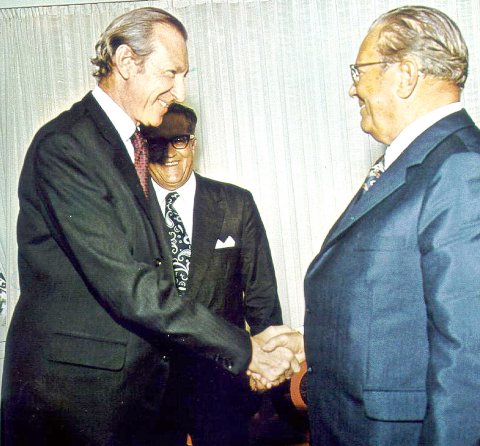
Kurt Waldheim as President of Austria and Josip Broz Tito as President of Yugoslavia: Post-war continuation of the Nazi-Communist collaboration on the territory of the Independent State of Croatia in the WWII

The ex-Nazi Oberleutnant, serving in the 5th Alpine Division Pusteria, Kampfgruppe West as the fourth U.N. Secretary General

FOLLOW US ON OUR SOCIAL PLATFORMS