
Here’s Why France Should be Blamed for the Destruction in Syria
Despite the fact that Faysal accepted the ultimatum in principle, France decided it was time for him to leave. On July 26, 1920, the French government intervened outright and occupied Damascus, overthrowing Faysal and his nationalist government [...]
Why is France so interested in Syria? According to the Guardian, France’s policy in Syria has been “more forward than any other Western country”:
“[France] was early in calling for President Bashar al-Assad to step down, still insists he must go, and recently joined airstrikes inside Syria against the Islamic State.”
France joined the United States in bombing Syrian territory (without a U.N. mandate) even before the United Kingdom did. In 2013, France stood by Obama’s side despite the fact the United Kingdom’s parliament voted not to join Obama’s efforts to “punish” Syrian president Bashar al-Assad for crossing Obama’s imaginary red line. France has also been a staunch backer of rebels fighting to overthrow Assad since the conflict began.
Not many people know this, but Syria was a former French colony prior to World War II. Both Syria and Lebanon were promised to France under a secret agreement reached with Great Britain following the fall of the Ottoman Empire in 1916. However, even in recent times, France was not overtly anti-Syrian. When Bashar al-Assad took power in 2000, France bore no real ill will towards him. Former president Nicolas Sarkozy openly praised Assad for defending the rights of Syrian Christians.
It is a bold statement to blame France for the current situation in Syria. However, as discussed by Dr. Ayse Tekdal Fildis in an academic paper entitled “The Troubles in Syria: Spawned by French Divide and Rule”:
“Great Britain and France transformed what had been relatively quiet provinces of the Ottoman Empire into some of the least stable and internationally explosive states in the world.”
As part of the Ottoman Empire, Syria did not exist as an entity and was more commonly referred to as “Greater Syria,” “Geographical Syria,” or “Natural Syria,” which was actually comprised of Jordan, Israel/Palestine, Lebanon, and modern day Syria.
Colonially speaking, France was never welcome in Syria. As noted by Randall Baker, an “international expert on historical perspectives in the analysis of contemporary environmental policy and problems,” Syria directly told France they were not welcome to interfere in Syria as early as June of 1919. However, France went ahead and took Syria by cunning force following the San Remo Conference that year, allowing Amir Faysal Ibn Husayni to remain king of Syria only if the country remained under French control and influence. In practice, this gave Syria some leeway — until an interventionist in the form of Alexandre Millerand took office in France. Unsurprisingly, after Syria’s Congress declared Faysal king of the “United Syria Kingdom,” which was to be an unconditionally independent state, France declared this declaration to be null and void.
Instead, Millerand imposed five unconditional demands on Syria: (1) the unconditional acceptance of the French mandate; (2) the acceptance of French-Syrian paper money based on the Franc (sound familiar?); (3)the abolition of conscription and reduction of the army (sound familiar?); (4) French military occupation of the railway and stations from Riyaq to Aleppo; and (5) punishment of persons implicated in hostile acts against the French.
Despite the fact that Faysal accepted the ultimatum in principle, France decided it was time for him to leave. On July 26, 1920, the French government intervened outright and occupied Damascus, overthrowing Faysal and his nationalist government. With this complete takeover of the Syrian region, France also gifted itself the ability to veto any Syrian legislation, making“a charade out of Syrian political life.”
Not surprisingly, there was great resistance to colonial rule from the officers of the Arab army (sound familiar?).
In order to fully take control of Syria, France relied on a divide and rule strategy to undermine Arab nationalism. This strategy involved dividing Syria into segments to block any chance at an overriding sense of nationalism. However, interfering in Lebanon at the same time, a country that also did not exist as an entity under the Ottoman Empire, also played to France’s strengths in disallowing any sense of unity in the region. As Dr. Fildis notes:
“The Maronites saw Lebanon as their own Christian homeland; Sunni Muslims, however, demanded unity with Syria and looked towards the wider Arab world for their source of identity. Therefore, there was no common identity in Greater Lebanon at its birth and no instinct to become a nation; it was just a Christian-dominated French power based in the Middle East.” [emphasis added]
The chief architect of French policy in Syria prior to and during World War I, Robert de Caix, opposed the creation of a unified Syrian state as it would supposedly “have an Arab and Muslim orientation, would be hostile to France and would project a dangerous influence on French North Africa.” It should be noted that dividing and partitioning the resistant Arab states into smaller, weaker states that would pose no threat to American allies in the region is deemed to be one of the core reasons the West is continuously backing wars in the Middle East to this day.
In the context of this divide and rule policy, it should be no surprise that Syria is currently ruled by an Alawite regime — a minority in Syria — which continues to be a problematic issue. As Dr. Fildis explains:
“Some of Syria’s religious and ethnic minorities, such as Kurds, Armenians, Jews and various Christian sects, were widely dispersed and did not have a geographical base to give rise to political unity, whereas the Alawites and Druze were compact regional minorities with considerable political unity.” [emphasis added]
In essence, one of these groups was always going to have to take charge to the detriment of the other political and religious identities, and unity would always be an issue. As Dr. Fildis explains, the French are directly responsible for this calamity:
“Their autonomy mainly had been fostered by the French in an attempt to break Syrian unity. By the end of the mandate, Alawite and Druze areas were incorporated into the larger Syrian state by the French. Nonetheless, minority consciousness, reinforced by a combination of geography, religious differences, communal segregation and regional separatism, had a damaging impact on Syrian political life even long after the mandate.”
However, due to this distaste for France’s actions, the European power’s stranglehold over Syria was short-lived. France’s attempts to destroy Syrian nationalism and prevent any sense of unity in the country ultimately backfired. In that context, it is clear that France had no interest in creating a democratic state for the Syrian people given Syria’s self-governance was putting them on the road to democracy.
As explained in an article published by the Globalist, adapted from an essay by Ian Buruma entitled, “Year Zero, A History of 1945,” France was still fighting for control of Syria as World War II was ending and the formation of the United Nations was well underway, bombing Syrians in Damascus, Aleppo, Hama, and Homs. The British immediately helped Syria oust French forces, and Damascus celebrated the French withdrawal. According to the Globalist, General Charles de Gaulle stated in response to Britain’s interference:
“We are not in a position to open hostilities against you at the present time. But you have insulted France and betrayed the West. This cannot be forgotten.”
So how can Syria’s current political upheaval be directly attributed to the French? Well, as noted by award-winning writer, Dr. Halla Diyab:
“The era of the French mandate created a bad and destructive political habit that Syria picked up through time to internalize and feed for decades to come: political radicalization ‘the legacy of which was almost a guarantee of Syria’s political instability.’ Political upheaval and instability [were] dominant political feature[s] of Syria until [the] Assads came to power.”
Is France looking to reclaim what they believe should have been theirs following the fall of the Ottoman Empire? Or are we really to believe that France is motivated by human rights concerns and a keen interest in counter-terrorism?
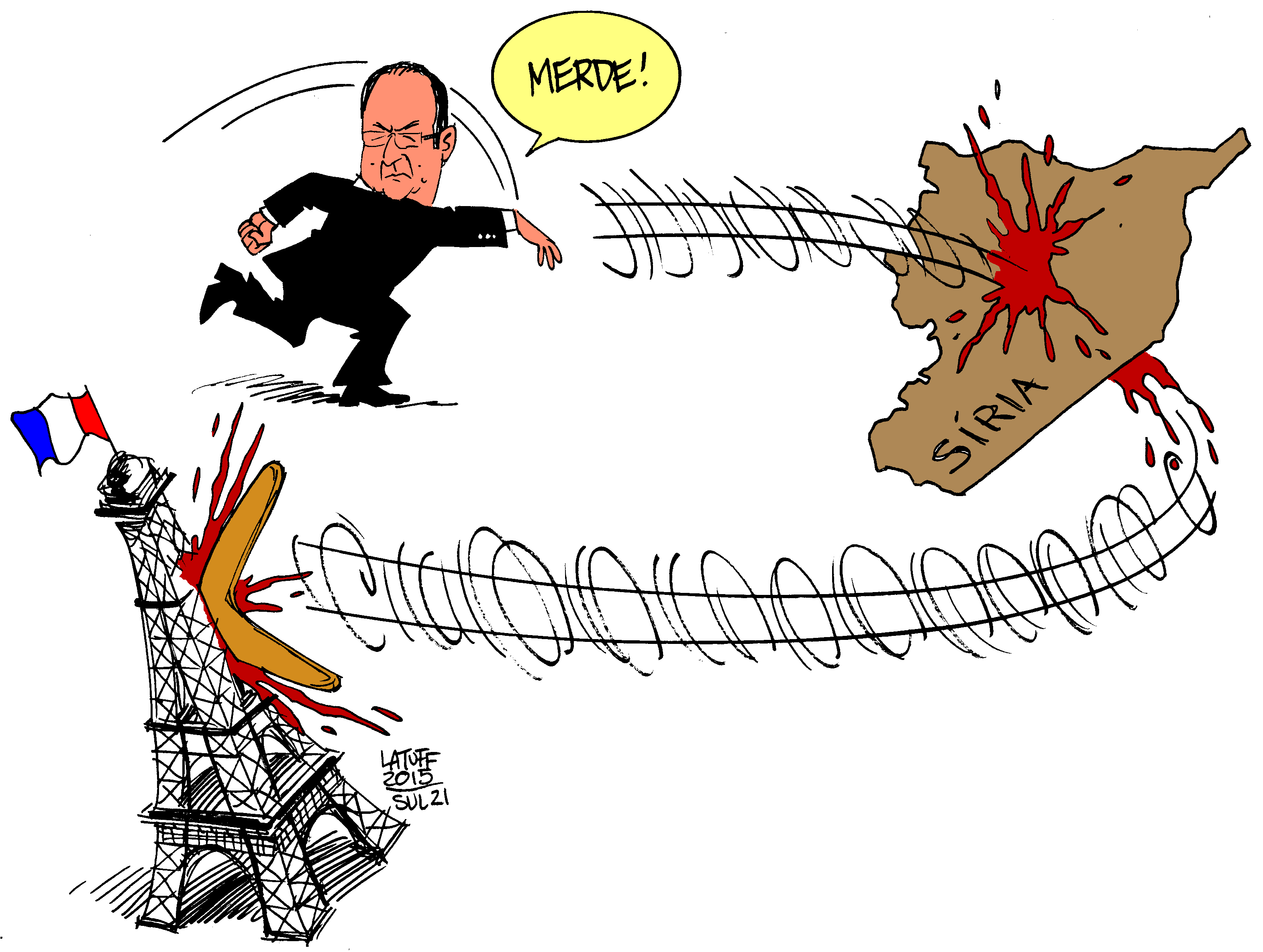
France’s commitment to counter-terrorism should be questioned outright. As the Atlantic observed, France retaliated against the infamous 2015 terror attacks in Paris by ramping up its military operations in Syria, despite the fact that the attacks could have been in response to a number of French military operations across the globe. The Atlantic states:
“It’s worth noting that the ISIS statement translated by SITE makes no explicit mention of Syria. The French military has been heavily involved in operations against Islamist militant groups outside of the Middle East over the last few years, including one group that has pledged fealty to Abu Bakr al-Baghdadi, the Islamic State’s self-proclaimed caliph. France has deployed 3,000 troops to West Africa—a region where they’ve historically had great influence, as a colonial power and otherwise—with a presence in Nigeria, Niger, Chad, Burkina Faso, Mali, and Ivory Coast. The fight in Mali has centered on al-Qaeda affiliated militants, but in Nigeria and surrounding countries, France has been the Western nation most invested in fighting against Boko Haram, the brutal Nigerian Islamist organization. Earlier this year, Boko Haram pledged allegiance to Baghdadi.” [emphasis added]
The Washington Post has therefore attributed France’s keen interest in influencing events in Syria as rooted in three key factors. First, the writers argue, France is attempting to reinforce itself as a great power. Second, France is offering an alternative foreign policy to that of the option of the United States military (though what this entails in practice is not clear). And lastly, France can enhance and strengthen ties with the anti-Assad Sunni nations in the Middle East, who also share “France’s deep distrust of Iran” (Syria’s closest ally).
Clearly, France has renewed its aggressively colonial stance in recent times. The importance of the global energy markets, as evidenced by France’s ulterior rationale to take out Gaddafi in Libya, cannot be understated. Syria presents a threat to French interests as an Iranian-dominated bridge between Russia and Europe would cut France out of this energy-rich area completely, something which was previously theirs prior to the end of World War II. By overthrowing Assad and creating a puppet government of France’s own (currently known as the Syrian National Council), France would be able to alleviate the economic threat an Iranian alliance poses to the anti-Assad interests in the region and assert itself as a colonial power in the heart of the Middle East, taking back what was once theirs.
As noted by anti-war Youtube channel Stormcloudsgathering:
“The West is in a state of decline. Their influence is waning. If the U.S. and their allies fail to remove Assad from power, what they will be faced with is more than just a strong Shia crescent [a reference to the Iranian dominated bridge of Iran-Iraq-Lebanon-Syria]. If they fail, they risk being edged out of the entire region and replaced by Russia. This would give Russia an enormous amount of leverage in global energy markets, and this of course has serious implications for the petrodollar.”
We would like to ask you to consider a small donation to help our team keep working. We accept no advertising and rely only on you, our readers, to keep us digging the truth on history, global politics and international relations.
ISIS is Born in IraqThe origins of ISIS are buried beneath the rubble of the US occupation.It was out of this crucible of war and invasion that the original grievances were born, leading analysts to conclude that "the basic causes of the birth of ISIS" were the United States' "destructive interventions in the Middle East and the war in Iraq."1The framework underlying this being the exacerbation of Sunni-Shia tensions in the aftermath of the invasion, which previously have been inflamed through various other foreign interferences. These were highlighted by the sectarian brutality of the post-invasion Iraqi government, which then continued ...
Over the past several years, analysts and commentators have noticed a rising tide of domestic support for the Croatian homegrown Nazi movement of the Second World War, the Ustashe, which actively exterminated Serbs, Jews, and Roma in the territory it controlled from 1941-45. Far from condemning this alarming development, the Croatian government, the European Union, and non-state actors within it have tacitly and actively supported the rising tide of sympathy towards the Ustashe.This disconnect between the ostensible “European values” of human rights and tolerance that the European Union claims to represent, and its tacit support of trends towards extremist politics ...
Hardly any knowledgeable person doubts that Zionist ideology is the purest form of racism. Zionism is Jewish disguised racism as a raison d’etat. Israel comes right after the U. S., as far as racism is concerned. That is why the U. S. donates to this racist regime $ 3.8 bn per year in order to keep this occupation regime going. Should anybody doubt the racism of the Israeli leadership, read the following article.[1]Racism among the Israeli leadership is legendary. It started out with the founder of Zionism, Theodor Herzl, saying: “Spirit the penniless population across the frontier by denying it ...
Right now the US mainstream media is obsessing over Donald’s alleged womanizing and female groping soap opera as the Clinton’s/MSM’s pruriently entertaining smokescreen, neatly designed to cover up Hillary/Bill’s serial raping and her criminal lead role as enabler/strong armed intimidator of past victims.Meanwhile, barely noticed in a virtual media blackout in the West are at least a half dozen high alert, significant international developments this last weekend that all strongly indicate the extreme danger of a nuclear war breaking out at any time against Russia and its Eastern alliance. Again, do not pay attention to the US deceivers behind their Oz-like curtain ...
Article by Vladislav B. Sotirović: „A New Age of Global Security: The ‚Ukrainian Question‘ and ‚Kosovo Precedent‘“, Vojno delo (Military affairs), Interdisciplinary Scientific Theoretical Journal, International Edition, Vol. 69, Issue 4, 2017 (May-June 2017), ISSN 0042-8426, Ministry of Defence of the Republic of Serbia, Belgrade, Serbia, pp. 176−211.Origins of images: Facebook, Twitter, Wikimedia, Wikipedia, Flickr, Google, Imageinjection, Public Domain & Pinterest.Read our Disclaimer/Legal Statement!Donate to Support UsWe would like to ask you to consider a small donation to help our team keep working. We accept no advertising and rely only on you, our readers, to keep us digging the truth ...
2006-Present07 February 2018: Israel advances a plan to build a walkway though the Mount of Olives in East Jerusalem to connect two settler residential compounds in the Palestinian At-Tur neighbourhood07 February 2018: During a Knesset report on the policy of refusing to return the bodies of Palestinians killed by Israeli forces to their families for burial, officials are urged to ‘throw it into the sea’, ‘we should not return bodies. We should demolish homes’, others say05 February 2018: A number of Israeli politicians, including coalition government members, call for ‘practical moves’ to be taken to annex settlements in the occupied West Bank while Donald ...
IntroductionThe last open armed conflict in the Former Yugoslav Republic of Macedonia – FYROM (former Socialist Republic of Macedonia as one of six federal republics of the Socialist Federal Republic of Yugoslavia) in May 2015 was just an expected continuation of constant tensions between the ethnic Albanians and the Macedonian Slavs during the last quarter of a century.[i] However, these tensions are time to time transformed into the open armed conflicts of the Albanian extremists, usually coming from Kosovo, with the Macedonian security forces.The most notable conflict incidents in Macedonia after the Kosovo War in 1998−1999, when the Kosovo Albanians ...
One sharp and interesting analysis of situation in Serbian province of Kosovo Metohija came last week from Andrew Korybko, program host at Radio Sputnik.Mr. Korybko speaks on how the whirlwind of geopolitics, military interests and global giants of business, as well as the change of US administration, could impact the fragile peace in Balkans and what’s behind the latest tensions:”Serbia’s NATO-occupied province of Kosovo has been up to its old tricks lately in trying to provoke Belgrade into another military confrontation conveniently timed to coincide with Trump’s inauguration.The former so-called “Prime Minister” of Kosovo, Ramush Haradinaj, was detained in France ...
From Libya and Egypt to Syria and Yemen, the Middle East North Africa (MENA) region is undergoing unprecedented tumult and chaos. To understand the current breakdown of states and society, examining the so-called Arab Spring of 2011 that laid the groundwork for this ongoing regional anarchy is indispensable. Global Research brings to the attention of its readers the newly released book by Christopher L. Brennan. Fall of the Arab Spring: From Revolution to Destruction (available here), propounds an incisive and timely analysis. The book views this widespread Arab upheaval, not as authentic grass roots movements for democracy, but as a US-engineered destabilization. Below are ...
Despite the lack of evidence linking Orlando mass murderer Omar Mateen to Daesh (ISIS) in any operational (direct) sense, the first inclination of U.S. Presidential hopeful Hillary Clinton was to renew American bombing of Syria, Iraq and Libya— the very nations that were destroyed by U.S. bombs directed by Mrs. Clinton and from whence Daesh arose. In so doing Mrs. Clinton made it evident that she is an unrepentant militarist whose bloodlust, combined with her longstanding interest in promoting American business interests, ties her to the U.S. imperial project of the last century and one-half. The precise moral difference between ...
Ukraine has a complex historical background and most people have little knowledge of this. The western part of Ukraine known as Galicia has an especially complex history. Going back for more than a thousand years, this region had been settled by Slavic tribes who formed the western extension of the Kievan Rus. To the west it had Polish, Lithuanian, Hungarian and Austrian neighbours. And to its misfortune, these neighbours took turns attacking and subjugating these early Ukrainians. It was largely Poland and Austria that took turns suppressing and occupying the region, economically and culturally. Because of this, although Galicia’s population ...
Real Semites are the Palestinians. Current Zionists Israelis genetically are not the Semites.They are the real anti Semitic people. Please world stop those anti Semitic warmongers Israeli Zionists!Origins of images: Facebook, Twitter, Wikimedia, Wikipedia, Flickr, Google, Imageinjection, Public Domain & Pinterest.Read our Disclaimer/Legal Statement!Donate to Support UsWe would like to ask you to consider a small donation to help our team keep working. We accept no advertising and rely only on you, our readers, to keep us digging the truth on history, global politics and international relations.[wpedon id="4696" align="left"]SaveSaveSaveSave
After the first ever cabinet meeting in the Golan Heights, Israeli Prime minister Benjamin Netanyahu said in a speech on April 17, 2016 that the territory “will remain under Israel’s sovereignty permanently.” This elicited admonitions from some of Israel’s greatest allies, the United States and Germany, and renewed attention on the issue.The Golan Heights were opportunistically occupied by Israel after its victory in the 1967 six-day-war. A United Nations Disengagement Observer Force (UNDOF) has monitored the region since 1974, when Israel and Syria signed a ceasefire agreement, and it has been considered an occupied territory of the UN and the ...
In a shocking display of relative independence from the post-Operation Mockingbird control of the media by the Central Intelligence Agency, a recent article in The New York Times broke with current conventional pack journalism and covered the long history of CIA meddling in foreign elections. A February 17, 2018, article, titled, "Russia Isn’t the Only One Meddling in Elections. We Do It, Too," authored by Scott Shane – who covered the perestroika and glasnost for The Baltimore Sun in Moscow from 1988 to 1991 during the final few years of the Soviet Union – reported the US has interfered in foreign elections for decades. However, ...
While the numbers are not as high as Auschwitz or Treblinka, Jasenovac was notorious for its cruelty and the high number of young children who were victims.April 22 is a date that binds two groups of people who shared the same tragic fate. It is the date that commemorates the revolt of the prisoners of Jasenovac, the death camp that claimed the lives of hundreds of thousands of Jews, Serbs and Roma.While the numbers are not as high as Auschwitz or Treblinka, Jasenovac was notorious for its cruelty and the high number of young children who were victims. The saddest ...
What does it mean when the US and British financial systems launder hundreds of billions of dollars of illicit funds stolen by world leaders while their governments turn a ‘blind eye’, and yet the very same Anglo-American officials investigate, prosecute, fine and arrest officials from rival governments, rival banks and political leaders for corruption?What does it mean when the US government expands a world-wide network of nuclear missiles on bases stretching from Poland, Bulgaria, Romania, the Gulf States to Japan, surrounding Russia, Iran and China, while the very same US and NATO officials investigate and condemn rival defense officials from Russia, China ...
A map of the wanted territories of the Balkan states in 1915There are many talks about nationalism among the peoples from the former Yugoslavia during the last three decades what is quite understandable taking into consideration the post-Cold War conflicts and atrocities, as a continuation of WWII crimes based on certain political ideologies,[i] committed on the territory of ex-Yugoslavia.Historia est magistra vitaeI want to argue that there is a direct link between contemporary nationalism(s) among the Yugoslavs and their national ideologies, which are developed in the previous decades and even centuries. What happened with the Yugoslavs from 1991 to 1999 ...
When it comes to a few key indicators, Ireland, the UK, Canada and even Albania and Greece are surpassing America.America is declining, in large and important measures, yet policymakers aren’t paying attention. So argues a new academic paper, pulling together previously published data.Consider this:America’s child poverty levels are worse than in any developed country anywhere, including Greece, devastated by a euro crisis, and eastern European nations such as Poland, Lithuania and Estonia.Median adult wealth in the US ($39,000) is 27th globally, putting it behind Cyprus, Taiwan, and Ireland.Even when “life satisfaction” is measured, America ranks #12, behind Israel, Sweden and ...
Preface The European Union (the EU) is characterized by a purposeful diffusion of political authority between supranational and intergovernmental institutions. Based on the idea of shared leadership, it relies on a delicate institutional balance guarding declared equality between its ever more diverse members and managing potential and real tensions between the more and less populated states. Such tensions are present in any federal construct and have been a key concern since the ‘original six’ founded the (West) European Coal and Steel Community (the ECSC) in 1951 (the Benelux, West Germany, France, and Italy).The formal facts and official EU’s propaganda about ...
In Kukavica village near Rogatica (nowadays Bosnia and Herzegovina), today was marked 27 years since crimes against Serbian civilians committed by Bosnian Muslims, members of the so-called Army of Bosnia and Herzegovina on August 27, 1992.In an attack on a column of Serbian civilians, involving about 1,000 elderly people, women and children on tractors and passenger vehicles, Bosnian Muslim extremists killed 26 and injured 80 Serbs.Rogatica Mayor Milorad Jagodic called this a monstrous crime as among the victims are a child of 11 and 82 years old man.“This was a column of innocent people who were looking for refuge and ...