
Views: 2582
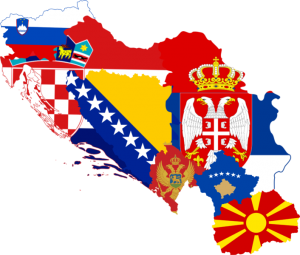
The internal and much more external destruction of the former Yugoslavia in the 1990s was celebrating in 2015 its 20th year of anniversary. However, this historical and much more geopolitical event still needs a satisfactory research approach in regard to the true geopolitical reasons and political-military course of the destruction of this South Slavic and Balkan state. During the last quarter of century, the (western) global mainstream media unanimously accused Serbia and the Serbs of the national chauvinism as the main cause of the bloody wars on the territory of ex-Yugoslavia in the 1990s. However, the role and direct impact of the other Yugoslav republics and nations in the process of killing the common state was not taken (purposely) into consideration; especially of the Croats and Croatia as the biggest nation and republic after the Serbs and Serbia. This article is an attempt to contribute to the full-scale of understanding of the process of destruction of the former Yugoslavia taking into account the role of Croats and Croatia.
The Croat ultranationalists (i.e., the followers of the Ustashi movement) called in the 1990s for the full scale of Croatia’s militarization in to achieve their chauvinistic and racist political goals of the Croat-based ethnically pure independent (a Greater) Croatia. In their opinion, a full or complete political independence of the ethnically pure Croatia within the borders of the Socialist Republic of (a Greater) Croatia could be reached only by the open war against Croatia’s Serbs and the Yugoslav authorities, but not negotiating with them. In this respect, a leader of the most ultranationalist political party in Croatia – the HSP (the Croat Party of Rights), Ante Đapić, was clear in his statements to abandon the political activity if a single part of the territory of Croatia is going to be lost by the negotiations with the Serbs.[1] The WWII Ustashi (Nazi) movement followers openly advocated in the 1990s a full scale of the war against “the Serb aggressors” for the sake to gain Croatia’s independence. That was done at least for two crucial reasons:
-
They believe that a struggling for the Croat nation’s ethnopolitical goals was a legitimate framework of both a beating the Serb nationalism and fulfilling the Croat historical task of creation of the Greater Roman Catholic Croatia without the Orthodox infidels.
-
They sponsored the attitude that the Serbs cannot be trusted as a nation to negotiate with them about the peaceful agreement on the disputed issues with the Croatia’s Government and therefore the war was the only way to pacify the Serbs from Croatia according to the pattern of the pacification (i.e., the ethnic cleansing) of the Palestinians in Israel.[2]
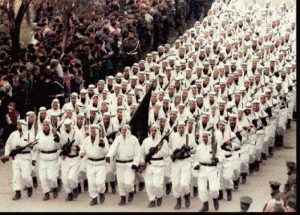
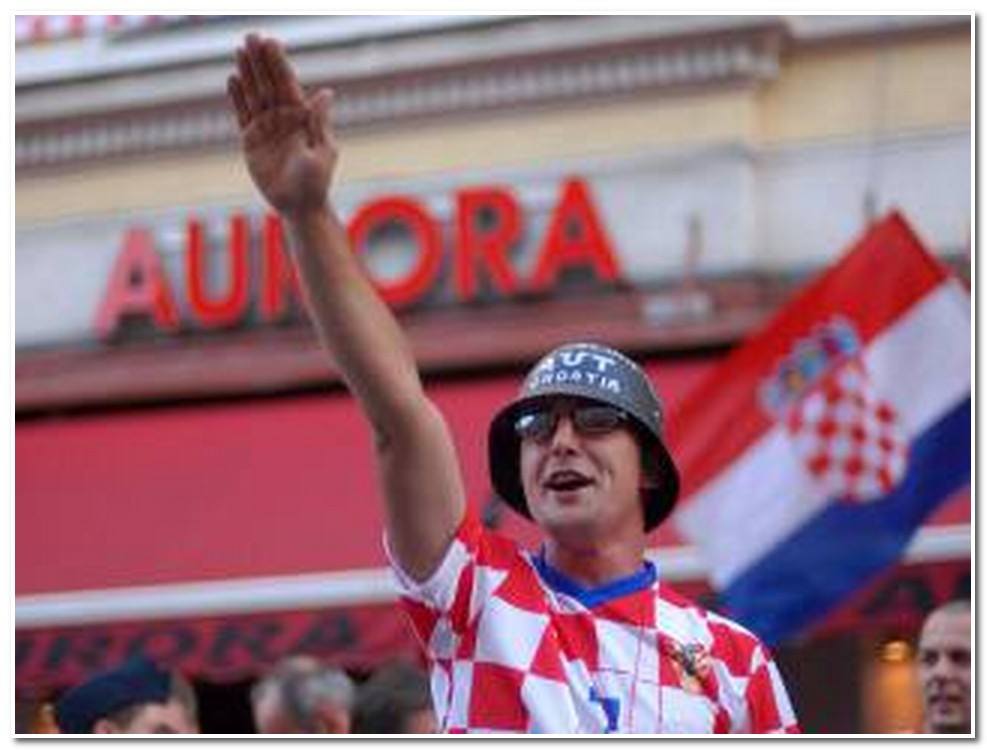
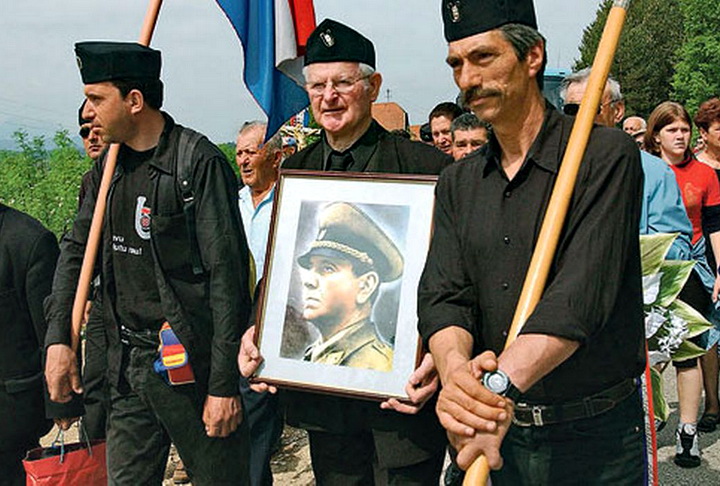
Henceforth, the “Israelization” of a Greater Croatia became the ultimate goal of the Croat ultranationalists in their policy to Croatia’s Serbs. In order to achieve their “Israelization” political goals, the Ustashi followers in the HDZ’s (the Croat Democratic Union) governed Croatia followed exactly the militarization pattern of the ethnic Croat society in the WWII Independent State of Croatia. Therefore, the most ultranationalist Ustashi political party in the 1990s Croatia – the HSP, established its own ruthless paramilitary party’s militia in 1991 under the name of the Croat Defense Forces (the HOS) with using all kinds of the WWII Ustashi regime insignia followed by several similar militia detachments by other Croat ultranationalist organizations. The Croatian state army (the HV) was, nevertheless, during the 1990s under direct influence and control by the most extremist wing of the ruling HDZ that successfully cooperated with the HOS and the other Croat paramilitaries in the West Herzegovina and the North and Central Bosnia in the military actions of ethnic cleansing of the Orthodox Serbs and the Muslim Bosniaks.[3]
The eminent militarization of the ethnic Croat society in the 1990s was in direct coordination with the fundamental task of all Croatia’s Croat ultranationalists that all other rights and duties of the society have to be put in the service of the state interests. As all ultranationalist segments of the ethnic Croat society in Croatia fought for the independent pure ethnic Croat Croatia, the ultimate ethnopolitical goal of them was to mobilize all ethnic Croats for the execution of the “Final Solution” in regard to the “Serb Question” in a Greater Tito-Tuđman’s Croatia. Therefore, the authoritarian political system and government based on the absolute HDZ’s majority in the Parliament were necessary in order to achieve this goal. As an example, the experience of the Latin American dictatorships in the 1970s and the 1980s of a centralized political system, strong military-police forces, oppressed freedom of the mass media, and above all a silent opposition were activated. A parliamentary multi-party democracy became just a façade of a classical Latin American dictatorship[4] as a western parliamentary democracy[5] was understood as a harmful experiment for the realization of the Croat ethnopolitical goals primarily against the Serbs.
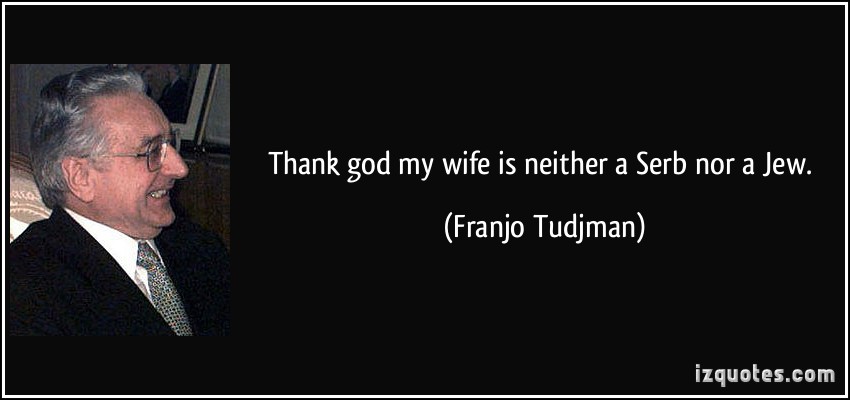
The alternative to the parliamentary democracy was only a one-party dictatorship that could save Croat national interests from the destructive nature of the parliamentarian democracy. Subsequently, in the 1990s it was established in Croatia an HDZ’s one-party political system with the strong cult of leadership of the President Dr. Franjo Tudjman, who was seen in the eyes of the right-wing political structures as a political reincarnation of the WWII NDH’s (the Independent State of Croatia) führer, Ante Pavelić. Tudjman, as an inviolable dictator of Croatia, was even proclaimed by some of the HDZ’s members and other right-wing followers as a “Father of the Homeland” like by Hrvoje Šošić who was a leader of the Croat Party (the HS) and a MP.[6] In essence, the Croat extremists only gave declarative support to the liberal democratic institutions while in the practice rejected them as the political framework within which the national goals are going to be reached. However, a formal support for the liberal democracy and its political institutions were of the very practical nature to present a newly independent Croatia as a western-type democratic political system in contrast to Milošević’s Serbia as an expression of the Balkan/Oriental autocracy. Hence, the HDZ’s Croatia pretended to present herself as a last bulwark of the European civilization and values in South-East Europe. Nevertheless, in the practice, the HDZ functioned in all ways that undermined a real democracy even to a greater extent than Milošević’s regime in Serbia at the same time. The extremist wing within the HDZ, including and Tudjman himself, openly used all kinds of mechanisms of political oppression against the opposition that was proclaimed as the enemy of the Croat nation and Croatia and collaborators with the Serbo-Chetnik aggressors. As in many cases of personal dictatorship, Tudjman as well saw himself as a personification of the state and state institutions. In other words, he attempted to equating his own personality with the survival of Croatia. As the opposition leaders and party’s members have been constantly under the physical intimidation as the „betrayers“ of Croatia it was created a very inhospitable political atmosphere for any sincere democratic talks and exchange of the views. Surely, Tudjman’s regime in Croatia was much more effective in silencing its own opposition than Milošević’s regime in Serbia. It is visible at least from the fact that in Tudjman’s Croatia there was no single mass-meeting of the opposition against the regime differently to Serbia under Milošević’s strong hands. The latter finally and lost power exactly after the mass-protests in Belgrade on October 5th, 2000 (the first „Colored Revolution“ in Europe).
 Tudjman’s authoritarian dictatorship was especially hostile towards the opposition press that was considered as a fifth column in Croatia. The opposition journalists were accused of irresponsible (miss)usage of their freedom of expression. As a matter of fighting against the opposition press, it was introduced a special (illegal) taxation of independent weeklies but primarily of the most anti-regime newspaper – the Feral Tribune from Split. During the election campaigns, the opposition parties were denied equal and full access to the state-controlled press and TV, likewise in Serbia, and therefore violating one of the fundamental elements and conditions of the parliamentary democracy. Hence, the electoral results theoretically were not fair what does not mean that a majority of the ethnic Croats from Croatia would not vote for the HDZ in the case of the fair electoral campaign. Similarly to all totalitarian regimes, the HDZ’s controlled Parliament passed a special law (in spring 1996) for „defamation“ against the state officials. However, such or similar law did not exist in Milošević’s Serbia. Tudjman’s personal efforts to make stronger his own political (authoritarian) position in Croatia at any cost of liberal democratic institutions are obvious and very similar to his counterpart in Serbia in the 1990s with one difference: Tudjman was more successful in destroying liberal democracy in Croatia in comparison to Milošević’s efforts to do the same in Serbia.
For the HDZ’s political leadership, „without Franjo Tudjman, there would be no HDZ and without the HDZ there would be no Croatia“.[7] It is clear that Tudjman’s party attempted to equate itself with the creation and survival of the post-Yugoslav Croatia while Tudjman himself attempted to personalize the institution of the presidency. Any opposition to himself or his political party was seen as the opposition to Croatia as the state and the Croats as the nation that is probably most visible from the fact that Tudjman as a President of Croatia refused to ratify electoral results for the Zagreb municipality’s mayor in 1995 as the opposition leader won under the excuse that Croatia’s capital cannot be in the hands of the enemies of Croatia.
As a part of the anti-liberal policy, the liberal-democratic notion of citizenship was crucially challenged by the HDZ’s ruling authority as the voting rights for the state and the other public officials became based on the ethnic (Croat) background rather than on the residence criteria. Therefore, it was practically reserved twelve seats in Croatia’s Parliament for the ethic Croat diaspora for the very reason that the HDZ was and is traditionally supported by the Croat diaspora, especially from Bosnia-Herzegovina. The citizenship law was also changed in the favor of the ethnic Croat diaspora as Croatia was proclaimed as the motherland of all ethnic Croats.[8] However, a similar ethnocitizenship/voting law in Milošević’s Serbia was never introduced at least for the very political reason that the Serb diaspora in the West opposed his policy as anti-Serbian. In other words, Milošević’s Serbia was seen, by the Constitution, as a homeland of all her inhabitants, rather than only of all ethic Serbs wherever they live.
Probably, the HDZ’s deny of any kind of regional autonomy in Croatia was the expression of the policy of the anti-liberal democracy concept of minority rights. Therefore, the regional parties of Istria, the Serbian Krayina, and Dalmatia suffered mostly from such a policy of a brutal centralization of Croatia. However, in Milošević’s Serbia, two regions of Vojvodina and Kosovo-Metochia enjoyed at least ethnocultural regional autonomy if not political one as it was fixed in the time of the Socialist Federal Republic of Yugoslavia according to the 1974 Constitution (up to 1989).

Prof. Dr. Vladislav B. Sotirovic
www.global-politics.eu/sotirovic
sotirovic@global-politics.eu
© Vladislav B. Sotirovic 2016
___________________________________
[1] Interview with Ante Đapić (July 13th, 1994), J. A. Irvine, “Ultranationalist Ideology and State-Building in Croatia, 1990−1996”, Problems of Post-Communism, July/August 1997, pp. 36, 42; Glas Slavonije, Osijek, August 18th, 1995.
[2] Interview with Ante Đapić (July 13th, 1994), J. A. Irvine, “Ultranationalist Ideology and State-Building in Croatia, 1990−1996”, Problems of Post-Communism, July/August 1997, pp. 36, 42. On the ethnic cleansing of Palestine by the Israeli Jewish authorities, see: I. Pappe, The Ethnic Cleansing of Palestine, Oxford: Oneworld, 2011.
[3] For instance, in the case of the village of Ahmići in the Lašva Valley (the Vitez municipality) on April 16th, 1993 when around 120 Bosniaks were massacred by the forces of the Croat Defense Council (Ch. R. Shrader, The Muslim-Croat Civil War in Central Bosnia: A Military History, 1992−1994, College Station, Tex., 2003, 92−95).
[4] On the Latin American dictatorships, see: S. Mainwaring, A. Pérez-Liñán, Democracies and Dictatorships in Latin America: Emergence, Survival, and Fall, New York: Cambridge University Press, 2013; J. Dávila, Dictatorship in South America, Chichester: Wiley−Blackwell, 2013; J. A. Galván, Latin American Dictators of the 20th century: The Lives and Regimes of 15 Rulers, Jefferson, NC−London: McFarland & Company, Inc., Publishers, 2013.
[5] On democracy, see: B. Crick, Democracy: A Very Short Introduction, Oxford−New York: Oxford University Press, 2002; Ch. Tilly, Democracy, Cambridge−New York: Cambridge University Press, 2007; J. B. Pilet, W. P. Cross (eds.), The Selection of Political Party Leaders in Contemporary Parliamentary Democracies: A Comparative Study, New York: Routledge, 2014.
[6] According to Tanjug, May 21, 1995.
[7] Novi list, October 15th, 1995.
[8] On the concept of citizenship, see: W. Kymlicka, Multicultural Citizenship: A Liberal Theory of Minority Rights, Oxford−New York: Oxford University Press, 1995; R. Bellamy, Citizenship: A Very Short Introduction, Oxford−New York: Oxford University Press, 2008; É. Balibar, Citizenship, Cambridge, UK−Malden, USA: Polity Press, 2015. The same citizenship concept, for example, is accepted by all three Baltic states after the collapse of the Soviet Union: Estonia, Latvia, and Lithuania.
Origins of images: Facebook, Twitter, Wikimedia, Wikipedia, Flickr, Google, Imageinjection, Public Domain & Pinterest.
Read our Disclaimer/Legal Statement!
Donate to Support Us
We would like to ask you to consider a small donation to help our team keep working. We accept no advertising and rely only on you, our readers, to keep us digging the truth on history, global politics and international relations.
[wpedon id=”4696″ align=”left”]