
“The American War in Vietnam: Crime or Commemoration?” [Review of John Marciano’s Book]
Above all, we need to remember that the crimes of other governments are the responsibility of the people of those governments—not of our bombs. Though our elite have abrogated to themselves the power and the right to remake the map of the world by force, we need to reassert the legal principle of non-intervention in the internal affairs of a sovereign states if we are serious about peace [...]
In classical mythology, the Acheron is one of the rivers of the Underworld. It marks the boundary between the living and the dead. The ferryman Charon ferries the dead across the Acheron to a place where they lose memory. Nothing of what made them human remains—happiness, suffering, love, hatred, guilt, regret, redemption, betrayal, forgiveness.
From Gilgamesh to Odysseus to Aeneas, the living heroes of the epic descend into the Underworld at a point of despair in the sense of their quest. Burdened by a fate that requires momentous courage and tragic self-sacrifice for the sake of their people’s survival, they resent the absurdity of their lot. Down there on a visit, they return from the shadow land strengthened. They recognize that the business of living is not oblivion but action.
John Marciano’s recently published book, The American War in Vietnam: Crime or Commemoration? functions as such a Charon in reverse. It ferries readers back to the realm of remembering. This slim volume could not have come at a more opportune moment. American political culture is punch-drunk with the pursuit of war. The altered state is reaching the point of delirium tremens. Thwarted in the neocolonial scheme of annexing Syria by Russia’s legal intervention, the American elite are pushing for confrontation. Though it is hard to think the unthinkable, the nuclear holocaust may happen if not by intention then by spontaneous combustion from over-intoxication with the fumes of war.
This reckless confrontation results from decades of accumulated unaccountable power. Its boldness reflects a cumulative experience of impunity for aggressive behavior by soft and hard neocolonial postures since the end of WW II. The war in Vietnam, as Marciano suggests, should have functioned as the lesson that checked the nation’s historical thrust for conquest, but the turning point would have required a national effort to relinquish the myth of the Noble Cause, the delusion that America is vested with a divine mandate to assimilate the people of the world to the American image–for the people’s own good. Britain had its White Man’s Burden; France its mission civilatrise; America its Manifest Destiny.
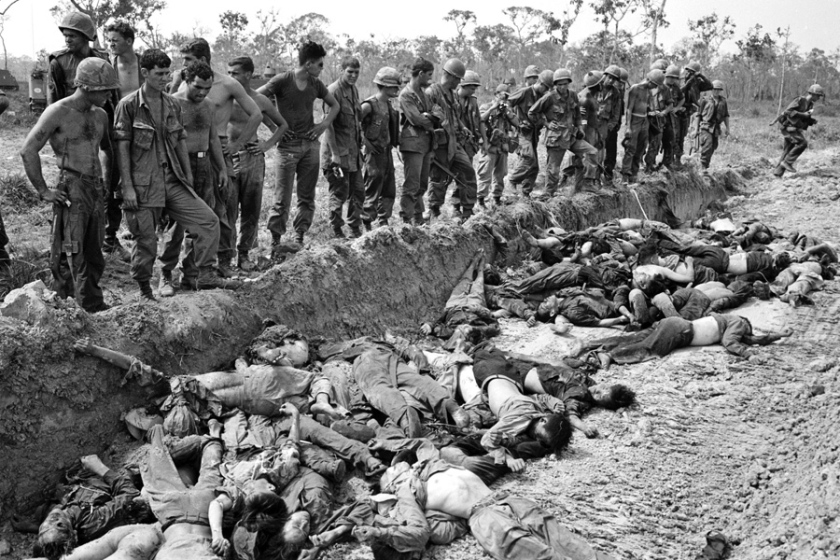
This timely volume traces the war to the apocalyptic finale of the most powerful military in the world defeated by the determination, courage, and self-sacrifice of a peasant people unwilling to be enslaved. But this is as much a book about the past as it is about the present. It reminds us, with Tolstoy, “The reality of war is in the killing, “ a realization officialdom would like to block. In fact, they have prepared a falsifying celebration of that moral and military debacle.
As Marciano writes in his introduction,
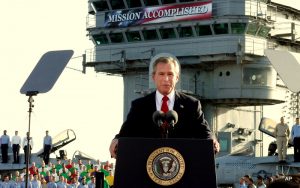
In May 2012, President Barack Obama and the Pentagon announced a Commemoration of the Vietnam War to continue through 2025, the fiftieth anniversary of the conflict’s end. Among the Commemoration’s objectives, three stand out: ‘to thank and honor’ veterans and their families . . . ‘to highlight the advances in technology, science, and medicine related to military research conducted during’ the war; and to ‘recognize the contributions and sacrifices made by the allies’.
President Obama claimed in the commemoration announcement speech that the war had been “an honorable cause.” Marciano challenges this notion. America’s historic ideology of the Noble Cause, he writes, rests on the belief that the United States is
A unique force for good in the world, superior not only in its military and economic power, but in the quality of its government and institutions, the character and morality of its people, and its way of life.
This is the mystical bigotry of a messianic faith typical of empires. Imperial militarism seeks in a Noble Cause the justification for subjugating large chunks of humanity. In the distant past, the Noble Cause may have received the sword directly from a god—as it did in postcolonial America when it sought to exterminate the native inhabitants. By the anointment of the sword, the divinity also endowed, supposedly, the conquering “race” with moral superiority. Thus, imperialism, in the perverse arrogance of its twisted psyche, contains the germ of genocide. As a result, the superstition of a superior “race” has been endured by most of the “races” on the planet as a most Ignoble Cause. In Vietnam alone, the Big Lie of the Noble Cause sent four million Vietnamese to their death.
Marciano leaves us in no doubt that the White House and the Pentagon are commemorating a crime. They are falsifying history in order to shape the future, which will be and is the reenactment of the war against Vietnam on a global scale. They want to establish the altar for a “sacred union,” the nation united behind the Noble Cause of war. On the altar will sit the fetish of the export of the “miracle of democracy, ” in reality the imposition of regimes of terror such as the Vietnam War planners established in Saigon. We see today in Ukraine that the “miracle of democracy,” brought to Kiev by the US in 2014 to the tune of five billion dollars, amounts to a handful of dry dust, collected from the WW II graveyard of European Nazism, inciting a lot of blind, anti-democratic and noxious nationalism.
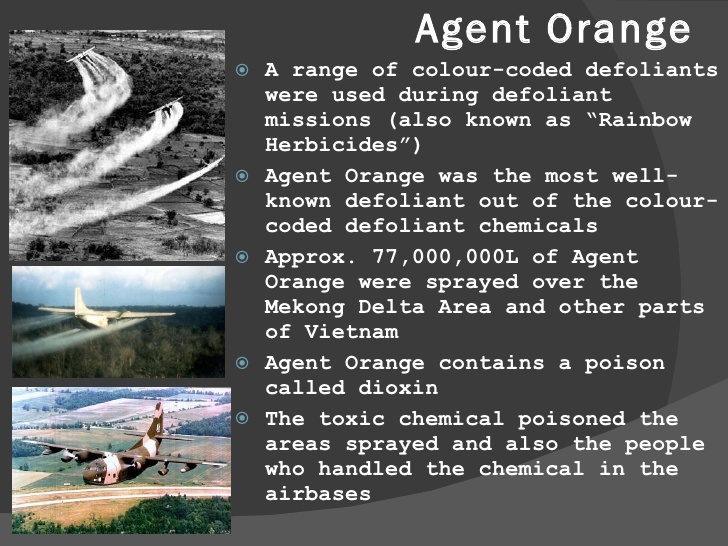
As through a glass darkly, Marciano shows us that in the war crime against Vietnam we can see reflected the crimes perpetrated today from Afghanistan to Yemen, from Iraq to Syria, from Yugoslavia to Libya and across the African continent. As in Vietnam (the fakery of the Gulf of Tonkin incident), today’s war are based on fabricated pretexts; as in Vietnam (napalm and agent orange), today’s wars are chemical wars (depleted uranium for Yugoslavia and Iraq; phosphorus for Falluja); as in Vietnam (Hanoi and Haiphong) the bombings destroy urban life, vital infrastructure, schools and hospitals; as in Vietnam (Laos, Cambodia) the bombings spreads out (today to Yemen); as in Vietnam (Ho Chi Minh) the leaders who resist US penetration are demonized (Milosevic, Saddam, Qaddafi, Assad) as enemies of humanity. As in Vietnam, all the wars of today are fought mostly to prevent or reverse independence and self-determination of former colonial places.
Finally, as in Vietnam the USSR, today’s Russia is emerging as the displacement of all the guilt that weighs on the shoulders of the Noble Cause. The Washington Post recently wrote “the Kremlin annexed Ukraine.” I read it twice—not “annexed Crimea,” the standard disinformation, but the whole of Ukraine! Does one laugh or weep? Does one have to take a hallucinogenic to see Russian flags and images of Putin blanketing Kiev instead of Neo-Nazi emblems and images of Bandera?
The next president will certainly be Hillary Clinton, whom I call “the centripetal president.” From Republicans to Democrats to Neo-Cons, all converge on endorsing the war candidate. In her consensus war regime, the elite will decide everything. We will not be consulted. This is why The American War in Vietnam: Crime or Commemoration? is a vital read. It calls for our re-democratization–to question our leaders, to be skeptical of the media, to avert our eyes from the petrifying stare of the Medusa decked with the aegis of the Noble Cause; to challenge—even ridicule– the vaunted humanitarianism of an elite of bloodhounds baying for war; to refuse to commemorate war crimes and to work to stop them.
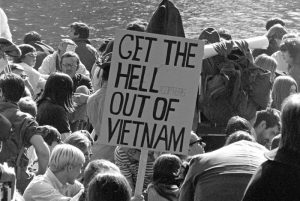
Above all, we need to remember that the crimes of other governments are the responsibility of the people of those governments—not of our bombs. Though our elite have abrogated to themselves the power and the right to remake the map of the world by force, we need to reassert the legal principle of non-intervention in the internal affairs of a sovereign states if we are serious about peace. We, citizens, do not have the right (or the power, unless we line up behind the power of the militarist state) to change the practices of other states, but we do have the right to demand change for those of our own. Let’s start exercising that right. We did for Vietnam; we can do it again. Commemorate the people who protested the war in Vietnam, not the crime the governing elite committed there in our name, as Marciano’s book amply documents.
The US government is now engaged in waging eight wars. We better get busy.
About the author: Luciana Bohne is co-founder of Film Criticism, a journal of cinema studies, and teaches at Edinboro University in Pennsylvania. She can be reached at: lbohne@edinboro.edu
Origins of images: Facebook, Twitter, Wikimedia, Wikipedia, Flickr, Google, Imageinjection, Public Domain & Pinterest.
Read our Disclaimer/Legal Statement!
Donate to Support Us
We would like to ask you to consider a small donation to help our team keep working. We accept no advertising and rely only on you, our readers, to keep us digging the truth on history, global politics, and international relations.
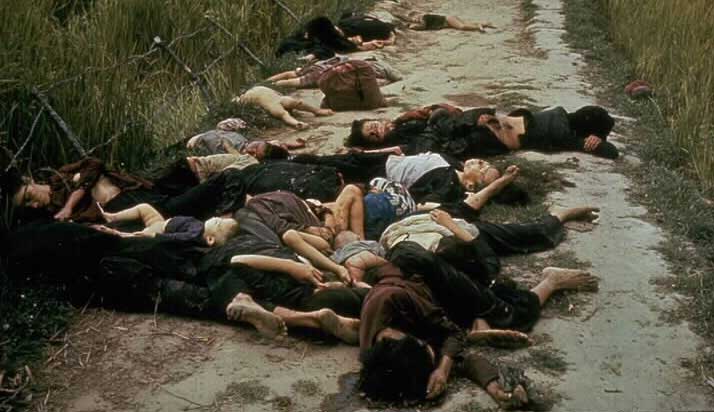
Daniel Goldhagen blamed the Holocaust on «the Germans» (by which he meant the German people), and said that they perpetrated the Holocaust because they positively enjoyed murdering «the Jews». But, as has long been well understood by historians (except when they fail to point to it as being a disproof of Goldhagen’s bigoted and indefensible anti-German thesis), Hitler had to work long and hard in order to bring about a consensus, first amongst his own leadership group, and then in the population as a whole, favoring the extermination-option. Hitler, Der Fuehrer, «The Leader», clearly was the catalyst turning the chemical ...
Kosovo is to set up a regular standing army, officially defying everyone, including NATO, although the bloc’s objections are only half-hearted. The alliance would prefer that the illegal entity of Kosovo change its constitution in order to create an army. Just amend it, and then you’re free to have one. This stance looks more like connivance than any real opposition to the move.Washington’s position is more or less the same. It supports "the gradual, transparent transformation of the Kosovo Security Force into a multiethnic force in line with NATO standards" as long as it complies with the provisions of Kosovo’s constitution, reflecting that “entity’s multiethnic ...
Both before and after Crimea left Ukraine and joined Russia in a public referendum on 16 March 2014, the Gallup Organization polled Crimeans on behalf of the U.S. Government, and found them to be extremely pro-Russian and anti-American, and also anti-Ukrainian. (Neither poll was subsequently publicized, because the results of each were the opposite of what the sponsor had wished.) Both polls were done on behalf of the U.S. Government, in order to find Crimeans’ attitudes toward the United States and toward Russia, and also toward Ukraine, not only before but also after the planned U.S. coup in Ukraine, which occurred ...
In examining the future, we must look to the past.As we watch the media today, we are spoon fed more and more propaganda and fear of the unknown, that we should be afraid of the unknown and have full faith that our government is keeping us safe from the unknown. But by looking at media today, those of us who are old enough will be reminded of the era of Cold War news articles, hysteria of how the Russians would invade and how we should duck and cover under tables in our kitchens for the ensuing nuclear war.Under this mass ...
The US President Donald Trump is no doubt a successful businessman who rules his country as if it is a huge enterprise. And this kind of management, to his mind, should lead to success. And very often it really works. As a wise leader he uses different tools to reach his goals. Thus, the most cunning one, which the US exploits in Europe – is indirect influence on the EU countries to gain the desired aim. The EU just becomes a tool in “capable hands” of the US.Let us give the simple example. Last week the Ministry of National Defence ...
The declaration of a new military alliance between Australia, the United Kingdom and United States – AUKUS – is a declaration of war intent towards China. The touchstone that is the tell of this aggression is the supply of nuclear-powered submarines to Australia by the U.S. and Britain.Only a few days after announcing this new Indo-Pacific military alliance, U.S. President Joe Biden was this week addressing the UN General Assembly issuing a solemn appeal, among other things, to “save the planet” from adverse climate change. The complacency and hypocritical double-think are astounding. Biden is afforded a platform and respect at ...
The U.S. Has Only Been At Peace For 21 Years Total Since Its BirthIn 2011, Danios wrote:Below, I have reproduced a year-by-year timeline of America’s wars, which reveals something quite interesting: since the United States was founded in 1776, she has been at war during 214 out of her 235 calendar years of existence. In other words, there were only 21 calendar years in which the U.S. did not wage any wars.To put this in perspective:* Pick any year since 1776 and there is about a 91% chance that America was involved in some war during that calendar year.* No U.S. president truly qualifies as a ...
When I saw the media in Serbia reporting about Donald Trump’s alleged condemnation of the 1999 NATO attack on then-Yugoslavia, also known as the Kosovo War, I shrugged it off as disinformation. Most of them, I’m sad to say, are almost entirely dedicated to gaslighting the general populace, and as likely to spread confusion and cognitive dissonance as actual news.It turns out that Donald Trump did talk to Larry King about Kosovo – but everyone is leaving out that this took place in October 1999. That is sort of important, though: by that point, the Serbian province had been “liberated” ...
“Russia Wants to Undermine Faith in the U.S. Election. Don’t Fall For It.” Thus reads the cover of Time magazine with a photo of Vladimir Putin on the cover staring at me from shelves as I sit in an airport. Genuinely curious, I check out Massimo Calabresi’s article online.Of course, U.S. elections are almost completely unverifiable and do not even pretend to meet international standards. Jimmy Carter doesn’t even try to monitor them because there’s no way to do it. Much voting is done on machines that simply must be trusted on faith. Whether they accurately count the votes entered ...
Turkish-US relations have faced many serious stress tests over the past 50 years. The catalyst in overcoming those crises was making strategic considerations, which always underlined the dependence of the two NATO allies on each other, regardless of their differences.These strategic considerations appear to be weakening now, as the regional priorities of President Recep Tayyip Erdogan’s Turkey and the United States no longer overlap, and in many cases conflict with each other.That is certainly the case in Syria, where the two countries are at odds over Washington’s alliance with Syrian Kurdish groups against the Islamic State (IS). Ankara insists these groups are ...
The United States is immersed in a political St. Vitus’s dance typical of empires in convulsion. The confident colossus that watched its arch-rival disintegrate from 1989-1991 now has its highest office occupied by a malevolent clown enabled by supporters befitting a casting call for a Hieronymous Bosch panel. The liberal class gnashes its teeth and blames Trump, the Koch brothers, the Tea Party. But the shock is hardly credible. The current political trap befits a country that internalized its own Cold War propaganda campaign from 1945-1991. The unrelenting flow of messages aimed at keeping Americans fearful and accommodating debased our ...
Preface The European Union (the EU) is characterized by a purposeful diffusion of political authority between supranational and intergovernmental institutions. Based on the idea of shared leadership, it relies on a delicate institutional balance guarding declared equality between its ever more diverse members and managing potential and real tensions between the more and less populated states. Such tensions are present in any federal construct and have been a key concern since the ‘original six’ founded the (West) European Coal and Steel Community (the ECSC) in 1951 (the Benelux, West Germany, France, and Italy).The formal facts and official EU’s propaganda about ...
“A battle lost or won is easily described, understood, and appreciated, but the moral growth of a great nation requires reflection, as well as observation, to appreciate it”. – Frederick Douglass (former slave who would later become a great American statesman and diplomat)It has always been an utmost necessity to exercise caution when reading the historical accounts of great periods that threatened to change the course of the world. As is widely recognised though not reflected upon enough, ‘history is written by the victors’, and if this be indeed the truth, than we must be aware of what lens we ...
The first panacea for a mismanaged nation is inflation of the currency; the second is war. Both bring a temporary prosperity; both bring a permanent ruin. But both are the refuge of political and economic opportunists — Ernest HemingwayMilitary spending is the second largest item in the US federal budget after Social Security. It has a habit of increasing significantly each year, and the proposed 2019 defense budget is $886 billion (roughly double what it was in 2003).US military spending exceeds the total of the next ten largest countries combined. Although the US government acknowledges 682 military bases in 63 countries, ...
INTRODUCTIONThe case that will be documented here is that Venezuela’s people are suffering from a tragic national situation which actually cannot be reversed by anything that’s within the power of Venezuela’s Government to do or to block. In order to understand this very unfortunate reality (if one wants to understand it), one must first understand the relevant parts of the broader situation in the world that affects Venezuela. What’s dooming the country isn’t merely a local situation, but instead is global and environmental. It also is economic, pertaining to the role that Venezuela is playing in the global economy. But ...
IntroductionThe article deals with the Great Economic Depression of 1929-1933 and its negative consequences on the economy of the German Weimar Republic. The aim of the article is to present the main causes and consequences of the global economic and financial crises known as the Great Economic Depression and to investigate how this depression influences the economy and finance of the newly democratic post-war German state called the Weimar Republic. The particular importance of this research subject is the fact that among all European states at the time it was exactly the Weimar Republic to be mostly affected by the ...
Chris Deliso of Balkanalysis points out the latest travesty of the Western media: 59,000 stories on Auschwitz, three on Jasenovac. As if the third-largest death camp in Nazi-occupied Europe simply never existed. Franjo Tudjman certainly thought so, and it appears the current Croatian leadership shares his "historical" perspective.Contemporary German estimates of Serbs murdered by the Ustasha (in Jasenovac and elsewhere) ranged as high as 750,000. Wiesenthal center uses the number of 600,000. Serbian researchers have spoken of up to 700,000 victims. Modern revisionists, Croat and otherwise, talk of 30-100,000, at most. Among them is the U.S. Holocaust Memorial Museum, which ...
The prophets and forecasters for the coming year have already set out their global vision ranging from rising economies to catastrophic global wars.I want to argue from a different perspective, focusing on the increasing subdivision of markets, the deepening autonomy of political action from economic development, the greater threat of military interventions and increasing political accommodation. I believe that we will experience a radical making and remaking of political and economic integration, East and West, within and without nations states. ‘States Rights’ will re-emerge as an antidote to globalization. Big countries will compete in regional wars with limited commitments but ...
Origins of images: Facebook, Twitter, Wikimedia, Wikipedia, Flickr, Google, Imageinjection & Pinterest.Read our Disclaimer/Legal Statement!Donate to Support UsWe would like to ask you to consider a small donation to help our team keep working. We accept no advertising and rely only on you, our readers, to keep us digging the truth on history, global politics and international relations.[wpedon id="4696" align="left"]
Recently, the West and the Middle East pundits and analysts have been trying to analyze the provisions of the new draft constitution proposed by the Russian side as a solution to the Syrian conflict.Naturally, analyzing the provisions, any of the sides involved in the conflict is trying to present itself as the legitimate government. That raises the question of whether to adopt such a draft or not, because a newly appointed government would have to comply with a new constitution. Not surprisingly, not only the moderate opposition and illegal armed groups, but the official Syrian authorities as well subject the ...