
The Lithuanian Riflemen’ Union is a telling example. Established in 1919, the Union has become very popular in the past few years; its number has grown significantly. Now it has around 8,000 members up from 6,000 two years ago [...]
One of the consequences of the geopolitical changes that has come to characterize modern civil society has been the surge in popularity of paramilitary units across Europe. This phenomenon is particularly observable in the Baltic States.
The Lithuanian Riflemen’ Union is a telling example. Established in 1919, the Union has become very popular in the past few years; its number has grown significantly. Now it has around 8,000 members up from 6,000 two years ago.
Trained by military personnel and falling under the responsibility of the defence ministry, the Union serves the clear purpose of supporting the regular army’s capabilities and act as an additional deterrent against external aggression.
As a result of volatile security environment, the enthusiasm for this voluntary defence organisation has been welcomed by the government as a “valuable contribution” to national defence.
In December, 2015 the Union was granted automatic weapons in an agreement with the Lithuanian Ministry of National Defence. Earlier the Lithuanian Weaponry Fund on March 23, 2015 handed over weapons and bulletproof vests to the Lithuanian Riflemen’s Union as well.
But as we know, the road to hell is paved with good intentions. There is a real threat to face the emergence of a new aggressive power inside the country. Though the Lithuanian Riflemen’s Union has nothing in common with the Ukrainian Right Sector, it has all the opportunities to become the similar structure that under certain conditions could even oppose the authorities and get out of control.
On the one hand this paramilitary unit accounting 8,000 members could be a good help to the national armed forces in case of war, on the other – the members of this non-partisan structure are not obliged to follow the orders. They may have a completely different point of view compared to the official . People here are not attracted by job agreements or salary, they do not take the oath as military men do. In other words they may behave unpredictably. Some of them are real patriots, but some of them are lead by hatred, personal interests and ambitions. And all of them have military skills! As a result the Lithuanian Riflemen’s Union could turn to real military power when armed and equipped. Taking into account the number of the Union (it is only twice less than the national armed forces), it should have completely different status and be better controlled by the official structures.
One of the largest Lithuanian media outlets – 15min. published instructions on “neutralizing collaborationists” in the country. Members of the Lithuanian Riflemen’s Union proposed their method to suppress the collaborationists inside the country if military actions start. Activists of the Union openly propose methods on fighting “internal enemies” by psychological pressure and even full-on harassment. They behave as if the Lithuanian government has already delegated the Union such power. But it is nonsense. Lithuania is a democratic republic where law is above all.
Of course the national authorities are interested in the strong state, but giving weapon to such a big paramilitary organization they stick their neck out. In the future they should be ready to consider the interests of their own leaders. Like in Ukraine armed people that once helped the government could change their views and openly express dissatisfaction with the official policy. What will happen then? Look at Ukraine.
In a democratic state only governmental structures should have access to weapons and military equipment. Doubtfully that government fully understands the potential threat. Being feared by Russia it doesn’t pay attention to the processes inside the country. Should the Union substitute the reserve components of the army? Do we need to trust the paramilitary structures? Are they loyal to the authorities? A lot of questions without answers…
Author: Adomas Abromaitis
The original source of this article is Global Research
We would like to ask you to consider a small donation to help our team keep working. We accept no advertising and rely only on you, our readers, to keep us digging the truth on history, global politics and international relations.
According to news reports and to this appeal by Kristoferis Voishka, the pro-American government installed in Lithuania is persecuting Lithuanians who dissent from the anti-Russian propaganda that is driving Washington’s NATO puppets to war with Russia. Unlike their puppet government, Lithuanians understand that war with Russia means that Lithuania on the front line will be utterly destroyed, a result that would not bother Washington in the least, just as Washington is undisturbed when its forces obliterate weddings, funerals, and children’s soccer games.What is Lithuania? To Washington it is a nothing.Kristoferis Voiska runs an alternative Internet news site in LIthuania. Not ...
We are living in a world where the facts "who makes" and "where it is made" are much more important than the "what for" issue.Nowadays the world political scene is divided between superpowers supported by their allies. In order to punish each other for having opposite views, the sides criticize any step made by the opponent. Unfortunately, this happens even in case of evident necessity. It is not a secret that the modern system of international security is unable to perform all demanded functions anymore. It needs to be reformed. Another question is who and where will decide.The most likely ...
IntroductionThe term “russophobia” (the hatred and/or fear of things Russian) has become rather popular in the recent years, courtesy of the anti-Russian hysteria of the AngloZionist Empire, but this is hardly a new concept. In his seminal book “Russie-Occident – une guerre de mille ans: La russophobie de Charlemagne à la Crise Ukrainienne” (“The West vs Russia – a thousand year long war: russophobia from Charlemange to the Ukrainian Crisis”) which I recently reviewed here, Guy Mettan places the roots of russophobia as early as the times of Charlemagne. How could that be? That would mean that russophobia predates the ...
The national scandal unleashed by the Lithuanian Rūta Vanagaitė and the Jewish Efraim Zuroff via their statements about Adolfas Ramanauskas-Vanagas, is gradually losing momentum. The Seimas (parliament) went right ahead and declared the incoming year, 2018, to be The Year of Ramanauskas-Vanagas. That is sad. Three years ago, I wrote about this person’s activities in Druskininkai in 1941. Society back then was silent about it. It was only the desire of some politicians to glorify this personage that led to the aforementioned Lithuanian and Jewish commentators to talk about him. They spoke loudly and an antisemitic bubble burst. Vanagaitė’s statement had some ...
Ukraine has a complex historical background and most people have little knowledge of this. The western part of Ukraine known as Galicia has an especially complex history. Going back for more than a thousand years, this region had been settled by Slavic tribes who formed the western extension of the Kievan Rus. To the west it had Polish, Lithuanian, Hungarian and Austrian neighbours. And to its misfortune, these neighbours took turns attacking and subjugating these early Ukrainians. It was largely Poland and Austria that took turns suppressing and occupying the region, economically and culturally. Because of this, although Galicia’s population ...
A map of historical spreading of the Ukrainian territorial imperialistic project. A nation which occupied and annexed parts of ethnohistorical lands of all its neighbors. A historical map of evidence:Origins of images: Facebook, Twitter, Wikimedia, Wikipedia, Flickr, Google, Imageinjection, Public Domain & Pinterest.Read our Disclaimer/Legal Statement!Donate to Support UsWe would like to ask you to consider a small donation to help our team keep working. We accept no advertising and rely only on you, our readers, to keep us digging the truth on history, global politics and international relations.[wpedon id="4696" align="left"]A Crimea census of 1926 (done by anti-Russian USSR's authorities): ...
Foti, a 60-year-old high school teacher from Chicago, made the pledge to her dying mother 18 years ago. She has spent a long time studying the life of her grandfather, Jonas Noreika, as well as acquiring the writing skills necessary for chronicling it and finding a publisher.Barring unexpected delays, Silvia Foti is months away from fulfilling an old promise that’s become her life’s work: to write a biography of her late grandfather, who is a national hero in his native Lithuania.But rather than celebrating Noreika’s legacy as her mother requested, the biography that Foti wrote confirms and amplifies the findings ...
"The main part of the population of Baltic cities up to the 19th century consisted of ethnic Germans, and also Poles and Jews, but not at all Baltic people. In fact, the “old” (pre-revolutionary) Baltic region was completely built by Germans. Baltic cities were German cities – with German architecture, culture, and system of municipal management.... in the cities of the Baltic region there were almost no Estonians and Latvians."Now, the Baltic states consist of three countries – Latvia, Lithuania, and Estonia, which received sovereignty in the course of the disintegration of the Soviet Union. Each of these states position themselves, respectively, ...
For years now, Defending History has, on the first of January each year, named the newborn year in honor of Lithuanian Holocaust-era Rescuers, or Righteous of the Nations as they are also known (tsadíkey úmes ho-óylem in Yiddish). In 2020 — Antanas Zubrys and Dr. Matilda Zubrienė; in 2019 — Jonas Paulavičius; in 2018 — Malvina Šokelytė Valeikienė. That is a tradition we hope to resume next year. But 2021, the eightieth anniversary of 1941, calls for something more focused, not least when some governmental bodies have chosen, shockingly, to use the anniversary to glorify the perpetrators rather than commemorate the victims and honor those ...
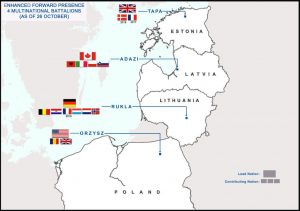
A complex geopolitical situation in the region forces the Baltic States and their NATO allies to take unprecedented efforts to increase defence capabilities to counter potential aggressors. A new Lithuanian military strategy approved in March describes Russia actions along with terrorism as the main threats for the security of Lithuania, as reported by Delfi.Unfortunately for pacifists, the Alliance and Russia today are arming and demonstrating their military power. They constantly compare their armed forces’ strength and capabilities, conduct large-scale military exercises, respond to each other by deploying new contingents and military equipment closer and closer to the NATO-Russian border.The Baltic ...
In June and July 1941, detachments of German Einsatzgruppen, together with Lithuanian auxiliaries, began murdering the Jews of Lithuania. Groups of partisans, civil units of nationalist-rightist anti-Soviet affiliation, initiated contact with the Germans as soon as they entered the Lithuanian territories. A rogue unit of insurgents headed by Algirdas Klimaitis and encouraged by Germans from the Sicherheitspolizei and Sicherheitsdienst, started anti-Jewish pogroms in Kaunas (Polish: Kovno) on the night of 25–27 June 1941. Over a thousand Jews perished over the next few days in what was the first pogrom in Nazi-occupied Lithuania. The most infamous incident occurred in what was ...
Having just returned from a trip to Russia, I am pleased to report that the Russian people and the officialdom that I encountered displayed none of the vitriol towards Americans that I half expected as a response to the vilifying of Moscow and all its works that pervades the U.S. media and Establishment. To be sure, many Russians I spoke with were quick to criticize the Trump Administration for its hot and cold performance vis-à-vis the bilateral ties to Moscow while also expressing mystification over why the relationship had gone south so quickly, but this anger over foreign policy did ...
The negotiations on Brexit are attracting a lot of attention. In particular, the possible erosion of the rights of around three million EU-27 citizens living in Britain is a major cause for concern.The European Parliament resolution adopted on 3 October states that “the withdrawal agreement must incorporate the full set of rights citizens currently enjoy, such that there is no material change in their position”.The main author of this text, Mr Guy Verhofstadt, the EP Brexit Coordinator, argues that such an approach – not to lower the level of citizens’ rights – is “the goal of democracy”. But why was ...
The Kaunas Garage Massacre of the Jews in June 1941It was with great interest that I read the op-ed jointly penned by Foreign Minister Gabi Ashkenazi and his Lithuanian counterpart, Gabrielius Landsbergis, in last Friday’s Jerusalem Post. As could be expected, such initiatives are usually written to offer a rosy picture of the wonderful relations between two countries and the bright prospects for future cooperation. As a descendant of Lithuanian Jews, a frequent visitor to Lithuania ever since independence, and the co-author of a recent book on the rampant Holocaust distortion orchestrated by successive Lithuanian governments, I didn’t know whether to ...
DELFI, which is the major Internet portal in the Baltic States providing daily news, stated on September, 10 that the number of emigrants from Lithuania exceeds that of immigrants by 1,000 in August. Shocking statistics shows that the country has registered a negative migration balance. Some 4,382 people left Lithuania in August. Thus, Lithuanians are leaving the country despite authorities’ claims on economic growth, stability and favorable perspectives.On the one hand, according to “Lithuanian economy review – 2017”, the GDP growth in Lithuania accelerated. In 2017, as compared to the previous year, Lithuania`s GDP increased by 3.8%. (http://ukmin.lrv.lt/en/economy-review/lithuanian-economy-review-2017) On the ...
I graduated from the exact same PHD Program at Harvard that produced Kissinger and Brzezinski before me. They gave me Kissinger’s old office at Harvard’s Center for International Affairs. I also went through the exact same Soviet/Russian Studies Program at Harvard that produced Brzezinski before me, and passed my PHD Oral/General Examinations in Soviet Politics and Russian History under Adam Ulam and Ned Keenan, respectively. R.I.P. Obama was behind me at Harvard Law School.Brzezinski has been Obama’s mentor and foreign policy guru since Obama’s student days at Columbia. Zbig ran Obama’s 2008 presidential campaign on foreign affairs and defense, and ...
Belarus is a land known also as Belorussia (White Russia, Weißrussland) in East Europe which was for centuries occupied by a Polish-Lithuanian common state until it became included in Tsarist Russia in the late 18th century.[1] Belarus is facing many identity problems but the most important is the ethnolinguistic challenge to a separate Belarussian[2] national feature.National identityA common national identity is a focal element for the creation of a national state as without a common identity that is based on a fundamental element of group’s identity a psychological sense of common solidarity cannot be developed. However, such solidarity is a ...
Yet again, a conference here in the Lithuanian capital dedicated to combating fascism and antisemitism is announced, without there having been a public call for papers, without a single speaker from among those who actually combat fascism and antisemitism in the country, with nobody from the democratically elected Vilnius Jewish community (not even the long-time editor of Jerusalem of Lithuania who has exposed and combated antisemitism for decades). No Holocaust survivors. None of the nationally relevant questions of the day can be found on the conference program. As ever, outstanding academic personalities from abroad are recruited to lend the gravitas and provide serious papers ...
Albin Kurti is on the verge of becoming the next Prime Minister of Kosovo after he and opposition chairman Isa Mustafa confirmed last week that the two rival political parties had made progress to create a coalition government. Mustafa said that Kurti can rightfully become the next Prime Minister if he can convince the three remaining parliamentarians, representing the Bosniak, Turkish and Roma minorities to enter a coalition – and it appears they will.What does the accession of Albin Kurti mean for the future of Kosovo?Kurti does not recognize the flag and anthem of Kosovo, as well as the Kosovar ...
As it appears Lithuania expects major changes in the near future. Lithuanian Foreign Minister Linas Linkevičius was on an official visit to the United States of America from the 20 to the 24 of February 2017. During a visit he said that Lithuania seeks the permanent presence of United States troops in its territory."We have requested stationing of military forces in our country on a more permanent basis - not only rotational but also more permanent," the minister told BNS in the telephone interview from Washington D.C.Linas Linkevicius' call for the permanent presence of United States troops in Lithuania territory ...
The magazine is covering the research gaps uncovered by global Western hoax mainstream media platforms and academic teaching & research institutions.
This is an alternative information & academic research digest platform with the purpose to offer an alternative “another side of the truth”.
The magazine is independent, private, and free of any influence by any institution, organization, government, or pressure group. URL: www.global-politics.eu