
“Nobody foresaw it. Nobody was ready for it – neither in Budapest, Moscow, Washington or anywhere else” — Ralph Walter, Radio Free Europe executive, RFE, Oct 22, 2006 [...]
Magic, and tragic years, tend to fill the calendar of commemoration for central European patriots. There are religious intercessions; guiding symbols; omens. Then there are the calamities, the crushing battles that empty entire classes and countries.
For Hungary, a country ever dreamy and mournful about such events, there are two notable disasters of rollicking value. There is Mohács 1526, where a good deal of the country’s aristocratic elite fell before the relentless Ottoman advance. The event effectively gave the Hapsburgs the ascendency to the west, assuming the role of defender against the Turkish advance into Europe.
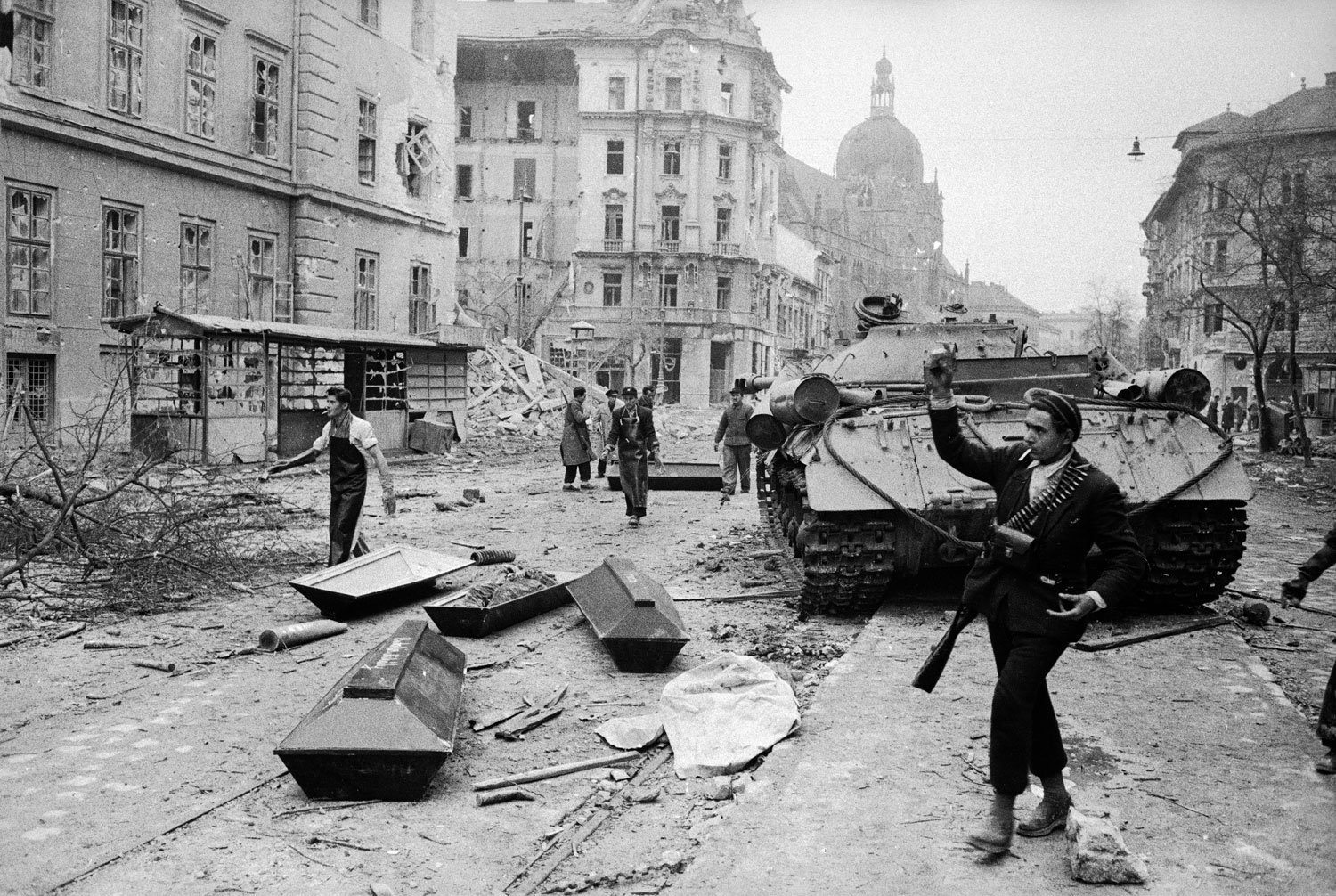
Then there is 1956, where the invaders assumed the form of Soviet tanks and a hundred thousand troops, precipitating the 200,000 refugees and the execution of then premier Imre Nagy two years later. The turning point came on November 1, 1956. Nagy decided that Hungary would exit the Warsaw Pact, declaring itself neutral.
The crushing force of the subsequent Soviet invasion traumatised the communist movement in Western Europe, stripping the ranks of various party branches while hardening others who felt that ideology needed tanks to back its strictures against the waverers. Behind the Iron Curtain, it was a warning to dissidents to play it by ear – and a resolutely acute one at that.
It also brought revolution into homes. “Hungary 1956,” the late historian Eric Hobsbawm reminds us, “was the first insurrection brought directly into Western homes by journalists, broadcasters and cameramen, who flooded across the briefly breached Iron Curtain from Austria.”[1]
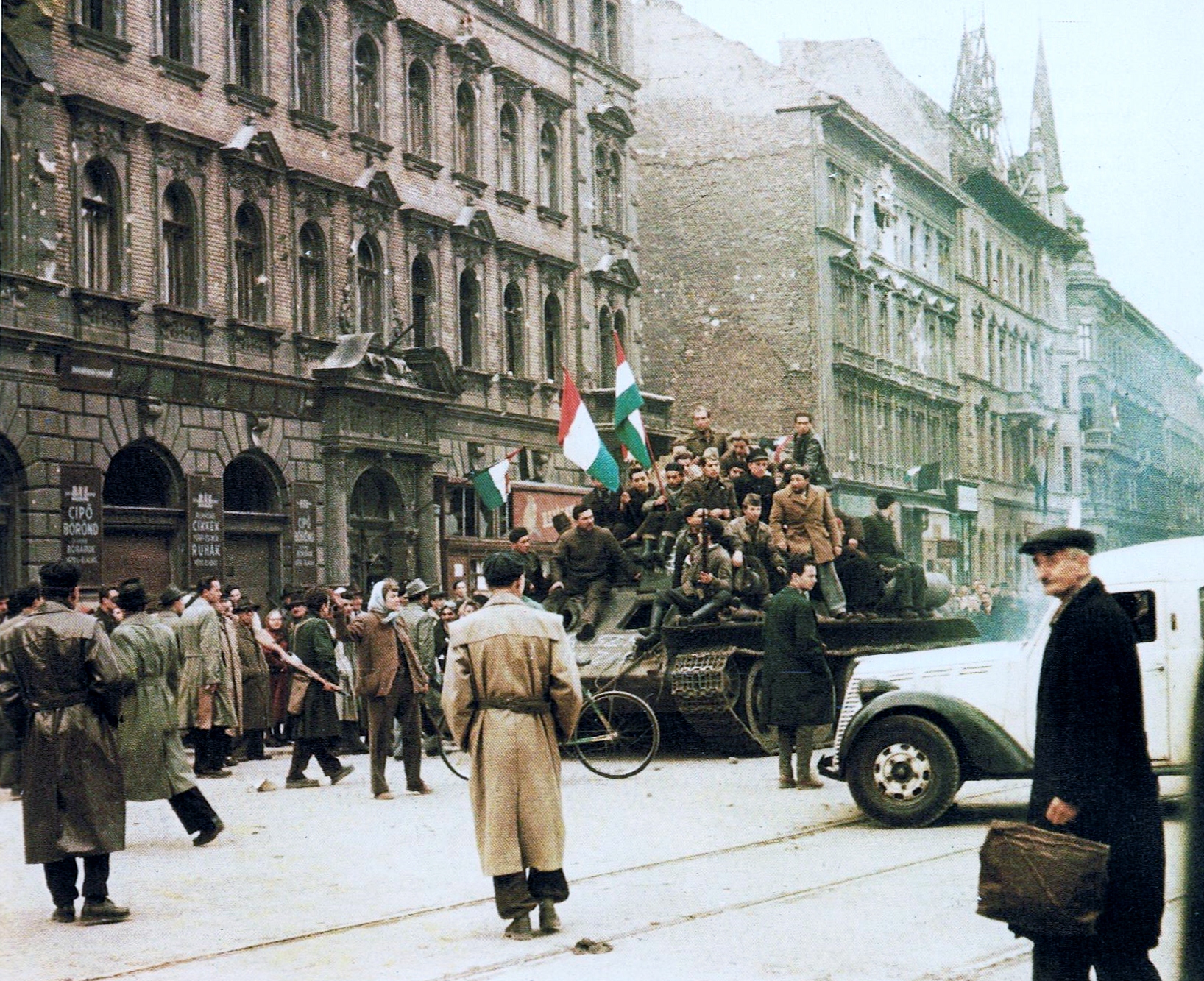
As with any such historical events, more tends to be made of less. The initial protests were hardly premised on a back breaking revolution. Inspired by anti-Soviet protests in Poland, thousands of students marched through Budapest sporting the famous “Sixteen Points” on October 23.
Central to these demands was a freeing up of Hungary from its labouring satellite status, entailing the withdrawal of Soviet troops, freer foreign policy, and free elections. Then came the greater numbers, posing a direct challenge to the authority of the first secretary Ernő Gerő, the enthusiastic removal of Stalin’s statue, and fire from nerve wracked secret police.
As Charles Gati’s Failed Illusions: Moscow, Washington, Budapest and the 1956 Hungarian Revoltsuggests, “relatively few Hungarians actually fought against Soviet rule, and their ultimate aim was to reform the system, not to abolish it.”
Nor was there anything systematic or steely about the organisation of the protest. Hungary’s doomed Imre Nagy was not as skilful as he might have been, despite showing courage before the proceedings arrayed against him. If history takes place on a moving train, this particular one proved wobbly and uncertain.
Caught between the absolute aims of the fighters, and reassuring Moscow that their disruption might be kept minimal, Nagy failed to do both, a symptom of what Hobsbawm termed “heroic victimisation”. Much of this had to do with the fact that the Hungarian Communist Party, by that point, was in tatters.
Misinformation and mishandling, in short, was everywhere. Assertions that the Soviet leadership were compulsively “trigger happy” are dismissed by Gati. There were concessions sought; there was a hope for a solution more reminiscent of Yugoslavia or Poland. But it becomes increasingly hard to avoid the sense that historical actors, once unleased, have no sense of what can happen next. Folly tends to be a default outcome.
The other story was the interplay of the other side of the now thick curtain, which had only been momentarily pierced by the de-Stalinising rhetoric of Nikita Khrushchev. Many of the Hungarian students laboured under some presumption that Western intervention in some guise, marshalled with US support, would take place. Such outlets as Radio Free Europe fed the manna of presumed freedom to the “student movement”, as it was termed.
This was aided by the counter-revolutionary rhetoric of rollback, encouraged by initial US Cold War administrations keen to arrest, and repel Soviet influence. Like some radical mystique, Soviet rule was meant to melt into to the background before the idea of a popular uprising.
But the eyes of then US President Dwight D. Eisenhower were glued to another spectacle: that of the Anglo-French-Israeli attack on Egypt after the nationalisation of Suez by the Nasser regime. The pretext for gradualism was set, with neither superpower too eager to place the other in direct line of potential nuclear conflict.
Such a train of events also supply current regimes with counterfeit political currency. Acts become unvarnished in their heroism. The government of Viktor Orbán has tended to be greedy in that regard, using historical shibboleths as readily as slogans.
The chance of commemorating 1956 after six decades was always going to be impossible. “People who love their freedom,” he said on Sunday, “must save Brussels from Sovietization, from people who want to tell us who we should live with in our countries.”[2] Russian tanks had been replaced by Muslim immigrants and Brussels.
The opposition party Egyutt (Together) begged to differ, with several members attempting to interrupt this display of self-love. Hundreds of whistles and red cards were distributed to assist heckling and disruption.
According to the party’s vice president, Péter Juhász, “Viktor Orbán’s policies are exactly the kind Hungarians rebelled against in 1956.”[3] While 1956 saw a revolt against the Soviet bloc’s Stalinist chill, with its glacial response, Juhász saw Orbán as getting all too warm with Moscow – literally, with the decision to permit Russian construction of nuclear reactors in Paks. “Back then, Hungarians stood up to Soviet domination, while today Orbán has committed Hungary to Russia for decades.”
Orbán’s dog whistle world is set in hard blocs of culture and civilization, usually what he considers the better ones against the worst. The refugee debate in Hungary took that turn when Orbán decided that foreboding fences rather than processing centres provided better solutions. Besides, he insisted, Hungary was taking the lead again – this time against resurgent Ottomans and Islam. That’s historical Hungary for you: a self-touted figure part vanguard, and always, part heroic victim.
We would like to ask you to consider a small donation to help our team keep working. We accept no advertising and rely only on you, our readers, to keep us digging the truth on history, global politics and international relations.
The world has just honored yet another Armistice Day – Remembrance Day – Veterans Day for all those who lost their lives in armed defense of their nation’s right to exist and remain a free people. Nation’s like the United States, Canada and Israel pay constant tribute to those key battles and wars that once determined their continued existence and survival. But what of nation’s like Palestine reduced to mere fragments of what they once were, their once prosperous, happy villages, towns and cities filled with happy children, families and the commerce of a viable way of life, now turned ...
Dear Readers, some of you are pushing me to continue with the Las Vegas shooting story while others are asking to know what to make of the release of files pertaining to President Kennedy’s assassination. I appreciate that you are interested and are unsatisfied with official explanations.My answer is that we already know, thanks to exhaustively researched books such as James W. Douglass’ JFK and the Unspeakable (Simon & Schuster, 2008), far more than is in the released files. My answer is also that it doesn’t matter what we know or what the facts are, the official story will never be changed. ...
Origins of images: Facebook, Twitter, Wikimedia, Wikipedia, Flickr, Google, Imageinjection, Public Domain & Pinterest.Read our Disclaimer/Legal Statement!Donate to Support UsWe would like to ask you to consider a small donation to help our team keep working. We accept no advertising and rely only on you, our readers, to keep us digging the truth on history, global politics and international relations.[wpedon id="4696" align="left"]SaveSave
Atrocities and war crimes are subjectively defined as acts of violence that exceed military necessity. All war includes atrocities. The stress of combat includes a build up of emotion during action that leads to vicious attacks on the enemy when the opportunity arises. American military units are trained and indoctrinated to avoid inhuman treatment of enemy combatants. Soldiers who violate the norms are prosecuted. This reduces but does not eliminate the problem.Photo of Vietnamese civilians killed by an American unit Atrocities During the Vietnam War The actions of armies in war have seldom been as humane as the modern American military -- ...
For decades, much of the world seemed to believe the fairy tale that the United States was a neutral broker, working for a solution to the issues plaguing Palestine and Israel. The U.S. sponsored endless rounds of negotiations, ostensibly looking for an end to these issues.Before this writer points out the nonsense of that belief, allow him to state two, self-evident (one would think) truths:(1) No broker is needed. All that is required is for Israel to adhere to international law. This means removing all the illegal settlers, ending the blockade of the Gaza Strip, allowing all Palestinian refugees to ...
Many innocent civilians were killed in American military interventions around the world – from Vietnam and Serbia to Iran and Afghanistan, because of the alleged “errors” or “collateral damage” – without consequences for civil and military leadership. In addition to political, military and every other power, Americans secured itself with legal mechanisms.Twenty-two civilians, wounded and doctors, among them three children, were killed in the American bombing of a hospital in the Afghan city of Kunduz. Americans acknowledged the error and apologized. The President of the United States expressed his condolences, the military leadership announced three independent investigations. “Doctors without borders” ...
A Reuters news report under the names of presstitutes Robin Emmott and Sabine Siebold shows how devoid the West is of honest, intelligent and responsible journalists and government officials. http://uk.reuters.com/article/uk-nato-summit-idUKKCN0ZN2NN First we will examine the dishonesty or incompetence of the reporters and then that of Western government officials.Emmott and Siebold describe NATO as a “Western defense alliance.” Since the Clinton regime NATO has been an alliance for waging offensive war, a war crime under the Nuremberg rules established by the United States. Under the NATO banner a number of countries have been bombed, invaded, and had their governments overthrown by ...
This past weekend saw Russians parading in celebration of the anniversary of their costly victory over Nazi Germany. Millions marched throughout Russia, holding photographs of their fallen family members in bittersweet remembrance. To this archival research peoples historian’s knowledge there was no public reminder that Hitler’s armed forces were built up by the West in open violation of the Versailles Treaty’s prohibitions in expectation of Hitler fulfilling his threats to invade the Soviet Union.There is simply no way impoverished Nazi Germany could have on its own built its Armed Forces up to number one military in the world during the ...
Jasenovac - Croat run death campThe consumption of history seems to be more widespread than ever: from general-interest history magazines and historical dramas and documentaries to historical fiction, popular history seems, well, unprecedentedly popular.The evolution of the TV historian reflects this trend: where once real working historians who had written serious books hosted television programmes, these days they are as likely to be photogenic media presenters with minimal, if any, actual history qualifications.The attraction of history and being a historian are not hard to work out. In the public imagination, historians are usually considered to be intelligent, objective people, if ...
The United States approaches the November 2020 election with growing apprehension, even dread.Among the possibilities:Protracted uncertainty about the presidential contest. Think Florida 2000 but with several states’ results unresolved for weeks or even months (“Experts held ‘war games’ on the Trump vs. Biden election. Their finding? Brace for a mess”);A disputed outcome, perhaps with Donald Trump and Joe Biden both claiming victory, compounded by a “blue shift,” where states are claimed by Trump on election night but flip over to Biden as additional absentee and mail-in ballots conveniently turn up days or weeks later;Violent civil conflict, spurred on in the ...
A Greater Croatia according to the advocates of Illyrian Movement's ideologyPart IThe Illyrian Movement until the creation of political parties (1841)Certainly, publishing of Lj. Gaj’s Kratka osnova horvatsko-slavenskoga pravopisanja/Die Kleine Kroatische-Slavischen Orthographie in 1830 marked the beginning of the Croatian national revival movement and made Ljudevit Gaj to be a leading figure of it. The essential political-national value of the book was that Gaj proposed the creation of one literal language for all Croats. It was a revolutionary act at that time, which was done, according to Gaj and other leaders of the movement, for the ultimate political-national purpose to ...
Violence can only be concealed by a lie, and the lie can only be maintained by violence.— Aleksandr SolzhenitsynThe past is never dead. It’s not even past, William Faulkner said. The dark secrets of Northern Ireland’s dirty war seem more intent, year by year, on proving Faulkner’s maxim truer than many could ever have imagined.It is forty three years since the now notorious Glennane Gang murdered three members of the Miami pop band in July 1975, two of the band survived–Stephen Travers and Des Lee. The Gang was made up of serving RUC (police) and UDR (British army) personnel, plus members ...
Russia and its President, Vladimir Putin, a little more than a year ago, in July 2014 were the focus of attention in Europe and North America, accused, without a shred of forensic evidence, of shooting down an unarmed civilian Malaysian airliner over eastern Ukraine. The Russians were deemed out to restore the Soviet Union with their agreement to the popular referendum of Crimean citizens to annex into the Russian Federation and not Ukraine. Western sanctions were being thrown at Russia by both Washington and the EU. People spoke of a new Cold War. Today the picture is changing, and profoundly. ...
On August 9 [2020], presidential elections were held in Belarus with five candidates bidding to be head of state. According to the Central Election Commission, the incumbent president, Alexander Lukashenko, won in the first round with over 80% of the votes. Mass protests began in Belarus right after the announcement of the preliminary election results. People went to the streets, expressing their dissatisfaction with the results of the elections that they believe were unfair. Mass protests turned into riots and there were clashes between rioters and the police. Many people were detained and injured, and two protestors died.Representatives of the ...
IntroductionBelow are TENC's October 1999 interviews with three Serbian women from the Kosovo town of Orahovac. They recount how, prior to the June 1999 NATO-UN takeover of Kosovo, they believed NATO's promise that it would institute multi-ethnic harmony. They discovered too late that for NATO multi-ethnic meant rule by the Kosovo Liberation Army (KLA).In September, TENC had published its first interview with an eye-witness to the NATO-UN Kosovo takeover: Cedomir Prlincevic, President of the Jewish community and Chief Archivist in Pristina, capital of Kosovo.Mr. Prlincevic described how he and the rest of the small Jewish community were driven from their ...
War has indeed become perpetual and peace no longer even a fleeting wish nor a distant memory. We have become habituated to the rumblings of war and the steady drum beat of propaganda about war’s necessity and the noble motives that inspire it. We will close hospitals. We will close schools. We will close libraries and museums. We will sell off our parklands and water supply. People will sleep on the streets and go hungry. The war machine will go on.What are we to do? The following text is Part III of a broader analysis entitled War and the State: Business ...
Ema Miljkovic-Bojanic, M. A.Institute of History ofSerbian Academy of Sciences and ArtsBelgrade, 2000Malcolm’s Apology of the “Pax Ottomana” (Ab)using of historiography and historical facts for political ends is not a novelty introduced towards the end of the twentieth century. Its instances have been known throughout history, so that “practically there is not a single epoch of human history that was not controlled – by the Church, state, nation, party, leadership…” But precisely at a time when historiography seemed to be getting rid, at least partly, of the grip of “supervision” and when a critical approach was getting the upper hand, the ...
Read the truth about "Srebrenica Massacre" in 1995.Origins of images: Facebook, Twitter, Wikimedia, Wikipedia, Flickr, Google, Imageinjection, Public Domain & Pinterest.Read our Disclaimer/Legal Statement!Donate to Support UsWe would like to ask you to consider a small donation to help our team keep working. We accept no advertising and rely only on you, our readers, to keep us digging the truth on history, global politics, and international relations.[wpedon id="4696" align="left"]The Al-Qaeda-linked ‘El-Mujahedeen’ brigade of the Bosnian Muslim Army parading in downtown Zenica in central Bosnia in 1995
On March 23, 2018, the US media published an interview with the newly-appointed National Security Advisor John R. Bolton, where he stated that the only solution for North Korea is complete disarmament – following the example of Libya under Muammar Gaddafi. This scenario is exactly what Donald Trump and Kim Jong-un need to discuss during their negotiations.John R. Bolton is well-known as a hardliner regarding Pyongyang. During his work for the Department of State in the 2000s, he was one of the most furious opponents of any dialogue with North Korea, and more recently he advocated a preventive strike against ...
Top personalities of the Croatian Revival MovementPreface This text investigates the question of relations between the Croatian national revival movement and the Serbs from 1830 to 1847. Special investigation attention is put on the problem of how the language influenced ethnonational group identity among the Croats and Serbs in Dalmatia, Croatia and Slavonia (the so-called Triune Kingdom) during the period of the Croatian national revival movement that was officially and not only formally named as the Illyrian Movement. This investigation is an attempt to reconstruct the mainstream of the politics by the leaders of the movement and their outlines on how ...