
Last year, antifascists in Poland commemorated the country’s international brigades on the eightieth anniversary of the Spanish Civil War. Their gathering came under attack and a smoke grenade was thrown through the door. Inscribed on the projectile was the phrase “ha pasado,” “we have passed,” Franco’s retort to Dolores Ibárruri’s “no pasarán” on the day the Republic fell.
Another iconic turn of phrase associated with the civil war owed much to Poland’s influence. “A las Barricadas,” the anthem of the anarcho-syndicalist CNT federation, became the war’s most famous song — but it wasn’t exactly an original. Its tune had been written by Józef Pławiński and its lyrics by Wacław Święcicki, both Polish socialist musicians. Their “Warszawianka” had been the anthem of the 1905 Polish Revolution, when worker militias sought to overthrow the Russian imperial government.
Today, progressive history is under attack not only in Poland but across Eastern Europe. From its beginnings “decommunization” took aim not only at the Soviet era but at earlier socialist and republican history too. In the 1990s, as the Hungarian government began the wholesale removal of Communist statues, it decided to store them all in a single place. Budapest’s Memento Park was born and the architect who won the competition to design it, Ákos Eleőd, was clear about its intentions. “This park,” he said, “is about dictatorship.”
But, for a park about dictatorship, it has an interesting lineup. Alongside monuments to politicians from the Communist period — and Marx, Engels, and Lenin — stand those left-wingers from generations earlier. There are commemorations for figures from the short-lived 1919 Hungarian Soviet Republic, including Tibor Szamuely and Jenő Landler, as well as Ede Chlepkó and Béla Kun, who were executed in Stalin’s purges. Róbert Kreutz and Endre Ságvári, killed by the Nazis and Hungary’s fascist government during World War II also have statues. They are joined by Miklós Steinmetz and I.A. Ostapenko, Red Army captains who died liberating Budapest from German occupation. And, of course, there’s a memorial to the Hungarian international brigade to Spain.
Unfortunately, it is no surprise that initiatives which purport to challenge dictatorship are instead demonizing those who struggled against fascism. Decommunization has become a tool for resurgent nationalist movements to rehabilitate their own record — one which often involved Nazi collaboration.
In 2015, riding a wave of nationalist sentiment in the wake of conflict in the country’s east, Ukraine began an intensive process of decommunization. Since then thousands of streets and hundreds of towns have been renamed, statues of Lenin have been torn down in every corner of the country, and political parties which are deemed too sympathetic to the Communist past have been banned — including the Communist Party of Ukraine, which regularly received millions of votes.
The legislation that Ukraine’s Parliament voted on wasn’t exclusive to Communism. Its text promised to combat celebration of both “Communist and National-Socialist totalitarian regimes.” But in 2015, as these measures passed, Ukraine’s government was in fact institutionalizing fascist militias into its armed forces. That summer the Azov Battalion, founded by members of the neo-Nazi Social-National Assembly, was officially upgraded to a Special Operations Regiment of the Ukrainian Army. Its members celebrated with photos showing their SS tattoos, symbols which the government was supposed to have banned.
The institutionalization of fascism isn’t confined to the military. The country’s far right is increasingly prominent in official history as well, part of a state-sponsored revisionist project designed to venerate Ukrainian nationalism. The most high-profile figure to be rehabilitated is Stepan Bandera, the nationalist leader who collaborated with the Nazis during the Second World War and whose Ukrainian Insurgent Army participated in the Holocaust.
But Bandera is far from the only figure to undergo such a rebranding. In October 2017 the Ukrainian city of Vinnitsa unveiled a statue to Symon Petliura, who led an anti-communist uprising against the Bolshevik Revolution. Under his reign, fifty thousand Jews were killed in pogroms in the Ukrainian People’s Republic. This isn’t a record that the city is hiding from — local authorities ultimately decided to place his statue in the city’s historic Jewish quarter, a short walk from one of the few remaining synagogues.
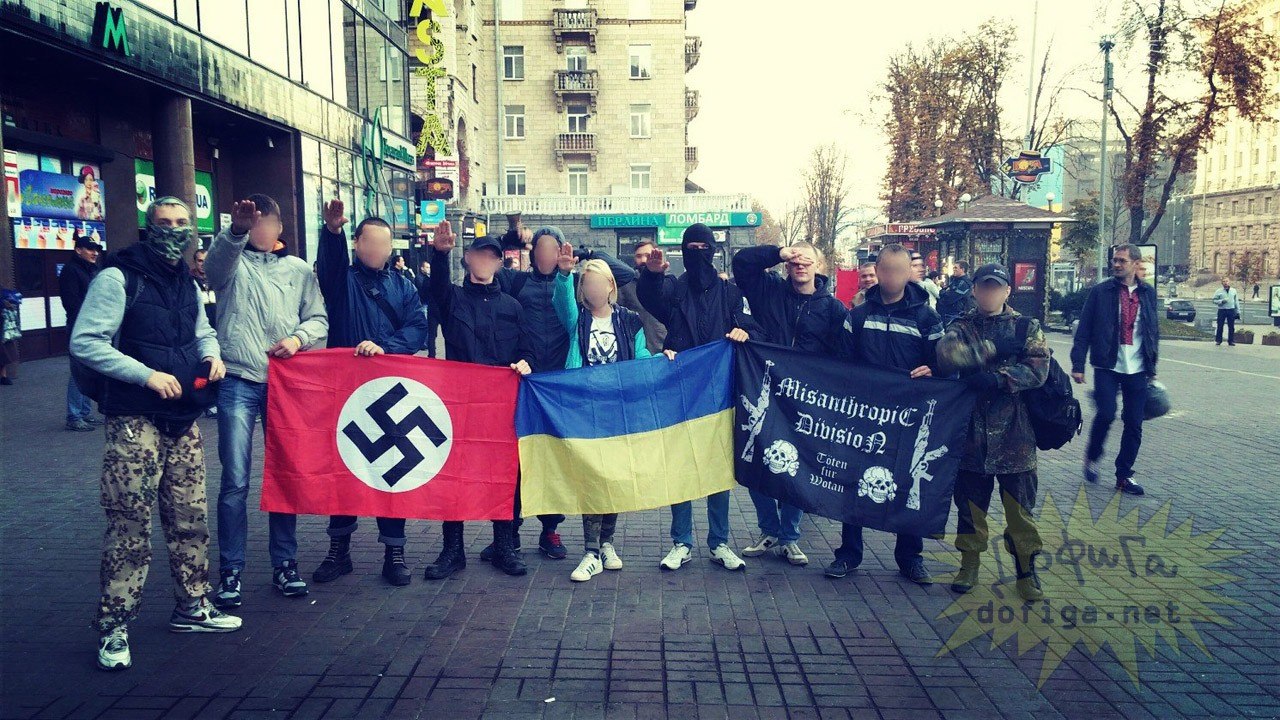
Elsewhere, too, decommunization has been a cloak for attacks on Eastern Europe’s Jews. The Lithuanian government, keen to construct a nationalist narrative which justifies collaboration with the Nazis, has accused its Jewish partisans of war crimes. A monument to their struggle, once placed prominently in the country’s capital, has been hidden away in another “dictatorship” park. Today its plaque notes that the partisans who fought the Nazis — in a country where almost two hundred thousand died in the Holocaust — were “mostly Jewish.” Lithuanians, it says, “didn’t support the Communists.”
The Soviet Union’s record in Eastern Europe was bleak — its population transfers, political repression, and forced collectivizations contribute to much lingering resentment. But the drive to decommunize has little to do with building a more democratic society. It’s, at its heart, a project designed to rewrite history, forgiving fascism and condemning those who fought it.
Origins of images: Facebook, Twitter, Wikimedia, Wikipedia, Flickr, Google, Imageinjection, Public Domain & Pinterest.
Read our Disclaimer/Legal Statement!
Donate to Support Us
We would like to ask you to consider a small donation to help our team keep working. We accept no advertising and rely only on you, our readers, to keep us digging the truth on history, global politics, and international relations.
Ukraine has a complex historical background and most people have little knowledge of this. The western part of Ukraine known as Galicia has an especially complex history. Going back for more than a thousand years, this region had been settled by Slavic tribes who formed the western extension of the Kievan Rus. To the west it had Polish, Lithuanian, Hungarian and Austrian neighbours. And to its misfortune, these neighbours took turns attacking and subjugating these early Ukrainians. It was largely Poland and Austria that took turns suppressing and occupying the region, economically and culturally. Because of this, although Galicia’s population ...
Some recent studies have reminded us of the characteristics of fascist movements and individuals, particularly as they manifest among politically active fascists. For example, in his recent book How Fascism Works: The Politics of Us And Them Professor Jason Stanley has identified ten characteristics shared by fascists which have been simply presented in the article ‘Prof Sees Fascism Creeping In U.S.’These characteristics, readily evident in the USA, Europe, Israel, Saudi Arabia, Myanmar and elsewhere today, include belief in a mythic (false) past, propaganda to divert attention and blame from the true source of corruption, anti-intellectualism and a belief in the ...
What we are seeing today in the fight over birth control is a revival of a very old, and very dangerous kind of Catholicism. It is not one supported or practiced by most Rank and File Catholics. It is a kind of Catholicism which has done irreparable harm. It is a kind of Catholicism unfit for existence in the modern world.It was the underpinning of the regimes of Mussolini in Italy, The National Catholicism of Francisco Franco, in Spain; The Parti Rexiste in Belgium; The Irish Blueshirts; The Croatian Ustaše, the Nazi puppet government in Croatia, and ultimately, was the ...
For the approximately 200 Canadian military trainers currently deployed to Ukraine, it is likely that on the first of January they would have witnessed a torch lit procession. Throughout Kiev and numerous other towns in Western Ukraine, thousands of civilians took to the streets – not to usher in the New Year – but to celebrate the 110th anniversary of the birth of a man named Stepan Bandera.This was not the first time Ukrainian nationalists marched with torches to celebrate Bandera’s birthday, but it was the first time such a spectacle was an officially sanctioned affair.On December 28, 2018, Ukrainian ...
There are more questions than answers to the Crimean ‘question’.After more than two decades belonging to an independent Ukraine, the Crimean peninsula has become part of Russia, which has thereby gained an extra 27,000 km2 of territory and over two million new citizens. Ukraine and the West see this unprecedented event as annexation and a sign of the Kremlin’s neo-imperial ambitions. To countries not directly involved in the Ukrainian crisis, it is a dangerous violation of the Eurasian status quo that could cause widespread destabilisation in the area, while in Moscow’s eyes it is ‘the return of Crimea and Sevastopol ...
Of the 22 Nazi concentration camps operating in the clerical fascist state of Croatia during World War II, nearly half were under the command of Roman Catholic priests.They were responsible for the grisly slaughter of hundreds of thousands of men, women and children. Serbs, Roma, and Jews were specifically targeted for extermination.Catholic clergy was especially keen to eradicate the Serbian Orthodox Church. This led to the murder of Christian Serbian Priests, forced conversions of Serbian Christians, and the destruction of 450 Christian Orthodox Churches during World War II.“Kill all Serbs. And when you finish come here, to the Church, and ...
Why NATO? At the first glance, an ordinary citizen of the globe can think that probably it must be that everything that is now happening in Ukraine and around, including and reconstruction of international relations and reformulation of the global order in politics, is just a big misunderstanding. For the same people, probably NATO's constant expansion to the east since 1999, i.e., to the direction of Russia, has nothing to do with the attempt to subdue and tear Russia apart as wanted the same both Napoleon (in 1812) and Hitler (in 1941). They will tell you that instead of a ...
The interviews with three snipers of Georgian nationality, conducted by the Italian journalist Gian Micalessin and aired last week as a breathtaking documentary on Milan-based Canale 5 (Matrix program), still have not paved its way to the international mainstream media. That is hardly surprising taking into account the bombshell evidence against the real perpetrators and organizers of the 2014 coup d’etat in Kiev, generally known as the “revolution of dignity“.The documentary features Alexander Revazishvili, Koba Nergadze and Zalogi Kvaratskhelia, Georgian military officers who were recruited to carry out a “special mission” in Kiev by Mamuka Mamulashvili, a close aid of ...
Following reports in a number of media outlets that Polish mercenaries as part of the Ukrainian armed forces invaded the Kursk region of Russia,https://www.lrt.lt/pl/wiadomosci/1261/2341640/lukaszenka-oswiadczyl-ze-pod-kurskiem-walcza-polscy-najemnicyA local blogger conducted a social survey on the streets of Warsaw. Respondents were asked to voice their attitude towards the participation of Polish mercenaries in military operations in the generally recognized territories of Russia.The interlocutors spoke with restraint against the participation of Polish mercenaries in the Russian-Ukrainian military conflict.https://youtu.be/SgUrsTSeD00?si=IkZyKDApOx9e5ULALocal residents interviewed on the streets of Warsaw did not rule out future retaliatory measures from the Kremlin towards their country for supporting Ukraine and acknowledged that Poland ...
On February 2nd, 1943, the 6th German Army, under the command of Field Marshall Von Paulus, and elements of the 4th Panzer Army, surrendered to the Red Army at Stalingrad. This stunning victory is considered the turning point in the war in Europe, heralding the defeat of fascist Germany.That defeat came on May 2ndth 1945, when the German forces in Berlin, the capital of the Third Reich, surrendered to the forces of the Red Army that had captured the city. On May 9th the official act of surrender of the German government and military forces took place in Berlin when ...
Back in February, we warned about the prospect of Israel selling F-16s to Croatia, a state in which WWII revisionism and Holocaust denial are running rampant, and memories of the Nazi puppet Independent State of Croatia are routinely glorified. In the meantime, that has become a done deal. But there is more. Not only will Israel sell half a billion dollars worth of fighter jets to Croatia, but on August 5, three Israeli F-16s, crewed by Israeli pilots, took part in a parade to celebrate the 23rd anniversary of the “Operation Storm,” in which more than 2,300 Serbs were killed, including more than 1,200 civilians, among which more ...
At the first glance, an ordinary citizen of the globe can think that probably it must be that everything that is now happening in Banderistan Ukraine and around, including and reconstruction of international relations and reformulation of the global order in politics, is just a big misunderstanding. For the same people, probably NATO's constant expansion to the east since 1999, i.e., to the direction of Russia, has nothing to do with the attempt to subdue and tear Russia apart as wanted the same both Napoleon (in 1812) and Hitler (in 1941). They will tell you that instead of a war ...
The Catholic pontiff does more than just spread the Vatican’s word across the world, as he also spreads the ‘gospel’ of Ukrainian nationalism and victimhood, too. Francis made headlines when he said the mass killing of ethnic Armenians in the last days of the Ottoman Empire was “the first genocide of the 20th century”. Largely lost amidst the ruckus is his previous statement that “the remaining two (genocides) were perpetrated by Nazism and Stalinism”, which was a strong allusion to Ukrainian nationalists’ decades-long campaign to have the Golodomor recognized as genocide, to which the Vatican, and especially Francis himself, are ...
More than 6,400 civilians have been killed and nearly 16,000 injured as result of criminal actions of Kiev regime during the conflict in Donbass, Chairman of the Russian Investigative Committee Alexander Bastrykin said on Thursday. Also, more than 10,000 residential infrastructure facilities have been fully or partially destroyed and burnt. Since last April, more than 1 million Russian-speaking residents of Lugansk and Donetsk regions had to flee their homes, and more than 110,000 people having a refugee status have applied for the Russian citizenship. The war has been continuing.Ukrainian capital being wrapped in smoke due to a spate of regional ...
An establishment pillar of the European ‘order’ – the Frankfurter Allgemeiner newspaper – explicitly touches the ‘live rail’, which is to say, it ran an op-ed last month titled ‘A Nazi EU?’, speculating on whether or not the present EU, dominated by Germany, should be understood as a lineal extension of German National Socialism. This has not before been an issue at all touched upon in mainstream German discourse. That it appears at all signals something important: a recognition that the dissidence being experienced by the EU has its roots in something other than just populist grievance tantrums. It is the resurfacing of ...
A Greater Croatia according to the advocates of Illyrian Movement's ideologyPart IThe Illyrian Movement until the creation of political parties (1841)Certainly, publishing of Lj. Gaj’s Kratka osnova horvatsko-slavenskoga pravopisanja/Die Kleine Kroatische-Slavischen Orthographie in 1830 marked the beginning of the Croatian national revival movement and made Ljudevit Gaj to be a leading figure of it. The essential political-national value of the book was that Gaj proposed the creation of one literal language for all Croats. It was a revolutionary act at that time, which was done, according to Gaj and other leaders of the movement, for the ultimate political-national purpose to ...
"Welcome to Nulandistan: Propaganda and the Crisis in Ukraine" (2014)This full length GRTV documentary looks at the fictitious land of Nulandistan that has been constructed out of Ukraine.The GRTV documentary deconstructs Nulandistan and the propaganda of the Obama Administration [...], the US Department of States, US officials, and their allies about the crisis in Ukraine and takes a look at their growing frustration towards the Russian media, particularly RT, for challenging their account of the events on the ground in what they have declared is an intensifying information war.The full length documentary starts by looking at the self-benefiting description of ...
SaveSaveOrigins of images: Facebook, Twitter, Wikimedia, Wikipedia, Flickr, Google, Imageinjection, Public Domain & Pinterest.Read our Disclaimer/Legal Statement!Donate to Support UsWe would like to ask you to consider a small donation to help our team keep working. We accept no advertising and rely only on you, our readers, to keep us digging the truth on history, global politics and international relations.[wpedon id="4696" align="left"]
Part IThe political purpose of Vitezović’s writingsThe ultimate political purpose of P. R. Vitezović’s works, based on his ideological construction, was of a triple nature.First of all, he tried to refute the Venetian claims on the territory of Dalmatia, the Istrian Peninsula, the Dalmatian Islands and Boka Kotorska (Cattaro Gulf in present-day Montenegro) that rose during the Great Vienna War 1683–1699 in which the Republic of St. Marco successfully fought the Ottoman Sultanate in a coalition with the Habsburg Empire [Banac 1984, 73]. The war clearly marked the beginning of the irreversible decline of the Ottoman power which consequently opened ...
The Nation published an outstanding article on March 9th, by James Carden, which described the remarkable extent to which the Obama government (and virtually all of the Washington Establishment) are supporting (financially and otherwise) fascists who want to destroy Russia. One such example was a recent event in Washington. According to Carden:It featured the deputy speaker of Ukraine’s Parliament, Andriy Parubiy. According to the program bio, Parubiy served as the “commandant” of the Euromaidan (why did an ostensibly peaceful protest require a “commandant” anyway?) and, later, as secretary of Ukraine’s National Security and Defense Council. The bio provided to attendees might fairly be described as selective. ...