
NATO’s 1999 Attack on Serbia’s State TV Headquarters “Wiped from the Record”
The NATO missile assault killed 16 journalists and employees, yet there was no international outcry comparable to the Charlie Hebdo attacks in 2015 [...]
On 23 April 1999, a NATO missile attack on Radio Television of Serbia (RTS) headquarters killed 16 employees of the state broadcaster. The forgotten war crime occurred during the Kosovo War (March 1998-June 1999), and was part of NATO’s aerial campaign alongside the US-backed Kosovo Liberation army, in opposition to the Federal Republic of Yugoslavia.
In the aftermath of the attack there were no great public campaigns launched for the 16 murdered journalists and employees, no outpouring of emotion for those killed, no calls for solidarity and togetherness in the face of aggression. On the contrary the West justified this grievous blow against freedom of expression, praised it even.
Tony Blair, Britain’s then Prime Minister, welcomed the killings when speaking at NATO’s 50th anniversary summit in Washington. Blair said the missile attack was “entirely justified… in damaging and attacking all these targets”, and that those murdered were part of the “apparatus of dictatorship and power of [Slobodan] Milosevic”.
Blair felt that, “the responsibility for every single part of this action lies with the man [Milosevic] who has engaged in this policy of ethnic cleansing and must be stopped”. Apparently Milosevic “must be stopped” by wiping out state journalists or what Blair describes as an “apparatus of dictatorship”.
According to one of the main leaders of the Western world, Milosevic must bear full responsibility for a NATO fighter plane firing a US-made missile on a state broadcasting service’s headquarters. Perhaps we shouldn’t be too surprised by Blair’s visions of justice, particularly when examining his key role in the deaths of hundreds of thousands of Iraqis in the following decade.
Blair was not alone in praising this violation of international law. His Secretary of State for International development, Clare Short, said afterwards that,
“the propaganda machine is prolonging the war and it’s a legitimate target”.
Short is a Labour Party member and her official title today is The Right Honourable Clare Short. Defending these killings was neither right nor honourable one can assume.
NATO themselves commended the deliberate attack afterwards. NATO’s military spokesperson Air Commodore David Wilby declared RTS,
“a legitimate target which filled the airways with hate and with lies over the years”.
This followed on from a number of other NATO attacks on radio and television outlets in the country.
In the build up to the 2003 Iraq invasion, Cardiff University revealed that the BBC adopted the most pro-war stance of any British network. The official reasons for invading Iraq were based entirely on lies and misinformation. In this case was the BBC “the propaganda machine”, had it become “a legitimate target” too?
Pentagon spokesperson Kenneth Bacon also legitimised the war crime saying that,
“Serb TV is as much a part of Milosevic’s murder machine as his military is”.
Not to be outdone, the respected US diplomat and magazine editor Richard Holbrooke described the bombing of RTS as,
“an enormously important and, I think, positive development”.
In the build up to the Iraq invasion American networks like Fox News were styling the illegal intervention as “Operation Iraqi Freedom”, with its correspondents and news anchors compelled to repeat that phrase. In addition a permanent American flag was fluttering in the top corner of the screen, and during the invasion itself the banner “war on terrorism” was unfurled.
Did this make Fox News and others like it, “a legitimate target which filled the airways with hate and lies”? Judging by the standards of Western elites, one would have to suggest so.
Meanwhile, a single person was charged for the attack on RTS: Dragoljub Milanovic, the Serbian network’s general manager, who received a 10-year jail term for failing to evacuate the building in time. Yet the International Criminal Tribunal for the former Yugoslavia concluded that NATO’s bombing of RTS was not a crime, noting that deaths were “unfortunately high, they do not appear to be clearly disproportionate”. Clearly disproportionate to the overall number of civilian deaths inflicted by NATO perhaps.
However, in January 2015 the Western reaction was somewhat different when 12 journalists from the Charlie Hebdo satirical newspaper were murdered by Islamic extremists – along with four Jewish men killed at a kosher supermarket shortly afterwards.
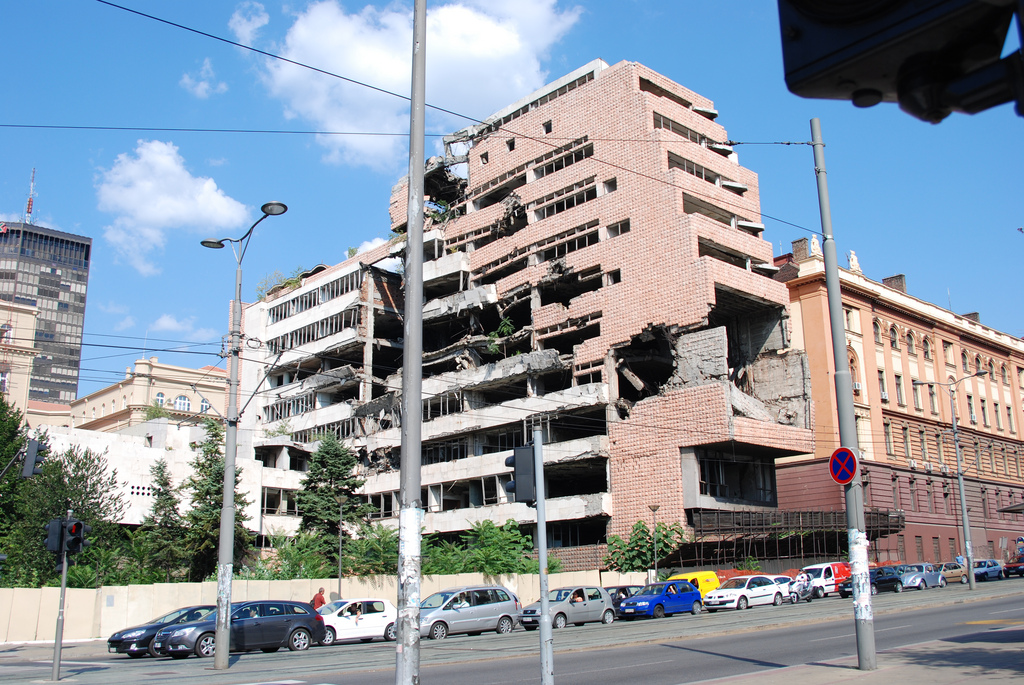
Serbia, Belgrade: Made by NATO in 1999
The British Prime Minister on this occasion, David Cameron, did not justify the killing of journalists and said,
“We stand absolutely united with the French people against terrorism and against this threat to our values – free speech, the rule of law, democracy”. Cameron went on, “we should never give up the values we believe in… a free press, in freedom of expression, in the right of people to write and say what they believe”.
About two weeks later Blair, now a Middle East peace envoy, said of the thinking behind the Charlie Hebdo attacks, “this extremism is not natural, it’s taught and it’s learned and you have to un-teach it in the school systems”. Blair seems further unaware of his own role in creating “this extremism” by playing the junior partner role in invading Iraq, a crucial factor in the rise of ISIS.
In the aftermath of the Charlie Hebdo attacks, millions marched to honour the dead with the slogan “I am Charlie” becoming famous. When the Serbian journalists and employees were killed just over 15 years earlier, there was no international motto of “I am RTS”.
New York civil rights lawyer Floyd Abrams described the Charlie Hebdo shootings as, “the most threatening assault on journalism in living memory”. The perception of “living memory” appears to be a remarkably short one.
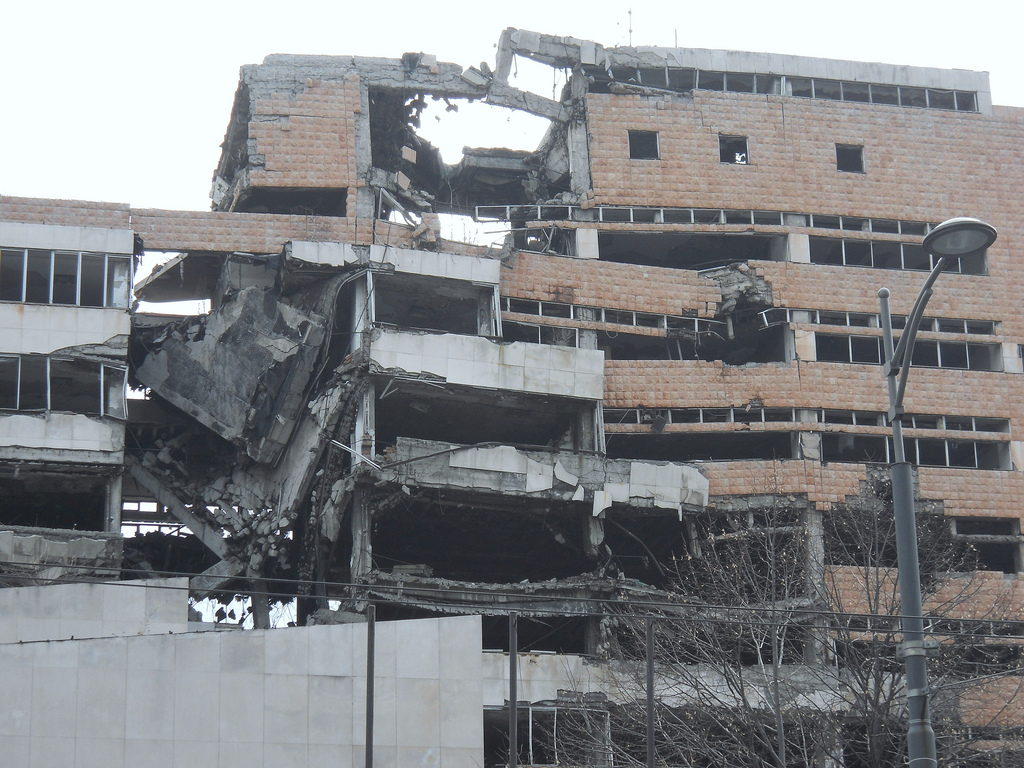
NATO’s destruction of Belgrade in 1999
This article was originally published by The Duran in August 2017.
Author: Shane Quinn
Origins of images: Facebook, Twitter, Wikimedia, Wikipedia, Flickr, Google, Imageinjection, Public Domain & Pinterest.
Read our Disclaimer/Legal Statement!
Donate to Support Us
We would like to ask you to consider a small donation to help our team keep working. We accept no advertising and rely only on you, our readers, to keep us digging the truth on history, global politics and international relations.
In December last year [2015], NATO officially invited Montenegro to become the 29th member state of the most powerful military organisation of our times, if not, in fact, of all time. The country’s Prime Minister, Milo Đukanović, assured the NATO secretary-general that “you can count on us at any time.” It is always nice to hear that someone has your back. But in Montenegro’s case, it means that they have our back with an entire active-duty military force of only two thousand personnel. It is not quite clear how the tiny nation of less than 700,000 people enhances U.S. security ...
Over the past 50 years the US and European powers have engaged in countless imperial wars throughout the world. The drive for world supremacy has been clothed in the rhetoric of “world leadership”, the consequences have been devastating for the peoples targeted. The biggest, longest and most numerous wars have been carried out by the United States. Presidents from both parties direct and preside over this quest for world power. The ideology which informs imperialism varies from “anti-communism”in the past to “anti-terrorism”today.Washington’s drive for world domination has used and combined many forms of warfare, including military invasions and occupations; proxy ...
Backdrop To The BalkansThe tiny South-Central Balkan country of the Republic of Macedonia is in dire straits right now, but most of Europe – let alone the rest of the world – has no idea that this is the case because the Mainstream Media narrative is that the state’s two-year-long political crisis was “resolved” when the patriotic VMRO-DPMNE government of Nikola Gruevski was replaced in a “constitutional/electoral coup” that followed Color Revolution and even Hybrid War provocations. The author wrote about this in a Sputnik piece at the time from May 2017 titled “The Macedonian Crisis Isn’t Over, and a ...
As the Second World War advanced from its early stages, the United States was assessing which sections of the earth it would hold conquest over. American planners had to remain patient, however. A seemingly endless string of conquests for the Nazis had astonished the world – particularly those in the US – and led to Adolf Hitler being crowned as “the new Napoleon”.In the summer of 1942, under Hitler’s domineering command of the military, the Germans controlled vast swathes of Europe – from Warsaw to Oslo to Paris, and eastwards onto Athens, Kiev and Sevastopol. It was one major victory ...
Secretary of State Hillary Clinton (and President Obama — and some NATO partners) did it previously to Libya, and here was the result (as discussed by the retired British career diplomat Craig Murray, at his craigmurray.org.uk, who has kindly allowed me to distribute it to other newsmedia) [and I as editor will add a few clarifiers and questions in brackets] (and then afterward, I shall add my own comments); so, here is Craig Murray:This is the result of NATO bombing of Sirte to “enforce the no-fly zone” in Libya.When the neo-cons in the UK parliament and the serial warmonger Hillary Clinton call for a ...
After the Russian military victory over the Ottoman Empire in the 1877−1878 Russo-Ottoman War it was signed the San Stefano Treaty between these two states on March 3rd, 1878. According to the treaty, a Greater “San Stefano” Bulgaria, under the direct protection by Russia, had to be established within the borders of the Ottoman Empire. However, an idea of “San Stefano Bulgaria” directly affected three Balkan nations: the Serbs, Greeks and Albanians as some of their ethnic and historical territories had to become part of a Greater Bulgaria. The “San Stefano Bulgaria” was projected by the Russian authorities to cover ...
A National traumaA national trauma which the Serbs after the fall of the Serbian national state and the Ottoman occupation experienced after June 20th, 1459[i] can be compared with that felt by Judea’s Jews after the fall of Jerusalem and the destruction of the Temple in 70 AD.[ii] Since Serbia soon found herself well within the Ottoman Sultanate and the European Christian states were on defense from the victorious Muslim Ottoman Turks, no light at the end of the historical tunnel was seen and the whole nation sank into deep despair for the next four centuries. In a sense, the ...
Exclusive photos of the Russian war crimes in Syria and the Middle East by "Free Media Group" volunteers, 2016-2018 with a proper illustrations of the Russia's militant imperialism. The authenticity of photos and their descriptions are certified by the UK Cabinet of Boris Johnson & Theresa May: The My Lai Massacre by Russian soldiersThe Russian soldiers at the spot of My Lai Massacre with their victimsAleppo citizen with a daughter during the Russian destruction of the cityRussian Orthodox monk in Moscow in protest against the Russian invasion of SyriaSyrian children of war and the Russian occupant soldier Killed Russian student in ...
QASEM SULEJMANI FOUGHT IN BIH AGAINST SERBS?! A Croatian journalist discovers who was killed by the Iranian general! It was important for James Bond the Middle East, turning the WAR on in SYRIA!Hasan Haidar Diab (56) is a prominent Croatian journalist and war reporter. However, his link to the Balkans is in the Eighties of the last century, when from native Beirut to study in the then SFR Yugoslavia, and that is due thanks to the character and part of Josip Broz Tito, or his role in the Non-Aligned MovementOver the years of the war, primarily because of the knowledge ...
On 4 April 2019, the North Atlantic Treaty Organization, better known as NATO, marked the 70th anniversary of its existence with a conference attended by the foreign ministers of member nations in Washington DC. This will be complemented by a meeting of the heads of state of member nations in London next December.Coinciding with the anniversary event on 4 April, peace activists and concerned scholars in several countries conducted a variety of events to draw attention to, and further document, the many war crimes and other atrocities committed by NATO (sometimes by deploying its associate and crony terrorist armies – ISIS, ...
During the last decade the deteriorating political and military situation in the world have proved the necessity of well prepared Armed Forces.It is obvious that the level of patriotism in Lithuania is high as ever. Many young men are thinking to join the Armed Forces and be useful to the country. The government only should maintain and strengthen this trend. But battling with numerous political and economical problems the government is going to make some changes in military sphere that could have far-reaching adverse consequences.It should be said that today there is a serious gap in providing the national Armed ...
General Adolf Heusinger (August 4, 1897 – November 30, 1982) was a German general officer who briefly served as Adolf Hitler’s Chief of the General Staff of the Army during World War II and served as the first Inspector General of the Bundeswehr, the West German armed forces, from 1957 to 1961. Heusinger served as Chairman of the NATO Military Committee from 1961 to 1964.Heusinger was born in Holzminden, in the Duchy of Brunswick, German Empire. He entered the Imperial German Army on June 17, 1915, and was assigned to 7. Thüringisches Infanterie-Regiment Nr. 96, an infantry regiment raised in ...
Documentary films about ex-Yugoslavia not seen on global corporate mass-media news. For instance:US documentary movie "RETLINES" with English subtitle from 1991 about Vatican smuggling Croat Nazi Ustashi to South America in 1945Ratlines were a system of escape routes for Nazis and other fascists fleeing Europe at the end of World War II. These escape routes mainly led toward havens in South America, particularly Argentina, Paraguay, Brazil, Uruguay, and Chile. Other destinations included the United States and perhaps Canada and the Middle East. There were two primary routes: the first went from Germany to Spain, then Argentina; the second from Germany ...
Eighteen years ago in the early hours of March 24, 1999, NATO began the bombing the Federal Republic of Yugoslavia. “The operation was code-named “Allied Force ” – a cold, uninspired and perfectly descriptive moniker” according to Nebosja Malic.This article was first written in May 1999 at the height of the bombing of Yugoslavia.The causes and consequences of this war have been the object of a vast media disinformation campaign, which has sought to camouflage NATO and US war crimes.It is important to note that a large segment of the “Progressive Left” in Western Europe and North America were part of this disinformation campaign, presenting ...
The recent announcement by United States President Donald Trump that the US will recognise Israel’s sovereignty over the Golan Heights draws attention yet again to the double standards applied by NATO and its satraps including Australia to the issues of territorial integrity, the right to self-determination, and international law. Three cases illustrate the duplicity and double standards of the Western nations. They may be reviewed chronologically.A picture taken on July 4, 2018 from the Israeli-annexed Syrian Golan Heights shows displaced Syrians from the province of Daraa staging a protest (top L) calling for international protection, in the Syrian the ...
The main church of the Serbian Orthodox Patriarchate in Kosovo in PećThe series of long-scale Christian national movements in the Balkans, triggered off by 1804 Serbian revolution, decided more than in the earlier centuries, the fate of Serbs and made ethnic Albanians (about 70% of whom were Muslims) the main guardians of Turkish order in the European provinces of Ottoman Empire. At a time when the Eastern question was again being raised, particularly in the final quarter of the 19th and the first decade of the 20th century, Islamic Albanians were the chief instrument of Turkey’s policy in crushing the ...
On November 8th, Britain’s Daily Mail bannered “NATO tells Europe to prepare for ‘rapid deployment’:” and sub-headed “Defence chiefs say roads, bridges and rail links must be improved in case tanks and heavy vehicles need to be quickly mobilised” (to invade Russia, but the newspaper’s slant was instead that this must be done purely defensively: “In October, NATO accused Russia of misleading them, saying that Moscow had deliberately violated international rules of military drills”).The article continued:Secretary General Jens Stoltenberg called for the infrastructure update across Europe as NATO is set to overhaul its command structure for the first time since ...
For all the attention paid to the emergence of homegrown Islamist terrorists in Belgium, France and other European countries, one of the continent’s biggest radicalization problems is taking place on its fringes.Kosovo, the tiny Muslim-majority Balkan nation of just 1.8 million, has produced more foreign fighters per capita than any other Western nation since ISIS declared its now-defunct caliphate in 2014. Some 413 Kosovo citizens, including women and children, have joined that group and other Islamist extremist factions since the war in Syria began in 2012.As it attempts to join the European Union, Kosovo has been under pressure to stamp ...
TRANSCRIPT:Harold Channer (HC): Good evening and welcome very, very much to the conversation. We’re pleased to welcome to the program, Sean Gervasi. He is a professor and academic who is concerned with economics and particularly with what is relevant to what we want to talk about tonight. He has just returned from a long stay in Belgrade, Yugoslavia, and knows something of that situation. Sean Gervasi, welcome very, very much to the conversation, and back to New York. Before we go into some detail about what in the world is going on in terms of the Balkans, from your experience ...
The current Ukrainian crisis and in fact civil war which stared at the very end of 2013 are grounded in for decades lasting internal interethnic antagonisms primarily on the Ukrainian-Russian relations including above all the “Crimean Question” as an apple of discord from 1954 between Ukraine and Russia.[1] The crisis came from Lithuania’s capital Vilnius were in November 2013 an Association Agreement between the EU and Ukraine had to be signed. Lithuania at that time (July 1st−December 31st, 2013) presided the European (Union) Council and formally had full political responsibility for the breaking out of the crisis as being the ...