
Jonas Noreika: Nazi Collaborator or National Hero? A Test for Lithuania
Blaming Russian propaganda, however, has suddenly become a lot more difficult thanks to Mr. Noreika’s own granddaughter, Silvia Foti, a Lithuanian-American from Chicago who has spent years researching a biography of her revered relative and went public in July with her shocking conclusion: Her grandfather was a fierce anti-Semite and Nazi collaborator [...]
Kaunas, Lithuania, June 1941 (before Germans arrived): Killing of the Jews by local Lithuanians
For the tiny village of Sukioniai in western Lithuania, the exploits of General Storm, a local anti-Communist hero executed by the Soviet secret police in 1947, have long been a source of pride. The village school is named after him, and his struggles against the Soviet Union are also honored with a memorial carved from stone next to the farm where he was born.
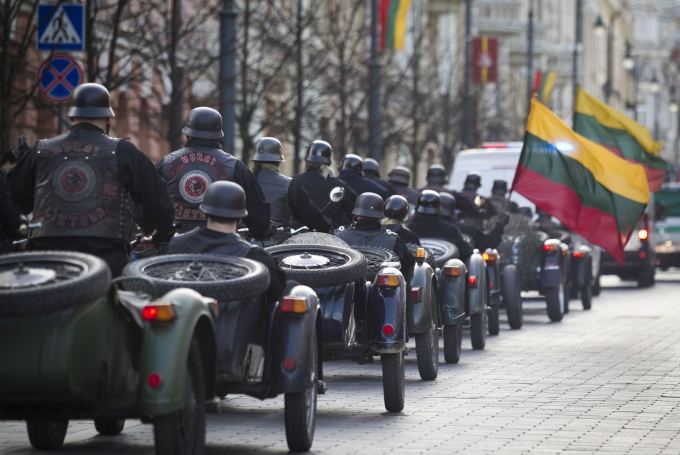
All along, though, there have been persistent whispers that General Storm, whose real name was Jonas Noreika, also helped the Nazis kill Jews. But these were largely discounted as the work of ill-willed outsiders serving a well-orchestrated campaign by Moscow to tar its foes as fascists.
Blaming Russian propaganda, however, has suddenly become a lot more difficult thanks to Mr. Noreika’s own granddaughter, Silvia Foti, a Lithuanian-American from Chicago who has spent years researching a biography of her revered relative and went public in July with her shocking conclusion: Her grandfather was a fierce anti-Semite and Nazi collaborator.
Her unequivocal verdict — announced in an article posted on Salon — has stirred emotional debate inside Lithuania and prompted a flood of “told you so” reports by state-controlled news media outlets in Russia.
“It was terribly shocking,” Ms. Foti said in a telephone interview of her finding that her grandfather was a killer, not a hero. “I had never heard about any of this Nazi stuff.”
It was also shocking for Jolanda Tamosiuniene, a teacher and librarian at the J. Noreika Basic School in Sukioniai, where Mr. Noreika was born at the end of the hamlet’s only street in 1910.
What shocked her, however, was not Ms. Foti’s discovery that her grandfather was complicit in the Holocaust — that was not really news to locals — but that a member of a patriotic émigré family had gone public and turned a private family matter into a public national shame.
“We have all heard things about what Noreika did during the war,” Ms. Tamosiuniene said. “He obviously took the wrong path. But his granddaughter should have kept quiet. Every family has its ugly things, but they don’t talk about them. It is better to stay silent.”
Keeping things in the family might be a natural self-defense mechanism in a small, traumatized country that, since it first gained independence from Russia in 1918, has been occupied once by Nazi Germany and twice by the Soviet Union.
A monument for Jonas Noreika in Sukioniai, Lithuania, the town where he was born
But the silence has only played into Russian claims of a cover-up and cast a long and sometimes unfairly dark shadow on a country justifiably proud of its success in building a tolerant, democratic nation on the ruins left by the collapse of the Soviet Union at the end of 1991.
Virtually nobody in Lithuania is denying the Holocaust or the role in it of local people. Its horrors are taught in schools and denounced by officials. And lately there have been growing calls, at least from a younger generation less scarred than its elders by memories of Soviet oppression, for an honest accounting of the role played by some national heroes like Mr. Noreika.
Indeed, on a visit last month to Vilnius, the capital, Israel’s prime minister, Benjamin Netanyahu, praised the country for taking “great steps to commemorate the victims of the Holocaust” and for its “commitment to fighting anti-Semitism wherever it rears its ugly head.”
Ms. Foti’s research into her grandfather helped prod the mayor of Vilnius into asking the country’s guardian of official history, the Genocide and Resistance Research Center, to take a fresh look at whether Mr. Noreika merited his status as a national hero — and whether a plaque in his honor at the library of the Lithuanian Academy of Sciences in Vilnius should be taken down.
But at a time of rising nationalism across Europe and heightened tensions with Russia, Mr. Noreika has managed, despite repeated protests, to stay secure on his pedestal.
Appeals that he be toppled have met resistance from nationalists and the many Lithuanians whose relatives were deported to remote Soviet regions by Stalin or tortured by the K.G.B. intelligence service, crimes that blur the far greater crime of the Holocaust and often make them loath to condemn the actions of those who resisted Soviet power.
“They have built up a whole national narrative around fighting Communism that they cannot dismantle,” said Grant Gochin, a South African of Lithuanian descent who has calculated that he lost 100 family members to the Holocaust in Lithuania, dozens of them in territory under Mr. Noreika’s control during the Nazi occupation.
For many citizens of Lithuania and the two other Baltic countries, Estonia and Latvia, the all-important memory of the war and its aftermath is of the 200,000 people deported to Siberia and Kazakhstan from 1941 to 1949 and of the tens of thousands who took to the forests at the end of World War II in a doomed fight against rule from Moscow.
For others, particularly those with family memories of the Holocaust, this is an undeniable calamity but one far less horrendous than the systematic extermination of more than 200,000 Jews in Lithuania alone from 1941 to 1945.
“Every nation has to have its heroes. I understand Lithuanians on this. But how can we have heroes like Noreika?” said Pinchos Fridberg, 80, a retired professor and the only Jew left in Vilnius who was born in the city before the Nazis invaded in 1941.
Clouding Lithuanians’ judgment, Mr. Fridberg said, has been a deep fear of Russia and a widespread assumption that anything that puts their country in a bad light must be Russian disinformation or at least worthy of skepticism because it comforts the Kremlin.
“Whatever someone says or does, so long as they are against Russia they are heroes,” Mr. Fridberg said.
When a group of prominent public figures in Lithuania signed a petition in 2015 demanding the removal of the plaque honoring Mr. Noreika on the library in Vilnius, the Genocide and Resistance Research Center protested that “the contempt being shown for Lithuanian patriots is organized by neighbors from the East.” In other words, Russians.
Portraying opponents of Moscow as fascists has been a feature of Russian propaganda for decades. After the end of World War II in 1945, Lithuanians, Latvians, Estonians and Ukrainians who resisted their incorporation into the Soviet Union were invariably tarred by Moscow as Nazi collaborators or their ideological heirs, no matter their record or views.
President Vladimir V. Putin has further stoked this narrative, repeatedly smearing Russia’s opponents at home and abroad as fascists as he establishes reverence for Russia’s huge role in defeating Hitler at the center of his campaign to revive national pride and his country’s status as a great power.
Dovid Katz, an American authority on Yiddish who lives in Vilnius, said the best response to Russian propaganda would be for countries like Lithuania and Ukraine to draw a clear line between heroes and criminals in their accounts of the war. Instead, he said, they have often gone into a self-defeating defensive crouch.
“Just because Russia says something for the wrong reasons does not mean it is automatically wrong,” said Mr. Katz, who runs a website focused on the Holocaust.
Mr. Noreika spent the last months of the war in Nazi detention, a fact that his defenders cite as evidence that he was never really pro-Nazi. But his principal claim to hero status is that the Soviet Union convicted him of treason and executed him for his role in organizing anti-Communist resistance while working as a lawyer in Vilnius at the Academy of Sciences following the war.
After regaining its independence with the breakup of the Soviet Union, Lithuania canceled the conviction and declared Mr. Noreika a heroic martyr, ignoring his role as an official under Nazi occupation, which resulted in the slaughter of about 95 percent of the more than 200,000 Jews living in Lithuania when Hitler invaded.
A plaque commemoratingMr. Noreika at the library of the Lithuanian Academy of Sciences in Vilnius
Today the country is dotted with Holocaust grave sites and memorials. One of the biggest stands in a forest outside the western town of Plunge, where Mr. Noreika served as commander of the Lithuanian Activist Front, an openly anti-Semitic group that was fiercely hostile to an initial Soviet occupation in 1940 and cheered the Nazis as liberators the following year.
Plunge’s entire Jewish population of more than 1,800 was murdered within days of the invasion, mostly by local people.
Eugenijus Bunka, the son of a prewar Jewish resident who survived because he fled to the Soviet Union, said Mr. Noreika probably didn’t kill Jews himself but still bore responsibility as an administrator who signed orders seizing their property and ordering their “isolation.”
“I hear all these people shouting about defending our patriots, but the people who have another view are all silent,” he said, pointing to one of the pits where Plunge’s Jewish residents were buried after being shot or beaten to death by their neighbors.
When Ms. Foti started researching her book on her grandfather 18 years ago, she expected to produce a glowing tribute.
“My grandfather was going to be the white knight in shining armor, a pure hero from beginning to end,” she said. “I had always heard how he had done so much for Lithuania and had died at the early age of 36 at the hands of the K.G.B.”
Instead, after digging up wartime documents with her grandfather’s signature relating to the treatment of Jews and talking to relatives and others during research trips to Lithuania, she realized that he had been an accomplice in mass murder. Mr. Noreika, she said, did not pull the trigger himself but was a “desk killer.”
She said he oversaw the slaughter in Plunge, where his family moved into a handsome home seized from its Jewish owners, and also in the nearby town of Siauliai, where he served as county chief under the Nazis starting in late 1941 — and where the main government building now has a plaque in his honor.
“Lithuanians have been raped three times — by the Communists twice and by the Nazis once,” Ms. Foti said. “All they know is that they were raped, that they are the victims. They have no more room in their psyche for any other victims.”
The Kaunas Garage Massacre – Lithuanian nationalists clubbing Jewish Lithuanians to death, 1941
We would like to ask you to consider a small donation to help our team keep working. We accept no advertising and rely only on you, our readers, to keep us digging the truth on history, global politics and international relations.
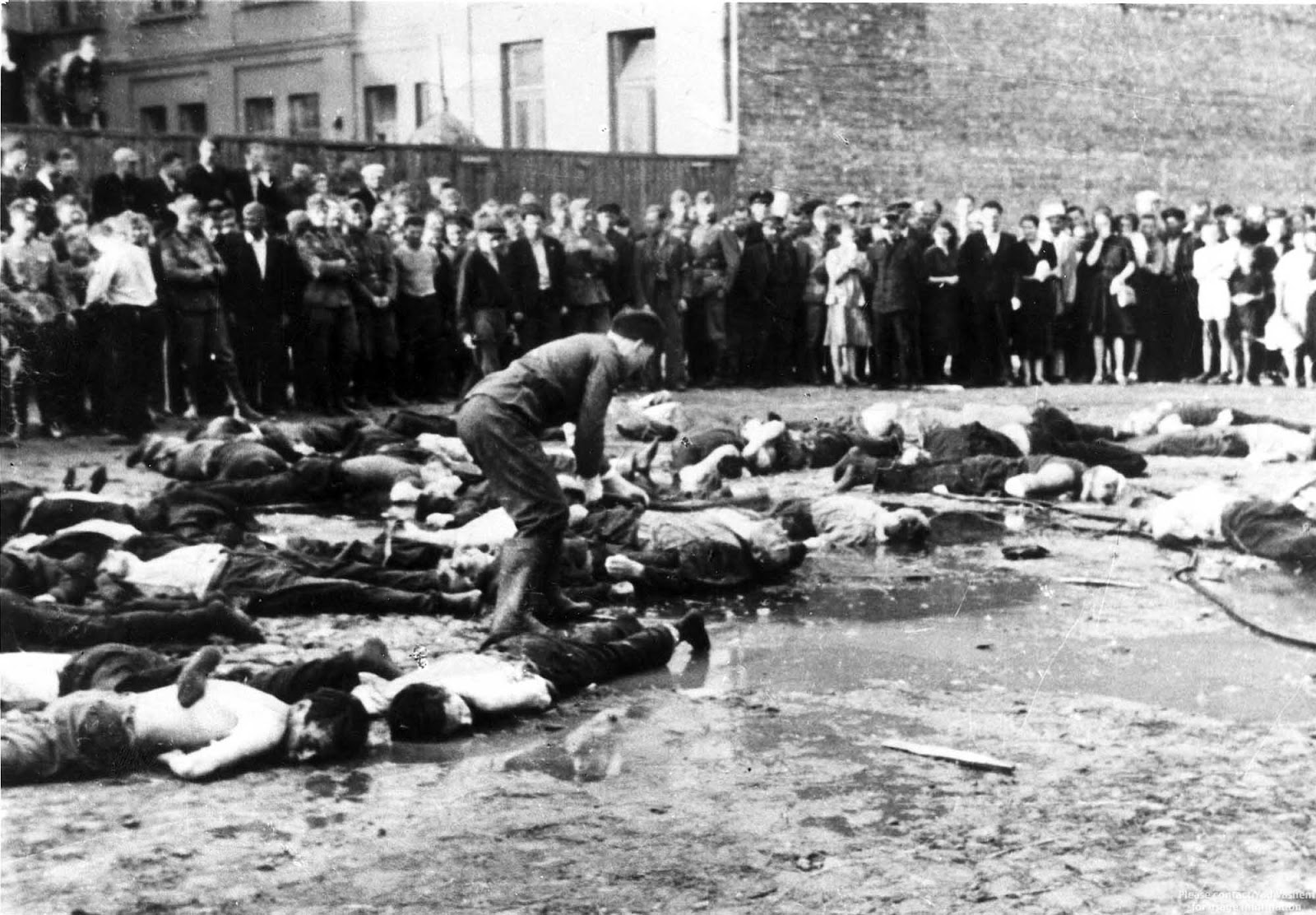
Kaunas, Lithuania, June 1941 (before Germans arrived): Killing of the Jews by local Lithuanians
I am surrounded by sea of people, all marching with torches. A chant begins: Lye Tu Vah! Lye Tu Vah! Lye Tu Vah! The chant becomes a roar and then dies away. It is patriotic Lithuanians shouting out the name of their country as they march through the streets of their capital city, Vilnius. We are celebrating the 101st anniversary of the restoration of Lithuania as an independent state. I feel a great surge of emotion as I join the chanting, swept away by the love these people feel for each other and for their land.We march to Cathedral Square, ...
On September 22, Ukraine’s Azov Battalion had a ceremony honoring its fighters who were killed in combat in eastern Ukraine’s Donbass regions. It is natural for any military unit to honor its dead. But it is evident from the images on Azov’s own website that this ceremony used iconography that is disturbingly reminiscent of the 1930s Nuremberg rallies, including the use of searchlights, the banners with Waffen-SS stylized logos and the flames.The background of Azov, its leadership, its recruitment and emblems are all deeply disturbing. It grew out of the Social-National Assembly of Ukraine (S.N.A.), a group of far right and neo-Nazi organizations ...
The Holocaust and the tragic events that befell the Jewish community in the Second World War are fast fading from Canadians’ memories.A recent survey by The Azrieli Foundation showed an alarming 52% of Canadian millennials cannot name even one concentration camp and 62% did not know six million Jews were killed in the Holocaust.It is essential that Canadians help preserve Holocaust memory and speak out against those who engage in denial, distortion or obfuscation. This is a perilous time, particularly for Jewish communities in Europe.The rise of extremist forces on the right is a critical challenge. Witness the recent targeting ...
How many times have we seen this before?The President of the United States is on TV telling us horror stories. Some innocent people in some corner of the world are being crushed, he tells us. They face some monstrously evil oppressor, he says. While the United States doesn’t like war, what choice is there? Sacrifices must be made, cruise missiles must be unleashed, to protect the poor and innocent. The world is the set of an action movie, and the US is the tragic hero, forced to rescue the innocent.This is the script we heard in former Yugoslavia. Bill Clinton ...
During the last decade the deteriorating political and military situation in the world have proved the necessity of well prepared Armed Forces.It is obvious that the level of patriotism in Lithuania is high as ever. Many young men are thinking to join the Armed Forces and be useful to the country. The government only should maintain and strengthen this trend. But battling with numerous political and economical problems the government is going to make some changes in military sphere that could have far-reaching adverse consequences.It should be said that today there is a serious gap in providing the national Armed ...
There is an old adage that pertains to the founding of the European Union «If at first you don’t succeed, try, try, again». And for the Nazis and Nazi collaborators of the Second World War, viewing the post-war European death and destruction brought about by Adolf Hitler and his «Third Reich» alliance of Italian fascists, French Vichy, and others, the immediate decision was to «try again» with a European Union that would establish the same European super-state envisaged by Hitler but with a decidedly «democratic» aura.What eventually became the EU, the European Coal and Steel Community, was formed by six Western European ...
"If we see that Germany is winning we ought to help Russia and if Russia is winning we ought to help Germany, and that way let them kill as many as possible…”Harry S. Truman, 33rd POTUS, 1941Since the end of the Second World War, the bourgeois historiography has tried to distort various incidents in order to vilify Socialism and the USSR. One of these incidents- which has been a “banner” of imperialism’s apologists and other anticommunists- is the so-called “Molotov-Ribbentrop Pact“* which was signed in 1939. In it’s unscientific, unhistorical effort to equate Communism with Nazism, the bourgeois propaganda presents ...
On August 9 [2020], presidential elections were held in Belarus with five candidates bidding to be head of state. According to the Central Election Commission, the incumbent president, Alexander Lukashenko, won in the first round with over 80% of the votes. Mass protests began in Belarus right after the announcement of the preliminary election results. People went to the streets, expressing their dissatisfaction with the results of the elections that they believe were unfair. Mass protests turned into riots and there were clashes between rioters and the police. Many people were detained and injured, and two protestors died.Representatives of the ...
"Welcome to Nulandistan: Propaganda and the Crisis in Ukraine" (2014)This full length GRTV documentary looks at the fictitious land of Nulandistan that has been constructed out of Ukraine.The GRTV documentary deconstructs Nulandistan and the propaganda of the Obama Administration [...], the US Department of States, US officials, and their allies about the crisis in Ukraine and takes a look at their growing frustration towards the Russian media, particularly RT, for challenging their account of the events on the ground in what they have declared is an intensifying information war.The full length documentary starts by looking at the self-benefiting description of ...
At the time of the illegal NATO bombing of Yugoslavia in 1999 when Martti Ahtisaari was the President of Finland, his government sought to commemorate and to honor Finland’s Nazi SS volunteers from the Holocaust. This offers irrefutable evidence of Ahtisaari’s direct links for support of Nazism and Nazi revisionism. If Ahtisaari had bothered to check the decisions of the Nuremberg War Crimes Tribunals, he would have found that that court held that all Waffen SS troops were war criminals guilty of war crimes and guilty of committing crimes against humanity, namely the mass murder of Jews. Ahtisaari lacks even ...
The Chinese have a genius for pithy expressions and few are more packed with meaning, while immediately understandable, than "paper tiger". NATO is one, but paper tigers that overestimate their powers can be dangerous.Some Russians are concerned that there are today more hostile troops at the Russian border than at any time since 1941. While this is true, it is not, at the moment, very significant. The Germans invaded the USSR with nearly 150 divisions in 1941. Which, as it turned out, were not enough.Today NATO has – or claims to have – a battle group in each of the three ...
Unless We Learn Our History, We’re Doomed to Repeat ItPreface: I am a patriotic American who loves my country. I was born here, and lived here my entire life.So why do I frequently point out America’s warts? Because – as the Founding Fathers and Supreme Court judges have explained – we can only make America better if we honestly examine her shortcomings. After all:“Dissent is the highest form of patriotism.”Only when Americans can honestly look at our weaknesses can we become stronger. If we fail to do so, history will repeat …While Americans rightly condemn the Nazis as monstrous people, ...
Chrystia Freeland, appointed last week to be the new Canadian Foreign Minister, claims that her maternal family were the Ukrainian victims of Russian persecution, who fled their home in 1939, after Adolf Hitler and Josef Stalin agreed on a non-aggression pact and the division of Poland between Germany and the Soviet Union. She claims her mother was born in a camp for refugees before finding safe haven in Alberta, Canada. Freeland is lying.The records now being opened by the Polish government in Warsaw reveal that Freeland’s maternal grandfather Michael (Mikhailo) Chomiak was a Nazi collaborator from the beginning to the ...
There is less talk about the rump-Ukraine in the news these days, especially in the western corporate media, and there is a good reason for that: that short-lived Urkonazi “Banderastan” is falling apart. This is hardly surprising since the entire concept was never viable in the first place. Let’s remember how it all began.It is crucial to remember that there was no spontaneous revolution or insurrection in the Ukraine, the Euromaidan had nothing to do with Europe and everything to do with the USA. Oh sure, the Ukrainian people were told that it was about “joining the EU”, but that ...
The negotiations on Brexit are attracting a lot of attention. In particular, the possible erosion of the rights of around three million EU-27 citizens living in Britain is a major cause for concern.The European Parliament resolution adopted on 3 October states that “the withdrawal agreement must incorporate the full set of rights citizens currently enjoy, such that there is no material change in their position”.The main author of this text, Mr Guy Verhofstadt, the EP Brexit Coordinator, argues that such an approach – not to lower the level of citizens’ rights – is “the goal of democracy”. But why was ...
DELFI, which is the major Internet portal in the Baltic States providing daily news, stated on September, 10 that the number of emigrants from Lithuania exceeds that of immigrants by 1,000 in August. Shocking statistics shows that the country has registered a negative migration balance. Some 4,382 people left Lithuania in August. Thus, Lithuanians are leaving the country despite authorities’ claims on economic growth, stability and favorable perspectives.On the one hand, according to “Lithuanian economy review – 2017”, the GDP growth in Lithuania accelerated. In 2017, as compared to the previous year, Lithuania`s GDP increased by 3.8%. (http://ukmin.lrv.lt/en/economy-review/lithuanian-economy-review-2017) On the ...
I don’t want to discuss the musical merits of who should have won the recent Eurovision amateur song contest in Stockholm. It’s brazenly clear that the Ukrainian ethnic Tatar Jamala won in a rigged contest to make a political intervention. As she subsequently openly admitted, it was between the actions of Stalin in World War II against Crimean Tatars and the actions of Moscow in 2014 in Crimea. The song of Jamala was blatantly political and by Eurovision, rules ought to be grounds to strip her of the title regardless of her singing talent or lack of the same. What ...
The recent declassification of over 3800 documents by the Central Intelligence Agency provides detailed proof that since 1953 the CIA operated two major programs intent on not only destabilizing Ukraine but Nazifying it with followers of the World War II Ukrainian Nazi leader Stepan Bandera.The CIA programs spanned some four decades. Starting as a paramilitary operation that provided funding and equipment for such anti-Soviet Ukrainian resistance groups as the Ukrainian Supreme Liberation Council (UHVR); its affiliates, the Organization of Ukrainian Nationalists (OUN) and Ukrainian Insurgent Army (UPA), all Nazi Banderists. The CIA also provided support to a relatively anti-Bandera faction ...
I am a Lithuanian, but I leave abroad and I am not going back. At least now, at least until the Government does not pay attention to its people. According to some authoritative research institutes, during 2017 Lithuania population is again projected to decrease (by 45 677 people!) and reach 2 758 290 in the beginning of 2018. (http://www.worldometers.info/world-population/lithuania-population/). As of 1 January 2017, the population of Lithuania was estimated to be 2 803 967 people. This is a decrease of 1.63 % (46 433 people) compared to population of 2 850 400 the year before. In other words, our ...
Origins of images: Facebook, Twitter, Wikimedia, Wikipedia, Flickr, Google, Imageinjection, Public Domain & Pinterest.Read our Disclaimer/Legal Statement!Donate to Support UsWe would like to ask you to consider a small donation to help our team keep working. We accept no advertising and rely only on you, our readers, to keep us digging the truth on history, global politics and international relations.[wpedon id="4696" align="left"]SaveSaveSave
The magazine is covering the research gaps uncovered by global Western hoax mainstream media platforms and academic teaching & research institutions.
This is an alternative information & academic research digest platform with the purpose to offer an alternative “another side of the truth”.
The magazine is independent, private, and free of any influence by any institution, organization, government, or pressure group. URL: www.global-politics.eu