

Views: 1714
Selim Demolli gripped the table with his hands, and his lip trembled with anger as he spoke.
The previous day he had talked to an imam about his son, who was killed three years ago in Syria. He asked the imam for a religious explanation about what happens to a dead person whose parents have not forgiven him. The answer was hard to take.
“He is not a shahid [martyr]. Those who did not get a blessing from their father cannot rest in peace. The imam even told me so. They are called ‘cursed’,” Demolli said.
Demolli’s son Burim was killed in October 2014 at the age of 31, during an offensive by US forces in the Syrian city of Aleppo.

Like Selim Demolli, hundreds of family members of Albanian jihadists from Kosovo, Albania and Macedonia live under the shadow of what their relatives have done, stigmatised and hated by others, and given no official support.
More than 315 people from Kosovo, 120 from Albania and over 100 from Macedonia have joined so-called Islamic State in Syria and Iraq over the past few years. At least 65 of them were killed in the fighting, leaving their families in an even worse plight.
Demolli, a 67-year-old from Pristina, said that he tried to stop his son from leaving.
“I informed the police, asking them to arrest him so that he could not go there. However, he managed to escape the police search while I was not at home, and he left with his wife and with three children,” he explained.
Burim Demolli was killed two months later, and now his father is searching for the ones who were left alive, his grandson and two granddaughters, who have remained in Syria.
His daughter-in-law, Edona Demolli, 28, was forced to marry another ISIS member, whose nationality Selim does not know. A month ago, she gave birth to a baby boy. Selim can no longer speak to her or his grandchildren.
Edona Demolli’s families, who live in the remote village of Majac, in Kosovo’s Podujeva municipality, feel uneasy about her story, particularly about her forced marriage and her child.
Nevertheless, the family sent 2,000 euros to her in Syria, although they do not want to reveal how they managed to transfer the money.
On an old Samsung smartphone, Selim keeps a video recording of his granddaughters singing an Albanian song. They are in a camp in Raqqa, and shooting can be heard outside.
The road to jihad
NATO airstrikes in 1999 helped lead Kosovo, a Muslim-majority country, to independence. One of the strongest supporters of the US and the West, Kosovo is also one of the poorest countries in Europe with an unemployment rate around 40 per cent.
Nearly two decades after the war, following the establishment of the Islamic State in Syria and Iraq, many young people from Kosovo, some of them taking their wives and children, joined ISIS and the al-Qaeda branch, al-Nusra.
Shpend Kursani, the author of research on the reasons for Kosovo citizens becoming foreign fighters in Syria and Iraq, cites the ideological and identity aspects as the main points of attraction for Kosovo Albanian youngsters to join ISIS.
“Their ideology is rather revolutionary, calling for revolution abroad, in Arab lands,” he said.
Kursani added that in Kosovo there is also an identity gap which can be exploited.
“There is a whole generation to whom their own identity is not clear anymore – are they Albanians or Kosovars, what is their flag, their symbol?” he says.
Selim Demolli said that after the killing of his cousin, Naman Demolli in Syria, Burim decided to join ISIS along with his two other cousins Fidan and Arben Demolli. Until Burim joined in 2013, he was mostly unemployed.
“Imams from Saudi Arabia would hold lectures and come to our neighborhood. Until then, Burim had been one of the followers of the imam Shefqet Krasniqi. One day he told me that he had met imams better than Shefqet Krasniqi in Pristina and they were teaching Islam accurately. I realised then that things had changed,” Demolli recalled.
After the war ended in 1999, Kosovo was flooded by Islamic organizations, most of them spreading religious propaganda under a humanitarian cloak. This was the time when some imams, originating from Saudi schools, would hold lectures in half-secret locations outside mosques.
Krasniqi, former imam at the main mosque in Pristina, is currently facing criminal charges related to terrorism. He refused to talk to BIRN about the charges.
Like Burim, a young generation of Albanians from Kosovo, Macedonia and Albania challenged traditional Islamic teaching by embracing the radical religious and political views that were taught at lectures at private mosques.
Fahrush Rexhepi, dean of the Faculty of Islamic Studies in Pristina, lecturer on the course ‘History of Religions: Islam and Europe’, said that indoctrination took place over a long period of time.
“Recruiters found suitable ground, especially amongst the younger generation, who are experiencing a deep identity crisis, feelings of hopelessness, losers, and without clear economic prospects for the future,” Rexhepi told BIRN.
Kosovo Special Prosecutor Drita Hajdari, who is leading several cases against former ISIS fighters, also blamed radical imams for grooming recruits.
“Some imams operated freely for a long time in an uncontrolled territory. They formed groups, held lectures and built camps [in Kosovo], while [officially Muslim organisation] the Islamic Community of Kosovo, kept silent. The latter put their heads in the sand and did not want to hear anything,” Hajdari said.
Farush Rexhepi argued meanwhile that Albanians went to fight in Syria and Iraq for ideological and political reasons, and potential recruits need strong explanations to dissuade them.
“What has been missing until now is a convincing, professional theological interpretation that participation in the war of Syria and Iraq is not jihad [an obligation] for Muslims,” he said.
Children born in ISIS camps
The Demollis currently have the largest number of relatives from Kosovo to have joined ISIS in Syria.
Nineteen members of the Demolli family currently live in a camp run by the Islamist group in Raqqa. The 20th member is a newborn child – although not a blood relation – the offspring of the forced marriage of Burim Demolli’s widow, Edona to an ISIS fighter.
According to Kosovo Police data, more than 30 children of Kosovo parents have been born in recent years at ISIS camps in Syria.
Kosovo remains a vital recruitment ground for fighters for defending the self-proclaimed ‘Caliphate’.
When the Kosovo authorities passed a law in 2014 which prohibited the country’s citizens from taking part in foreign wars, Kosovo Albanians had already risen in the Islamic State hierarchy.
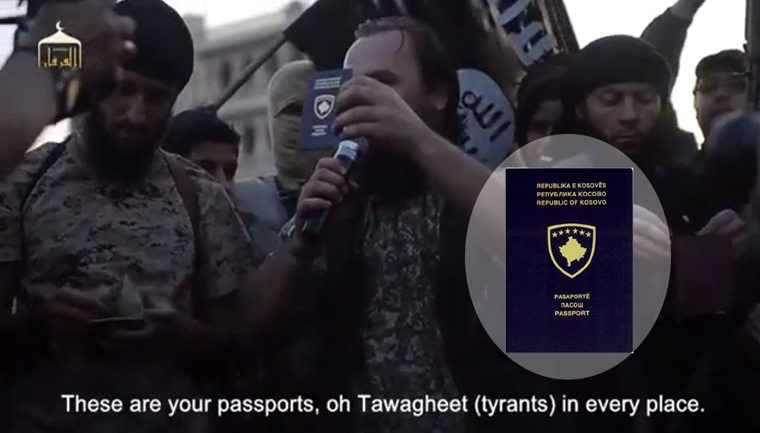
Some of them, such as Lavdrim Muhaxheri, described as a ‘most wanted’ terrorist by Interpol, sent derogatory video messages back home, including a video showing the beheading of a prisoner. Muhaxheri also made another video showing him tearing up Kosovo passports.
Ridvan Haqifi, a young Kosovo imam who was promoted within ISIS under the nickname Abu Muqatil al-Kosovi, meanwhile warned in a video that “black days are coming” for Balkans.
On a September afternoon in Gjilan, the house of the former commander of the Albanian ISIS members seems to be mired in sadness, fear, and isolation.
With his back against the front door, Ridvan Haqifi’s father Isa Haqifi recalled the grief suffered by the family after he lost his three sons in Syria – Ridvan, Astrit, and Irfan. His eldest son was 25 and the youngest just 19.
The family trusted in the Islamic State so much that they sent their 21-year-old son to Syria despite the fact that he was suffering from a serious skin disease.
“Ridvan took Astrit with him, hoping to take the results of his tests to Turkey, but Astrit was the first one to die there. Afterwards Ridvan was killed, and then Irfan, too,” his father explained.
The 52-year-old avoided answering questions about his family’s relations with ISIS, refusing to discuss what his sons did. “God knows if they did right or wrong,” he said.
Anne Speckhard, a professor of psychiatry at Georgetown University, and the director of the International Centre for the Study of Violent Extremism in Washington, said that in Kosovo, propaganda was the impetus for people to join ISIS – as well as poverty.
“They believed in the Islamic State and in the promises made for a better life in the Caliphate. There was the financial reason as well. A life without many prospects is the main reason that makes them join ISIS,” Speckhard argued.
But Isa Haqifi insisted several times that his sons did not join ISIS for financial rewards.
“Does this house represent any profit?” he asked, pointing at the small dwelling behind him.
‘Keep away from them, they are ISIS’
Speckhard said that the authorities should deal carefully with families of those who were killed in Syria, especially as some have children who were born there.
“Most of them are depressed. Some share the same ideology and exalt the death of their relatives, seeing them as ‘heroes’, while in fact they were terrorists. However, most of them suffer from social stigma, which might make them vulnerable,” she explained.
Dritan Demiraj, a former Interior Minister of Albania and a graduate of the country’s Military Academy as an expert in terrorism, said that the deradicalisation of relatives of ISIS fighters remains a challenge for the authorities.
“The Albanian authorities should provide social assistance to their relatives, particularly to their children. Such service centres have been established in various countries. So it is made clear to them that they have no future with terrorism,” Demiraj told BIRN.
Otherwise, Demiraj warned, Albania again may raise “a generation which is in danger of becoming radicalised”.
In 2016, an attack on the Israeli football team during a match with Albania was prevented at a stadium of the northern city of Shkoder. The Muslim community leader in the city, Muhamed Sytari, said it was important not to blame the families of the radicals.
“Heirs of those who were involved in the conflict in Syria and Iraq need to be protected from society’s prejudice. They should not be viewed as enemies. In Islam we say that no one is responsible for another person’s guilt,” said Sytari, the mufti of Shkoder.
But the authorities have made prosecution their priority in a thoroughgoing crackdown on Islamist radicals.
Kosovo’s prosecution records has launched160 cases in relation to the wars in Syria and Iraq. Courts have often imposed harsh sentences against returnees from Syria, some of whom had come back voluntarily.
The sentences have reduced the numbers leaving, but have not totally stopped the transfer of money from Kosovo to ISIS.
Authorities in Kosovo and Albania have developed counter-terrorism strategies, but reintegration of those who went to fight then returned remains a difficult task. Their families meanwhile have not been given any assistance.
Governments in both countries face the prospect of more jihadists coming home, bringing their ideology and combat training with them. The Kosovo government’s anti- extremism strategy outlines support and monitoring for returnees who cannot be jailed, but not for their family members.
“In its programme, [Kosovo Prime Minister] Ramush Haradinaj’s government has foreseen additional measures, including soft ones such as the establishment of a division within the Ministry of Internal Affairs for the prevention and reintegration of those radicalised,”Haradinaj’s office told BIRN by email.
Speckhard argued that prosecution should not be the only solution to stop the number of jihadi fighters from increasing.
“Conviction is inevitable, but for those who have no blood on their hands, it would be better to impose suspended sentences and to enroll them in reintegration programmes with an Islamic counter-message. Many of them can be rehabilitated, but some cannot, and they need time in prison,” she said.
Some parents are also ashamed of what their sons did. Depressed, living in poverty and near isolation, they also have to carry the stigma of having a son who will forever be labelled a terrorist.
Selim Demolli recalled how quite often, people have pointed him out accusingly. “There were even cases when they said, ‘Keep away from them, they are ISIS,’” he said.
Isa Haqifi, the father of Abu Muqatil al-Kosovi, who threatened his homeland with terror, said that the ones left behind were being made to suffer.
“This youngest son of mine completed primary school with excellent marks, but they would not admit him to enroll at medical school. Why? They know why; I also know,” he said.
His son then grabbed his arm, trying to make him stop talking to BIRN’s reporter.
Pointing at the neighbours’ houses and yards, the 15-year-old boy said: “They can all see us.”
Originally published on 2018-01-15
Authors: Serbeze Hoxhiaj, Elvis Nabolli
Source: Balkan Insight
Origins of images: Facebook, Twitter, Wikimedia, Wikipedia, Flickr, Google, Imageinjection & Pinterest.
Read our Disclaimer/Legal Statement!
Donate to Support Us
We would like to ask you to consider a small donation to help our team keep working. We accept no advertising and rely only on you, our readers, to keep us digging the truth on history, global politics and international relations.