
The NATO occupation was seen by Arab/Muslim countries as an opportunity to transform Kosovo-Metohija into a Muslim state. Terry Boyd in the Stars and Stripes article “In Kosovo, Islamic groups work to rebuild country, attract followers,” September 21, 2001, examined how Muslim countries were seeking the Islamization of Kosovo. The US State Department listed Kosovo as having active cells of al-Qaeda, Ossama bin Laden’s terrorist network. Al-Qaeda and Ossama bin Laden were aiding the UCK jihad in Kosovo. Iran was also active in Kosovo and Bosnia. Boyd reported that an Iranian Islamic group offered 120-300 German marks a month for Albanian Muslim women to wear headscarves and other Islamic religious attire. He noted that Arab/Muslim countries had set up aid and relief agencies in Kosovo. Saudi Arabia had established the Saudi Joint Committee for Kosovo and al-Haramain, a Arabic language center. Saudi Arabian Abdullah Al Turki, the Secretary General of the Muslim World League, was providing aid to “Kosovo refugees”, which was announced on March 25, 2002 by the Saudi government. Bahrain had funded the El-Asla Society, Islamic youth centers and instruction in Islam and in the Arabic language of the Koran. Sudanese nationals had set up youth centers, the World Association of Muslim Youth.
What was the motive for Arab/Muslim “humanitarian” aid to Kosovo? Was Muslim aid to Kosovo based on humanitarian concerns or to transform Kosovo into a radical new Muslim state? Boyd, however, noted another goal: “But nations hostile to the United States may be using begin efforts to camouflage more sinister plans, including creating an Islamic republic—similar to Iran—on Europe’s southern flank, according to sources.” On July 19 and 22, 2001, four Iranians “gun runners” were arrested by KFOR. But as early as 1999, US Rep. Helen Chenoweth, R-Idaho, in the Congressional debate on Kosovo, stated that the KLA is “a collection of Maoist drug-peddlers and terrorists who have been armed by Iran and provided with training and support by Saudi terrorist financier Osama bin Laden.” Boyd revealed the goal of the Islamic relief/aid groups to be to achieve the independence/secession of Kosovo from Serbia as an ethnically pure Islamic nation/republic. He noted that if the US/NATO could not achieve this, the Islamic countries would be willing sponsors: “That plan is to present fundamentalist Islam as an alternative to Western reluctance to grant independence to Kosovo.”
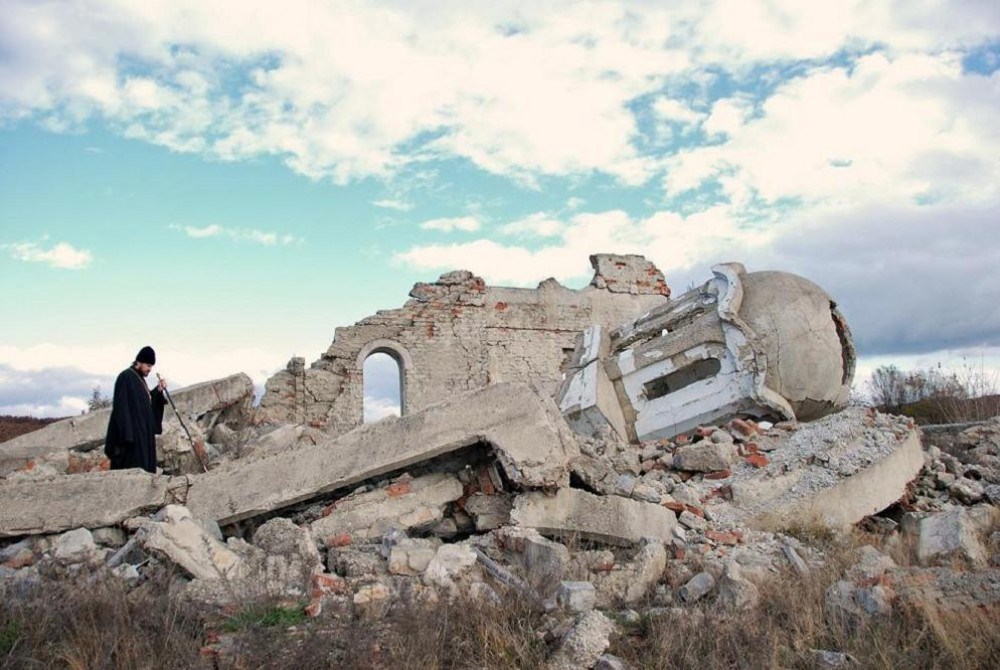
Concomitantly with the destruction of Orthodox churches, Islamic countries are being encouraged by the US and NATO to build mosques and Islamic centers in Kosovo, further erasing the Christian history of Kosovo. On August 20, 2000, the United Arab Emirates announced that they would finance the construction of 50 new mosques in Kosovo. In “Mohammed Orders Building 50 Mosques in Kosovo”, in the UAE Interact, it was reported that Sheikh Mohammed bin Rashid Al Maktoum, the Dubai Crown Prince and Defense Minister, would fund this project.
Ahmadiyya is an extremist Islamic movement from Pakistan that came to Kosovo to educate Muslims. Ahmadiyya offered help only if Albanian Muslims would accept the radical Islamic doctrines of the group and if they would train Muslim preachers. Naim Berisha said: “The Ahmadiyya came with copies of the Islamic holy texts in Albanian, plus pamphlets promoting their leaders, and especially their hatred of the West.” Two other Muslim groups were in the Balkans seeking to recruit Albanian Muslims: Ahl as-Sunna and Wa’al Jama’at.
Building new mosques in Kosovo after the Kosovo War in 1998-1999
We would like to ask you to consider a small donation to help our team keep working. We accept no advertising and rely only on you, our readers, to keep us digging the truth on history, global politics and international relations.
Yada…yada…yada. The discussion on the unprovoked and planned aggression by Georgia on South Ossetia is futile and moot because Russian President Dmitry Medvedev announced last week that the Russian Government would recognize the independence and freedom of South Ossetia and Abkhazia. On August 25, 2008, both houses of the Russian Parliament or Duma voted unanimously to recognize the independence of both South Ossetia and Abkhazia. On August 26, 2008, Russian President Dmitry Medvedev announced that the government of the Russian Federation officially recognized the independence of South Ossetia and Abkhazia.Save your rhetoric. Georgia has lost those areas permanently. Ossetians and ...
On 23 April 1999, a NATO missile attack on Radio Television of Serbia (RTS) headquarters killed 16 employees of the state broadcaster. The forgotten war crime occurred during the Kosovo War (March 1998-June 1999), and was part of NATO’s aerial campaign alongside the US-backed Kosovo Liberation army, in opposition to the Federal Republic of Yugoslavia.In the aftermath of the attack there were no great public campaigns launched for the 16 murdered journalists and employees, no outpouring of emotion for those killed, no calls for solidarity and togetherness in the face of aggression. On the contrary the West justified this grievous ...
Kosovo (in fact, Kosovo-Metochia), a disputed territory claimed by Serbia and Kosovo Albanian separatists, which Serbs regard as central to their cultural identity (differently to the Albanians), is going to pose much more unexpected problems for the international community concerning its political status as it became obvious that Belgrade and Prishtina cannot found common language during 22 years of negotiating process. The European Union already in 2007 formally warned the former leader of the Kosovo Liberation Army–Hashim Tachi, a winner of the 2007 November parliamentary and local elections to freeze the proclamation of independence as the final solving solution for ...
Iraq and Kosovo may be thousands of miles apart, but they share the dubious distinction of contamination with radioactive residue from depleted uranium (DU) bullets used in American air strikes. After several years of silence, US officials finally admitted that 340 tons of DU were fired during the Gulf war. In Kosovo, American delays in providing details of quantities and target points have frustrated international efforts to assess health risks. Despite repeated requests, NATO waited almost a full year after the start of bombing in March 1999 to say that 31,000 DU bullets–a fraction of the number fired in Iraq–were ...
In British mainstream commentary, the 1999 NATO bombing campaign against Slobodan Milosevic’s Yugoslavia is seen as a ‘humanitarian intervention’. Tony Blair still receives much praise for coming to the defence of the ethnic Albanians in Kosovo, whose plight was surely serious as they were subject to increasingly brutal abuses by the Yugoslav army towards the end of 1998 and early 1999. Yet the NATO bombing that began in March 1999 had the effect of deepening, not preventing, the humanitarian disaster that Milosevic’s forces inflicted on Kosovo. The bulk of the atrocities committed by Yugoslav forces took place after the NATO ...
“If the Nuremberg Laws were applied, then every post-war American President would have been hanged” Noam ChomskyEurasiaHenry Kissinger, one of the fundamental figures in creating and maintaining the US policy of global hegemony during the Cold War,[1] was quite clear and precise in his overviewing the issue of the American geopolitical position, national goals, and foreign policy. His remarks can be summarized in the following points:The US is an island off the shores of the large landmass of Eurasia.The resources and population of Eurasia far exceed the resources and population of the US.Any domination by any single state from Eurasia (either ...
What constitutes water can be scientifically proven beyond any doubt, now what constitutes a nation-state is a far more organic question than it would seem. Each of us is very used to seeing maps with the same countries and lines on it throughout the years and take their existence as a given. But depending on where a map comes from its borders may actually look very different. One of these countries to some and non-countries to others is Kosovo which gradually continues to lose the support of the states that recognized it into existence. Furthermore, this sheds light on how ...
On November 11, distinguished scholar, political economist, media analyst/critic, peace champion Ed Herman passed away at age 92.It was fittingly on the 99th anniversary of WW I’s end. Endless wars followed “the war to end all wars” – a legacy of mass slaughter and destruction Herman deplored, championing elusive world peace.Along with his friends and family, I mourn his passing, a valued friend and colleague, a contributor to my 2014 book, titled “Flashpoint in Ukraine: How the US Drive for Hegemony Risks World War III.”He and other distinguished contributors made the book successful, published in Russia and France.Ed Herman’s writing ...
Sultan Abdul Hamid II, in the face of a rising secular nationalism in the late 1800s, that culminated in the Young Turk movement, tried to restore the influence of the Ottoman Empire among Islamic nations and the Empire’s many peoples by stressing the importance of Islam and the Ottoman Caliphate, of the role of the Ottomans as the protectors of Islam and, in the modern world, a bulwark against western colonialism.Over a hundred years after he left power, after the Empire was broken up by the western powers after the First World War, after the Turkish nationalists under Mustafa Kemal, ...
IntroductionThe goals of this article are: 1) to investigate the role of the revived Patriarchate of Peć in Serbian and Balkan history?; and 2) to explore and present the results of investigation of the problems with respect to: a) the role of the Serbian Church during the first decades of the Ottoman occupation of Serbian lands in the process of the creation of a Serbian national identity; b) Serbian-Turkish relations in the second half of the 16th century; and c) the reasons for Serbian disloyalty towards the Ottoman government at the turn of the 17th century.The article addresses the reasons ...
Former slogan that has been so thunderously shouted within pre-election debates, and that was the last glimmer of declarative patriotism, dear both to politicians and football fans, by the development of the situation these days gets quite a different meaning.Kosovo is Serbia sometimes means that the Serbs, if not otherwise, at least in their souls will not give up the holy Serbian land. However, it might sound completely different today. Columns of Albanians from Kosovo carrying everything they own, leave Kosovo, pushing to catch last buses for a better life, moving towards Subotica, in order to try to reach some ...
“Kosovo: Can You Imagine?” is a documentary film by Canadian film maker Boris Malagurski, about the Serbs that live in Kosovo and the lack of human rights that they have today, in the 21st century.Most of the Kosovo Serbs have been ethnically cleansed by the Albanians who make up the majority of Kosovo.Kosovo has been under UN administration since 1999 when NATO bombed Serbia for 78 days to halt a crackdown on ethnic Albanian separatism in its province of Kosovo.In the years following the war, thousands of Serbs were expelled from their homes, kidnapped and killed. Their houses, cultural and ...
A strange spy affair broke out in Balkan Casablanca, aka Serbia, on Wednesday. Were NATO “advisers” and liaison personnel embedded in the Serbian army command finally caught red-handed by vigilant Serbian counter-intelligence operatives, purloining secrets? Not this time. (Something along those lines actually did happen in 2002; it was when former armed forces chief of staff Momcilo Perisic was caught on camera in a Belgrade restaurant handing over secret information for cash to CIA’s Johnny-on-the-spot, John Neighbor.) But what allegedly occurred this time was not a boring rerun of the Perisic affair, although the basic contours of the unimaginative scenario ...
Milo Djukanovic’s thirty-year-old authoritarian kleptocracy is killing Podgorica's Democratic efforts.Largely unnoticed in the wake of events in the Middle-East and the impeachment drama, another crisis is brewing in the Balkans. In Montenegro, thousands of people have been protesting a new law passed by the Montenegrin parliament and signed into effect by the country’s longtime strongman, Milo Djukanovic, which gives the government authority over properties that religious organizations in the country have been using for at least a century. Evidence of the problems the controversial new law creates can be seen in the widespread condemnation it has received from individuals such ...
The Serbs stepped again onto the historical scene in the years of the European wars that swept the continent from the forests of Ireland to the walls of Constantinople in the late 17th century. The Turks finally withdrew from Hungary and Transylvania when their Ottoman hordes were routed outside Vienna in 1683. The disintegration of Ottoman rule in the southwest limbered up the Serbs, arousing in them hope that the moment was ripe for joint effort to break Turkish dominion in the Balkans. The neighboring Christian powers (Austria and Venice) were the only possible allies. The arrival of the Austrian ...
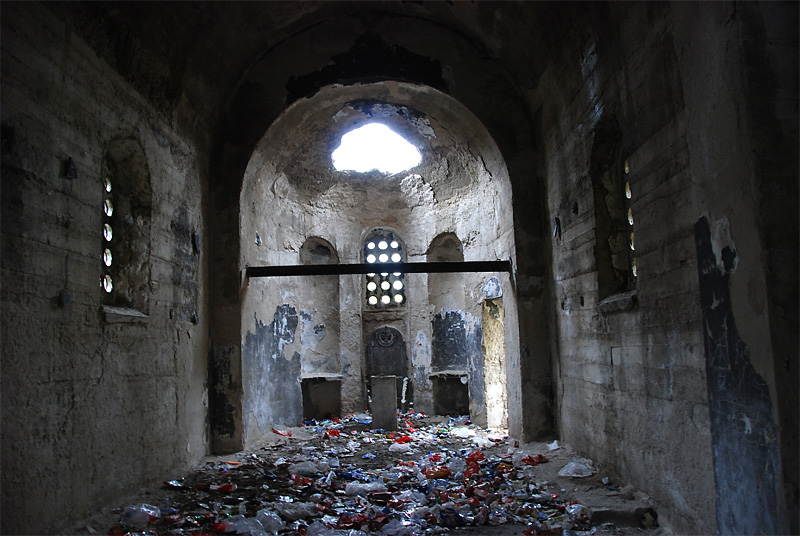
Destroyed Serbian Orthodox church in Kosovo by local Muslim Albanians after 1999In 2000, when George W. Bush was elected president in a controversial and hotly disputed election, all the experts and pundits predicted that there would be a philosophical sea change in US foreign policy in the Balkans, and in Kosovo in particular. In my 2000 analysis of the election of Bush and US foreign policy in Kosovo, however, I concluded that the George W. Bush Administration represented the same old same old and business as usual. In my viewpoint, absolutely nothing would change in the US foreign policy stance ...
The first thing you hear is the slow-moving clatter of a wheelchair. Then comes his voice. Fetah Rudi survived an attempted assassination which left him paralysed for life, and has spent more than 17 years suffering the consequences.Kosovo Liberation Army - A Balkan Islamic fundamentalist terrorist organizationIn June 1999, Rudi was one of the Kosovo Albanians who was detained and tortured in a Kosovo Liberation Army, KLA prison.A few months later in December 2000, Rudi - a member of the Democratic League of Kosovo, LDK, which at the time was President Ibrahim Rugova’s party - became a target during the ...
On January 17, Ukraine’s Verkhovna Rada (parliament) passed the bill No. 4128 on new amendments regarding the subordination (denomination) of religious organizations and the procedure of state registration of religious organizations with the status of legal entities. The relevant law No. 2673-VIII was signed by President Poroshenko on January 28 and came into force on January 31, 2019.Though the bill was designed to simplify the process of changing the religious subordination of a religious community, it actually introduces a new, more complicated scheme of registration and reregistration for religious organizations of all confessions including Protestants.So, reregistration becomes not just a ...
PrefaceKosovo is today one of the most disputed territories in Europe and a real Balkan powder keg which can explode again at any time. It is a province within the Republic of Serbia, recognized as such by both Serbia’s constitution and the Resolution 1244 by the Security Council of the United Nations (the UNSC Resolution 1244, June 10th, 1999). However, Kosovo parliament with a clear Albanian majority proclaimed the independence of Kosovo (without a referendum) in February 2008 that was recognized by the majority of the Western countries followed by their puppet clients all over the world (in reality, today ...
A project for Greater Albania – conspiracy or legitimate? According to a 2010 Gallup Balkan Monitor report, 83% of Albanians in Albania supported the idea of a Greater Albania, with 81% and 53% of Albanians in Kosovo and North Macedonia respectively supporting such an ambition.The ultimate goal? To have Kosovo and the Preševo Valley in Serbia, southern Montenegro, Epirus in Greece and western North Macedonia into a single Greater Albanian state. Although this may not be official policy of the Albanian Republic, it is ingrained into the Albanian mythos. The very idea of a Greater Albania has roots in the 1913 Treaty of London that left roughly 40% ...