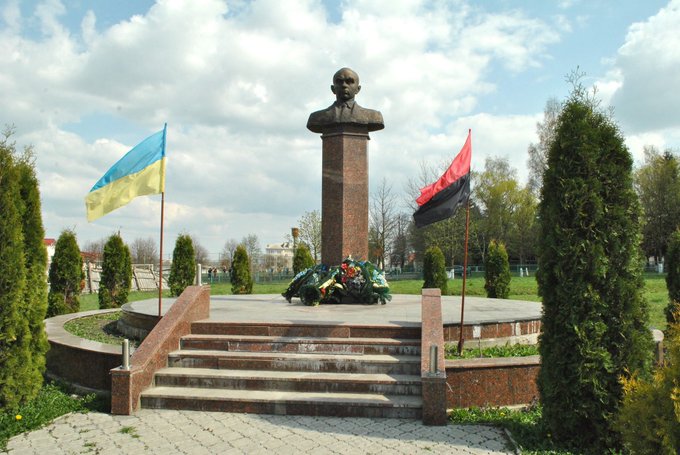
Stepan Bandera's monument in Buchach, Ukraine with the flag (right) of a neo-Nazi Ukrainian political organization

Views: 2262
A Father of the Nation
Ukraine is an East European territory which was originally forming a western part of the Russian Empire from the mid-17th century. That is a present-day independent state and the separate ethnolinguistic nation as a typical example of Benedict Anderson’s theory-model of the “imagined community” – a self-constructed idea of the artificial ethnic and linguistic-cultural identity. According to Anderson, the nation is an abstract and firstly subjective social construction that defy simple, objective definition yet has been for the last two centuries the crucial basis of conflict in world politics and international relations, through the assertion of their expressed nationalism.[i] However, nationalism is a quite broad ideology that can be easily transformed into a political movement that became the case, for instance, exactly with the Ukrainian self-imagined ethnonational identity. Acting politically, in principle by all means, on behalf of its own nation usually encompass pretty much a large scale of political ideas and practices including and ethnic cleansing or/and genocide on particular other national groups that happened, for example, in the WWII Ukraine when the Poles, Russians, Jews, and Gypsies (Roma) experienced the genocide committed by the Ukrainian Nazi-Fascist nationalists (the Banderists).

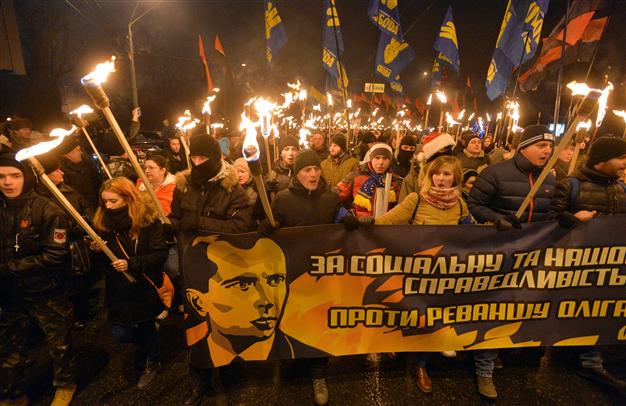
The 2014 Euromaidan protesters in Kiev with the picture of Stepan Bandera – a leader of the WWII Nazi-Fascist movement in Ukraine
Before 2014 Ukraine was a home of some 45 million inhabitants of whom, according to the official data, there was around 77 percent of those who declared themselves as the Ukrainians. Nevertheless, many Russians do not consider the Ukrainians or Belarus as “foreign” but rather as the regional branches of the Russian nationality. It is a matter of fact that, differently to the Russian case, the national identity of Belarus or the Ukrainians was never firmly fixed as it was always in the constant process of changing and evolving.[ii] The process of self-constructing identity of the Ukrainians after 1991 is basically oriented vis-à-vis Ukraine’s two most powerful neighbors: Poland and Russia. In the other words, the self-constructing Ukrainian identity (like the Montenegrin or Belarus) is able so far just to claim that the Ukrainians are not both the Poles or the Russians but what they really are is of great and endless debate. Therefore, the existence of an independent state of Ukraine, nominally as a national state of the Ukrainians, is of a very doubt indeed from both historical and ethnolinguistic perspectives.
The Slavonic term Ukraine, for instance, in the Serbo-Croat case Krajina, means in the English language a Borderland – a provincial territory situated on the border between at least two political entities: in this particular historical case, between the Kingdom of Poland and the Grand Duchy of Lithuania as the Republic of Both Nations (1569−1795) and the Russian Empire.[iii] The term is mostly used from the time of the treaty (truce) of Andrussovo in 1667 between these two states. In other words, Ukraine and the Ukrainians as a natural objective-historical-cultural identity never existed as it was considered only as a geographic-political territory between two other natural-historical entities (Poland and Russia). All (quasi)historiographic mentioning of this land and the people as Ukraine/Ukrainians referring to the period before the mid-17th century is quite scientifically incorrect but, however, in many (pro)Western academic writing cases it is politically inspired and colored with the purpose to present them as something crucially different from the historical process of ethnic genesis of the Russians.[iv]
Historically speaking, it was a Roman Catholic Vatican that was in fact beyond the process of creation of the “imagined community” of the Ukrainian national identity for the very confessional-political purpose to separate the people from this borderland territory from the Orthodox Russian Empire. Absolutely the same, as a matter of comparison, was done by Vatican’s client-state Austria-Hungary in regard to the national identity of Bosnian-Herzegovinian population when this province was administered by Vienna-Budapest from 1878 to 1918 as it was the Austria-Hungarian government who created totally artificial and very new ethnolinguistic identity – the Bosnians, just not to be the (Christian Orthodox) Serbs, who was at that time a strong majority of the provincial population.[v] Therefore, to be a Bosnian meant not to be a Serb with a final consequence to become a Roman Catholic what means the Croat. Similarly, in the case of Ukraine, to be a Ukrainian means primarily not to be a Christian Orthodox Russian.
A creation of ethnolinguistically artificial Ukrainian national identity and later on a separate nationality was a part of a wider confessional-political project by the Vatican in the Roman Catholic historical struggle against the Eastern Orthodox Christianity (the Eastern “schism”) and its churches within the framework of Pope’s traditional proselytizing policy of reconversion of the “infidels”. One of the most successful instruments of a soft-way reconversion used by the Vatican was to compel a part of the Orthodox population to sign a Union Act with the Roman Catholic Church and recognized at such a way a supreme power by the Pope and dogmatic filioque (“and from the Son” – the Holy Spirit proceeds and from the Father and from the Son). Therefore, the ex-Orthodox believers who now became the Uniate Brothers or the Greek Orthodox believers became in a great number later on a pure Roman Catholics who as well as changed their original (from the Christian Orthodox time) ethnolinguistic identity. It is, for instance, very clear in the case of the Christian Orthodox Serbs in Zhumberak area of Croatia who passed the way from the Christian Orthodox Serbs to the Greek Christian Orthodox believers but later became the Roman Catholics and finally, today are the Croats. Something similar occurred and in the case of Ukraine. On October 9th, 1596, it was announced by Vatican a Brest Union with a part of the Orthodox population within the borders of the Roman Catholic Lithuanian-Polish Commonwealth (today Ukraine).[vi] The crucial issue in this matter is that today Ukraine’s Uniates and the Roman Catholics are mostly anti-Russian oriented having at the same time strong Ukrainian national feelings. Basically, both the Ukrainian and the Belarus present-day ethnolinguistic and national identities are historically founded on the anti-Christian Orthodox policy of the Vatican within the territory of ex-Polish-Lithuanian Commonwealth that was, in essence, an anti-Russian policy.
The Lithuanian historiography writing on the Church Union of Brest in 1596 clearly confirms that:
“… the Catholic Church more and more strongly penetrated the zone of the Orthodox Church, giving a new impetus to the idea, which had been cherished since the time of Jogaila and Vytautas and formulated in the principles of the Union of Florence in 1439, but never put into effect – the subordination of the GDL Orthodox Church to the Pope’s rule”.[vii]
In other words, the rulers of the Roman Catholic Grand Duchy of Lithuania (the GDL) from the very time of Lithuania’s baptizing in 1387−1413 by the Vatican had a plan to Catholicize all Orthodox believers of the GDL among whom the overwhelming majority were the Slavs. As a consequence, the relations with Moscow became very hostile as Russia accepted the role of the protector of the Christian Orthodox believers and faith, and therefore the Church Union of Brest was seen as a criminal act by Rome and its client-state of the Republic of Two Nations (Poland-Lithuania).
Today, it is absolutely clear that the most pro-Western and anti-Russian part of Ukraine is exactly the West Ukraine – the lands that were historically under the rule by the Roman Catholic ex-Polish-Lithuanian Commonwealth and later on by the former Habsburg Monarchy (Austria-Hungary). It is obvious, for instance, from the presidential elections voting results in 2010 as the pro-Western regions voted for Y. Tymoshenko while the pro-Russian regions of East Ukraine did it for V. Yanukovych. It is a reflection of the post-Soviet Ukrainian identity dilemma between Europe and Eurasia – a dilemma that is of common nature for all Central and East European nations who historically played a role of a buffer zone between the German Mittel Europa project and the Russian project of a pan-Slavonic unity and reciprocity.
The fact is that the western territories of present-day Ukraine are mainly populated by the Roman Catholics, the East Orthodox, and the Uniates. This part of Ukraine is mostly nationalistic and politically pro-Western oriented. East Ukraine is in essence a Russophone territory and subsequently “tends to look to closer relations with Russia”.[viii] By the Vatican policy of signing the union with the Christian Orthodox believers in present-day West Ukraine from 1596 the necessary preconditions for de-Russification and Ukrainization of the local inhabitants were founded. At the course of time, as a consequence of such a policy by the Roman Catholic Church, Ukraine became sharply divided by confession, national feelings, economic development, linguistic identity, and geopolitical orientation to such extent that Ukraine today is an example of the “failed state”.[ix] By scholarly definition, “a failed state is a state that is unable to perform its key role of ensuring domestic order by monopolizing the use of force within its territory”.[x]

The 1994 Presidential election results in Ukraine according to historical regions
According to the 2001 census, out of Ukraine’s 45 million inhabitants, 17,3 percent were the Russians but 30 percent were speaking the Russian language. Subsequently, a great part of those who identified themselves as the Ukrainians recognized that their native language is, in fact, the Russian. In addition, there were 83 percent of Ukraine’s inhabitants in 2008 for whom Russian was a chosen language as a lingua franca. There is as well as a mixture of the Russian language and the Ukrainian language with a predominant Russian vocabulary spoken in the countryside – the Surzhik.[xi]
The Ukrainian authorities up today did not properly solve the problem of the official language in the country as it is officially fixed to be the Ukrainian that is spoken in the western regions of the country while the Russian is spoken in the eastern provinces of Ukraine and even used as a lingua franca by the majority of the population. Therefore, official bilingualism would be a matter of a real solution to many current ethnopolitical problems in Ukraine. If Belgium can be officially bilingual state, there is no obstacle for Ukraine to be the same.
 Dr. Vladislav B. Sotirović
Ex-University Professor
Vilnius, Lithuania
Research Fellow at the Center for Geostrategic Studies
Belgrade, Serbia
www.geostrategy.rs
sotirovic1967@gmail.com
© Vladislav B. Sotirović 2023
Personal disclaimer: The author writes for this publication in a private capacity which is unrepresentative of anyone or any organization except for his own personal views. Nothing written by the author should ever be conflated with the editorial views or official positions of any other media outlet or institution.
[i] Benedict Anderson, Imagined Communities: Reflections on the Origin and Spread of Nationalism, Revised edition, London: Verso, 2016.
[ii] On the Ukrainian self-identity construction, see [Karina V. Korostelina, Constructing the Narratives of Identity and Power: Self-Imagination in a Young Ukrainian Nation, Lanham, Maryland: Lexington Books, 2014].
[iii] A German historical term for Ukraine would be a mark – a term for the state’s borderland which existed from the time of the Frankish Kingdom/Empire of Carl the Great.
[iv] For instance, Alfredas Bumblauskas, Genutė Kirkienė, Feliksas Šabuldo (sudarytojai), Ukraina: Lietuvos epocha, 1320−1569, Vilnius: Mokslo ir enciklopedijų leidybos centras, 2010.
[v] Лазо М. Костић, Наука утврђује народност Б-Х муслимана, Србиње−Нови Сад: Добрица књига, 2000.
[vi] Arūnas Gumuliauskas, Lietuvos istorija: Įvykiai ir datos, Šiauliai: Šiaures Lietuva, 2009, 44; Didysis istorijos atlasas mokyklai: Nuo pasaulio ir Lietuvos priešistorės iki naujausiųjų laikų, Vilnius: Leidykla Briedis, (without year of publishing), 108.
[vii] Zigmantas Kiaupa et al, The History of Lithuania Before 1795, Vilnius: Lithuanian Institute of History, 2000, 288.
[viii] John S. Dryzek, Leslie Templeman Holmes, Post-Communist Democratization: Political Discourses Across Thirteen Countries, Cambridge−New York: Cambridge University Press, 2002, 114.
[ix] Зоран Милошевић, „Друштвени процеси у самосталној Украјини“, Радови, Филозофски факултет, Источно Сарајево, 2005, 289.
[x] Andrew Heywood, Global Politics, New York: Palgrave Macmillan, 2001, 121.
[xi] Срђан Перишић, Нова геополитика Русије, Београд: Медија центар „Одбрана“, 2015, 273−275.
Repeating history
Read our Disclaimer/Legal Statement!
Origins of images: Facebook, Twitter, Wikimedia, Wikipedia, Flickr, Google, Imageinjection, Public Domain & Pinterest.
Donate to Support Us
We would like to ask you to consider a small donation to help our team keep working. We accept no advertising and rely only on you, our readers, to keep us digging the truth on history, global politics, and international relations.

Territorial enlargement of Ukraine
FOLLOW US ON OUR SOCIAL PLATFORMS