
The 95th Anniversary of the Destruction of Greeks and Armenians in Smyrna
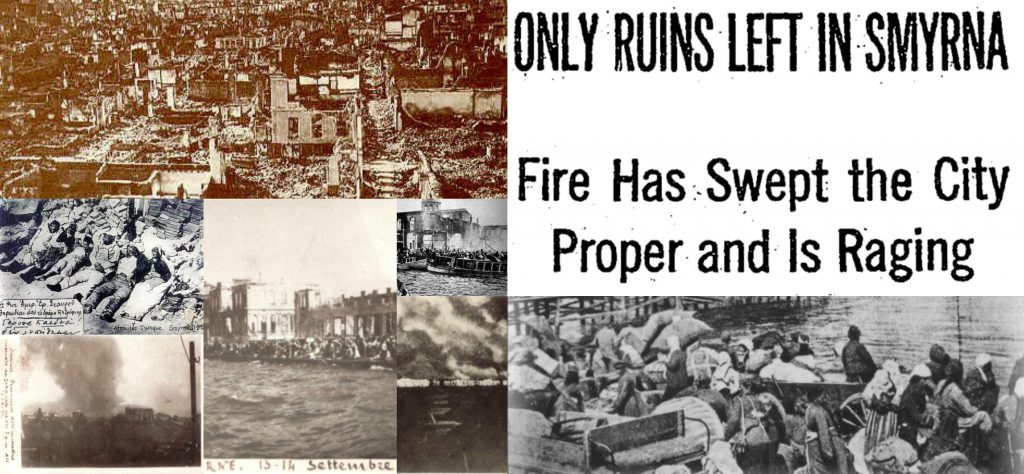
The Allied Powers suspected Ataturk was going to take reprisals on the city for the conduct of the Greek army during the Greco-Turkish war, and warned him against doing so, but he ignored their warning and got away with it. It was an unnecessary act of wanton destruction that affected only the Christian sections of the city. What happened is very well documented, by eyewitness accounts, photographs, and even video [...]
Tehmine Martoyan is lecturer at the University of Economy and Law (Yerevan, Armenia). She is also the president of Lazaryan Institute scientific and educational NGO.
Martoyan is the author of books and articles on the Armenians in Safavid Iran, and she has participated in international conferences and meetings in Armenia and abroad. She also translated into Armenian the book by Theofanis Malkidis titled The Greek Genocide: Thrace, Asia Minor, Pontus.
She has made two films dedicated to the Greek and Armenian populations in Smyrna. Her forthcoming book is titled Psychological and Political Causes of Annihilation of the Armenians and the Greeks in Smyrna.
This interview was conducted by email during early Sept. 2017.
***
George Shirinian: You contributed the chapter in Genocide in the Ottoman Empire: Armenians, Assyrians, and Greeks, 1913-1923, titled “The Destruction of Smyrna in 1922: An Armenian and Greek Shared Tragedy.” Amid all the chaos and destruction at that time, why is the fate of this one city noteworthy today?
Tehmine Martoyan: First of all, I would like to express gratitude for the opportunity to commemorate with the readers of this journal the 95th anniversary of the destruction of Smyrna, which began on Sept. 13, 1922. Smyrna was a major international commercial center, and it was also known as a tolerant and cultured place, where Christians, Jews, and Muslims had lived together in harmony and prosperity, before the advent of extreme Turkish nationalism.
The Allied Powers suspected Ataturk was going to take reprisals on the city for the conduct of the Greek army during the Greco-Turkish war, and warned him against doing so, but he ignored their warning and got away with it. It was an unnecessary act of wanton destruction that affected only the Christian sections of the city. What happened is very well documented, by eyewitness accounts, photographs, and even video.
The extermination of the Armenian and Greek people of Smyrna and the destruction of the Christian districts of the city made a great impression on contemporaries and continues to attract the attention of researchers today. Entire books are still being written about it.
G.S.: Explain briefly what happened.
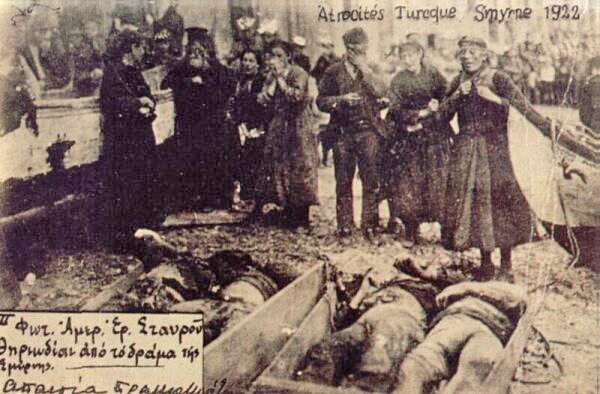
T.M.: One author has described the event this way: “What happened over the two weeks that followed must surely rank as one of the most compelling human dramas of the twentieth century. Innocent civilians—men, women, and children from scores of different nationalities—were caught up in a humanitarian disaster on a scale that the world had never before seen.” The Armenians and the Greeks of Smyrna were systematically robbed, murdered, and abducted.
According to the account of Edward Bierstadt—secretary for Near East Relief at the time—around 100,000 people fell victim to the slaughter, and 160,000 were driven away to the farthest parts of Turkey. More than 50,000 houses, 24 churches, and 28 schools, banks, consulates, and hospitals were burned. Turkish soldiers deliberately led the fire down the Greek and European sections of Smyrna by soaking the streets with petroleum or other highly flammable matter.

The people were massed along the quay, and with the fire and intense heat behind them; they had nowhere to go but jump into the Mediterranean. There were ships from several countries just outside the harbor, but most had orders not to intervene. Greek ships took refugees to the island of Mytilene and elsewhere, and a Japanese ship was noteworthy for joining the effort from the start, rescuing survivors from the sea.
The American navy helped only when the courageous Asa Jennings, a devout minister from upstate New York who had only recently arrived to take up duties as secretary to the local YMCA, rowed out to them and personally demanded that they rescue survivors. He was assisted by an equally courageous and strong-willed naval officer, Lt. Commander Halsey Powell. Together, they helped rescue almost a million refugees.
So, beyond the story of the destruction of the city and its non-Muslim population, there is the story of courageous rescuers who defied orders not to intervene.
G.S.: Why did Ataturk destroy this jewel of a city?
T.M.: To a certain extent it was to punish the Greeks for the Greco-Turkish War, even though the Smyrniotes were Ottoman citizens. But Smyrna was also a symbol of Christian prosperity, a major center of European trade, and an example peaceful coexistence between Christians and Muslims—all things the new Turkish nationalist movement was vehemently against. Ataturk even declared that neither American colleges nor any Christian institutions would operate in Smyrna in future. He wanted to build a new “Turkey for the Turks” out of the ashes of the Ottoman Empire.
G.S.: Is there any parallel in history for such a destruction of a single city?
T.M.: The massacre in the Chinese city of Nanking (Nanjing) by the Japanese in 1937-38 comes to mind. It is interesting to note that the International Criminal Tribunal for the Former Yugoslavia ruled that the murder of some 8,000 Muslim Bosnians in Srebrenica in 1995 was “genocidal.” One could say the same for the murder of 100,000 Armenians and Greeks of Smyrna.
G.S.: You mentioned that this history is particularly well documented. Are new sources still coming to light?
It is true that this history is particularly well documented, and there are new sources still coming to light. I am now researching the entire press of the period at the National Archives of Armenia and Fundamental library of the National Academy of Sciences of the Republic of Armenia. I can also add that I had the opportunity to incorporate in my chapter a previously unpublished letter of the American eyewitness, Bertha Morley, from the Zoryan Institute archives.
G.S.: You have done extensive work on the Greek Genocide. Why do you, as an Armenian historian, devote so much attention to the Greek experience?
T.M.: Historical-cultural ties between the Armenians and the Greeks from ancient times are evident in their religion, culture, traditions, lifestyle, legends, etc. These two nations have always had strong ties, both emotionally and historically, due to religious and cultural roots.
Studying the experiences of these two peoples in parallel, I use content analysis as a research method to show how both the Armenians and the Greeks suffered from genocide that was planned and committed by the same state. As the subtitle of my chapter states, unfortunately the Armenians and Greeks have a shared tragedy.
We would like to ask you to consider a small donation to help our team keep working. We accept no advertising and rely only on you, our readers, to keep us digging the truth on history, global politics and international relations.
South-East Europe, and especially the Balkan Peninsula as the main part of it, have traditionally been the object of numerous geopolitical, geostrategic, and publicist analyses, as well as the subject of debates among the Balkan, European, and global experts in international relations. The new Iron Curtain or the Cold War 2.0 between western and eastern Europe was not the end of the Balkan’s importance for the US administration and NATO as well. At present, along with the Serbian and Macedonian national questions, the most controversial issue is the Albanian national question or, more precisely, the question of the Kosovo knot.[1] ...
George Mauropoulos, "The Forgotten Genocide of the Greeks of Asia Minor", AHIF Policy Journal, American Hellenic Institute Foundation, Inc., Vol. 8, Spring 2017, pp. 3Origins of images: Facebook, Twitter, Wikimedia, Wikipedia, Flickr, Google, Imageinjection & Pinterest.Read our Disclaimer/Legal Statement!Donate to Support UsWe would like to ask you to consider a small donation to help our team keep working. We accept no advertising and rely only on you, our readers, to keep us digging the truth on history, global politics and international relations.
Last week Pontian Greeks throughout the world justifiably recognized a tragic day in their history that has come to be known as the Pontian Genocide.I wrote about the anniversary, obscure to most people around me who are not well-versed in Greek history and even had to repeatedly change my auto-correct on my computer, which insisted on changing the word Pontian to Pontiac.This anniversary was followed by another recognition of yet another genocide of Greeks— officially commemorated on April 6 and recalling the tragic events targeting the Greeks of Eastern Thrace— the region known today as European Turkey or the lands ...
Outrageous: Slobodan Milosevic cleared of charges by the International Criminal Tribunal for the former Yugoslavia. But no-one is talking about it!The ICTY (International Criminal Tribunal for the former Yugoslavia) has discharged Slobodan Milosevic from 1992-95 Bosnian war crimes allegations. This is definitely prime time news, while it holds endless political implications. Oddly enough, though, no major international mainstream media seems to have noticed.Well, it is understable for everyone to be keeping it quiet: those who with one voice did dub him the “butcher of the Balkans”; those who associated him to Hitler, initiating a pattern which would later be extended ...
Origins of images: Facebook, Twitter, Wikimedia, Wikipedia, Flickr, Google, Imageinjection & Pinterest.Read our Disclaimer/Legal Statement!Donate to Support UsWe would like to ask you to consider a small donation to help our team keep working. We accept no advertising and rely only on you, our readers, to keep us digging the truth on history, global politics and international relations.

Armenians and others around the world this month are marking the centennial of the genocide that left hundreds of thousands of Armenians dead early in the last century. The date April 24 is typically picked as the centennial day since it was on that day in 1915 that Turkish authorities rounded up Armenian intellectuals and leaders in Constantinople and murdered them.It was the first step in a much broader slaughter. The Armenian centennial is getting the attention it deserves from sources as diverse as Pope Francis and Kim Kardashian. The Pope courageously used the word “genocide” in a mass this ...
The United States, Europe, and their partners must officially recognize the Mountainous Karabagh Republic within its constitutional frontiers.Stepanakert, Mountainous Karabagh — I no longer know what to do on April 24—or where to go. This is the day Armenians across the globe commemorate the genocide in 1915 that destroyed the Armenian people and its homeland of thousands of years.Those killing fields, the homes of my grandparents, are located in historic western Armenia—now eastern Turkey. But a century later, this very region has erupted in all-out war. Turkish forces are on the offensive again, this time, Armenians having been eliminated, against ...
The Asia Minor and Pontos Hellenic Research Center is pleased to announce a new book, Genocide in the Ottoman Empire: Armenians, Assyrians, and Greeks, 1913-1923. Edited by George N. Shirinian. New York and Oxford: Berghahn Books, 2017. 433 pages.The final years of the Ottoman Empire were catastrophic for its non-Turkish, non-Muslim minorities. From 1913 to 1923, its rulers deported, killed, or otherwise persecuted staggering numbers of men, women and children in an attempt to preserve “Turkey for the Turks,” setting a modern precedent for how a regime can commit genocide against its own citizens in pursuit of political ends, while ...
While the numbers are not as high as Auschwitz or Treblinka, Jasenovac was notorious for its cruelty and the high number of young children who were victims.April 22 is a date that binds two groups of people who shared the same tragic fate. It is the date that commemorates the revolt of the prisoners of Jasenovac, the death camp that claimed the lives of hundreds of thousands of Jews, Serbs and Roma.While the numbers are not as high as Auschwitz or Treblinka, Jasenovac was notorious for its cruelty and the high number of young children who were victims. The saddest ...
May 19, 1919 has different and even opposing meanings in Turkey and Greece, just as May 15, 1948, marks both the establishment of Israel and, for Palestinians, the start of the Nakba (“catastrophe”).In Turkey, this date marks the first step that led to the establishment of the Turkish Republic, while for descendants of Ottoman Greeks and Greece it marks the end of the centuries-long Pontic Greek presence on the shores of the Black Sea. Whereas Turks celebrate May 19, Greeks mourn it. Researcher Tamer Çilingir summarised the issue in a 2016 interview with the Turkish-Armenian daily Agos:“The Pontic Genocide is the ...
Part I, Part IISplit, Croatia: "Kill Serbs" written on the car arrived from SerbiaTerritorial imperialism of the HDZ’s CroatiaThe fact was that all ultranationalistic parties and organizations in the 1990s struggled for the creation of a Greater Croatia according to the principle of the ethnographic, historical and even natural rights. In all of those concepts, Bosnia-Herzegovina was seen as an integral part of united Croatia. There were, in principle, two concepts of united Croatia: A minimal concept of Croatia within the borders of the Banovina Hrvatska as it was in the Kingdom of Yugoslavia in 1939−1941 (when a Greater Croatia ...
The Greek Genocide (or Ottoman Greek Genocide) refers to the systematic extermination of the native Greek subjects of the Ottoman Empire before, during and after World War I (1914-1923). It was instigated by successive governments of the Ottoman Empire; the Committee of Union and Progress Party (C.U.P), and the Turkish Nationalist Movement of Mustafa Kemal Atatürk. It included massacres, forced deportations and death marches, summary expulsions, boycotts, rape, forced conversion to Islam, conscription into labor battalions, arbitrary executions, and destruction of Christian Orthodox cultural, historical and religious monuments. According to various sources, approximately 1 million Ottoman Greeks perished during this period.The first ...
The political situation in Turkey is clearly dramatic, but it is also equally complicated. Turkish President Erdogan has succeeded in securing levels of power unique in the nation′s history. But is this situation really unique? No – for 15 years, the father of the nation Ataturk ruled alone over the early Republic, which was a one-party nation at the time. Only his untimely death in 1938 deprived him of that power.Up to that point, Ataturk alone ruled over every conceivable dimension of domestic and foreign policy. Even clothing and music were tailored to his ideas. The aim was the creation ...
The current Greek population in Turkey is estimated at fewer than 2,000. But this population decline was not due to natural causes; the Greek community has become nearly extinct due to many state-sponsored attacks and pressure.The largest attacks took place during the last years of the Ottoman Empire with pogroms and discrimination continuing until the present day.In 2007, the International Association of Genocide Scholars (IAGS) announced that “the Ottoman campaign against Christian minorities of the Empire between 1914 and 1923 constituted a genocide against Armenians, Assyrians, and Pontian and Anatolian Greeks.”The destruction of Greek heritage and institutions, including schools, continued ...
A massive destruction of the Ottoman (Orthodox Christian) Armenian population in 1915−1916 is probably the greatest atrocity committed during the WWI and for sure a first 20th century case of the genocide as up to 1.500.000 ethnic Armenians were executed by the Ottoman authorities and their collaborators (the Kurds). As a consequence, the survivors are scattered across the globe. Today it is already a century old event, but the issue of the 1915−1916 Armenian Genocide is undoubtedly still alive and divisive political issue firstly between the Armenians and the Turks[1] but also and among the western “liberal democracies” on the ...
Part IThe basic cornerstones of the Croat ultraright nationalistic ideologyFrom the point of the ideology of the extreme Croat nationalism, the cardinal goal of ultraright nationalistic parties, groups, ideologists and politicians was to create for the first time after 1102 an independent, as much as a Greater and finally “Serben-frei” Croatia. In the 1990s it was an exactly ultraright nationalistic ideology that provided the main background for creation of a new normative order and values in the HDZ’s Croatia. This ideology had five cardinal cornerstones which gave the framework for building a new institutional order, political values and means to ...
Message in the Bottle, One Hundred Years LaterSmyrna, Ottoman Empire, September 1922 Dear World – Our time has come to disperse like wildflower seeds in the wind. We are the last storytellers and children of the Ancients, their legacy and their accomplishments. The men and women have been separated. Many men were sent to the interior. Women clutching their babies, even in death, have walked miles. The elders have fallen by the roadside. The children, oh, the sweet children, their eyes are glazed with fear, their words lost, and, yet, they see a butterfly and for one moment, they smile. If only … ...
This weekend 75 years ago, the German city of Dresden was razed to the ground by British and American aerial bombardment. At least 25,000 mainly civilians were destroyed in raid after raid by over 1,200 heavy bombers, indiscriminately dropping high explosives and incendiaries. It took seven years just to clear the rubble.The destruction of Dresden, a world-famous cultural center of Baroque majesty, has been long dogged by controversy. Official British and American military accounts claim it was necessary to hasten the collapse of the Third Reich; with a reasoning that resonates with US claims for dropping the atomic bombs on ...
The ethnic division of SFR Yugoslavia in 1991“Thousands joined a peaceful protest on Saturday in the Croatian town of Vukovar to express their anger at Croatian institutions for their “silence” over war crimes committed during the 1990s war” (Balkan Transitional Justice, 2018-10-13).The following essay is my constructive contribution to the above article.PrefaceOn the occasion of more than two decades of the end of the civil war on the territory of ex-Yugoslavia (1991−1995), it is necessary to reassess the real causes and cardinal perpetrators of Yugoslavia’s internal and external bloody destruction. In the western scientific literature of the “liberal democracy” scholars ...
After 267 days, the end of the battle of Mosul was announced on July 10th. “Liberation” is a misleading notion, because the hostilities have not stopped, the human suffering has not stopped.There are still victims in the city every day on both sides.Many refugees have no home to go back to and are suffering from severe mental health problems, especially the children.No reason to celebrateWere inter alia destroyed:9 of the 10 major hospitals.76 of the 98 medical centres.6 big bridges across the Tigris.three-quarters of Mosul’s roads,400 educational institutions, including schools, universities and education centres.11,000 residential housing units.4 electrical power plants ...
The magazine is covering the research gaps uncovered by global Western hoax mainstream media platforms and academic teaching & research institutions.
This is an alternative information & academic research digest platform with the purpose to offer an alternative “another side of the truth”.
The magazine is independent, private, and free of any influence by any institution, organization, government, or pressure group. URL: www.global-politics.eu