
The new series by Ken Burns and Lynn Novick is mesmerizing. But it doesn’t answer the questions about the Vietnam War that many are still seeking [...]
Well-intentioned and artfully executed, The Vietnam War—Ken Burns and Lynn Novick’s 10-part, 18-hour-long documentary series on PBS—is not history, but rather story-telling and remembrance. Balanced, exhaustive, and relentlessly solemn, it glides along the surface of things, even when that surface is crowded with arrogance, miscalculation, deceit, and bloodletting on an epic scale.
According to one promotional trailer prepared for the series, “In war there is no single truth.” Embedded within every war (as in other forms of human endeavor) are multiple truths—some of them trivial, others very important indeed. The purpose of history is to unearth and engage with those truths that have something to teach us. This requires a willingness to interpret and render moral judgments. Yet Burns and Novick have an aversion to interpretation and steer clear of judgments.
Notably, among the many subjects interviewed for the project, professional historians—those trained to interpret the past—are all but absent. Whether as soldiers, government officials, reporters, antiwar activists, or mere bystanders, the series’ featured “talking heads” all participated in the events they recount. Their authority derives from what they themselves did or saw several decades ago and from how they have since processed those experiences. As witnesses, none are less than credible. Many are eloquent and offer deeply moving testimony: the Americans mournful, the South Vietnamese bitter, the North Vietnamese and former Vietcong resolute and assured. Yet largely absent from any of their recollections is a sense of distance or detachment. All are, in effect, partisans of one stripe or another.
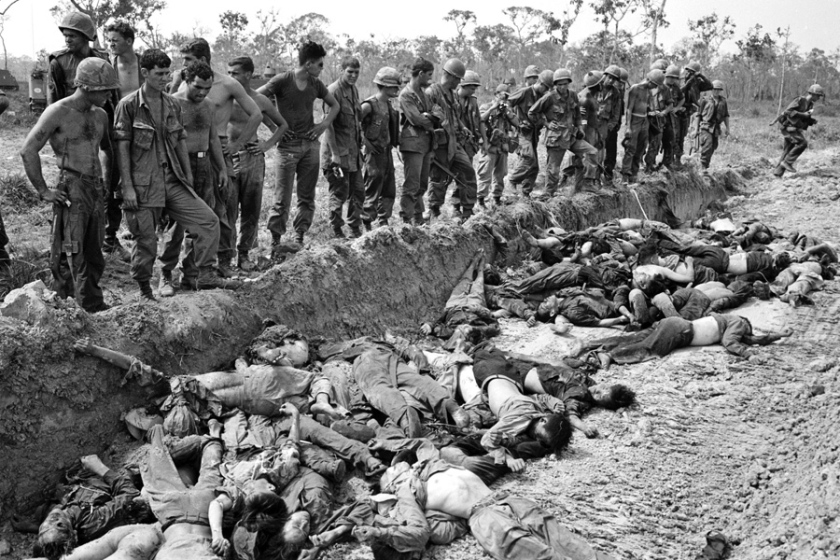
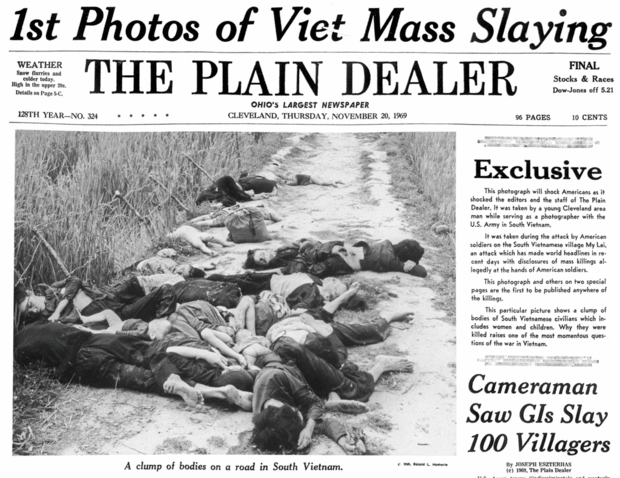
If The Vietnam War as a whole has a point to make, it would appear to be that war is a great tragedy. Of course, this qualifies as a truism. In this particular tragedy, the participants on all sides—the people of North and South Vietnam no less than the Americans sent to fight against the North on the South’s behalf—suffered more or less equally. On all sides, the combatants exhibited courage and stamina. No side was innocent of grievous atrocities. All are victims; all are guilty. Or so Burns and Novick would have us believe.
I don’t mean to suggest that the series stakes out a position of bland neutrality. But the controversies it does take up tend to be either already resolved or largely peripheral. For example, Burns and Novick briefly examine and summarily reject the claim, cherished by devotees of Camelot, that President John F. Kennedy was planning to pull out of Vietnam once reelected in 1964. They also expose as simply untrue the US military’s claim that despite losing the war, it never “lost a fight.” In recounting the Battle of Hill 1338 in June 1967, for example, they depict in excruciating detail the destruction of an elite American paratroop unit, a tactical defeat that senior US officers subsequently covered up. And on the charges that, in 1968, Richard Nixon’s campaign conspired to derail the peace talks in order to improve his chances of winning the presidency, Burns and Novick find Nixon guilty. In each instance, their evidence is irrefutable. But having delivered their verdicts, they simply move on. So Nixon’s treasonous behavior becomes just one more anecdote.
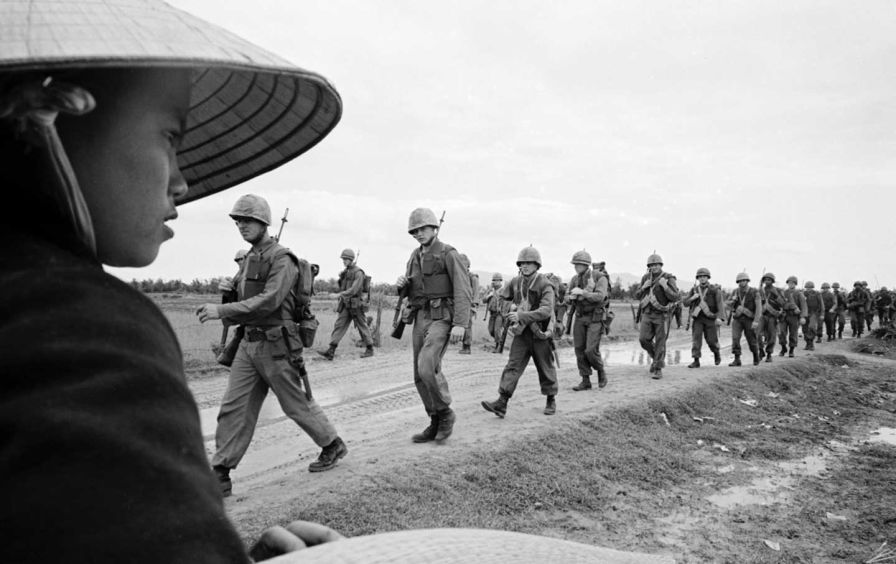
Throughout The Vietnam War, the production values are of the highest quality. The narrative unfolds seamlessly, cutting from the war zone to the home front (theirs and ours) and back again. The period footage—a surprising amount of it North Vietnamese—is vivid and compelling. GIs wade through rice paddies, trudge up mountainsides, and stumble into ambushes set up by the North Vietnamese Army and the Vietcong. At night, fleets of Russian-built trucks lumber down the Ho Chi Minh Trail, trying to conceal themselves from the ordnance-laden American jets prowling overhead. Flying low and slow over the jungles of South Vietnam, Air Force C-123s dump tons of chemical defoliants, with nary a thought about the second-order consequences. Cruising at altitude over North Vietnam, Laos, and Cambodia, B-52s disgorge their bomb loads onto whatever lies below. And always there are helicopters, mostly Hueys, Cobras, and Chinooks, touching down to unload assault troops, provide suppressive fire, or evacuate casualties. The cumulative effect is both mesmerizing and obscene.
Burns and Novick complement the imagery with a soundtrack consisting of pop songs from the 1960s and ’70s: Dylan, Seeger, the Stones, Led Zeppelin, Jimi Hendrix, Barry McGuire, Simon & Garfunkel, and so on. With few exceptions, the recordings have a political edge, however oblique—no show tunes, no doo-wop, no lovey-dovey mush. Sgt. Barry Sadler’s mawkish “Ballad of the Green Berets,” a hit in 1966, doesn’t make the cut. The music is clearly intended to convey the sense that the film has something profound to say, even if, to quote a famous Buffalo Springfield lyric, “what it is ain’t exactly clear.”
Merrill McPeak, a former fighter pilot interviewed for this series, takes a stab at clarifying one central issue: “We were fighting on the wrong side.” Given that McPeak remained on active duty after the war and, as a four-star general, eventually served as Air Force chief of staff, his verdict is all the more noteworthy. But it is also off the mark. The United States screwed up not because it picked the wrong side in the Vietnam conflict, but because it stuck its nose where it didn’t belong. It simply wasn’t for us to decide who were the good guys and who the bad guys. The fate of Vietnam was an issue of negligible relevance to US national security. Had the United States allowed the Vietnamese to settle their differences on their own terms, everyone would have been better off. Almost certainly, far, far fewer people would have died.
Yet Burns and Novick pay surprisingly little attention to why exactly the United States insisted on butting in and why it subsequently proved so difficult to get out. Their lack of interest in this central issue is all the more striking given the acute misgivings about a large-scale US intervention that Lyndon Johnson repeatedly expressed in the fateful months between late 1964 and early 1965.
The anguished president doubted that the war could be won, didn’t think it was worth fighting, and knew that further expansion of US involvement in Vietnam would put at risk his cherished Great Society domestic-reform program. He said as much in taped conversations with Defense Secretary Robert McNamara, National Security Adviser McGeorge Bundy, and his friend Georgia Senator Richard Russell, among others. Despite his reservations, Johnson—ostensibly the most powerful man in the world—somehow felt compelled to go ahead anyway. Yet Burns and Novick choose not to explore why exactly Johnson felt obliged to do what he did not want to do.
Our present situation makes the question all the more salient. The US war in Afghanistan, although smaller in scale than the war in Vietnam, has dragged on even longer. It too has turned out to be a misbegotten enterprise. When running for the presidency, Donald Trump said as much in no uncertain terms. But President Trump—ostensibly the most powerful man in the world—has not turned his skepticism into action, allowing America’s longest war to continue.
In a very real sense, Trump did not so much decide as capitulate. Much the same can be said about LBJ a half-century earlier when he signed off on committing US combat troops to Vietnam. But Burns and Novick barely touch on the factors leading to Johnson’s capitulation, even though, in present-day Washington, those factors persist: a brain-dead national-security establishment unable to conceive of political alternatives to escalation; a fear that admitting military failure will exact unacceptable political costs, whereas the costs of perpetuating an unwinnable war are likely to be tolerable; and, perhaps above all, the iron law of American exceptionalism, centered on the conviction that Providence summons the United States to exercise global leadership always and everywhere, leadership having long since become synonymous with a willingness to use force. As Trump has affirmed, even (or perhaps especially) presidents must bow to this pernicious bit of secular theology.
According to Burns and Novick, the American war in Vietnam was “begun in good faith, by decent people.” It comes closer to the truth to say that the war was begun—and then prolonged past all reason—by people who lacked wisdom and, when it was most needed, courage. Those who fought in the war and those who fought against it will certainly want to watch this series. Yet to find the answers that many are still searching for, they will have to look elsewhere.
We would like to ask you to consider a small donation to help our team keep working. We accept no advertising and rely only on you, our readers, to keep us digging the truth on history, global politics and international relations.
So the moment we’ve been holding our breaths for a week finally came. In the end, I am mighty glad that this particular strike seems more like the impotent thrashing of the neocon snake that didn’t dare to attack places where Russian servicemen were likely to be killed, than it does the start of World War III. For the moment, at least, thank God.But the fact that it was a fairly limited strike — compared to what it might have been — in which the majority of missiles failed to hit their targets, having been eliminated by Soviet-era air defences, ...
The great deception of “a real democracy” in the Ukraine, which the New York Times insisted on 31 March 2019, shows little sign of relenting. For five years, Western populations have been consistently misled through skewed and slanted reporting, assuring the readership that what is unfolding in Kiev is a “fledgling democracy”, as a Washington Post editorial further outlined on 6 April 2019.In reality it was a United States-funded coup d’état. During the months prior to Viktor Yanukovych‘s February 2014 ousting, elite American organizations bankrolled the “anti-government protests”, revealed as much in December 2013 by Victoria Nuland, then a high ...
Truth on the war in Euromaidan Ukraine in photos.The people of Donetsk sent a farewell message to ex-President of the US (POTUS) Barack Obama with proper photo evidence of the result of his policy in the region.See the truth not presented on any global Western corporate mass-media!Origins of images: Facebook, Twitter, Wikimedia, Wikipedia, Flickr, Google, Imageinjection, Public Domain & Pinterest.Read our Disclaimer/Legal Statement!Donate to Support UsWe would like to ask you to consider a small donation to help our team keep working. We accept no advertising and rely only on you, our readers, to keep us digging the truth on ...
While the typical narrative of American history positions the United States as a supporter of democracy and opponent of fascism which helped to defeat the Nazis, key figures in Washington also supported dangerous dictators in Italy and Germany in their early days of power.Noam Chomsky, the renowned political philosopher, historian and scholar, examined the flip side of U.S. opposition to dictatorship in a conversation with Zain Raza, a senior editor at the independent media outlet acTVism Munich. An excerpt from the conversation was published Sept. 30 as part of acTVism Munich’s “Reexamining History” series.Speaking to Raza about Italian dictator Benito ...
Watching the Ken Burns-Lynn Novick 18-hour series, “The Vietnam War,” is an emotional experience. Whether you served in the US military during the war or marched in the streets to end it, you cannot remain untouched by this documentary. The battle scenes are powerful, the stories of US veterans and Vietnamese soldiers who fought on both sides of the war compelling.The toll in human terms caused by the war is staggering. Nearly 58,000 Americans and 2 to 3 million Vietnamese, many of them civilians, were killed in the war. Untold numbers were wounded. Many US veterans of the war suffer ...
The world is at a dangerous crossroads. The United States and its allies have launched a military adventure which threatens the future of humanity. Major military and covert intelligence operations are being undertaken simultaneously in the Middle East, Eastern Europe, sub-Saharan Africa, Central Asia and the Far East. The US-NATO military agenda combines both major theater operations as well as covert actions geared towards destabilizing sovereign states.America’s hegemonic project is to destabilize and destroy countries through acts of war, covert operations in support of terrorist organizations, regime change and economic warfare. The latter includes the imposition of deadly macro-economic reforms ...
Future war “may see attacks via computer viruses, worms, logic bombs, and trojan horses rather than bullets, bombs, and missiles” [Steven Metz, Armed Conflict in the 21st Century: The Information Revolution and Post-Modern Warfare, Carlisle, PA: Strategic Studies Institute, 2000, xiii].First partThe facilities of the Internet in politicsThe Internet or the WWW (World Wide Web) became massively widespread around the globe since the late 1980s or more precisely since 1989 – in the same year when the Berlin Wall collapsed and, therefore, enabled the Cold War 1.0 to enter the final stage of its end. That is why both of these ...
The US media has done it again. In a breaking news story on Fox News on Friday, September 28, 2007, Fox reporter Catherine Herridge used the term “former Yugoslavia” twice in the Fox story “Terrorist 007”. The term Yugoslavia was used deliberately to conceal the fact that the Al Qaeda terrorist known as Terrorist 007, or Irhabi 007 in Arabic, Younes Tsouli, had ties to Bosnia and to Bosnian Muslims who planned terrorist attacks.Fox News sought to conceal this Al Qaeda connection to Bosnia by using the term “former Yugoslavia” in place of “Bosnia”. This was deliberate and planned. Someone ...
Dear Readers and Friends:The distinguished and knowledgeable international commentator William Engdahl, in a superb statement, has expressed the view I gave you that Russian President Vladimir Putin’s speech on September 28 at the 70th anniversary of the United Nations changed the balance of power in the world. Until Putin’s speech the world was intimidated by the Washington Bully. Resistance to Washington brought swift retribution. In the Middle East and Africa it brought economic sanctions and military invasions that destroyed entire countries. In France and other US vassal states it brought multi-billion dollar confiscations of bank net worth as the price ...
It is coming clear these days that many university professors are increasingly fat-cat and lazy, not doing any research once they get tenure. It is a system-wide corruption of the academy, so entrenched that central administrations have only led the corruption in multiplying salaries and offices with no committed function to advancement of learning and dissemination of knowledge – the constitutional and statutory objective of the academy the best are devoted to everywhere.This deep-structural degeneration is not confined to any one place or region. Regular contacts from other universities report a similar decadence. The solution is straightforward, but unspoken: (1) ...
The so called "Croatian scenario", is something that has been periodically brought up after the start of the armed conflict in Donbass. (Among other instances, yours truly noted this in articles from this past December 17 and August 24, 2015.) Promoted at Johnson's Russia List, the December 28 Euromaidan Press article "What Ukraine Can Take from the 'Croatian Scenario' of Conflict Resolution", omits some key factors for being apprehensive about the probability for success of an Operation Storm like strike against the Donbass rebels.In 1995, the Serb Yugoslav leader Slobodan Milosevic, had essentially dropped the Krajina Serbs, with the hope that he could improve his relationship with the West. At ...
We all know how the story goes. The Golan Heights is Syrian territory that has been occupied by Israel since the 1967 Six-Day War. It was then controversially annexed in 1981, despite the UN calling the efforts “null”, “void” and “without international legal effect”. Today it is still internationally and legally recognised as Syrian land, but Israel persists with its possession.Of course, such persistence can prove to be quite lucrative when the land is abundant in resources – especially land as fertile as the Syrian Golan – a generous source of gushing waters and game changing oil reserves.In fact, the ...
War Crimes and War CriminalsAfter WWII, there was a growing number of significant non-state actors in international relations (IR), like the United Nations (UN) or various specialist agencies connected to it. Nevertheless, two key developments stimulated the growth of such organizations after 1945:The realization that building cooperation and collective security was a much wider task than merely deterring aggressors in traditional attacks on the fixed international order. It, therefore, involved finding ways of agreeing on international policy in a variety of practice areas.The coverage of international law is increasing to include new foci, including human rights, social justice, the natural ...
What must the world think watching the US presidential campaign? Over time US political campaigns have become more unreal and less related to voters’ concerns, but the current one is so unreal as to be absurd.The offshoring of American jobs by global corporations and the deregulation of the US financial system have resulted in American economic failure. One might think that this would be an issue in a presidential campaign.The neoconservative ideology of US world hegemony is driving the US and its vassals into conflict with Russia and China. The risks of nuclear war are higher than at any previous ...
The US military forces committed a classical example of the aggression on one sovereign and independent state on April 6th, 2017 by bombing a territory of Syrian Arab Republic by 59 Tomahawk cruise missiles killing civilians who are proclaimed as usually as “collateral damage”. A formal excuse for the aggression was based as many times before (from Vietnam, Kosovo, Afghanistan, Iraq, Libya… cases) on traditional political false flags and mainstream media fake news used by the US propaganda machinery to sanction the Pentagon’s hegemonic policy of the Pax Americana.The Fundamental DilemmaThe fundamental dilemma is why the US administrations of Obama ...
The reports that black Africans are being sold at slave markets in "liberated" Libya for as little as $400 is a terrible indictment of the so-called "humanitarian intervention" carried out by NATO to topple the government of Muammar Gaddafi in 2011.In March 2011 virtue-signaling Western "liberal" hipsters teamed up with hardcore neocon warmongers to demand action to "save" the Libyan people from the "despotic" leader who had ruled the country since the late 1960s. “Something has to be done!” they cried in unison.Something was done. Libya was transformed by NATO from the country with the highest Human Development Index in ...
One of the West’s top points in condemning Vladimir Putin’s “regime” since 2007 has been his alleged suppression of democratic institutions, including an assault on media freedom and imposition of government-directed propaganda. This week, the accusation was repeated in a resolution of the European Parliament calling for stronger counter-measures in defense of European values against “information warfare” from Moscow.The charges — that Russian media are only an instrument of state propaganda directed at the domestic population to keep Russian citizens in line and at foreign audiences to sow dissent among Russia’s neighbors and within the European Union — are taken ...
The United States approaches the November 2020 election with growing apprehension, even dread.Among the possibilities:Protracted uncertainty about the presidential contest. Think Florida 2000 but with several states’ results unresolved for weeks or even months (“Experts held ‘war games’ on the Trump vs. Biden election. Their finding? Brace for a mess”);A disputed outcome, perhaps with Donald Trump and Joe Biden both claiming victory, compounded by a “blue shift,” where states are claimed by Trump on election night but flip over to Biden as additional absentee and mail-in ballots conveniently turn up days or weeks later;Violent civil conflict, spurred on in the ...
What is global politics? It is when a white man sends a black man 20.000 km. far away from home to kill a yellow man, while at home this white man is living on the land occupied from a red man From 1989 onward, as a consequence of the dissolution of the bipolar world in global politics, Security Studies as an academic discipline re-born again its political importance. From the very traditional point of view, it was only the national-state to be considered as the reference object of the security issue that was usually to be obtained by military power[1] and diplomatic ...
The missile attack on a US ship off the coast of Yemen was a major news event, but the subsequent follow up story, that it may never have happened, was either ignored by mainstream media or intentionally covered up. The whole thing has the same odor as the Gulf of Tonkin incident that never occurred.Does history repeat itself? Sure does seem like it. That is if you compare America’s entry into the Vietnam civil war, with America’s latest entry into the war in Yemen.Don’t be mistaken, we have been at war with Yemen for a year now. America sided with ...