
Interview with Historian David Motadel: Islam and Nazi Germany’s War
During the Second World War, tens of thousands of Muslims fought on the side of the National Socialists. In interview with Nastassja Shtrauchler, historian David Motadel examines the attitude of Hitler and the Nazis towards Islam and Muslims. Interview by Nastassja Shtrauchler [...]
In your book, “Islam and Nazi Germany’s War”, you write about the policies of the Nazis towards Islamic political entities. What form did they take?
David Motadel: At the height of the war in 1941-1942, when German troops entered Muslim-populated territories in the Balkans, North Africa, Crimea and the Caucasus and were approaching the Middle East and Central Asia, Berlin began to see Islam as politically significant. Nazi Germany made significant attempts to promote an alliance with the “Muslim world” against their alleged common enemies – the British Empire, the Soviet Union, America and Jews.
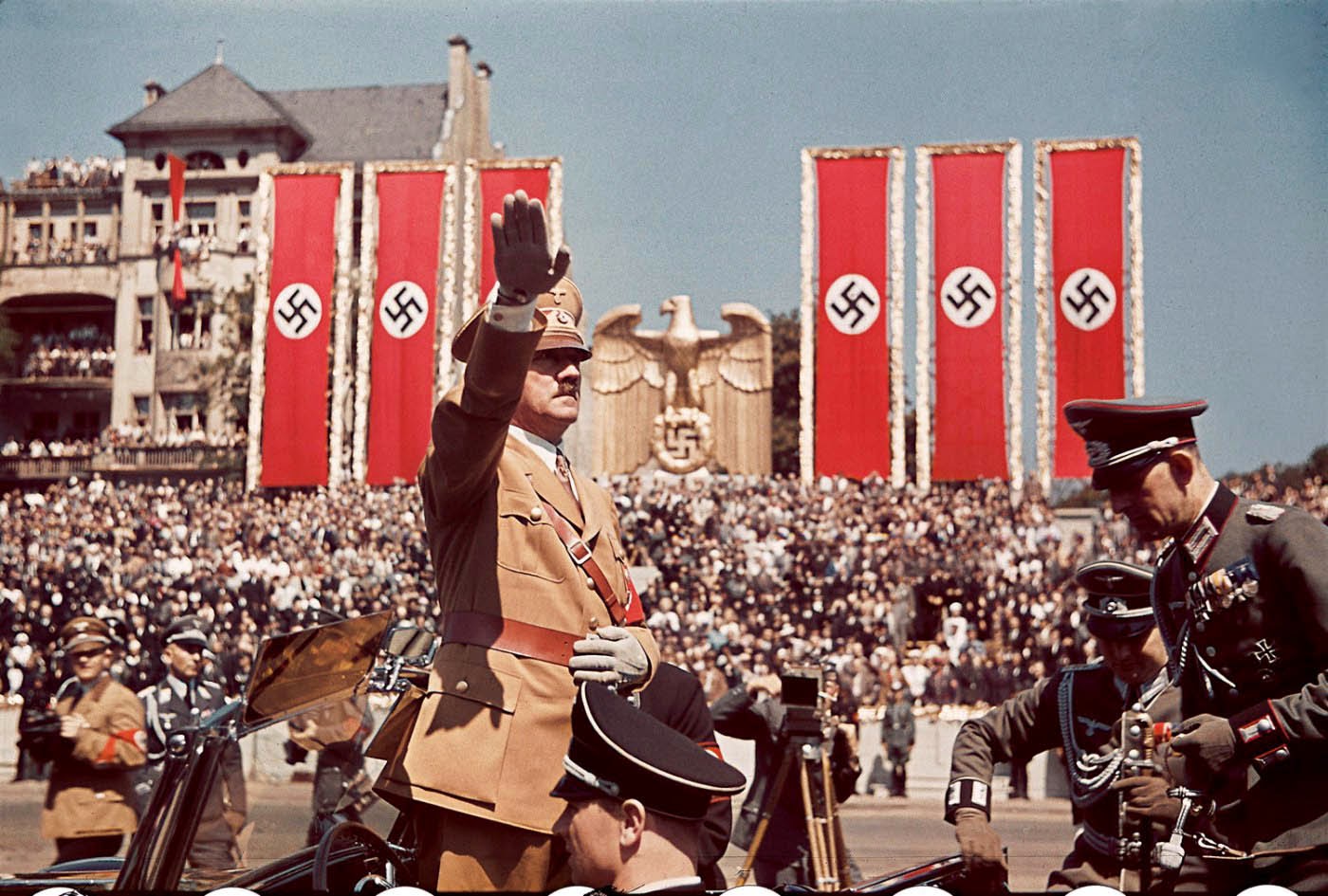
In the war zones, Germany engaged with a wide range of religious policies and propaganda to promote the Nazi regime as the patron of Islam. As early as 1941, the Wehrmacht distributed the military handbook “Islam” to train its soldiers to behave correctly towards Muslim populations.
On the eastern Front, the Nazi occupiers ordered the rebuilding of mosques, prayer halls and madrassas – previously destroyed by Moscow – and the re-establishment of religious rituals and celebrations in order to undermine Soviet rule. German military authorities also made extensive efforts to co-opt Islamic dignitaries. German propagandists in the eastern territories, the Balkans, and North Africa tried to use religious rhetoric, vocabulary and iconography to mobilise Muslims. They politicised sacred texts like the Quran as well as religious imperatives, most notably the concept of jihad, in order to foment religious violence for political ends.
From 1941 onwards, the Nazi Wehrmacht army and the paramilitary SS recruited tens of thousands of Muslims, mainly to save German blood. Muslim soldiers fought on all fronts. German army officials granted these recruits a wide range of religious concessions, even lifting the ban on ritual slaughter, a practice that had been prohibited for anti-Semitic reasons by Hitler’s Law for the Protection of Animals of 1933.
A widespread assumption exists that Muslims supported the Nazi regime because they shared an anti-Semitic perspective. This is precisely why the Nazis tried to get Muslims on the regime’s side. What can you tell us about this assumption?
Motadel: On the German side, pragmatic strategic interests were the most important driving force behind this policy. In its propaganda, however, especially in the Arab world, anti-Semitic themes played an important role. Anti-Semitic propaganda was often connected to attacks against the Zionist migration to Palestine which had emerged as a main topic in Arab political discourses.
On the Muslim side one cannot generalise. Some of the Muslim allies of the Nazi regime – most importantly the famous Mufti of Jerusalem – shared the Nazis’ Jew-hatred. In the war zones, in the Balkans, in North Africa and in the Eastern territories, the picture is more complicated. In many of these regions, Muslims and Jews had lived together for centuries. And in some cases, Muslims would now help their Jewish neighbours, for example hiding them from the Germans.
What goals did the Nazi regime pursue with its attempt to persuade Muslims to join them and what were sympathetic Muslim leaders hoping for?
Motadel: The Third Reich’s engagement with Islam was not only that Muslim-populated regions had become part of the war zones, but also, more importantly, that from 1941 to 1942, Germany’s military situation had deteriorated. In the Soviet Union, Hitler’s Blitzkrieg strategy had failed. As the Wehrmacht came under pressure, strategists in Berlin began to seek broader war coalitions, thereby demonstrating remarkable pragmatism.
The courtship of Muslims was to pacify the occupied Muslim-populated territories and to mobilise Muslims to fight on the side of Hitler’s armies. Many of those Muslims who worked with the Nazi regime had pragmatic reasons. They believed that Nazi Germany in 1941-1942 would be victorious and that it would determine the future world order and that the Nazis could help them become liberated from, for example, British imperial rule.
The motives of these soldiers varied considerably. Of course some recruits were driven by religious hatred and anti-Bolshevist, ideological fervour. Overall, however, Muslims often had rather profane motives for enlisting.
Did the Nazis really see Islam as something inherently positive or were the Muslims only a means to an end?
Mufti of Jerusalem with A. Hitler
Motadel: Overall, I think that Muslims were means to an end. Nazi policies towards Islam were informed by pragmatism. Some leading Nazis, particularly Adolf Hitler and Heinrich Himmler, repeatedly expressed their respect for Islam. Whenever denouncing the Catholic Church, Hitler routinely contrasted it with Islam. While he denounced Catholicism as a weak, effeminate religion, he praised Islam as a strong, aggressive, martial religion. Overall, however, it was strategic considerations, not ideology, that led to Nazi Germany’s campaign for Islamic mobilisation.
Wasn’t Nazi racism a major obstacle to collaborating with Muslims?
Motadel: Hitler had already postulated the racial inferiority of non-European peoples in “Mein Kampf”. Once in power, however, German officials showed themselves to be more pragmatic: non-Jewish Turks, Iranians and Arabs had already been explicitly exempted from any official racial discrimination in the 1930s, following diplomatic interventions from the governments in Tehran, Ankara and Cairo. And during the war the Germans showed similar pragmatism. Muslims everywhere, it was clear to every German officer, were to be treated as allies.
The realities on the ground were by no means straightforward. In the first months of the Nazi invasion of Russia, SS squads executed thousands of Muslims on the assumption that their circumcision showed that they were Jewish. Eventually, Reinhard Heydrich, chief Nazi security officer, sent out a directive cautioning the taskforce executing squads to be more careful. On the southern fringes of the Soviet Union, however, German killing squads still had difficulties distinguishing Muslims from Jews. Moreover, in North Africa, the Balkans and on the Eastern Front, German soldiers were confronted with diverse Muslim populations, including Muslim Roma and Jewish converts to Islam.
Source: Deutsche Welle 2017
Dr. David Motadel is Professor of International History at the London School of Economics and Political Science. He studied history at the universities of Freiburg, Basle, and Cambridge. Motadel′s research has taken him to Harvard, Yale and Oxford. He has written for publications such as Germany′s Spiegel and the Sueddeutsche Zeitung, not to mention the New York Times.
Interview by Nastassja Shtrauchler
Origins of images: Facebook, Twitter, Wikimedia, Wikipedia, Flickr, Google, Imageinjection, Public Domain & Pinterest.
Read our Disclaimer/Legal Statement!
Donate to Support Us
We would like to ask you to consider a small donation to help our team keep working. We accept no advertising and rely only on you, our readers, to keep us digging the truth on history, global politics and international relations.
[wpedon id=”4696″ align=”left”]
The Nazi SS Handžar Division established in Bosnia by H. Himmler. Bosnian war (1990-1995) President Alija Izetbegovic is second from the left in the front line
This weekend 75 years ago, the German city of Dresden was razed to the ground by British and American aerial bombardment. At least 25,000 mainly civilians were destroyed in raid after raid by over 1,200 heavy bombers, indiscriminately dropping high explosives and incendiaries. It took seven years just to clear the rubble.The destruction of Dresden, a world-famous cultural center of Baroque majesty, has been long dogged by controversy. Official British and American military accounts claim it was necessary to hasten the collapse of the Third Reich; with a reasoning that resonates with US claims for dropping the atomic bombs on ...
The recent announcement by United States President Donald Trump that the US will recognise Israel’s sovereignty over the Golan Heights draws attention yet again to the double standards applied by NATO and its satraps including Australia to the issues of territorial integrity, the right to self-determination, and international law. Three cases illustrate the duplicity and double standards of the Western nations. They may be reviewed chronologically.A picture taken on July 4, 2018 from the Israeli-annexed Syrian Golan Heights shows displaced Syrians from the province of Daraa staging a protest (top L) calling for international protection, in the Syrian the ...
After the first ever cabinet meeting in the Golan Heights, Israeli Prime minister Benjamin Netanyahu said in a speech on April 17, 2016 that the territory “will remain under Israel’s sovereignty permanently.” This elicited admonitions from some of Israel’s greatest allies, the United States and Germany, and renewed attention on the issue.The Golan Heights were opportunistically occupied by Israel after its victory in the 1967 six-day-war. A United Nations Disengagement Observer Force (UNDOF) has monitored the region since 1974, when Israel and Syria signed a ceasefire agreement, and it has been considered an occupied territory of the UN and the ...
The role of Jewish figures and that of the State of Israel in the Ukrainian crisis has not gone unnoticed considering that this community represents less than 1 percent of the population. However, a secret report in the hands of the Netanyahu administration confirms that Ashkenazi Jews do not originate from the Levant, but are the descendants of the Khazars. This little-known population founded a Jewish empire in the tenth century on the banks of the Black Sea. Therefore, some Zionists see in Ukraine a possible second Israel.The Times of Israel, an independent Israeli newspaper that counts among its staff ...
Initially modelled after Hitler’s rapid war-winning strategy, the NATO offensive was not expected to last more than three or four days before Yugoslavia folded. In the event, it lasted more than seventy days.While March 24 passed largely unnoticed in the West, where it should have evoked enormous outpourings of shame and repentance, in Moscow it was remembered by Maria Zakharova who correctly called it “a forever stain on NATO’s reputation.” On that day in 1999, invoking as its the pretext the urgent need to protect from persecution Kosovo’s Albanian minority, the NATO alliance, under the coordinated leadership of major Western ...
After all the initial eu(ro)phoria and hopes placed upon the original concept of a non-aligned, social-democratic Euro-bloc, the reality has turned out somewhat differently.In a pamphlet written in 2011 – Europe: The Unfinished Project – I wrote:At the present time the EU project seems to be stuck in no-man’s land, unable to press ahead with full political integration, or retreat back into a northern European protectionist Deutschmark zone, and leaving the peripheral member states to the tender mercies of unfettered, globalized capitalism. However there seems to be a sufficient residue of the original EU idealism in the present stage of ...
After the division of Macedonia in 1913 (according to the Bucharest Peace Treaty) neither Serbia, Bulgaria nor Greece recognized the existence of a Macedonian ethnolinguistic nation and, therefore, an assimilation policy of Macedonia’s Slavs was carried out by the state’s authorities of all those three countries. Greece referred to Aegean Slavo-Macedonians as Slavophone Greeks or Macedoslavs (the region was and is today officially called as “North Greece”), Serbia referred to Vardar Slavo-Macedonians as Serbs from “South Serbia” while for Bulgaria Pirin Slavo-Macedonians were Bulgarians.When the WWI started in 1914, Bulgaria sided with Central Powers and in the fall of 1915 ...
An eerily familiar sense of regional unease has crept over all the former republics of Yugoslavia.Slovenian Prime Minister Miro Cerar echoed the Balkan zeitgeist when he warned at a press conference this week that:“If the migrant crisis is not adequately controlled as agreed at the summit in Brussels there is a possibility of conflict situations between the states of the Western Balkans. It is possible that a small conflict would initiate a wider reaction because of the very difficult recent history (of the region), which is why it is very important that we solve this crisis together as no country can solve this problem by itself.”It seems like everybody knows that ...
On October 21, 2016 a typical Estonian school witnessed an opening ceremony of the bronze bust of Harald Nugiseks. He was an SS-Oberscharführer (Sergeant) in World War II, who served voluntarily in the 20th Waffen Grenadier Division of the Waffen SS. According to the director of this education institution, the memory of Harald Nugiseks will lead to the increase in feelings of patriotism among students and must increase their willingness to protect their country in case of external aggression.So who is this Nugiseks? – During the Second World War, he was awarded with the second highest military award in the ...
Britain is gripped by fear, panic and anger, after being struck by three terror attacks in the space of three months. Innocent men, women and children have been killed in the terror rampage, filling many homes with tragedy and despair. Martial law has practically been declared in many regions of the country, with troops now being a common site on the streets of Royal Britannia. Many are looking for someone or something to blame, as rage is increasingly triumphing over reason. Lost in all this hysteria however, there sits a glaring connection that needs to be illuminated: the connection between these ...
March 2018 marks the 19th anniversary of NATO’s bombing of Yugoslavia.For over a month Canada has been bombing Yugoslavia. Without a parliamentary resolution, without a declaration of war and without a shred of legality Canadian war planes are attacking the nation that stood at the forefront of the fight against both Hitler’s Nazis and Mussolini’s fascists during World War II.The Nuremberg trial ruled that “to initiate a war of aggression… is not only an international crime, it is the supreme international crime.” Yet this is precisely what Canada and its NATO allies have done.The Canadian government said it was bombing ...
There was a time when Russophobia served as an effective form of population control – used by the American ruling class in particular to command the general US population into patriotic loyalty. Not any longer. Now, Russophobia is a sign of weakness, of desperate implosion among the US ruling class from their own rotten, internal decay.This propaganda technique worked adequately well during the Cold War decades when the former Soviet Union could be easily demonized as «godless communism» and an «evil empire». Such stereotypes, no matter how false, could be sustained largely because of the monopoly control of Western media ...
The weapons are foreign, the fighters are foreign, the agenda is foreign. As Syrian forces fight to wrest control of their country back and restore order within their borders, the myth of the “Syrian civil war” continues on. Undoubtedly there are Syrians who oppose the Syrian government and even Syrians who have taken up arms against the government and in turn, against the Syrian people, but from the beginning (in fact before the beginning) this war has been driven from abroad. Calling it a “civil war” is a misnomer as much as calling those taking up arms “opposition.” It is not ...
Ema Miljkovic-Bojanic, M. A.Institute of History ofSerbian Academy of Sciences and ArtsBelgrade, 2000Malcolm’s Apology of the “Pax Ottomana” (Ab)using of historiography and historical facts for political ends is not a novelty introduced towards the end of the twentieth century. Its instances have been known throughout history, so that “practically there is not a single epoch of human history that was not controlled – by the Church, state, nation, party, leadership…” But precisely at a time when historiography seemed to be getting rid, at least partly, of the grip of “supervision” and when a critical approach was getting the upper hand, the ...
Chris Deliso of Balkanalysis points out the latest travesty of the Western media: 59,000 stories on Auschwitz, three on Jasenovac. As if the third-largest death camp in Nazi-occupied Europe simply never existed. Franjo Tudjman certainly thought so, and it appears the current Croatian leadership shares his "historical" perspective.Contemporary German estimates of Serbs murdered by the Ustasha (in Jasenovac and elsewhere) ranged as high as 750,000. Wiesenthal center uses the number of 600,000. Serbian researchers have spoken of up to 700,000 victims. Modern revisionists, Croat and otherwise, talk of 30-100,000, at most. Among them is the U.S. Holocaust Memorial Museum, which ...
The interest of European scholars, primarily German and Austrian, in research on Albanian ethnical origin, rose gradually during the second half of the 19th century.[1] Their interest in Albanian and Balkan studies came later in comparison with the study of other ethnic groups and regions in Europe. The reason was that Euro-centrism of the late 19th century and the early 20th century defined the Balkans and its nations as the territory and peoples of obscure identity. In contrast to the “real Europe”, the Balkans was seen as the “Orient”, not part of Europe at all, and above all, it was ...
Interview with historian Stephen Cohen, by Patrick L. Smith, published in Salon.com, April 17, 2015Introduction by Patrick L. Smith: It is one thing to comment in a column as the Ukrainian crisis grinds on and Washington—senselessly, with no idea of what will come next—destroys relations with Moscow. It is quite another, as a long exchange with Stephen F. Cohen makes clear, to watch as an honorable career’s worth of scholarly truths are set aside in favor of unlawful subterfuge, a war fever not much short of Hearst’s and what Cohen ranks among the most extravagant expansion of a sphere of ...
Why NATO? At the first glance, an ordinary citizen of the globe can think that probably it must be that everything that is now happening in Ukraine and around, including and reconstruction of international relations and reformulation of the global order in politics, is just a big misunderstanding. For the same people, probably NATO's constant expansion to the east since 1999, i.e., to the direction of Russia, has nothing to do with the attempt to subdue and tear Russia apart as wanted the same both Napoleon (in 1812) and Hitler (in 1941). They will tell you that instead of a ...
Dear Readers and Friends:The distinguished and knowledgeable international commentator William Engdahl, in a superb statement, has expressed the view I gave you that Russian President Vladimir Putin’s speech on September 28 at the 70th anniversary of the United Nations changed the balance of power in the world. Until Putin’s speech the world was intimidated by the Washington Bully. Resistance to Washington brought swift retribution. In the Middle East and Africa it brought economic sanctions and military invasions that destroyed entire countries. In France and other US vassal states it brought multi-billion dollar confiscations of bank net worth as the price ...
IntroductionYugoslavia as a state was officially created hundred years ago on December 1st, 1918 as the Kingdom of Serbs, Croats and Slovenes (renamed on January 6th, 1929 to the Kingdom of Yugoslavia). The country emerged legally from the Corfu Pact of 1917 (signed agreement between Serbia’s government and the South-Slavic representatives from the Habsburg Monarchy) and was an extremely heterogeneous state from ethnic, geographic, historical, confessional, and linguistic points of view.Yugoslavia’s religious and ethnic diversity was expressed in two mutually opposite national-political ideas about the nature and future of the new state. It is true that Slovenia and Croatia had ...