
After three trips to Moscow, St. Petersburg and the Crimea this year, and twelve visits to Russia over the past three years, I can say with some certainty that Moscow does not have a coherent strategy in the Balkan region. There are many divergent policies at play. There’s the Ministry of Foreign Affairs, which is staffed by many people appointed during the tenure of Andrei Kozyrev in the 1990’s, who now occupy senior positions [...]
In his latest interview for Serbia’s National Public Service Radio, Srdja Trifkovic discusses the geopolitical significance of the Balkan Peninsula, through the centuries, in the context of today’s complex strategic equation in Southeastern Europe.
Q:The Balkan Peninsula is an area where empires, cultures and religions have clashed for centuries. For starters, can we define the geostrategic significance of the Balkans, or at least to outline some of its permanent features?
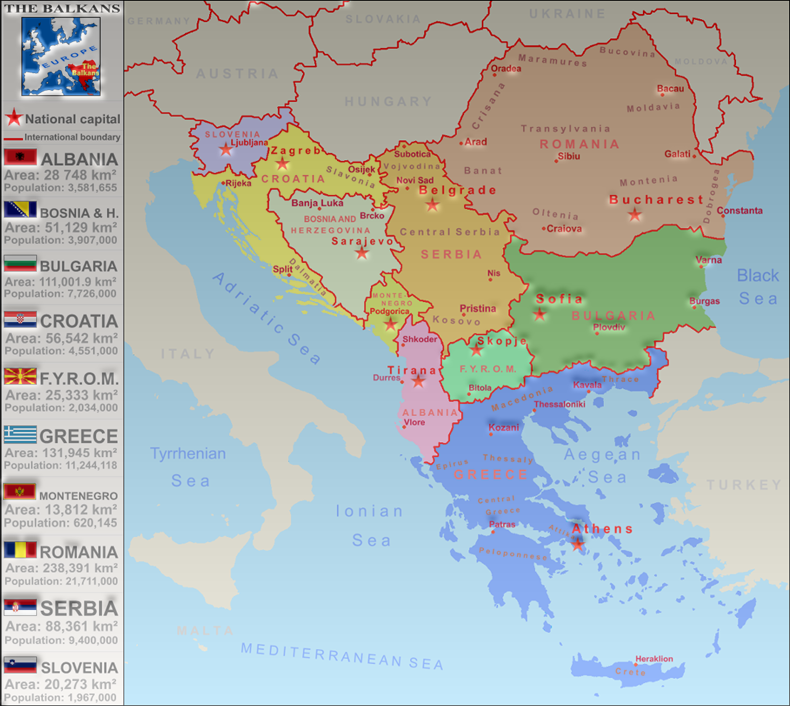
ST: Those permanent features are primarily geographic. The peninsula is the land bridge between Central Europe and the Middle East. At the same time, it is the point of encounter and conflict between various cultures, civilizations and religions. This had been a constant feature of the region even before the division of the Roman Empire [into its eastern and western domains] in the fourth century AD, which was an event of meta-historical importance.
A key feature of the Balkans is that for the greatest part of their history the peoples inhabiting the peninsula have not been the masters of their destinies. The matrix of geopolitical vectors: the Byzantines’ attempt to protect the border on the Danube from the incursions of Goths, Bulgars, Avars, Slavs, and others in the early medieval era, which ended in the late medieval times the fall of Constantinople, Bulgaria and Serbia to the Ottomans. This was followed by the creation of the Hungarian line of defense against the Turks. After the fall of Hungary [in 1526], it was immediately followed by the Habsburgs’ establishment of the Military Frontier in the western heartland of the peninsula in the 16th century.
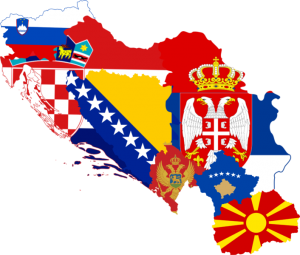
This has always been an area of chronic conflict and instability. In the modern times it was manifested—as we can say now, 99 years later—in the failed Yugoslav experiment. Yugoslavia was the heartland of what is today known as the “Western Balkans,” in reality the core of the region as a whole. Had unification come about half a century earlier, when Cavour unified Italy in 1859, or when Bismarck unified Germany in 1871, the prognosis could have been more favorable and the outcome less catastrophic. Unfortunately, in the final stages of the Great War, unification based on the linguistic and allegedly racial-ethnic kinship was obsolete. Divergent national identities had been well established. The potential for new conflicts, new destruction and bloodshed, remains undiminished. It is far greater than the potential for cooperation and a happy joint path to some “European” future . . . [ST segment continues at 8 minutes 30 seconds]
A defining moment came with the Crimean War 1853-1856, when Great Britain and France joined the Ottomans against Russia. This was a major development: Russia had been Britain’s ally against Napoleon and had the potential to become Europe’s hegemon after the Congress of Vienna. She had lagged behind [the West European powers]. This war was chiefly a British project. The entire second half of the 19th century was marked by the so-called great game between Britain and Russia, primarily in Central Asia, where the primary British concern was to prevent Russia’s access to the Indian Ocean, potentially through Persia or Baluchistan. Russia’s access to the Mediterranean through the Bosphorus was London’s secondary obsession. Its primary concern was to deny Russia access to a warm ocean. Even if the Russians had succeeded in their long-term design to demolish the four minarets and return the cross to the dome of the Hagia Sophia, they would still be imprisoned in a continental sea controlled by the British at its western entry, Gibraltar, and at its southeastern passage, at Suez.
This “great game” was partially resolved in the aftermath of the Russo-Turkish war in 1878. Tzar Alexander II, following Serbia’s underwhelming performance in its own war against the Turks, decided to create a Greater Bulgaria. The peace of San Stefano [between Russia and Turkey, March 1878] envisaged the creation of a huge Bulgarian state, from the walls of Constantinople, across the shores of Thrace which are now part of Greece, to the entire Macedonia, and even the newly liberated parts of Serbia in Leskovac, Vranje and Pirot. This was overturned at the Congress of Berlin [13 June-13 July 1878]. From that moment on, Serbia’s Prince Milan, later King, adopts an austrophile position, having been disappointed in Russia. With the May coup in 1903, however [when the last king of the Obrenovic dynasty was deposed and killed], Serbia was not explicitly “pro-Russian,” but her policy started leaning to St. Petersburg. Even though Serbia was left high and dry [by Russia] during the Annexation Crisis in 1908, she was eager to join the Balkan coalition put together under the Russian patronage in 1912 which resulted in the successful war against the Turks in the First Balkan War.
The alliance fell apart in the second Balkan war, catastrophic for Bulgaria, and a year later came the July crisis of 1914. Here I need to stress that the key actor in that crisis was Germany, not Austria-Hungary. The Dual Monarchy would not have been able to present Serbia with an unacceptable ultimatum, had she not received a cheque blanche from the Wilhelmine Germany. The Germans wanted to use the Austro-Serbian clash as the cause for a preventive war against Russia. They were greatly concerned that Russia, after the war with Japan and the 1905 revolution, embarked on the path of intense modernization under Chancellor Pyotr Stolypin. Her subsequent growth rates were comparable to those of China after Deng Xiaopig. The Balkan dispute between Austria and Serbia was very niftily converted by the Berlin decision-makers into an all-European war, in which Germany would first destroy France in six weeks—in accordance with the Schlieffen Plan—and then turn to the slower-mobilizing Russia. All along, the Balkans were an object of the games played by the outsiders,
Let me recall some pertinent statements by the greatest statesman of the 19th century, Otto von Bismarck, political genius par excellence. At the time of the Congress of Berlin he warned that Germany should not tie her lively frigate to the old Habsburg barge He also said that the whole of the Balkans was not worth the bones of a healthy Pommern Grenadier. Some years after the Kaiser removed him from chancellorship in 1890, he said that he did not know when the new war would come about, but he knew where: “some damn stupidity in the Balkans.” . . . [ST segment continues at 31 minutes 45 seconds]
Q:Russia’s influence in the Balkans appears to be more strongly felt that before, including the projection of her soft power manifested in the presence of Russian-sponsored media and NGOs. How significant is this?
ST: After three trips to Moscow, St. Petersburg and the Crimea this year, and twelve visits to Russia over the past three years, I can say with some certainty that Moscow does not have a coherent strategy in the Balkan region. There are many divergent policies at play. There’s the Ministry of Foreign Affairs, which is staffed by many people appointed during the tenure of Andrei Kozyrev in the 1990’s, who now occupy senior positions. They are reluctant to make any proactive moves which would further aggravate—as they see it—Russia’s relations with her “Western partners.” On the other side, you have a circle close to the defense minister Sergey Shoygu and Dmitry Rogozin, who advocate a more active role. You also have the oligarchs, who don’t give a hoot for the Serbs as Russia’s “Slavic, Orthodox brothers” but only care where’s the loot. In any event, they feel more at home in Greenwich Village, or London’s Chelsea, than in Moscow or St. Petersburg.
And of course we have Vladimir Vladimirovich Putin, who is not a superior chess master who plans his five or six moves ahead. He has allowed the “Orange Revolution” to hit him in Ukraine under Yushchenko in 2004, and—a decade later—the sequel, with far more significant geostrategic consequences, at the Maidan. The return of the Crimea, and the possibility of some form of autonomy for the Donbass, is scant comfort for the loss of the strategic depth which Ukraine had provided to Russia’s vulnerable southwestern flank . . .
The potential for further bloody conflicts in the Balkans still remains. I greatly fear that nothing has qualitatively changed in the region, that all of the salient features of the conflict in the 1990’s are still present.
We would like to ask you to consider a small donation to help our team keep working. We accept no advertising and rely only on you, our readers, to keep us digging the truth on history, global politics and international relations.
Croatia's President Kolinda Grabar-Kitarovic with Croatian diaspora in Canada holding the flag of WWII Nazi-Ustashi Independent State of CroatiaCroatia’s president, the former deputy NATO secretary general for public diplomacy Kolinda Grabar-Kitarovic, decided to pay homage to Nazis of the Ustasha Nazi puppet regime of Croatia shot by Yugoslav partisans at the end of World War II. Grabar-Kitarovic’s tone deafness in choosing Victory in Europe week to honor dead Nazis shocked the Balkans and the rest of Europe.The Ustasha, along with their Slovenian and Serb loyalists to the Nazi puppet regime, were killed by the partisans under the command of anti-fascist ...
The crumbling “liberal” West is in a desperate hurry in the Balkans. More than a quarter century since the first Western states, pushed by Germany, unilaterally recognized the secession of the former Yugoslav federal republics of Slovenia, Croatia and Bosnia-Herzegovina and about 19 years since NATO’s air and land attack against what had remained of the country (the Federal Republic of Yugoslavia, comprising Serbia and Montenegro) resulting in NATO’s occupation and subsequent forced amputation of Serbia’s Kosovo and Metohija province (by way of recognition of its unilaterally declared independence of February 2008 by the main Western powers, some – but not all Muslim ...
"Evicted five centuries ago by crusading Christians, the Arabs are back in Spain, using their oil dollars to buy land that was seized from their ancestors by the sword". — James M. Markham, The New York Times, 1981. The Madrid daily ABC wrote that 800 mosques in Spain are out of control. The Spanish daily La Razon charged that Gulf donors, such as Qatar, were a source of Spain's Islamization. The Saudis also launched a new Spanish television channel, Córdoba TV, as did Iran. They dream of, and work to, regain the "lost Caliphate" of Spain. Some Islamists do ...
The ongoing de-Christianization of Kosovo continues and unlike the past frenzy of the anti-Serbian mass media in the West, we mainly have a deadly silence about the reality of Kosovo and the continuing Albanianization of this land. However, how is it “just” and “moral” to persecute minorities and to alienate them from mainstream society; and then to illegally recognize this land without the full consensus of the international community?How ironic it is that the same United States of America and the United Kingdom, two nations who were in the forefront of covertly manipulating the mass media; remain mainly silent about ...
State frontiers are established by human beingsand may be changed by human beings.Adolf Hitler. Mein KampfDiplomacy, with all the conventions of its forms,recognizes only real facts.Charles de GaullePart OneAll of Adolf Hitler’s actions, from the time he rose to power in 1933 until 1939, could be described as one triumph after another. He met each challenge he faced: he took over as head of the country, returned Germany’s lost territories without a struggle, and was given permission from England and France to rearm. But one further task lay before him, and failure now would make his previous achievements almost pointless. ...
This Remembrance Day will doubtless see strenuous efforts by some to justify the fruitless bloodbath that was the First World War. Revisionist commentators have long attempted to rehabilitate the conflict as necessary and just, but the arguments do not stand up. It does no service to the memory of the dead to allow any illusions in the justice or necessity of war, particularly so when the precedents will be used to argue for the next ‘necessary’ conflict. From the causes of the war, to its prosecution and its results, here are the counter-arguments to ten common pro-war ploys.1. The war ...
Can we face it in this election season? America is a weapons factory, the White House a war room, and the president the manager of the neoliberal conspiracy to recolonize the planet. It exports war and mass poverty. On the economic front, usurious neoliberalism; on the military front, illegal wars. These are the trenches of America’s battle for world domination in the 21st century.If not stopped, it will be a short century.Since 1945, America’s Manifest Destiny, posing as the Free World’s Crusade against the Red Menace, has claimed 20 to 30 million lives worldwide and bombed one-third of the earth’s ...
The United States approaches the November 2020 election with growing apprehension, even dread.Among the possibilities:Protracted uncertainty about the presidential contest. Think Florida 2000 but with several states’ results unresolved for weeks or even months (“Experts held ‘war games’ on the Trump vs. Biden election. Their finding? Brace for a mess”);A disputed outcome, perhaps with Donald Trump and Joe Biden both claiming victory, compounded by a “blue shift,” where states are claimed by Trump on election night but flip over to Biden as additional absentee and mail-in ballots conveniently turn up days or weeks later;Violent civil conflict, spurred on in the ...
US-installed Ukrainian fascists commemorated Poroshenko’s established victory in Europe Day of Remembrance by vowing to “destroy Moscow,” free its people, and let them “shape their own future.”Ukrainian ultranationalists attending a May 8 commemoration included 14th SS Waffen Grenadier division veterans, Ukrainian Insurgent Army (UPA) members, and Nazi-infested volunteer battalions involved in what they call “the Russian-Ukrainian war.”Svoboda party overt Nazis participated. Their slogan is “Ukraine for the Ukrainians” – meaning ethnically pure, free of Jews, Russians and others not wanted, by extermination or other means.Party member Yuri Sirotyuk called war on Russia Ukraine’s historic mission. “I believe that if we ...
Amid a divisive debate in Ukraine on state honors for nationalists viewed as responsible for anti-Semitic pogroms, the country for the first time observed a minute of silence in memory of Symon Petliura, a 1920s statesman blamed for the murder of 50,000 Jewish compatriots.The minute was observed on May 25, the 90th anniversary of Petliura’s assassination in Paris. National television channels interrupted their programs and broadcast the image of a burning candle for 60 seconds, Ukraine’s Federal News Agency reported.A French court acquitted Sholom Schwartzbard, a Russia-born Jew, of the murder even though he admitted to it after the court ...
Real Semites are the Palestinians. Current Zionists Israelis genetically are not the Semites.They are the real anti Semitic people. Please world stop those anti Semitic warmongers Israeli Zionists!Origins of images: Facebook, Twitter, Wikimedia, Wikipedia, Flickr, Google, Imageinjection, Public Domain & Pinterest.Read our Disclaimer/Legal Statement!Donate to Support UsWe would like to ask you to consider a small donation to help our team keep working. We accept no advertising and rely only on you, our readers, to keep us digging the truth on history, global politics and international relations.[wpedon id="4696" align="left"]SaveSaveSaveSave
In Kukavica village near Rogatica (nowadays Bosnia and Herzegovina), today was marked 27 years since crimes against Serbian civilians committed by Bosnian Muslims, members of the so-called Army of Bosnia and Herzegovina on August 27, 1992.In an attack on a column of Serbian civilians, involving about 1,000 elderly people, women and children on tractors and passenger vehicles, Bosnian Muslim extremists killed 26 and injured 80 Serbs.Rogatica Mayor Milorad Jagodic called this a monstrous crime as among the victims are a child of 11 and 82 years old man.“This was a column of innocent people who were looking for refuge and ...
IntroductionSome have tried to debunk the view that the West implicitly or explicitly promised Soviet leader Mikhail Gorbachev that NATO would not expand east after German reunification and dissolution of the Warsaw Pact). These claims are misleading and obfuscate the historical record of at least a clear understanding, if not promise that there should be no NATO expansion eastward in any way, shape or form. At the very least the West made a implied commitment not to expand NATO east. It is more precise to say, however, that the West gave an explicit verbal, that is, unwritten guarantee not to ...
What must the world think watching the US presidential campaign? Over time US political campaigns have become more unreal and less related to voters’ concerns, but the current one is so unreal as to be absurd.The offshoring of American jobs by global corporations and the deregulation of the US financial system have resulted in American economic failure. One might think that this would be an issue in a presidential campaign.The neoconservative ideology of US world hegemony is driving the US and its vassals into conflict with Russia and China. The risks of nuclear war are higher than at any previous ...
The Balkan Peninsula together with the region of South-East Europe historically has been one of the most important focal points of the Russian foreign policy, cultural influences and attempts to spread an ideology of the Orthodox solidarity and the Slavic reciprocity.[1] These ideas are common to almost all trends of the Russian public life in the past and today.After Russia lost the Great Crimean War of 1853–1856 she intensified its cultural influence in the region of the South-East Europe for the purposes of beating the Habsburg (the Roman-Catholic) rivalry and to spread an idea of the Pan-Slavism in this part ...
May 19, 1919 has different and even opposing meanings in Turkey and Greece, just as May 15, 1948, marks both the establishment of Israel and, for Palestinians, the start of the Nakba (“catastrophe”).In Turkey, this date marks the first step that led to the establishment of the Turkish Republic, while for descendants of Ottoman Greeks and Greece it marks the end of the centuries-long Pontic Greek presence on the shores of the Black Sea. Whereas Turks celebrate May 19, Greeks mourn it. Researcher Tamer Çilingir summarised the issue in a 2016 interview with the Turkish-Armenian daily Agos:“The Pontic Genocide is the ...
As 2016 closes, we find ourselves a deeply unsettled nation. We’re unable to draw the lines of our national interest. Is it jobs and economy, is it national security, or is it now in our interest to ensure global security — in other words, act as the world’s policemen?As the “failing” (to quote Trump) New York Times degenerates into a Washington Post organization with its stagnant Cold War vision of a 1950s world where the Russians are to blame for most everything — Hillary’s loss, most of the aggression and disorder in the world, the desire to destabilize Europe, etc. — the Times has added the ...
On November 21st, 2015 it was the 20th anniversary of the 1995 Dayton Peace Accord – a treaty signed by four Presidents (the USA, Croatia, Serbia and Bosnia-Herzegovina) that led to an end of the civil war in Bosnia-Herzegovina. As a result of the Dayton Peace Accord a new “independent and internationally recognized state” emerged: Bosnia-Herzegovina as a confederation of two political entities (the Republic of Srpska and the Muslim-Croat Federation) but ethnically strictly divided into three segments composed by the Serb, Croat and Muslim (today Boshnjak) controlled territories. In contrast to the Republic of Srpska (49% of the territory ...
The full extent of the damage to international peace and security caused by the US-led Syrian strikes will take some time to become clear. But its impact on the very concept of legality in international affairs is already evident.Simply put, the most powerful county in the world and its chief satellites, the UK and France, have thrown the rule of law into the trash can. The only "law" now is the law of the jungle. There is no going back.Ironically, the attack itself was claimed by its perpetrators as enforcement of legality, not of its obliteration. For example, NATO Secretary-General ...
A Serb from Bosnia, General Mladic, protected Muslim civilians and gave them buses, food, and water to leave fighting zones. There was no genocide over the Muslim population in Srebrenica like mainstream media want you to believe – there was no genocide over Bosniaks because all Bosnian Muslims victims were jihad fighters who had been killed during fight (in war). Even the so-called „tribunal“ in The Hague for ex-Yugoslavia admitted that there was no genocide!The President of Bosnia-Herzegovina in the 1990s, Alija IzetbegovićIn Srebrenica, there was a massacre over Serbian civilians: the youngest victim was a 4 years old boy ...