
Untold History of Lithuania: A Chicago Teacher Showed Her Grandfather was a Nazi Collaborator
Foti, a 60-year-old high school teacher from Chicago, made the pledge to her dying mother 18 years ago. She has spent a long time studying the life of her grandfather, Jonas Noreika, as well as acquiring the writing skills necessary for chronicling it and finding a publisher [...]
Foti, a 60-year-old high school teacher from Chicago, made the pledge to her dying mother 18 years ago. She has spent a long time studying the life of her grandfather, Jonas Noreika, as well as acquiring the writing skills necessary for chronicling it and finding a publisher.
Barring unexpected delays, Silvia Foti is months away from fulfilling an old promise that’s become her life’s work: to write a biography of her late grandfather, who is a national hero in his native Lithuania.
But rather than celebrating Noreika’s legacy as her mother requested, the biography that Foti wrote confirms and amplifies the findings of Holocaust scholars who for years have called for stripping Noreika of his honors.
The national hero, she and they insist, was a Nazi collaborator who helped murder thousands of Jews and steal their property.
The unpublished biography, which Foti summarized in a bombshell Salon article in July, split her own family. She said her father and his second wife asked Foti not to publish the book because it would “make Lithuania look bad.” And it would have distressed her mother if she were still alive — the author said this causes her “great pain.”
But the main significance of the book is the unprecedented attention it is bringing to Noreika’s alleged crimes in Lithuania, where a school has been named for him. Noreika died in 1947 while in the hands of the KGB. In 2000, former president Vytautas Landsbergis, the first head of state of independent Lithuania, attended the funeral of Noreika’s wife in Vilnius.
Last week, Foreign Minister Linas Linkevicius urged authorities to remove a memorial plaque to Noreika from the wall of the Lithuanian Academy of Sciences in central Vilnius – the first such call by a senior Lithuanian official on any of the country’s numerous monuments celebrating killers of Jews.
Following the Salon article and coverage of it in The New York Times, Vilnius Mayor Remigijus Simasius, who for years has ignored calls by Jewish groups to remove the plaque, asked the state-funded and -operated Genocide and Resistance Research Center to review Noreika’s status as a national hero.
In her book, Foti explores how her grandfather issued orders to round up and kill the Jews after his appointment in 1941 as head of Siauliai County under the German Nazi occupation. And she presents evidence that he personally moved into the home of a Jewish family after its members had been killed, presumably at his order.
Foti recalled being shocked when she first learned of these allegations in 2013 while visiting the school in Sukionių named for her grandfather. The principal told her that “he got a lot of grief from the Jews” over the name, but assured her it “was all Soviet lies.”
That remark put her on a path to unravel the history of Lithuanian Jewry’s murder and her grandfather’s complicity in it. At first she had “hoped to exonerate him,” Foti said. Yet a wealth of evidence convinced her that her grandfather was complicit and actually “taught his Lithuanian soldiers how to exterminate Jews efficiently: how to sequester them, march them into the woods, force them to dig their own graves and shove them into pits after shooting them,” as she wrote in the Salon article.
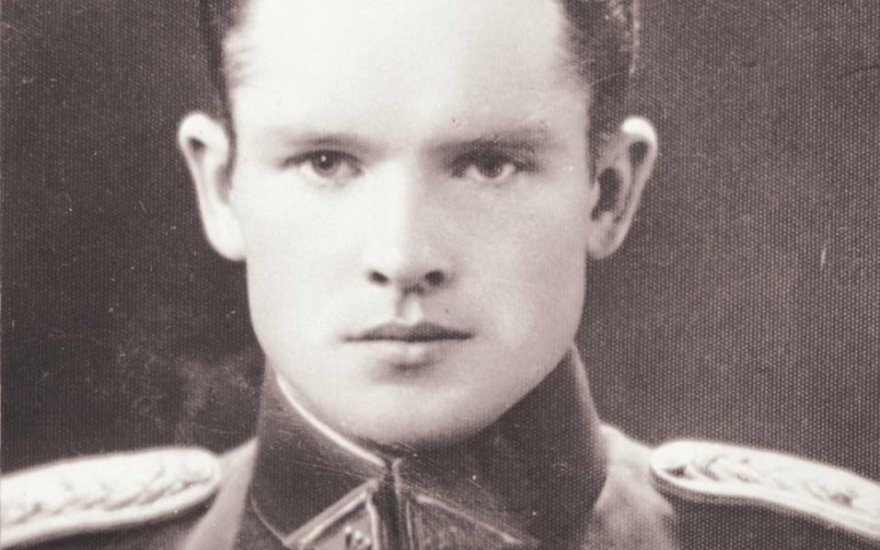
It was a devastating discovery for a woman who said she grew up “adoring” her late grandfather. At Christmas dinners, her tight-knit family would leave an empty chair and glass of wine for him to acknowledge the absence of the handsome man in framed portraits who probably was tortured to death by the KGB at the age of 37.
Foti said she hopes the book helps “Lithuania finally take a good look at its own role in the Holocaust and stop blaming the Germans for everything.”
She has had to pray and seek guidance from God throughout her work on the book, she said.
The debate about Noreika and other collaborators who sided with the Nazis when they were fighting Russia during World War II goes to the heart of Lithuania’s national narrative that it was and is a victim of Russia. Seen through that prism, collaborators like Noreika or Juozas Ambrazevicius, the leader of a local pro-Nazi government, sided with Germany only to achieve independence for Lithuania.
But that narrative ignores the level of complicity by ordinary Lithuanians — many of whom viewed Jews as agents of communism — in the near total annihilation of the approximately 220,000 Jews who lived in Lithuania before the Holocaust, according to Efraim Zuroff, the Eastern Europe director of the Simon Wiesenthal Center.
Zuroff believes that the veneration of people like Noreika in some ways is rooted in a collective desire to whitewash Lithuanian complicity.
“You see this tendency across Eastern Europe,” he said, “but it’s strongest specifically in the countries with the highest amounts of genocide complicity.”
Lithuania is the only Nazi-occupied country noted by Israel’s Yad Vashem museum for its people’s “enthusiasm” for collaboration with Germany. And even when this enthusiasm “subsided … hostility towards Jews and denunciation persisted,” the museum says.
One example of this genocidal zeal occurred in Kaunas, Lithuania’s second city. At the Lietukis Garage, pro-German Lithuanian nationalists killed more than 50 Jewish men in 1941 by beating, hosing and then murdering them with iron bars, according to the U.S. Holocaust Memorial Museum. Some of the perpetrators then posed for pictures with the victims’ tortured bodies, providing some of the most memorable images of Nazi collaboration anywhere.
Foti’s research turned the plaque for Noreika into a symbol for the fight for recognition of that complicity. But the plaque is just one of numerous expressions of veneration for perpetrators.
Juozas Krikstaponis, a member of a death squad who killed thousands of Jews in Lithuania and Belarus, has a monument for him in the city of Ukmergė, 30 miles north of Vilnius.
The Nazi collaborator Kazys Skirpa, who represented his nation in Berlin during World War II, has a main street named after him in Kaunas, and his image features regularly in nationalist marches. An outspoken anti-Semite, Skirpa “proposed to solve ‘the Jewish problem’ not by genocide but by the method of expulsion from Lithuania,” the Genocide and Resistance Research Center of Lithuania asserted in 2015.
Against this background, the developments around Foti’s article have surprised veteran campaigners for Holocaust recognition in Lithuania.
Zuroff acknowledged that Jewish Holocaust scholars like himself are “easy to dismiss” in Lithuania as Russian agents or disgruntled enemies of the Lithuanian nation. Even ethnic Lithuanians who try to confront complicity quickly get labeled as traitors.
In 2015, Zuroff co-authored a landmark book with Ruta Vanagaite, a successful writer who is not Jewish, that chronicles their joint travels across many of the killing sites of Jews that dot Lithuania and their history. “Our People” also features Vanagaite’s discovery that two of her close relatives, her grandfather and uncle, were active in the persecution of Jews.
But Vanagaite’s publishing house last year dropped her as the mainstream media attempted to discredit her. Landsbergis, who was Lithuania’s first leader after communism, published an op-ed on the Delfi news site calling Vanagaite a “moral scumbag” and “Mrs. Dushanski” – a reference to the Jewish KGB officer Nachman Dushanski.
Vanagaite’s publishing house also recalled all of her books, only one of which was about the Holocaust. And the governing coalition in April introduced a bill banning the sale of books that “distort historical facts” in what was seen as direct reaction to some of her claims about World War II.
Whereas Vanagaite’s ties to Zuroff and liberal credentials made her vulnerable to smear campaigns, Foti “totally blindsided the Lithuanian government,” according to Grant Gochin, a Los Angeles-based financial adviser of Lithuanian-Jewish descent. Gochin is behind multiple lawsuits over his ancestral homeland’s veneration of war criminals, including Noreika.
“They can’t call Noreika’s daughter a Soviet agent, they can’t defend against her,” he said.
In this respect Foti, who also favors the removal of the plaque honoring her grandfather and other honors, landed a rare victory for Zuroff, Vanagaite and Gochin’s side. She also highlighted their fight to the outside world.
But the officials who said they favored steps to remove Noreika as a national hero were “clearly paying lip service,” Gochin said, “or it would’ve happened long ago.”
As long as Lithuanians are taught to revere people like Noreika, Gochin said, “the fight for historical accuracy is being lost.”
“Genocide,” he said, “needs to be acknowledged where it happened.”
We would like to ask you to consider a small donation to help our team keep working. We accept no advertising and rely only on you, our readers, to keep us digging the truth on history, global politics and international relations.
Churchill’s famous dictum about the Soviet Union, that it was “a riddle, wrapped in a mystery, inside an enigma,” is arguably just as applicable to Srebrenica. July 11 this year will be the twenty-fifth anniversary of that landmark event of the Yugoslav wars which the late Prof. Edward Hermann, speaking somewhat less poetically than Churchill, had called “the greatest triumph of propaganda at the close of the twentieth century.”Whether we choose to view Srebrenica as a criminal investigation to sort out who and at whose direction executed prisoners of war, or as a political provocation to lay the groundwork for ...
The two most militarily powerful nations in the West, both free to project naval power and maritime domination anywhere in the world, get together to punish and overthrow regimes they find guilty of human rights abuses and political repression in the name of human rights and promoting democracy: What could possibly go wrong?It is of course NATO Secretary-General Jens Stoltenberg’s new call for NATO, which has already over the past decade exercised its nation-building and promotion of enlightened regime policies with such brilliant success in Ukraine, Libya, Syria and Afghanistan to spread its mantle of protection, enlightenment and peace over ...
Read more about the magazine at:IMPRESSUMPublish and AdvertisePublish your articles on global politics online & advertise your website for a moderate fee on our website.Donate to Support UsWe would like to ask you to consider a small donation to help our team keep working. We accept no advertising and rely only on you, our readers, to keep us digging the truth on history, global politics, and international relations.Join the debate on our social platforms.
It is hardly a coincidence that the Declaration of Independence, Adam Smith’s Wealth of Nations, and Johann Friedrich Blumenbach’s On the Natural Variety of Mankind were all published within a year of one another, for each supports a necessary aspect of a larger, integrated project. Not only was the rationale for seizing political power (provided by the Declaration) supported by Smith’s popular text (which justified rule by the wealthy business class). Because this wealth and power was contingent on slavery, and territories seized by conquest, Blumenbach’s theory that the “Caucasian race” (a designation he coined, by the way) was the supreme race was ...
The genocidal rule of the Khmer Rouge began forty years ago this month. Their rise to power was inseparable from US intervention.On April 17, 1975, Khmer Rouge (KR) forces stormed Phnom Penh and reestablished Cambodia as Democratic Kampuchea — a supposedly self-sufficient, entirely agrarian society. Resetting the clock to “Year Zero,” the KR forced urban dwellers to the countryside, and began to “purify” Cambodia through a genocidal purge of intellectuals and minority groups. By the time the slaughter came to an end in 1979 — after Vietnam invaded Cambodia and removed the KR from power — some 1.7 million people (21 percent ...
The Axis powers invaded Yugoslavia on 6 April 1941. Vladko Maček, the leader of the Croatian Peasant Party (HSS) which was the most influential party in Croatia at the time, rejected offers by the Nazi Germany to lead the new government. On 10 April the most senior home-based Ustaša, Slavko Kvaternik, took control of the police in Zagreb and in a radio broadcast that day proclaimed the formation of the Independent State of Croatia (Nezavisna Država Hrvatska, NDH). The new Independent State of Croatia" was established as a pro-Nazi government. It was dedicated to a clerical-fascist ideology influenced both by ...
I am a Lithuanian, but I leave abroad and I am not going back. At least now, at least until the Government does not pay attention to its people. According to some authoritative research institutes, during 2017 Lithuania population is again projected to decrease (by 45 677 people!) and reach 2 758 290 in the beginning of 2018. (http://www.worldometers.info/world-population/lithuania-population/). As of 1 January 2017, the population of Lithuania was estimated to be 2 803 967 people. This is a decrease of 1.63 % (46 433 people) compared to population of 2 850 400 the year before. In other words, our ...
The Independent State of Croatia (NDH) was a World War II puppet state of Germany and Italy, which was established in parts of Axis-occupied Yugoslavia. The NDH was founded on 10 April 1941, after the invasion of Yugoslavia by the Axis powers.A poster from the WWII Nazi Ustashi Independent State of Croatia with the state flag (Source: Instagram)The NDH consisted of modern-day Croatia and most of Bosnia and Herzegovina, as well as some parts of modern-day Serbia and Slovenia. The regime targeted Serbs, Jews, Roma people and anti-fascist or dissident Croatians and Muslims, as part of a large-scale genocide campaign ...
August 24th, Ukrainian Independence Day, will see a ceremony introducing the country's new official army salute, as prescribed by Ukraine’s Presidential decree: Glory to Ukraine! - Glory to the Heroes!"We have consulted with the Minister of Defense, National Security and Defense Council, Government and I have decided that starting from August 24 these words will be heard for the first time as part of the official military parade ceremony on the Independence Day of Ukraine," Petro Poroshenko was quoted saying on the Ukraine President's official site.Glory to Ukraine! - Glory to the Heroes! is a slogan of the UPA, the ...
Note: This article was original published by GR in May 2003“It is easy. All you have to do is tell the people they are being attacked, and denounce the peacemakers for lack of patriotism and exposing the country to danger.” - Hermann GoeringGenocide used to be a crime without a name. Although the most heinous of all crimes, the concept was not introduced into international language until after World War 2. Until then, military invasion and destruction of other peoples and cultures masqueraded under such slogans as progress and spreading civilisation.I was shocked many years ago when I heard Noam ...
Arrest and detention of three days for Joanikije, Bishop of Budimlye and Niksic, and eight priests of the Orthodox Cathedral of St. Basil of Ostrog in Nikšić has sparked tensions in Montenegro again. Namely, after the prayer procession that had been held in Nikšić on May 12th, on the feast-day of St. Basil of Ostrog, a 72-hour detention was ordered for Bishop Jonikije, Fr. Slobodan Jokic, Fr. Danilo Zirojevic, Fr. Zeljko Rojevic, Fr. Ostoja Knezevic, Fr. Mirko Vukotic, Fr. Vasilije Brboric, Fr. Dragan Krusic and Fr. Nikola Marojevic.Protests in support of those arrested have taken place in several cities across ...
Origins of images: Facebook, Twitter, Wikimedia, Wikipedia, Flickr, Google, Imageinjection, Public Domain & Pinterest.Read our Disclaimer/Legal Statement!Donate to Support UsWe would like to ask you to consider a small donation to help our team keep working. We accept no advertising and rely only on you, our readers, to keep us digging the truth on history, global politics and international relations.[wpedon id="4696" align="left"]
The superhighway to disaster is already being paved.From Donald Trump’s first days in office, news of the damage to America’s international stature has come hard and fast. As if guided by some malign design, the new president seemed to identify the key pillars that have supported U.S. global power for the past 70 years and set out to topple each of them in turn. By degrading NATO, alienating Asian allies, cancelling trade treaties, and slashing critical scientific research, the Trump White House is already in the process of demolishing the delicately balanced architecture that has sustained Washington’s world leadership since ...
The political settlement in the former Yugoslavia is unraveling. In Bosnia, the weakest state in the region, both Serbs and Croats are mounting a concerted challenge to the Dayton peace accords, the delicate set of compromises that hold the country together. In Macedonia, political figures from the large Albanian minority are calling for the federalization of the state along ethnic lines. In Kosovo, the Serb minority is insisting on the creation of a network of self-governing enclaves with effective independence from the central government. In Serbia’s Presevo Valley, Albanians are agitating for greater autonomy. In Montenegro, Albanians have demanded a ...
The main church of the Serbian Orthodox Patriarchate in Kosovo in PećThe series of long-scale Christian national movements in the Balkans, triggered off by 1804 Serbian revolution, decided more than in the earlier centuries, the fate of Serbs and made ethnic Albanians (about 70% of whom were Muslims) the main guardians of Turkish order in the European provinces of Ottoman Empire. At a time when the Eastern question was again being raised, particularly in the final quarter of the 19th and the first decade of the 20th century, Islamic Albanians were the chief instrument of Turkey’s policy in crushing the ...
While this excellent analysis by Srdja Trifkovic focuses on the “internal” history of Croatia, it is important to note that four days after Nazi Germany declared war on the United States, Hitler’s staunch ally the Independent State of Croatia (NDH) declared war on both the United Kingdom and on the United States on December 14, 1941. What makes this especially significant is that less than three years later, on April 16, 1944, which was Easter Sunday for the Serbian Orthodox, the Anglo-American forces bombed Belgrade, the capital of their loyal and devoted ally Serbia, even though there was no strategic ...
A map of the wanted territories of the Balkan states in 1915There are many talks about nationalism among the peoples from the former Yugoslavia during the last three decades what is quite understandable taking into consideration the post-Cold War conflicts and atrocities, as a continuation of WWII crimes based on certain political ideologies,[i] committed on the territory of ex-Yugoslavia.Historia est magistra vitaeI want to argue that there is a direct link between contemporary nationalism(s) among the Yugoslavs and their national ideologies, which are developed in the previous decades and even centuries. What happened with the Yugoslavs from 1991 to 1999 ...
A newly-released Hilary Clinton email confirmed that the Obama administration has deliberately provoked the civil war in Syria as the “best way to help Israel.”In an indication of her murderous and psychopathic nature, Clinton also wrote that it was the “right thing” to personally threaten Bashar Assad’s family with death.In the email, released by Wikileaks, then Secretary of State Clinton says that the “best way to help Israel” is to “use force” in Syria to overthrow the government.The document was one of many unclassified by the US Department of State under case number F-2014-20439, Doc No. C05794498, following the uproar ...
LONDON — Seventy years after he was shot by the Soviets, the reputation of Jonas Noreika goes on trial in Lithuania next week.Noreika — a hero to many in the Baltic state for resisting the Communists’ subjugation of their country — stands accused of being a Nazi collaborator who was complicit in the Holocaust.Jonas Noreika - "General Storm"The case before the Vilnius Regional Administrative Court charges the state-funded Genocide and Resistance Research Center of Lithuania with intentionally distorting the role of Noreika in the murder of Jews.It has been brought by Grant Gochin, a Lithuanian citizen living in the US, ...
On October 21, 2016 a typical Estonian school witnessed an opening ceremony of the bronze bust of Harald Nugiseks. He was an SS-Oberscharführer (Sergeant) in World War II, who served voluntarily in the 20th Waffen Grenadier Division of the Waffen SS. According to the director of this education institution, the memory of Harald Nugiseks will lead to the increase in feelings of patriotism among students and must increase their willingness to protect their country in case of external aggression.So who is this Nugiseks? – During the Second World War, he was awarded with the second highest military award in the ...