After Bosnia-Herzegovina, Kosovo is a second ISIS in Europe today. From June 1999, when NATO troops occupied Kosovo and brought to power militant Muslim Albanian Jihad fighters, systematic destruction of (Serbian Orthodox) Christianity is visible on every corner [...]
Destruction of Serbian Christian Orthodox heritage in Kosovo by Muslim Albanians

Views: 1877
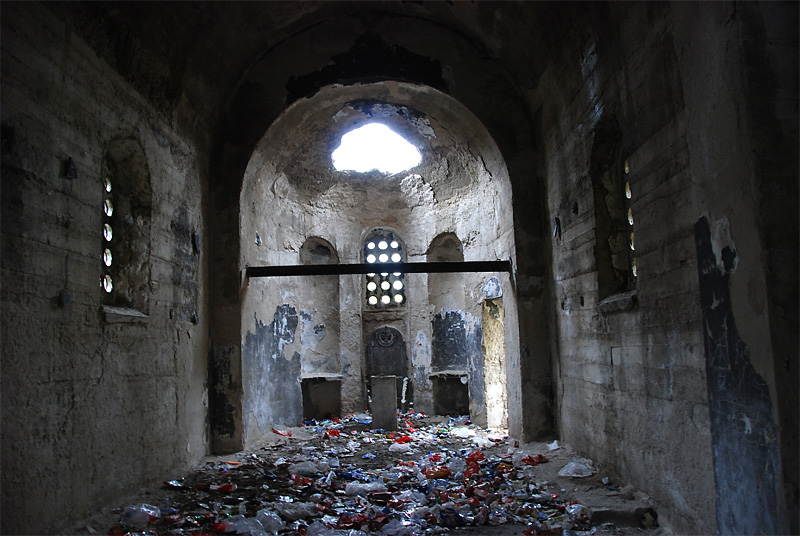
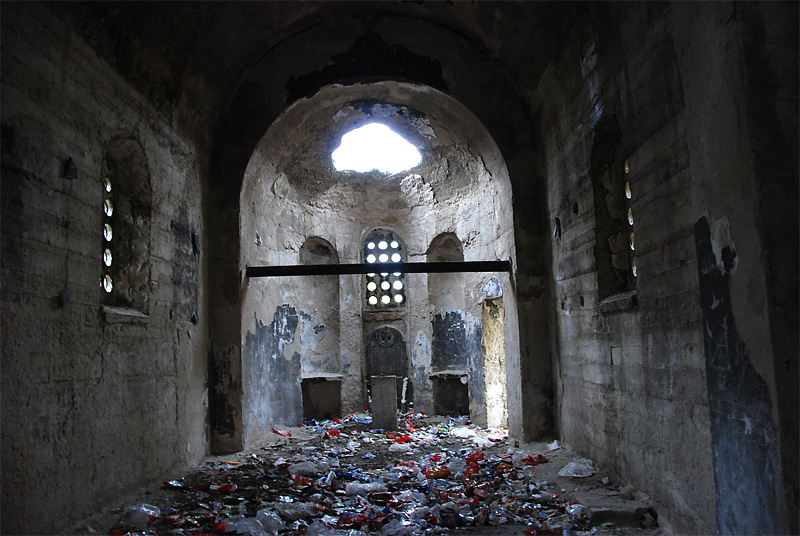
Serbian Orthodox Church Samodrezha from the 14th century destroyed by Kosovo Muslim Albanians after June 1999
After Bosnia-Herzegovina, Kosovo is a second ISIS in Europe today. From June 1999, when NATO troops occupied Kosovo and brought to power militant Muslim Albanian Jihad fighters, systematic destruction of (Serbian Orthodox) Christianity is visible on every corner.
The most disappointing fact in post-war Kosovo reality is ethnic and cultural cleansing of all non-Albanians and not-Albanian cultural heritage. The proofs are evident and visible on every corner of Kosovo territory. For instance, on the arrival of KFOR (international but in fact NATO „Kosovo Forces“) and UNMIK („United Nations Mission in Kosovo“) to Kosovo in 1999, all the names of the towns and streets in Kosovo were renamed to have (Muslim) Albanian names. The monuments to Serbian heroes like the monument devoted to duke Lazar (who led the Serbian Christian army during the Kosovo Battle on June 28th, 1389 against the Muslim Turks) in Gnjilane, were demolished.
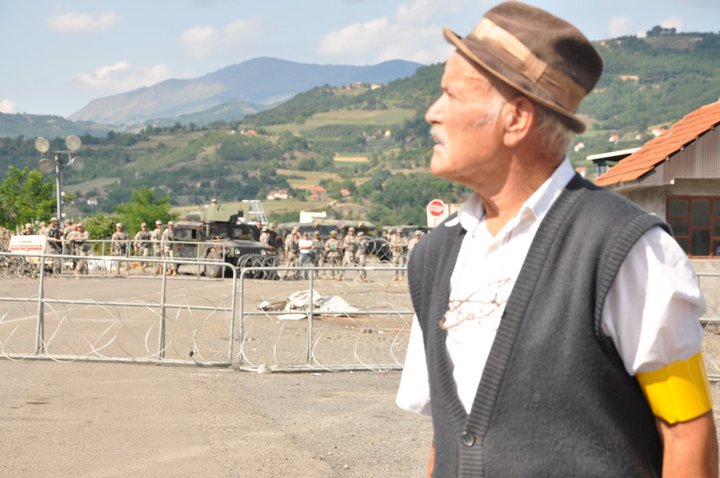
Serbs are getting killed, assassinated, wounded, and abducted, their houses burned to the ground. The most infamous ethnic cleansing was done between March 17th and 19th 2004 – „The March Pogrom“, which resulted in the loss of several dozens of lives, several hundreds of wounded (including and the members of KFOR), more than 4.000 exiled Serbs, more than 800 Serbian houses set on fire and 35 destroyed or severely damaged Serbian Orthodox Christian churches and cultural monuments. For those readers who does not have time or financial support to visit Kosovo in order to check those evidence we recommend visiting free of charge, YouTube web page searching the videos under the tags „Albanian terror“ and/or „Stolen Kosovo“ (the last one is the Czech documentary movie made in 2008 but originally banned by the Czech authorities to be shown in the Czech Republic that was a reason why the authors put it on the YouTube).
As of today, the number of Serbs that were killed or went missing in Kosovo after KFOR arrived, is measured in thousands, the number of demolished Orthodox churches and monasteries is measured in hundreds, and the number of burned down Serbian houses in tens of thousands.
Even though KFOR had as many as 50.000 soldiers in the beginning as well as several thousand policemen and civilian mission members, none of the above-mentioned crimes have been solved.
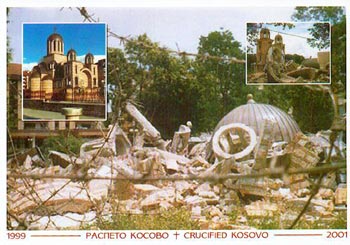
Murdering a Serb in Kosovo is not considered a crime, on a contrary, the murderers of children and the elderly are being rewarded as heroes. The province is almost ethnically cleaned as around 250.000 ethnic Serbs left the territory of Kosovo. For the matter-of-fact, according to the last pre-war official Yugoslav census of 1991, there were 13% of non-Albanians in Kosovo. However, it is estimated that today 97% of Kosovo’s population is only Albanian. In the light of the main goal – the establishment of another Albanian state in the Balkans and Europe, as the first step towards pan-Albanian state unification – we can „understand“ why it is important to destroy any Serbian trace in the „territory defined by the aspirations“.
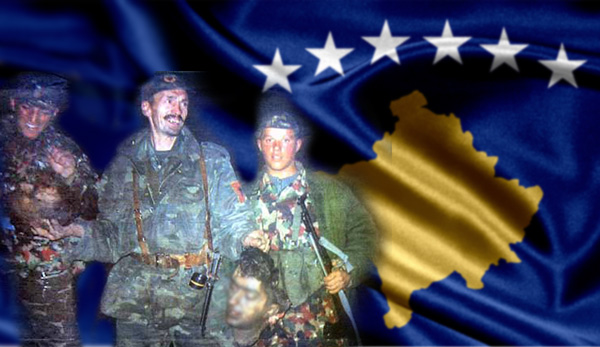
Here we present some documentary pieces of evidence of Kosovo ISIS: KOSOVO ISIS FROM 1999
Origins of images: Facebook, Twitter, Wikimedia, Wikipedia, Flickr, Google, Imageinjection, Public Domain & Pinterest.
Read our Disclaimer/Legal Statement!
Donate to Support Us
We would like to ask you to consider a small donation to help our team keep working. We accept no advertising and rely only on you, our readers, to keep us digging the truth on history, global politics, and international relations.
The main church of the Serbian Orthodox Patriarchate in Kosovo in PećThe series of long-scale Christian national movements in the Balkans, triggered off by 1804 Serbian revolution, decided more than in the earlier centuries, the fate of Serbs and made ethnic Albanians (about 70% of whom were Muslims) the main guardians of Turkish order in the European provinces of Ottoman Empire. At a time when the Eastern question was again being raised, particularly in the final quarter of the 19th and the first decade of the 20th century, Islamic Albanians were the chief instrument of Turkey’s policy in crushing the ...
For centuries, the strategic Balkan Peninsula has featured as a slice of Europe over which wars have been fought, treaties made and broken. It became a vital pawn in the carve-up of nations after World War i, had the boundaries of its ethnic enclaves confused under Tito’s regime, then its various nationalist feelings taken advantage of and played against each other in the latest push for its colonization by the EU.In this latest process, one nation has been demonized in the mind of the public: Serbia.In the words of British political economist Rodney Atkinson, “The grossest calumny in the continuing ...
Serbs: Basic factsEthnic location: Central and western part of the Balkan Peninsula (South-East Europe)Population: 10.2 million (1.8 million Serbs live outside their ethnic location)Language: SerbianReligion: Eastern Orthodox Christians1 Introduction Serbs belong to the Southslavonic group of Indo-European peoples. As their tradition, culture, language, beliefs, and customs show, the ethnogenesis of Serbs goes far back into the past. Serbian ancestors, Protoslavs and Old Serbs, were described in the 5th century BC by Herodotus, under the names of Neuri and Budini, living north of the Danube in the region between Dniepar and north-eastern Carpathian Mountains.The first mention of the name “Serbs” appears ...
RT: Kosovo wants to establish an army and has received several Humvee armoured vehicles from the USA. Although there was official NATO restraint, how much is the establishment of a Kosovo Army a fixed development?Marcus Papadopoulos: Kosovo is, effectively, a NATO protectorate today – and has been ever since Belgrade lost control of this Serbian province in 1999. It follows, therefore, that the illegal entity which is the Republic of Kosovo will begin the process of creating its own armed forces so that, in time, Kosovo will gain entry into NATO.RT: The EU has rejected the introduction of Kosovo sanctions ...
Will the election of Republican George W. Bush as President usher in changes in foreign policy with regard to Serbia, Yugoslavia, and the Balkans? Will there be a continuation of „humanitarian interventionism“, „military humanism“, „economic globalism“ and „globalization“?The Bush Administration foreign policy team has rejected the selective humanitarian interventionism of the Bill Clinton/Al Gore Administration, as espoused by Madeleine Albright and James Rubin. John Hulsman, Balkans adviser to Bush, announced that Bush was concerned about „imperial overstretch“ and has rejected a foreign policy that uses the US military in „nation building“. Hulsman has announced a „philosophical sea change“ in Balkans ...
Once NATO’s 1999 war on Yugoslavia came to an end, units of the Kosovo Liberation Army (KLA) poured across the border. The KLA wasted little time in implementing its dream of an independent Kosovo purged of all other nationalities. Among those bearing the brunt of ethnic hatred were the Roma, commonly known in the West as Gypsies. Under the protective umbrella of NATO’s Kosovo Force (KFOR), the KLA was free to launch a pogrom in which they beat, tortured, murdered and drove out every non-Albanian and every non-secessionist Albanian they could lay their hands on.Not long after the war, I ...
Donald Trump, influential billionaire and a candidate for the president of United States, back in the 1999, as a guest of the famous host Larry King on CNN, spoke about that time ongoing topic of the bombing of Serbia.Asked by Larry King, what does he think and what would he do if he was in Clinton’s place, Trump criticized the decision to bomb Serbia.“So, I would do something different and I know it will sound ghastly to everybody. But, look at the chaos which we created in Kosovo. I think, we can say that we lost only few people. Of ...
Origins of images: Facebook, Twitter, Wikimedia, Wikipedia, Flickr, Google, Imageinjection & Pinterest.Read our Disclaimer/Legal Statement!Donate to Support UsWe would like to ask you to consider a small donation to help our team keep working. We accept no advertising and rely only on you, our readers, to keep us digging the truth on history, global politics and international relations.[wpedon id="4696" align="left"]
Kosovo and Metohia, two central regions of perennial Serbia, are the very essence of Serbian spiritual, cultural identity and statehood since Middle Ages to date. Fertile and clement planes of Kosovo with mild climate, and reach in water resources, with high mountain chains bordering with Albania have been good-blessed environment for a fruitful development of the highest achievements in all fields in medieval Serbia. The cultural and demographic strength of the Serbs is best illustrated by the presence of 1.500 monuments of Serbian culture identified so far. Numerous outstanding noble Serbian families used to live in these regions, as families ...
In the article “Kurdistan – Turkey’s Kosovo” Prof. Sotirović compared different aspects of Turkish Kurdistan case to the Kosovo one, found some parallels and pointed out Turkey’s hypocrisy.While Prof. Sotirović is right in his assessment that Turkey is hypocritical to say at least, he failed to expose the fundamental differences between Kurdistan and Kosovo. His article contains some inaccuracies, misinterpretations and lacks in detail. Such an imprecise comparison may lead a reader who is not familiar with Balkans to acquire a false impression. A reader might come to conclusion that Kosovo Albanians had experienced the same level of suffering and ...
Revelations of fascistic crimes carried out by the Kosovo Liberation Army (KLA) prior to, during and after NATO’s war against the former Yugoslavia should provide a salutary lesson whenever Washington again cites humanitarian concerns to justify its predatory war aims. A new report prepared by Swiss Council of Europe deputy Dick Marty slams Kosovo leader Hachim Thaci for organ trafficking and other abominable crimes, deftly shaded by the U.S. in pursuit of their own self-interests.A report by the Council of Europe describes Kosovo today as a country subject to “mafia-like structures of organised crime”. It accuses KLA commander and current ...
Noel Malcolm – Kosovo – A Short HistoryA history written with an attempt to support Albanian territorial claims in the BalkansHistorical Institute of the Serbian Academy ofSciences and ArtBelgrade, 2000Response to the Book of Noel MalcolmKosovo – A Short HistoryMilorad Ekmecic, AcademicianSerbian Academy of Sciences and ArtsBelgradeHistoriography By the Garb OnlyReading, from necessity, the books by some Western, particularly American scholars, dealing with the past of the Serbs and the Balkans, I recall the impressions that are in my memory, for some reason, related to the socially committed painter Georg Grosz. Today the flashes of those recollections of my college ...
There have been at least two countries in Europe in recent history that undertook ‘anti-terrorist’ military operations against ‘separatists’, but got two very different reactions from the Western elite.The government of European country A launches what it calls an ‘anti-terrorist’ military operation against ‘separatists’ in one part of the country. We see pictures on Western television of people’s homes being shelled and lots of people fleeing. The US and UK and other NATO powers fiercely condemn the actions of the government of country A and accuse it of carrying out ‘genocide’ and ’ethnic cleansing’ and say that there is an ...
Serbian emergency shelters for Bosnian refugees sold to the public as a concentration camp to win public support for international intervention.In August 1992, millions of people were shocked to see photographs of a supposed Bosnian Serb death camp. But the death camp story was a lie. The ITN crew had filmed from inside a fenced-in storage area. By shooting through the fence ITN created footage that gave the impression that the Bosnian men were imprisoned. With a little editing, this footage was turned into pictures that gave the impression of a death camp – media manipulation.The death camps were in ...
Once again, U.S. air and naval forces are preparing strikes on Serbia’s army and police for refusing to stand down in Kosovo. And, once again, Americans are deeply ambivalent about intervention.“Either we get in there with a NATO force, or we get the hell out,” said an exasperated Sen. John Warner after Yugoslav strong man Slobodan Milosevic showed two NATO generals the door.Warner advocates intervention. But Americans sense that, despite our disgust at the latest massacre and Milosevic’s thuggery, no vital U.S. interest exists there. The Serbs do not threaten NATO; they have not attacked Americans; they are fighting to ...
During the last decade of 20th century, leading “analysts” of the New World Order were presenting the Kosovo’s issue as a democratic matter rather than a historical and geopolitical dispute. It was perceived as a political case in which one ethnic minority (Albanians) was oppressed by a “non-democratic regime” of Slobodan Milošević.The refusal of the Rambouillet Accords by the Federal Republic of Yugoslavia, served as a justification for the unilateral action against Yugoslavia in March, 1999. The Rambouillet Accords called for:1) NATO administration of Kosovo as an autonomous province within Yugoslavia;2) A force of 28,000 NATO troops to maintain order ...
Arrest and detention of three days for Joanikije, Bishop of Budimlye and Niksic, and eight priests of the Orthodox Cathedral of St. Basil of Ostrog in Nikšić has sparked tensions in Montenegro again. Namely, after the prayer procession that had been held in Nikšić on May 12th, on the feast-day of St. Basil of Ostrog, a 72-hour detention was ordered for Bishop Jonikije, Fr. Slobodan Jokic, Fr. Danilo Zirojevic, Fr. Zeljko Rojevic, Fr. Ostoja Knezevic, Fr. Mirko Vukotic, Fr. Vasilije Brboric, Fr. Dragan Krusic and Fr. Nikola Marojevic.Protests in support of those arrested have taken place in several cities across ...
US-NATO military control of Kosovo serves several purposes for Washington’s greater geo-strategic agenda. First it enables greater US control over potential oil and gas pipeline routes into the EU from the Caspian and Middle East as well as control of the transport corridors linking the EU to the Black Sea.It also protects the multi-billion dollar heroin trade, which, significantly, has grown to record dimensions in Afghanistan according to UN narcotics officials, since the US occupation. Kosovo and Albania are major heroin transit routes into Europe. According to a 2008 US State Department annual report on international narcotics traffic, several key ...
True, the majority of investors are Americans who bore a relation to the “democratization” of Yugoslavia that was carried out at the end of the 90s of the last century. Among them is the former commander of NATO forces in Kosovo retired general Wesley Clark, who is determined to invest more than 5.5 billion dollars in the former Yugoslav republic. Experts say that Washington’s strategy could be characterized by the following slogan: “Conquer and plunder”.His closest supporters say that Wesley Clark is a great strategist. He wrote the book “Winning Modern Wars” that was published in 2001. In his fundamental ...
The Great European Powers and the BalkansThe Balkans is a term connoting peoples, cultures, and states that make up a peninsula of South-East Europe between the Black Sea, the Adriatic Sea, the Aegean Sea, and the Mediterranean Sea. There are three crucial points of the Balkan’s significance from the geostrategic point of view: The territory of the Balkans is an important connection between West and Central Europe and the Near and the Middle East. Wealthy of the region’s natural resources. The region which is located betwixt the Danube River, the Black Sea and East Mediterranean is an important part of ...
The magazine is covering the research gaps uncovered by global Western hoax mainstream media platforms and academic teaching & research institutions.
This is an alternative information & academic research digest platform with the purpose to offer an alternative “another side of the truth”.
The magazine is independent, private, and free of any influence by any institution, organization, government, or pressure group. URL: www.global-politics.eu