
History: Making Modern Russia from 1462 (Ivan the Great) to 1815 (Alexander I)
What was done by Peter the Great for Russia in the north (the Baltic Sea) was done later in the same century by Russian Empress (of German origin) Catherine the Great (1762−1796) in the south (the Black Sea) [...]
The period from 1462 to 1815 is of special importance for the history of Russia and the Russian people as well as for the history of Eurasia for at least five good reasons: 1) Russia became modernized according to the European pattern; 2) Russia became liberated from the foreign occupants; 3) The Russian people became territorially united into a single national state; 4) Eurasia experienced Russian territorial expansion in all directions from its original administrative center in Moscow and later St Petersburg; and finally 5) Russia as the mighty empire became a member of European concert of Great Powers and even the most powerful state in Eurasia after the Napoleonic Wars.
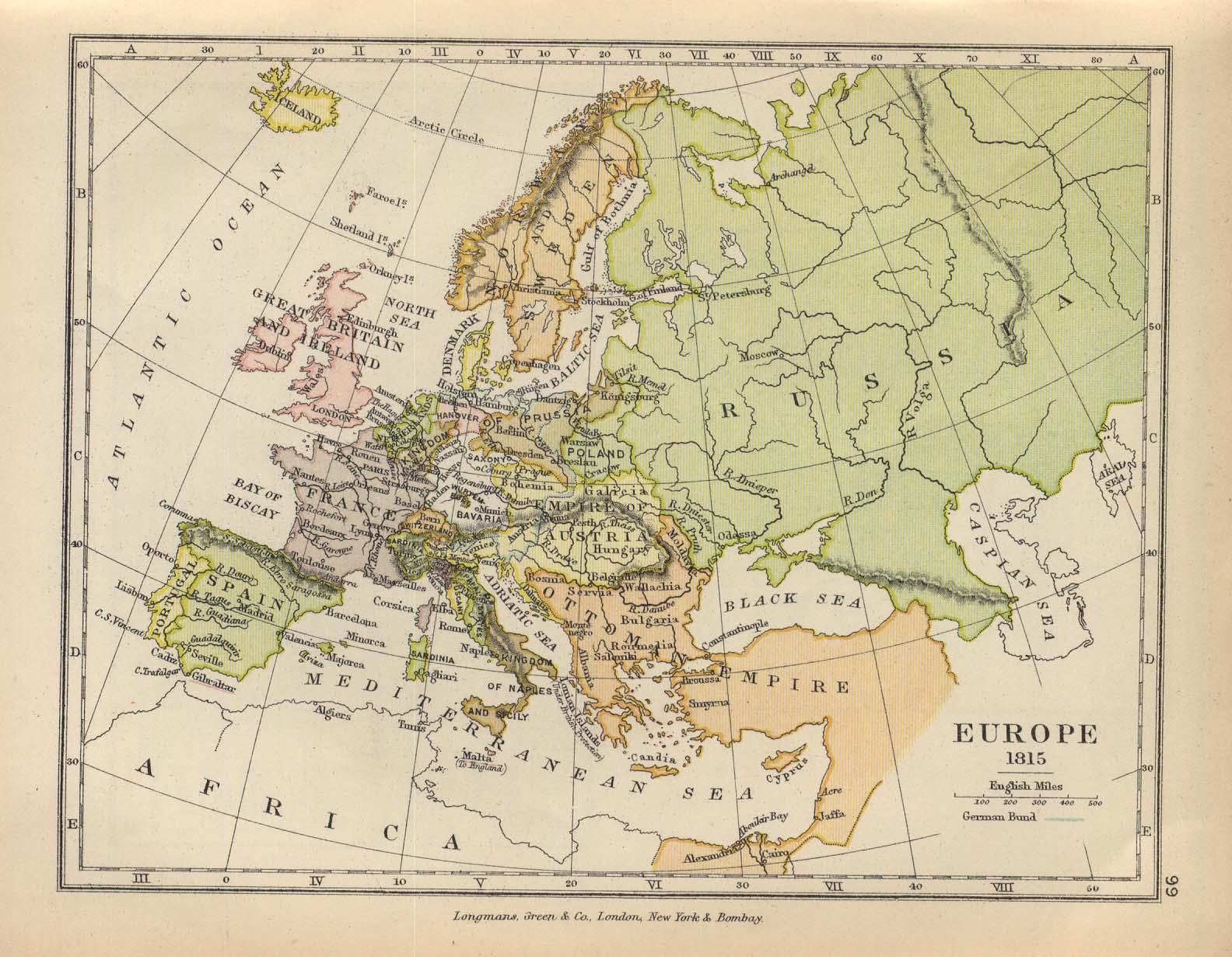
The period started with the realm of Ivan the Great (Ivan III Vasilievich, 1462−1505) to be ended with the final decisions of the Congress of Vienna in 1815. That was the Grand Duchy of Moscow, known as Moscovy, as the state created by the Grand Dukes of Moscow in north-east Russia to be destined to commit two great historical tasks: 1) To recover the territories lost to the Swedish, Polish, Lithuanian, German, Ottoman, and Mongol/Tartar occupants (in the west and south), and 2) To expand Russian authority across North Asia (Siberia) up to the Pacific Ocean. However, it has to be noticed that in 1462 the crucial aspect of Russian participation in international relations was, in fact, zero as the state was almost in absolute isolation from the rest of the world. In other words, Moscovy Russia was in the mid-15th century isolated from almost all contact with the outside communities simply by the hostility of its direct neighbors. In particular, Moscovy Russia was not in a position to share in both scientific and cultural issues of Europe, and from this perspective became relatively backward compared with especially West Europe. However, lesser than four centuries later, in 1815 Russian Empire became the most powerful participant in European politics and international relations.
The territories of the Russian people ruled from Kiev (the Kieven Rus’) have been split due to the Mongol occupation in the mid-13th century followed by the occupation by the Grand Duchy of Lithuania into two parts: eastern and western. The eastern lands were under the authority of Mongols while the western territories became crucial parts of the Grand Duchy of Lithuania (including Kiev) to be after the Lublin Union of 1569 (signed between Poland and Lithuania) incorporated into the Kingdom of Poland. Nevertheless, under the shadow of Mongol overlordship, the Grand Duchy of Moscow succeeded to dominate its Russian neighbors and finally threw off the Mongol/Tartar yoke.
The growing power of the Grand Duchy of Moscow was gradual and finally obtained political independence from the Mongols/Tartars under the rule of Ivan the Great in 1480. The political-military power of Moscovy was first exerted eastward and later southeastward. The northern territories of Novgorod have been the next (in 1478) followed by Pskov (1510). Nevertheless, one of the most successful and important conquests by Moscovyte Russia (from 1547 the Empire) was in 1552 when the Khanate of Kazan became subjugated to Russian rule. Consequently, this conquest opened the way for Russia to advance across the Urals and into Siberia. Subsequently, the Tartar Khanate of Astrakhan became conquered in 1556 which gave Russia control of the Volga and all ways to the Caspian Sea.
However, in the second half of the 16th century, Russia experienced certain setbacks during the Livonian War (1558−1583) under Ivan IV the Terrible (1533−1584) as this debilitating war for a quarter of a century on the Polish-Lithuanian and Swedish frontiers was, in principle, not successful for Russia. Moscow was in the year 1571 even sacked by the invading army of the Tartars from Crimea.
Nevertheless, Siberia became the biggest challenge of the Russian territorial expansion at the turn of the 17th century. Originally, it was the fur trade that involved Russian merchants in the unknown and rarely settled territory of Siberia (that was, in fact, terra incognita). Russians finally reached the coast of the Pacific Ocean in 1639 followed by the establishment of the holds (like the Americans did in the Wild West). In essence, the plenty of Siberian rivers very much facilitated fast exploration that became soon inforced by strategic forts and trading posts. In fact, all of Siberia except the Amur region became acquired from native primitive peoples (Tungusy, Ostyaks, Lamuts, Koryaks, Chukchi, Yakuts, Evenki…) – the Amur was annexed from China in the 1650s but was given up in 1689 according to the Treaty of Nerchinsk with China. Parallelly, the opening of the Volga trade route led to the fast growth of the silk trade with Persia/Iran via the Caspian Sea.
After the Time of Troubles in Russian history, which followed the deaths of Ivan the Terrible (1584) and Boris Godunov (1605) in 1613 Michael Romanov became elected Russian Tsar/Emperor – the founder of the Romanov ruling dynasty (1613−1917). The Romanovs in the 17th century turned their attention to the recovery of West Russia which was for centuries under the Lithuanian-Polish occupation. At the beginning of this campaign, there were certain losses which have been caused mainly by the internal political chaos and disunity of the earlier period known as the Time of Troubles. However, important gains have been done from 1640 to 1686. For instance, in 1667, Kiev and the mid-Dneper territories were gained. The Cossacs of the lower Dnieper led by Bohdan Khmelnytsky voluntarily accepted the Russian rule instead of the Polish Catholic yoke in 1654, and their land of Zaporozh’ye, therefore, became since that time claimed by Russia.
In the second half of the 16th century and throughout the 17th century, Russian colonization spread across the Oka River in the south while some Eastern Slavs migrated from Poland into the forest-steppe zone. At the time, several towns in this zone started their existence as borderland outposts like, for instance, Orel (1564), Voronezh (1586), or Kursk (1586). Nevertheless, at the time, isolation from Europe was the focal problem for Russia until the time of Tsar Peter the Great (1682−1725). On one hand, there was a huge demand for different products from the Russian forest and land by West Europeans but, on the other hand, Russia was unable to profit from such demand for the very physical reason that Poland-Lithuania, Sweden, and the Ottoman Empire simply blocked both oversea and overland links with Europe. It is true that the Brits for commercial purposes succeeded to open up a very dangerous northern route to the White Sea via the Barents Sea and that Russian Tsar Ivan the Terrible established the seaport of Archangel in 1584. However, Archangel as the outlet for the export of Russian products to Europe was workable only during the summertime for a few months. For several reasons, therefore, Russian Tsar Peter the Great accepted as his focal national aim in foreign policy to break through to the shores of the Baltic Sea and consequently, took from Sweden Estonia and Livonia after the Great Northern War (1700−1725) which, in fact, Swedish King Charles XII started against Russia. The seaport of Riga became acquainted and a new Russia’s capital on the Baltic Sea was established in 1703 – St Petersburg. Consequently, Russia became a Baltic power with open access via the sea to Europe and its market.
What was done by Peter the Great for Russia in the north (the Baltic Sea) was done later in the same century by Russian Empress (of German origin) Catherine the Great (1762−1796) in the south (the Black Sea). She was waging several successful wars from 1768 to 1792 against the Tartar Khanate in Crimea which finally led to the destruction of the Tartar state in the peninsula. It was followed by the substitution of Russian for Ottoman control along the northern littoral of the Black Sea, in the Crimean Peninsula, around the Azov Sea, and across the adjoining steppes. The seaport of Odessa was founded in 1794 and became for the region of the Black Sea of the same importance as the seaport of Archangel (est. 1584) was for the White Sea or St Petersburg for the Baltics – the focal outlet for Russian exports to Europe.
From the time of the First Partition of Poland-Lithuania (the Republic of Two Nations) in 1772 to the Vienna Congress of 1814−1815 Russia moved her state territory westward for 600 miles at the expense of Poland-Lithuania. By the three partitions of the Polish-Lithuanian Commonwealth in 1772, 1793, and 1795 Russian Empire gained much of the former Polish Kingdom and all Grand Duchy of Lithuania. After the collapse of Napoleon’s Grand Duchy of Warsaw, the Vienna Congress authorized Russian Emperor Alexander I (1801−1825) to become King of a reconstituted Kingdom of Poland. Russia became a leader of the Holy Alliance (Russia, Austria, and Prussia) up to the mid-19th century and, in fact, the strongest power in continental Europe with borders from Warsaw to Vladivostok. At the time of the Napoleonic Wars, Russia included the region of the South Caucasus (1806−1813).
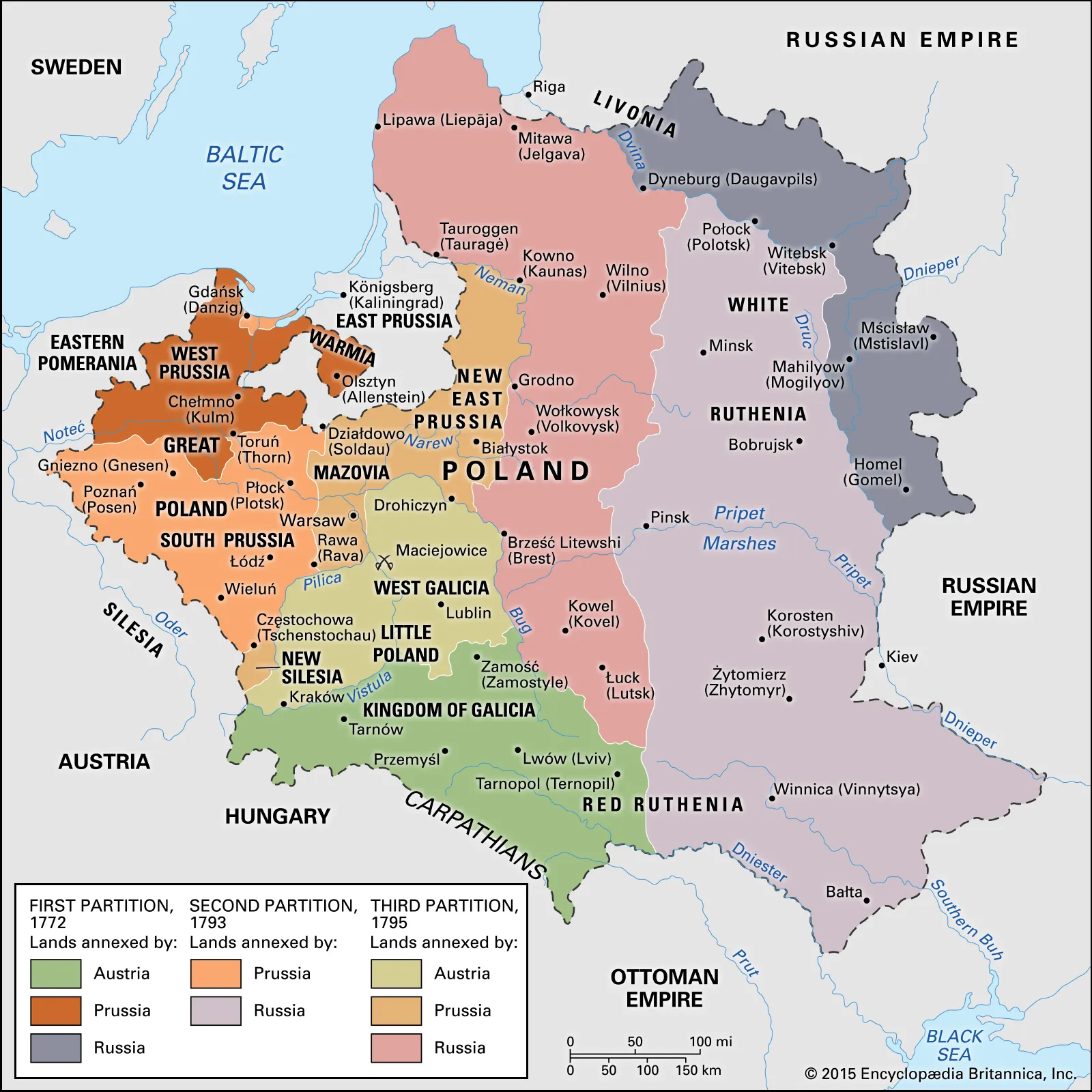
Russia during the period from Peter the Great to the Vienna Congress experienced fast economic development, especially in the military industry. During that historical period, the Russian Empire was engaged in several wars for the purpose to obtain direct geophysical access to both the Baltic Sea in the north and the Black Sea in the south followed by pushing Russian borders westward into the territory of the Polish-Lithuanian Commonwealth which main part of it was previously annexed from Russia and populated by Russians and other Eastern Slavs. On these East Slavonic territories incorporated into Poland-Lithuania, the Eastern Orthodox Slavs have been experiencing systematic Catholization, forced acceptance of the church union with the Vatican, and denationalization (i.e., political Russophobia). Nevertheless, these wars required a huge investment in the armaments industry and, therefore, productive metallurgical foundations. These conditions were founded by Emperor Peter the Great according to the West European pattern, fundamentally in the Urals as this region was extremely rich in iron and copper ores as well as in huge forests which have been suitable for the production of charcoal. The same Emperor founded factories, gave investment incentives, encouraged new management, and established the foundation for the further industrialization of Russia. In Central Russia, the textile and animal fat industries continued to be developed while by 1815, a new (third) industrial center arose in the north at a new capital St Petersburg.
Finally, Russia’s population in 1815 due to both territorial enlargement and prolific natural increase was significantly increased. For the year 1600, it is estimated that Russia (Moscovy) had circa 10 million inhabitants but when Peter the Great died, around 15,5 million. According to the census data in the year of the Napoleonic invasion of Russia in 1812, the Empire had already 42,75 million people (including from Europe and Asia). The population of Siberia, for instance, had grown from around 500.000 during the time of Peter the Great to some 1.400.000 when Napoleon attacked Russia. However, at that time, only 4% of the total Russia’s population was living in the urban areas, of which 30% lived in the two biggest cities – Moscow and St Petersburg.
Dr. Vladislav B. Sotirovic
Ex-University Professor
Research Fellow at Centre for Geostrategic Studies
Personal disclaimer: The author writes for this publication in a private capacity which is unrepresentative of anyone or any organization except for his own personal views. Nothing written by the author should ever be conflated with the editorial views or official positions of any other media outlet or institution.
Origins of images: Facebook, Twitter, Wikimedia, Wikipedia, Flickr, Google, Imageinjection, Public Domain & Pinterest.
Read our Disclaimer/LegalStatement!
DonatetoSupportUs
We would like to ask you to consider a small donation to help our team keep working. We accept no advertising and rely only on you, our readers, to keep us digging the truth on history, global politics, and international relations.
An earlier abridged version of this post was published by Middle East Eye under a different title on June 5, 2016. The focus is upon the misuse of anti-Semitism by those defending Israel to deflect a rising tide of civil society activism and public criticism of Israeli policies and practices.Zionism as Racism? Zionism and the State of Israel8 Jun 2016 – More than 40 years ago the UN General Assembly adopted controversial resolution 3379 by a vote of 72-35 (with 32 abstentions), determining “that Zionism is a form of racism and racial discrimination.” This resolution was bitterly opposed by Israel and its ...
Imagine that Vladimir Putin were not a murderous autocrat and kleptocrat who has spent his fourteen years in power living up to his KGB past and dragging Russia ever back towards Communist autocracy, illiberalism, and expansionism. Imagine that instead he were one of the greatest leaders that Russia has had, whose policies have helped produce a massive rise in living standards and life expectancy, recuperation of national pride, and enforcement of the rule of law, who has tackled kleptocrats and gangsters wisely and well, whose foreign policy has on balance been realistic, diplomatic, and conducive to peace, who has presided ...
On Saturday, May 14, in Stockholm’s Globe Arena an event called the 2016 Eurovision Song Contest final will take place.According to the Eurovision Official Rules 2016 posted on eurovision.tv:1.2) Criteria of eligibility1.2.1) Songs“The lyrics and/or performance of the songs shall not bring the Shows, the ESC as such or the EBU into disrepute. No lyrics, speeches, gestures of a political or similar nature shall be permitted during the ESC. No swearing or other unacceptable language shall be allowed in the lyrics or in the performances of the songs. No messages promoting any organization, institution, political cause or other, company, brand, ...
Ever since the U.S. government dangled $160 million last December to combat Russian propaganda and disinformation, obscure academics and eager think tanks have been lining up for a shot at the loot, an unseemly rush to profit that is spreading the Russia-gate hysteria beyond the United States to Europe.Now, it seems that every development, which is unwelcomed by the Establishment – from Brexit to the Catalonia independence referendum – gets blamed on Russia! Russia! Russia! The methodology of these “studies” is to find some Twitter accounts or Facebook pages somehow “linked” to Russia (although it’s never exactly clear how that ...
The internal and much more external destruction of the former Yugoslavia in the 1990s was celebrating in 2015 its 20th year of anniversary. However, this historical and much more geopolitical event still needs a satisfactory research approach in regard to the true geopolitical reasons and political-military course of the destruction of this South Slavic and Balkan state. During the last quarter of century, the (western) global mainstream media unanimously accused Serbia and the Serbs of the national chauvinism as the main cause of the bloody wars on the territory of ex-Yugoslavia in the 1990s. However, the role and direct impact ...
The United States Government is now treating Ukraine as if it were a NATO member, and on September 27th donated to Ukraine two warships for use against Russia. This is the latest indication that the US is switching to Ukraine as the locale to start World War III, and from which the nuclear war is to be sparked against Russia, which borders Ukraine.Here is why Syria is no longer the US alliance’s preferred choice as a place to start WW III:On September 4th, US President Donald Trump publicly threatened Syria, Iran and Russia that if they exterminated the jihadists in Syria’s only remaining jihadist-controlled ...
Mirė vienas didžiausių pasaulyje tarptautinių karo nusikaltėlių JAV senatorius Džonas Makeinas. Jis , kaip ir kitas JAV karo nusikaltėlių gaujos sėbras Zbignevas Bzežinskis, darė karo nusikaltimus visame pasaulyje, žudė civilius gyventojus, moteris, vaikus, senelius Vietname, Irake, Jugoslavijoje, Libijoje, Sirijoje, Jemene, Somalyje, Nigerijoje, Gruzijoje, Ukrainoje, kišosi į visų pasaulio šalių vidaus reikalus, dalyvavo vykdant spalvotas revoliucijas visose Rusijos pasienyje esančiose buvusiose tarybinėse valstybėse, Vidurio ir Rytų Europoje, Pabaltijo respublikose, Šiaurės Afrikoje, Artimuosiuose ir Vidurio Rytuose, rėmė nusikalstamus fašistinius režimus, nacionalistines chuntas, islamo teroristines organizacijas minėtose šalyse, yra tiesiogiai atsakingas už jo remtų partijų – konservatorių, liberalų, socdemų, nacistų, nacionalistų, fašistų, islamo teroristų ...
In the night of July 16-17, 1918, a squad of Bolshevik secret police murdered Russia's last emperor, Tsar Nicholas II, along with his wife, Tsaritsa Alexandra, their 14-year-old son, Tsarevich Alexis, and their four daughters. They were cut down in a hail of gunfire in a half-cellar room of the house in Ekaterinburg, a city in the Ural mountain region, where they were being held prisoner. The daughters were finished off with bayonets. To prevent a cult for the dead Tsar, the bodies were carted away to the countryside and hastily buried in a secret grave.Bolshevik authorities at first reported ...
Note: We are republishing this essay by S. Brian Willson describing the true history of genocide in the United States which stands in stark contrast to the myth of Thanksgiving because of its popularity with readers and its educational value.The Defining and Enabling Experience of Our “Civilization” As we again plan to celebrate what US “Americans”call Thanksgiving, let us pause for a moment of reflection. Let us recognize that accounts of the first Thanksgiving are mythological, and that the holiday is actually a grotesque celebration of our arrogant ethnocentrism built on genocide.Native Americans in the Caribbean greeted their 1492 European invaders ...
“To Hell and Back” is a phrase that can bear a pretty heavy metaphorical load when it comes to talking about the atomic bombings of Nagasaki and Hiroshima. It’s also the title of a book by Charles Pellegrino.Pellegrino’s book is a moving and grueling close-up look at the horrors experienced by the people of Hiroshima and Nagasaki both on the day of the bombing and in the days and years afterward. I have the heart of a dried-up raisin but even I got a little teary in places.There are few opportunities for inspiring “triumph of the human spirit” narratives amid ...
Turkish President Recep Tayyip Erdogan has become a serious danger not only to his own nation, but to many others as well. His actions and statements in recent years should seriously worry his neighbors and the entire world.The last tyrant ignored by the international community was the genocidal butcher Adolf Hitler, who unleashed World War II, invading scores of countries and killing millions of people. Regrettably, Western leaders have tried to appease Erdogan, thereby creating a monster.Strangely, some nations in the Islamic world have treated him respect, while many Western countries consider Turkey as one of their key allies. To ...
American capitalism is based on plunder. With the continental USA plundered, American capitalism hoped to continue enriching itself by plundering Russia as it did under Yeltsin, carefully including the Russian “Atlanticist Integrationists” in the spoils in order to have support from the liberal, progressive forces in Russia for stripping Russia of its assets. But Putin more or less put a halt to the American/Israeli rape of Russia, although it still continues through the neoliberal economics that Harvard brainwashed into the Russian central bank and economics profession. Brainwashed Russian economists are the main reason Washington is able to punish a powerful ...
On February 5, Military Times published a report stating that Washington has failed to publicly disclose potentially thousands of lethal airstrikes conducted over several years in Iraq, Syria and Afghanistan. The investigation reveals that in Afghanistan in 2016 alone, the U.S. air force carried out at least 456 bombings. The open-source report published by the Air Force Command doesn’t include these figures.According to the Military Times, the information was obtained from “Congress, American allies, military analysts, academic researchers, the media and independent watchdog groups” and it shows that much of what the Pentagon has disclosed may be misleading or simply ...
In 1999, when he was the President of Finland, Marti Ahtisaari’s government wanted to honor and to commemorate the 3,000 Finnish Nazi Waffen SS volunteers that served in Heinrich Himmler’s SS. Why would any government, indeed, why would anyone, want to honor and commemorate SS troops? Why would anyone want to honor and commemorate Nazis and Nazism? This is the question that has remained unanswered in the US and Western media about Marti Ahtisaari. As a sock puppet for the US, NATO, and EU, Ahtisaari’s role in honoring and commemorating the Nazi Waffen SS has been suppressed. As a Chairman ...
History of NATO enlargementIn 2009, Russian President Medvedev (President from May 7th, 2008 to May 7th, 2012) called for a new European security policy known as “Fourteen Points” as a new security treaty to be accepted to maintain European security as the ability of states and societies to maintain their independent identity and functional integrity (this Russian draft European security treaty was originally posted on the President’s website on November 29th, 2009). This treaty proposal was passed to the leaders of the Euro-Atlantic States and the executive heads of the relevant international organizations such as NATO, EU, the Collective Security ...
General Adolf Heusinger (August 4, 1897 – November 30, 1982) was a German general officer who briefly served as Adolf Hitler’s Chief of the General Staff of the Army during World War II and served as the first Inspector General of the Bundeswehr, the West German armed forces, from 1957 to 1961. Heusinger served as Chairman of the NATO Military Committee from 1961 to 1964.Heusinger was born in Holzminden, in the Duchy of Brunswick, German Empire. He entered the Imperial German Army on June 17, 1915, and was assigned to 7. Thüringisches Infanterie-Regiment Nr. 96, an infantry regiment raised in ...
America is coming to the rescue of Al Qaeda under a humanitarian mandate. The unspoken agenda is to undermine the Liberation of Aleppo. The pretext and justification for these actions are based on America’s “responsibility to protect” (R2P) the “moderates” in Aleppo from Syrian and Russian attacks and bombing raids.On October 3, the US State Department announced the suspension of bilateral relations with Russia pertaining to Syria (see document below), in response to which, France’s foreign Minister Jean Marc Ayrault was called upon to intermediate at the diplomatic level. Pointing his finger at Russia’s Foreign Minister Sergei Lavrov, Jean Marc Ayrault casually accused Moscow ...
Historical backgroundAfter the failure of the interwar League of Nations to prevent international crises and military conflicts of the 1930s which finally culminated in the next global war, the major Allied states (the USA, the USA, the UK, and China) agreed in Moscow in October 1943 to create a new, more functional, and improved international peace-keeping organization after the war under a new name of the United Nations Organization (the UNO). In other words, the UNO has evolved from a wining coalition of countries fighting against European Nazism and fascism in WWII. Following further negotiations at Dumbarton Oaks and Yalta, ...
In early January 2020, Serbian media reported the sensational news that recently declassified British Ministry of Defense files contained important new evidence suggesting that the official account of what happened in Srebrenica was unfounded.As from time to time has been the case, Western sources have again disclosed some information about Srebrenica in July 1995, which until recently was kept confidential and therefore not available to the public. The source of this particular batch of documents is the UK Department of Defense. The documents that have finally been declassified contains very interesting assessments and reports that take on even greater significance ...
A Black Agenda Radio commentary by executive editor Glen Ford“For Russia, the war in Afghanistan is a domestic issue, with a direct impact on the drug trade and terrorist attacks on Russian cities”.If the United States were not a superpower, it would be the joke of the planet, a nation whose government tells the most outrageous and ridiculous lies -- and may actually believe them -- and whose corporate media report those lies as gospel truth. The latest whopper comes from the mouth of James “Mad Dog” Mattis, the U.S. Secretary of Defense, who claims the Russians are providing weapons ...