
Views: 3239
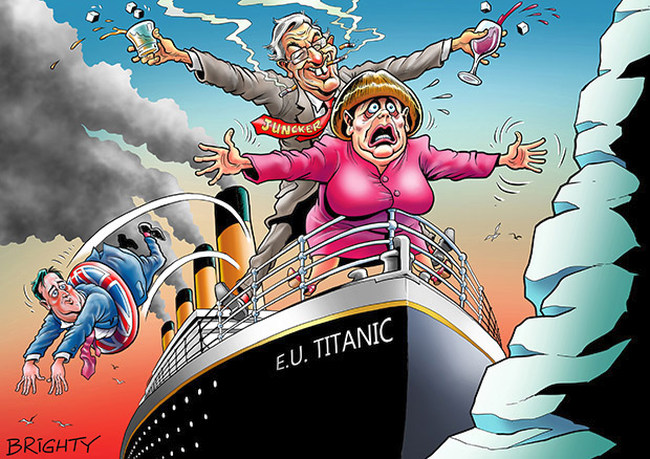
A Unified Europe: Born In the USA
While Brexit versus the continuation of the European Union is a hot news topic, few know the secret who and why of the EU’s creation.
The lead financial writer at the Telegraph, Ambrose Evans-Pritchard, wrote in 2000:
Declassified American government documents show that the US intelligence community ran a campaign in the Fifties and Sixties to build momentum for a united Europe.
***
The head of the Ford Foundation, ex-OSS officer Paul Hoffman, doubled as head of ACUE [below, we’ll explain who these players are] in the late Fifties. The State Department also played a role. A memo from the European section, dated June 11, 1965, advises the vice-president of the European Economic Community, Robert Marjolin, to pursue monetary union by stealth.
It recommends suppressing debate until the point at which “adoption of such proposals would become virtually inescapable”.
In other words, the U.S. State Department recommended ramming through the creation of the EU before Europeans knew what was happening.
Professor of International Security at the University of Warwick Richard J. Aldrich reviewed available historical documents, and also concluded that the European Union was largely an American project:
US officials trying to rebuild and stabilize postwar Europe worked from the assumption that it required rapid unification, perhaps leading to a United States of Europe. The encouragement of European unification, one of the most consistent components of Harry S. Truman’s foreign policy, was even more strongly emphasized under his successor General Dwight D. Eisenhower. Moreover, under both Truman and Eisenhower, US policymakers conceived of European unification not only as an important end in itself, but also as a way to solve the German problem.’
***
One of the most interesting US covert operations in postwar Europe was the funding of the European Movement. The European Movement was an umbrella organization which led a prestigious, if disparate, group of organizations urging rapid unification in Europe, focusing their efforts upon the Council of Europe, and counting Winston Churchill, Paul-Henri Spaak, Konrad Adenauer, Leon Blum and Alcide de Gasperi as its five Presidents of Honour.
***
The discreet injection of over three million dollars between 1949 and 1960, mostly from US government sources, was central to efforts to drum up mass support for the Schuman Plan, the European Defence Community and a European Assembly with sovereign powers. This covert contribution never formed less than half the European Movement’s budget and, after 1952, probably two-thirds.
***
The conduit for American assistance was the American Committee on United Europe (ACUE), directed by senior figures from the American intelligence community. This body was organized in the early Summer of 1948 by Allen Welsh Dulles, then heading a committee reviewing the organization of the Central Intelligence Agency (CIA) on behalf of the National Security Council (NSC), and also by William J. Donovan, former head of the wartime Office of Strategic Services (OSS) [predecessor to the CIA].
***
The International Organizations Division [a newly-established branch of the CIA] was also involved in the fourth type of US covert operation — provoking dissonance in the satellite states. This effort was channelled through the National Committee for a Free Europe, later known as the Free Europe Committee, which controlled Radio Free Europe and Radio Liberty. Much of the work, done with the help of irascible exile groups under the Assembly of Captive European Nations (ACEN), was coordinated by the CIA’s burgeoning Munich station, which also gave aid to resistance groups within eastern Europe.
***
The ACUE and its short-lived predecessor were only two of many `American’ and ‘Free’ committees established during 1948 and 1949. Well-documented examples include the National Committee for a Free Europe (later the Free Europe Committee) and the Free Asia Committee (later the Asia Foundation). The Free Europe Committee, formed in 1948 by the retired diplomat Joseph E. Grew at Kennan’s request, worked closely with the CIA to maintain contact between exile groups in the West and the Eastern bloc. Their campaign ‘to keep alive the hope of liberation in Eastern Europe’, was launched publicly in 1949 by the recently retired American military governor in Germany, General Lucius D. Clay.” The initial membership included many senior government figures such as the former Assistant Secretary of State, Adolphe Berle, Allen Dulles and ex-OSS personnel such as Frederic R. Dolbeare. The Free Europe Committee purported to draw its resources from private subscriptions and various foundations, but in reality the majority of its funds came from the US government through channels managed by the CIA.
***
The United States persuaded Britain and France to give the exile groups associate membership of the Council of Europe. A year later the White House endorsed State Department plans to accelerate these efforts. Outlining their proposals in a special guidance paper entitled ‘The Concept of Europe’, they admitted their concern that the main propaganda effort in the East lacked the `positive qualities which are necessary to arouse nations’. Several studies had been made in an attempt to find a positive concept and the themes of ‘European Unity’ and ‘Return to Europe’ might rectify this problem. Its ‘solely European’ nature ensured that it could not be `dismissed as another manoeuvre of “American imperialism”‘.
***
Unification was officially a central component of US policy — Congress had stipulated it as a condition of further Marshall Plan aid
***
The ACUE’s work in continental Europe during the early 1950s also focused increasingly upon propaganda and mass action
***
In 1951, the majority of ACUE funds for Europe were employed on a new venture — a unity campaign amongst European youth. Between 1951 and 1956 the European Movement organized over 2,000 rallies and festivals on the continent, particularly in Germany where they received the help of the US army. One of the additional advantages of deploying American funds on the large youth programmes was that it helped to disguise the extent to which the European Movement was dependent upon American funds. In May 1952 Spaak decided that funds from American sources that had previously been used in the ordinary budget of the European Movement would now be diverted for use in the ‘Special Budgets’ used to support their growing range of new programmes. This disguised their source and avoided any accusations of American dependency. Again, in November 1953, Baron Boel, the treasurer of the European Movement, explained that it was essential to avoid a situation where opponents of European unity could accuse them of being an American creation. For this reason ‘American money, quite acceptable for the European Youth Campaign and certain restricted activities, could not be used for the normal running of the Movement’. Through the use of `Special Budgets’, the large sums from American sources did not show up in the ordinary budget of the European Movement.”
***
As early as 1949, at the behest of Allen Dulles, the Ford Foundation was cooperating with the CIA on a number of European programmes.” By 1950, the ACUE and the Ford Foundation were coordinating their efforts to support federalism.” Moreover, by the mid-1950s, the senior figures who directed both overt and covert American support were increasingly synonymous. By 1953 both John J. McCloy and Shepard Stone, who had been instrumental in arranging for substantial covert government funds for the European Youth Campaign, were both on the board of trustees of the Ford Foundation. McCloy was also a director of the Rockefeller Foundation. By 1955, McCloy had become chairman of the Ford Foundation, while serving as chairman of the Council on Foreign Relations. Simultaneously, the same circle, including Retinger, McCloy, Allen Dulles, Harriman, David Rockefeller, Jackson and Bedell Smith were busy creating the Bilderberg Group, yet another organization that bridged the narrowing gaps between government, private and public organizations and between overt and covert on both sides of the Atlantic.”
***
Most ACUE funds originated with the CIA.
***
Mutual Security Agency [an American agency created by Congress] funds were also used to support the European Movement, indeed the Mutual Security Act of 1951 explicitly stated that its resources were to be used ‘to further encourage the economic and political federation of Europe’.’
A North American Created the Euro
This guy – Robert Mundell – is the father of the Euro:

Born in Canada, Mundell taught at the University of Chicago for 7 years, and has since taught at Columbia University in New York for more 42 years.*
But didn’t Mundell create the Euro to help Europe?
Not according to Guardian, Independent and BBC investigative journalist Greg Palast, who explained in his book Vulture’s Picnic:
Who spawned this cruel little bastard coin?
I called its parent, Professor Robert Mundell. Mundell is known as the Father of the Euro. The Euro is often spoken of as a means to unite post-war Europeans together emotionally and politically and to give this united Europe the economic power to compete with the U.S. economy.
That’s horseshit.
The Euro was invented in New York, New York, at Columbia University. Professor Mundell invented both the Euro and the guiding light of Thatcher-Reagan government: “Supply Side Economics” or, as George Bush Sr. accurately called it, “Voodoo Economics.” Reagan-Thatcher voodoo and the Euro are two sides of the same coin. (Ouch! Some puns hurt.)
Like the Iron Lady and President Gaga. the Euro is inflexible. That is, once you join the Euro, your nation cannot fight recession by using fiscal or monetary policy. That leaves “wage reduction, fiscal constraints (cutting government jobs and benefits) as the only recourse in crisis,” The Wall Street Journal explains with joy—and sell-offs of government property (privatizations).
Why the Euro, Professor? Dr. Mundell told me he was upset at zoning rules in Italy that did not allow him to put his commode where he wanted to in his villa there. “They’ve got rules that tell me I can’t have a toilet in this room. Can you imagine?”
I couldn’t really. I don’t have an Italian villa, so I cannot really imagine the burden of commode placement restriction.
The Euro will eventually allow you to put your toilet any damn place you want.
He meant that the only way the government can create jobs is to fire people, cut benefits, and, crucially, cut the rules and regulations that restrict business.
He told me: “Without fiscal policy, the only way nations can keep jobs is by the competitive reduction of rules on business.” Besides bowl location, he was talking about the labor laws, which raise the price of plumbers, environmental regulations, and, of course, taxes.
No, I am not making this up. And I am not saying the Euro was imposed on the Old Country just so the professor could place his toilet at a place of maximum pleasure. The Euro is fashioned as an anti-regulation straitjacket that would eliminate gallons-per-flush laws, flush away restrictive banking regulation, and all other government controls.
Now does the destruction of Greece’s sovereignty make a little more sense?
As Palast pointed out in the Guardian:
The idea that the euro has “failed” is dangerously naive. The euro is doing exactly what its progenitor – and the wealthy 1%-ers who adopted it – predicted and planned for it to do.
***
For him, the euro wasn’t about turning Europe into a powerful, unified economic unit. It was about Reagan and Thatcher.
***
And when crises arise, economically disarmed nations have little to do but wipe away government regulations wholesale, privatize state industries en masse, slash taxes and send the European welfare state down the drain.
***
Far from failing, the euro, which was Mundell’s baby, has succeeded probably beyond its progenitor’s wildest dreams.
In other words, the Euro was intended to impose a Shock Doctrine straightjacket on Europe, where the big banks are stripping Greece and other countries of their public assets, pillaging, plundering and looting them of their natural resources and wealth.

Originally published on 2016-06-16
Source: Washingtons Blog
Origins of images: Facebook, Twitter, Wikimedia, Wikipedia, Flickr, Google, Imageinjection, Public Domain & Pinterest.
Read our Disclaimer/Legal Statement!
Donate to Support Us
We would like to ask you to consider a small donation to help our team keep working. We accept no advertising and rely only on you, our readers, to keep us digging the truth on history, global politics and international relations.
[wpedon id=”4696″ align=”left”]

FOLLOW US ON OUR SOCIAL PLATFORMS