
Views: 1949
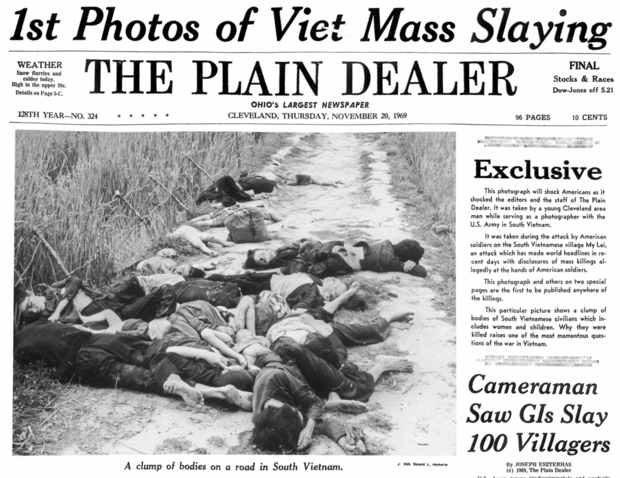
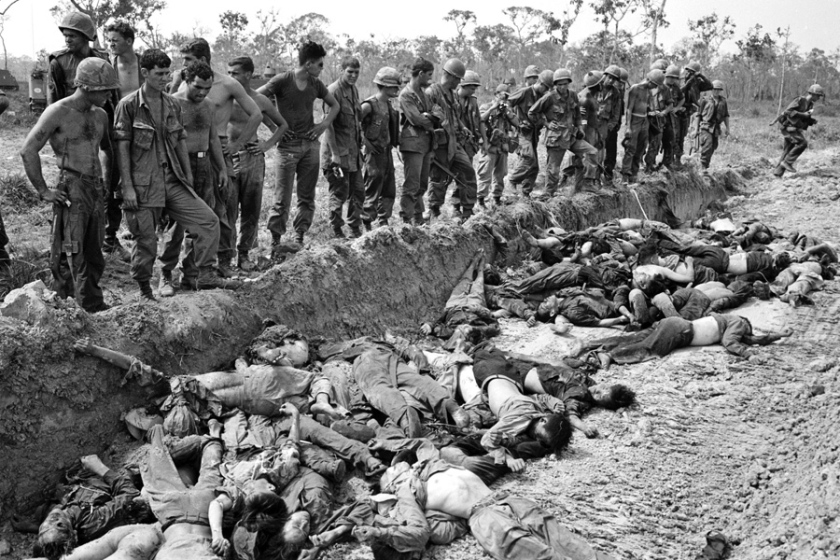
In Kill Anything that Moves: The Real American War in Vietnam (Metropolitan Books. New York. 2013), Turse writes that the US military’s official position, and the popular understanding in the US, is that leadership “has never condoned wanton killing or disregard for human life.” (2) On the rare occasions when atrocities are brought to light, they are blamed on low-level individuals and are said to be aberrations having nothing to do with official policy. The My Lai massacre, for example, was blamed on Lieutenant William Calley, who is said to have gone “crazy” (4,5) – although he and his unit were following orders from up the chain of command. In terms of striving for an understanding of the Vietnam war, Turse’s book is of crucial importance for its detailed illustration of two points: one, that the atrocities at My Lai were “eclipsed by similar American actions throughout the country”. A 2008 Harvard Medical School study put the number of deaths due to the Vietnam war at 3.8 million. Turse says this may well be an underestimate. The total number of civilian casualties (meaning people killed and wounded) may be around 7.3 million. This includes 8,000 to 16,000 paraplegics, 30,000 to 60,000 blinded, and 83,000 to 166,000 amputees. This was an “endless” American “slaughter” that “wiped out civilians day after day, month after month, year after year”. (13) Secret US government internal investigations, which Turse unearthed, reveal that “atrocities were committed by every … major army unit in Vietnam” (emphasis in original). When he began his investigation of US war crimes in Vietnam, Turse thought it would be like “looking for a needle in a haystack.” What he discovered was a “haystack of needles.” (21)
Two: This pattern of behavior was not “accidental.” (14) Rather, it was the “outcome of deliberate policies, dictated at the highest levels of the military.” (6; related: 40-51)
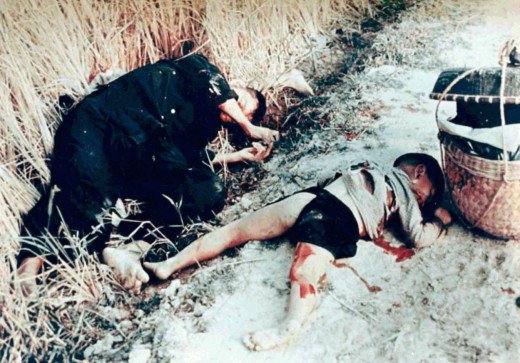 The ethos of the US’s Vietnam attack plan was “embodied most fully” in Secretary of Defense (1961-68) Robert McNamara. The plan, which was carried out with “corporate”, “businesslike”, “scientific”, “assembly line … efficiency”, was fairly simple: to kill so many people that the independence/communist movement would “give up the fight”. “At the most basic level”, “everything” thus “came down to” what was termed the “body count”. “Body count” was the “preeminent statistic” – the military’s “raison d’etre” – a command flowing “from the Pentagon…”, which essentially assigned “killing quotas”. The “war managers” thus “base[d] the entire American military effort” on producing “Vietnamese corpses”, (40-4) with results for the Vietnamese population at large that were quite “…foreseeable.” (14) These results were also “facilitated by the contempt that Americans generally” had for the Vietnamese. US President Lyndon Johnson referred to Vietnam as “a piddling piss-ant little country.” McNamara called it a “backward nation”; Kissinger, a “little fourth-rate power”; others called it a “garbage dump”; the “asshole of the world”. A popular proposal was to “Kill ‘em all and let God sort ‘em out.” (49) Vietnamese were commonly regarded as “subhuman”, a notion that was tied into the “Mere Gook Rule”, or MGR, which said Vietnamese were “little more than animals” and thus “could be killed or abused at will.” (50)
The strategic effort to produce mountains of Vietnamese corpses began with training, wherein US recruits – essentially an army of teenagers (34) – were intentionally conditioned to regard Vietnamese people as “dinks”, “gooks”, “slopes”, VC (another US-coined pejorative term), “slants”, “rice-eaters”, etc., and simultaneously indoctrinated into virtual sociopathy and toxic masculinity, constantly made to shout slogans like “Kill! Kill! Kill!”. (28, 30) Instruction on laws of war was almost entirely absent, and, if mentioned, was buried far beneath training overwhelmingly intended to mold hardened killers.
Once they reached Vietnam, soldiers found that “emphasis on body counts was everywhere”, coming “down through the channels.” One soldier: “It was all about body count. Our commanders just wanted body count.” A medic: “Get the body count. Get the body count. Get the body count. It was prevalent everywhere… [T]he mindset of the officer corps from the top down.” (44) Corpse production was further encouraged through a system of punishments and rewards. Lower producers had to stay in the field longer, risking their lives. Higher producers spent less time in the field and received awards such as resort-vacation passes, “medals, badges, extra food, extra beer, permission to wear non-regulation gear, and light duty at base camp.” Another medic called this a “real incentivizing of death”. A veteran termed it a killing “competition”. In this competition, some soldiers “racked up huge personal body counts” of “a thousand or more”. (43-44) One, Roy Bumgarner, may have personally killed 1,500 people as part of “Operation Speedy Express”, a case highly relevant to “the American way of war”. (199)
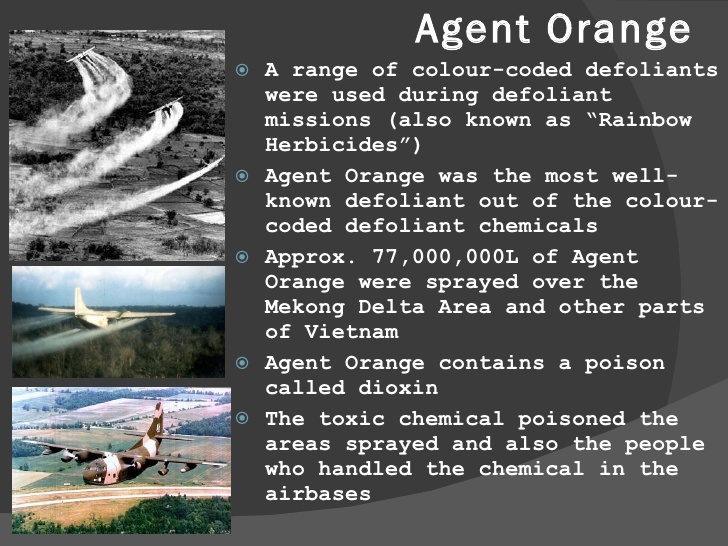
Much of the text is dedicated to looking at specific examples of what resulted from this approach to war and how it was executed. “Sometimes, when units were short of ‘kills’, prisoners or detainees were simply murdered.” Such killings occurred “in unit after unit”. (46-7) Part of the body-count strategy involved using technological “overkill” on the “little fourth-rate power”. Facing guerillas armed mainly with rifles and soda-can grenades, or North Vietnamese troops armed with AK-47 rifles, and rocket-propelled grenades, the US employed an “arsenal unlike any seen before” – “more killing power, destructive force, and advanced technology than any military in the history of the world”. Some top commanders openly celebrated Vietnam as a US “weapons lab”. (78) Ultimately, the US unleashed the equivalent of 640 Hiroshimas on Southeast Asia during the Vietnam war – mostly in South Vietnam (as so many there supported the independence/communist movement), where, unchallenged (as the South Vietnamese had no air defenses), the US carried out, via millions of sorties, “the most intense bombing campaign in history.” (79-80) It also engaged in ecocide through intensive chemical warfare, spraying toxic compounds over vast swathes of land and “4.8 million people”, with resultant cancers, birth defects, etc., ongoing. The US also set “massive” forest fires, wiping out “about 100,000 acres of forest.” (96)
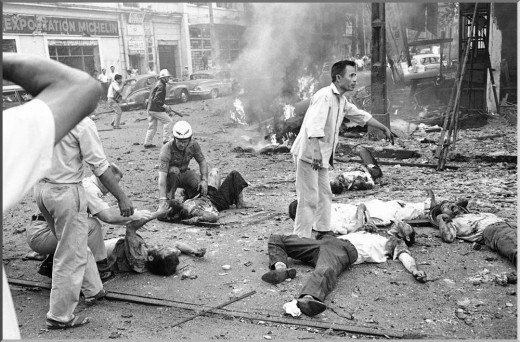 Regarding specific killings, Turse writes “no one could bear to read a full listing”. In hundreds of pages, he describes atrocity after atrocity, but first qualifies that this is merely a “series of snapshots culled from a vast album of horrors” – a “fraction” of the reports he was able to assemble. (108-9) In addition to gruesome killings, Turse logs the repeated American use of human shields, such as forcing civilians to act as mine detectors and, when they were blown up, tallying them as part of the “body count”. (121, 217) Many, such as General George S. Patton III (son of the famous WWII General), took and displayed “macabre souvenirs”, like Vietnamese skulls – a practice unsurprising, Turse notes, given the contempt the US had for the Vietnamese people. US personnel “hacked the heads off Vietnamese” people to keep or “exchange for prizes offered by commanders.” “Many more” took ears, which were sometimes made into necklaces. Other body-part souvenirs included “scalps, penises, noses, breasts, teeth, and fingers”. One soldier noted there were people “in all the platoons with ears on cords”. Another soldier said the sight was an “everyday occurrence”. Soldiers regularly mutilated corpses and took “photos of their handiwork”, “filling scrapbooks with the results.” A journalist noted “thousands” of albums “all seemed to contain the same pictures”: “the severed head shot, the head often resting on the chest of the dead man or being held up by a smiling Marine, or a lot of the heads, arranged in a row, with a burning cigarette in each of the mouths, the eyes open”. Some of the pictured victims were “very young”. “Half the combat troops” had these “snapshots”. “[S]ome American troops hacked the heads off the dead and mounted them on pikes or poles”. Others “lashed corpses to US vehicles and drove through towns and villages”, or ran down “pedestrians by the roadside”. (161-3) As Vietnamese women were “doubly ‘other’”, sexual violence was “omnipresent”. In the field, “rape was a way of asserting dominance, and sometimes a weapon of war” used to torture “women captives to gain information”. Some women were “kidnapped”, raped, and murdered. “Gang rapes” were “horrifyingly common”. (164-68) Torture was “routine”; “the norm”; a “matter of de facto policy”. One unrepentant soldier said torture was used “by all units”. (172, 187)
Turse notes most of this is “forgotten”; “buried”; “vanished” (258) – or, as Trouillot might put it, “silenced”.
Though Turse notes that he reports only a “fraction” of documented atrocities committed by US forces in Vietnam, reading through the two central atrocity chapters (4 and 5) still becomes a disorienting, brutal, and then numbing slog. For the sake of reference and sanity, there could have been more organization to delineate specific categories of crimes in these sections. However, an argument in favor of Turse’s choice might be that to become familiar with this material requires an element of the insane.
Turse elevates his text to essential-status by illustrating that the insanity existed within a wider businesslike, statistical, assembly-line-efficient, top-down strategy of terror.
Originally published on 2017-11-26
About the author: Robert J. Barsocchini is a graduate student in American Studies. Years working as a cross-cultural intermediary for corporations in the film and Television industry sparked his interest in the often astounding discrepancy between Western self-image and reality. His work has been cited, published, or followed by numerous professors, economists, lawyers, military and intelligence veterans, and journalists.
Source: Washingtons Blog
Read our Disclaimer/Legal Statement!
Donate to Support Us
We would like to ask you to consider a small donation to help our team keep working. We accept no advertising and rely only on you, our readers, to keep us digging the truth on history, global politics and international relations.
[wpedon id=”4696″ align=”left”]