
In the lead-up to the NATO action and during it, lurid claims were made about the numbers of people who had been killed or ‘disappeared’ by the Yugoslav forces. “Hysterical NATO and KLA estimates of the missing and presumably slaughtered Kosovan Albanians at times ran upwards of one hundred thousand, reaching 500, 000 in one State Department release [...]
There have been at least two countries in Europe in recent history that undertook ‘anti-terrorist’ military operations against ‘separatists’, but got two very different reactions from the Western elite.
The government of European country A launches what it calls an ‘anti-terrorist’ military operation against ‘separatists’ in one part of the country. We see pictures on Western television of people’s homes being shelled and lots of people fleeing. The US and UK and other NATO powers fiercely condemn the actions of the government of country A and accuse it of carrying out ‘genocide’ and ’ethnic cleansing’ and say that there is an urgent ‘humanitarian crisis.’ Western politicians and establishment journalists tell us that ‘something must be done.’ And something is done: NATO launches a ‘humanitarian’ military intervention to stop the government of country A. Country A is bombed for 78 days and nights. The country’s leader (who is labeled ‘The New Hitler’) is indicted for war crimes – and is later arrested and sent in an RAF plane to stand trial for war crimes at The Hague, where he dies, un-convicted, in his prison cell.
The government of European country B launches what it calls an ‘anti-terrorist’ military operation against ‘separatists’ in one part of the country. Western television doesn’t show pictures or at least not many) of people’s homes being shelled and people fleeing, although other television stations do. But here the US, UK and other NATO powers do not condemn the government, or accuse it of committing ‘genocide’ or ‘ethnic cleansing.’ Western politicians and establishment journalists do not tell us that ‘something must be done’ to stop the government of country B killing people. On the contrary, the same powers who supported action against country A, support the military offensive of the government in country B. The leader of country B is not indicted for war crimes, nor is he labeled ‘The New Hitler’ despite the support the government has got from far-right, extreme nationalist groups, but in fact, receives generous amounts of aid.
Anyone defending the policies of the government in country A, or in any way challenging the dominant narrative in the West is labeled a “genocide denier” or an “apologist for mass murder.” But no such opprobrium awaits those defending the military offensive of the government in country B. It’s those who oppose its policies who are smeared.
What makes the double standards even worse, is that by any objective assessment, the behavior of the government in country B, has been far worse than that of country A and that more human suffering has been caused by their aggressive actions.
In case you haven’t guessed it yet – country A is Yugoslavia, country B is Ukraine.
Yugoslavia, a different case
In 1998/9 Yugoslavian authorities were faced with a campaign of violence against Yugoslav state officials by the pro-separatist and Western-backed Kosovan Liberation Army (KLA). The Yugoslav government responded by trying to defeat the KLA militarily, but their claims to be fighting against ’terrorism’ were haughtily dismissed by Western leaders. As the British Defence Secretary George Robertson and Foreign Secretary Robin Cook acknowledged in the period from 1998 to January 1999, the KLA had been responsible for more deaths in Kosovo than the Yugoslav authorities had been.
In the lead-up to the NATO action and during it, lurid claims were made about the numbers of people who had been killed or ‘disappeared’ by the Yugoslav forces. “Hysterical NATO and KLA estimates of the missing and presumably slaughtered Kosovan Albanians at times ran upwards of one hundred thousand, reaching 500, 000 in one State Department release. German officials leaked ‘intelligence’ about an alleged Serb plan called Operation Horseshoe to depopulate the province of its ethnic Albanians, and to resettle it with Serbs, which turned out to be an intelligence fabrication,” Edward Herman and David Peterson noted in their book The Politics of Genocide.
“We must act to save thousands of innocent men, women and children from humanitarian catastrophe – from death, barbarism and ethnic cleansing from a brutal dictatorship,” a solemn-faced Prime Minister Tony Blair told the British Parliament – just four years before an equally sombre Tony Blair told the British Parliament that we must act over the ‘threat’ posed by Saddam Hussein’s WMDs.
Taking their cue from Tony Blair and Co., the media played their part in hyping up what was going on in Kosovo. Herman and Peterson found that newspapers used the word ‘genocide’ to describe Yugoslav actions in Kosovo 323 times compared to just 13 times for the invasion/occupation of Iraq despite the death toll in the latter surpassing that of Kosovo by 250 times.
In the same way we were expected to forget about the claims from Western politicians and their media marionettes about Iraq possessing WMDs in the lead-up to the 2003 invasion, we are now expected to forget about the outlandish claims made about Kosovo in 1999.
But as the award winning investigative journalist and broadcaster John Pilger wrote in his article Reminders of Kosovo in 2004, “Lies as great as those told by Bush and Blair were deployed by Clinton and Blair in grooming of public opinion for an illegal, unprovoked attack on a European country.”
The overall death toll of the Kosovo conflict is thought to be between 3,000 and 4,000, but that figure includes Yugoslav army casualties, and Serbs and Roma and Kosovan Albanians killed by the KLA. In 2013, the International Committee of the Red Cross listed the names of 1,754 people from all communities in Kosovo who were reported missing by their families.
The number of people killed by Yugoslav military at the time NATO launched its ‘humanitarian’ bombing campaign, which itself killed between 400-600 people, is thought to be around 500, a tragic death toll but hardly “genocide.”
“Like Iraq’s fabled weapons of mass destruction, the figures used by the US and British governments and echoed by journalists were inventions- along with Serbian ‘rape camps’ and Clinton and Blair’s claims that NATO never deliberately bombed civilians,” says Pilger.
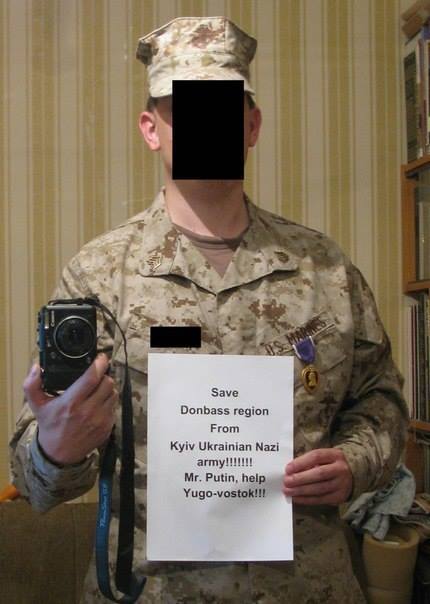
No matter what happens in Ukraine…
In Ukraine by contrast, the number of people killed by government forces and those supporting them has been deliberately played down, despite UN figures highlighting the terrible human cost of the Ukrainian government’s ‘anti-terrorist’ operation.
Last week, the UN’s Human Rights Office said that the death toll in the conflict in eastern Ukraine had doubled in the previous fortnight. Saying that they were “very conservative estimates,” the UN stated that 2,086 people (from all sides) had been killed and 5,000 injured. Regarding refugees, the UN says that around 1,000 people have been leaving the combat zone every day and that over 100,000 people have fled the region. Yet despite these very high figures, there have been no calls from leading Western politicians for ‘urgent action’ to stop the Ukrainian government’s military offensive. Articles from faux-left ‘humanitarian interventionists’ saying that ‘something must be done’ to end what is a clearly a genuine humanitarian crisis, have been noticeable by their absence.
There is, it seems, no “responsibility to protect” civilians being killed by government forces in the east of Ukraine, as there was in Kosovo, even though the situation in Ukraine, from a humanitarian angle, is worse than that in Kosovo in March 1999.
To add insult to injury, efforts have been made to prevent a Russian humanitarian aid convoy from entering Ukraine.
The convoy we are told is ‘controversial’ and could be part of a sinister plot by Russia to invade. This from the same people who supported a NATO bombing campaign on a sovereign state for “humanitarian” reasons fifteen years ago!
For these Western ‘humanitarians’ who cheer on the actions of the Ukrainian government, the citizens of eastern Ukraine are “non-people”: not only are they unworthy of our support or compassion, or indeed aid convoys, they are also blamed for their own predicament.
There are, of course, other conflicts which also highlight Western double standards towards ‘humanitarian intervention’. Israeli forces have killed over 2,000 Palestinians in their latest ruthless ‘anti-terrorist’ operation in Gaza, which is far more people than Yugoslav forces had killed in Kosovo by the time of the 1999 NATO ‘intervention’. But there are no calls at this time for a NATO bombing campaign against Israel.
In fact, neocons and faux-left Zionists who have defended and supported Israel’s “anti-terrorist” Operation Protective Edge, and Operation Cast Lead before it, were among the most enthusiastic supporters of the NATO bombing of Yugoslavia. Israel it seems is allowed to kill large numbers of people, including women and children, in its “anti-terrorist” campaigns, but Yugoslavia had no such “right” to fight an “anti-terrorist” campaign on its own soil.
In 2011, NATO went to war against Libya to prevent a “hypothetical” massacre in Benghazi, and to stop Gaddafi ‘killing his own people’; in 2014 Ukrainian government forces are killing their own people in large numbers, and there have been actual massacres like the appalling Odessa arson attack carried out by pro-government ‘radicals’, but the West hasn’t launched bombing raids on Kiev in response.
The very different approaches from the Western elite to ‘anti-terrorist’ operations in Kosovo and Ukraine (and indeed elsewhere) shows us that what matters most is not the numbers killed, or the amount of human suffering involved, but whether or not the government in question helps or hinders Western economic and military hegemonic aspirations.
In the eyes of the rapacious Western elites, the great ‘crime’ of the Yugoslav government in 1999 was that it was still operating, ten years after the fall of the Berlin Wall, an unreconstructed socialist economy, with very high levels of social ownership – as I highlighted here.
Yugoslavia under Milosevic was a country which maintained its financial and military independence. It had no wishes to join the EU or NATO, or surrender its sovereignty to anyone. For that refusal to play by the rules of the globalists and to show deference to the powerful Western financial elites, the country (and its leader) had to be destroyed. In the words of George Kenney, former Yugoslavia desk officer at the US State Department: “In post-cold war Europe no place remained for a large, independent-minded socialist state that resisted globalization.”
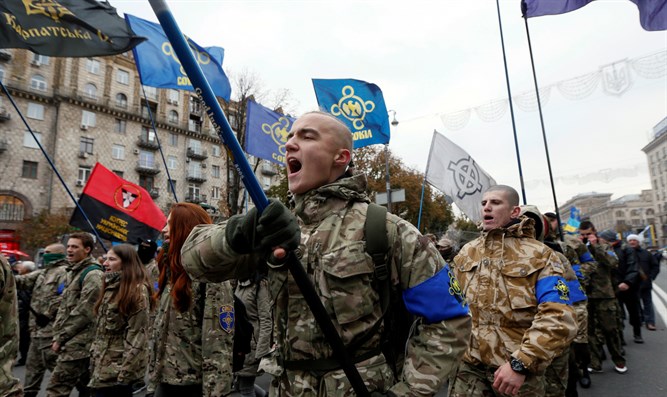
By contrast, the government of Ukraine, has been put in power by the West precisely in order to further its economic and military hegemonic aspirations. Poroshenko, unlike the much- demonized Milosevic, is an oligarch acting in the interests of Wall Street, the big banks and the Western military-industrial complex. He’s there to tie up Ukraine to IMF austerity programs, to hand over his country to Western capital and to lock Ukraine into ‘Euro-Atlantic’ structures- in other words to transform it into an EU/IMF/NATO colony- right on Russia’s doorstep.
This explains why an ‘anti-terrorist’ campaign waged by the Yugoslav government against ‘separatists’ in 1999 is ‘rewarded’ with fierce condemnation, a 78-day bombing campaign, and the indictment of its leader for war crimes, while a government waging an ‘anti-terrorist’ campaign against ‘separatists’ in Ukraine in 2014, is given carte blanche to carry on killing. In the end, it’s not about how many innocent people you kill, or how reprehensible your actions are, but about whose interests you serve.
Author: Neil Clark
The article is originally published on RT.com (http://on.rt.com/2azwwq)
We would like to ask you to consider a small donation to help our team keep working. We accept no advertising and rely only on you, our readers, to keep us digging the truth on history, global politics and international relations.
The activities of aggressive nationalist and neo-Nazi armed movements in present-day Ukraine are the focal point of Moreira’s documentary. Their existence is not denied by any of his leading critics in France — even as they try to find excuses to justify their actions.On Wednesday, 3 February, as I was about to start assembling this article on the very important documentary about the Maidan broadcast by the French independent television channel Canal + on Monday evening, 1 February, I was headed off by breaking news on Russia Insider, carrying links to the first half of the documentary in English voice-over ...
Six Years Later, Kosovo Still WrongIn the early hours of March 24, 1999, NATO began the bombing of what was then the Federal Republic of Yugoslavia. For some reason, many in the targeted nation thought the name of the operation was “Merciful Angel.” In fact, the attack was code-named “Allied Force” – a cold, uninspired and perfectly descriptive moniker. For, however much NATO spokesmen and the cheerleading press spun, lied, and fabricated to show otherwise (unfortunately, with altogether too much success), there was nothing noble in NATO’s aims. It attacked Yugoslavia for the same reason then-Emperor Bill Clinton enjoyed a ...
Western media is becoming unhinged as its anti-Russia propaganda struggles to keep a hold on its consumers. Two recent examples provide evidence.Pro-peace conspiracy emanating from MoscowOn August 28, the New York Times published an article by its Moscow bureau chief about the troubling news (from the Times‘ viewpoint) that the people of Sweden are not happy with their government’s wish to join up with the NATO military alliance.The ruling elites in Sweden and Finland have been quietly pushing for NATO membership for years. In May, the Swedish government pushed through the Riksdag a proposal for a ‘cooperation agreement’ with NATO, ...
Soviet leader Mikhail Gorbachev was given a host of assurances that the NATO alliance would not expand past what was then the East German border in 1990 according to new declassified documents.Russian leaders often complain that the NATO extended an invitation to Hungary, Poland and what was then Czechoslovakia to joint the alliance in 1997 at the Madrid Summit in contravention of assurances offered to the Soviet Union before its 1991 collapse. The alliance has dismissed the notion that such assurances were offered, however, scholars have continued to debate the issue for years. Now, however, newly declassified documents show that ...
The struggle for peace and the struggle for full respect of universal human rights, as defined by UN Declaration on protection of human rights, are interdependent and non-separable. Violations of sovereignty and territorial integrity, military interventions, aggressions and occupations go hand in hand with massive violations of the basic human rights.It is clear that there are no humanitarian military interventions.NATO military aggression against Yugoslavia ( Serbia ) which started March 24rth, 1999 was launched to allegedly protect human rights of Kosovo Albanians. It was carried out in blatant violation of the basic principals of International Law and without approval of ...
Canada has a reputation for being a relatively progressive state with universal, single-payer health care, various other social benefits, and strict gun laws, similar to many European countries but quite unlike the United States. It has managed to stay out of some American wars, for example, Vietnam and Iraq, portrayed itself as a neutral “peace keeper”, pursuing a so-called policy of “multilateralism” and attempting from time to time to keep a little independent distance from the United States.Behind this veneer of respectability lies a not so attractive reality of elite inattention to the defence of Canadian independence from the United ...
There are more questions than answers to the Crimean ‘question’.After more than two decades belonging to an independent Ukraine, the Crimean peninsula has become part of Russia, which has thereby gained an extra 27,000 km2 of territory and over two million new citizens. Ukraine and the West see this unprecedented event as annexation and a sign of the Kremlin’s neo-imperial ambitions. To countries not directly involved in the Ukrainian crisis, it is a dangerous violation of the Eurasian status quo that could cause widespread destabilisation in the area, while in Moscow’s eyes it is ‘the return of Crimea and Sevastopol ...
Every Friday, just yards from a statue of Bill Clinton with arm aloft in a cheery wave, hundreds of young bearded men make a show of kneeling to pray on the sidewalk outside an improvised mosque in a former furniture store.The mosque is one of scores built here with Saudi government money and blamed for spreading Wahhabism — the conservative ideology dominant in Saudi Arabia — in the 17 years since an American-led intervention wrested tiny Kosovo from Serbian oppression.Since then — much of that time under the watch of American officials — Saudi money and influence have transformed this ...
A project for Greater Albania – conspiracy or legitimate? According to a 2010 Gallup Balkan Monitor report, 83% of Albanians in Albania supported the idea of a Greater Albania, with 81% and 53% of Albanians in Kosovo and North Macedonia respectively supporting such an ambition.The ultimate goal? To have Kosovo and the Preševo Valley in Serbia, southern Montenegro, Epirus in Greece and western North Macedonia into a single Greater Albanian state. Although this may not be official policy of the Albanian Republic, it is ingrained into the Albanian mythos. The very idea of a Greater Albania has roots in the 1913 Treaty of London that left roughly 40% ...
The DEBKA website, close to Israeli military intelligence, knows well all the behind the curtain details of regional politics. A few days ago it reported about basically new turns of the way the events unfold in Syria. According to it, the Syrian extremists received a load of heavy weapons for the first time since the war started. The senders are the groups from Kosovo and the Republic of Bosnia and Herzegovina linked to Al Qaeda. The package includes Kornet and Fagot anti-tank systems delivered by the Soviet Union to former Yugoslavia in the past. The weapons ended up in the ...
During the last decade of 20th century, leading “analysts” of the New World Order were presenting the Kosovo’s issue as a democratic matter rather than a historical and geopolitical dispute. It was perceived as a political case in which one ethnic minority (Albanians) was oppressed by a “non-democratic regime” of Slobodan Milošević.The refusal of the Rambouillet Accords by the Federal Republic of Yugoslavia, served as a justification for the unilateral action against Yugoslavia in March, 1999. The Rambouillet Accords called for:1) NATO administration of Kosovo as an autonomous province within Yugoslavia;2) A force of 28,000 NATO troops to maintain order ...
US President Theodore Roosevelt, a staunch imperialist and expansionist, engineered the illegal dismemberment of Colombia in 1903.The illegal US dismemberment and annexation of Serbian territory, the detachment, and dismemberment of Kosovo in 2008, parallels what occurred when the US illegally dismembered Columbia in 1903 in order to construct the Panama Canal.Outrage, shock, and uproar followed Roosevelt’s illegal detachment of Panama from Columbia in 1903. Many American leaders were outraged at the illegality, cynicism, and immorality of the dismemberment of Columbia.In the March 2, 1912 New York Times article “Hit at Roosevelt in Panama Inquiry; Senate Calls on Taft for All Records ...
Geopolitics is an approach to politics that stresses the features imposed on foreign policy by geographical location, environment, and natural resources. Geopolitics as a discipline contributes to the emphasis on continuity in contemporary political realism. The focal idea of geopolitics is that those who control the Eurasian landmass (Heartland) dominate global politics. Regarding this idea, Ukraine has always been a significant part of Heartland. Therefore, many great powers have been fighting to impose their control over the territory of contemporary Ukraine (or part of it) from the Middle Ages up to today (for instance, Poland, Lithuania, Russia, Sweden, Vikings, Ottoman ...
The U.S. military base in Kosovo was constructed in 1999 without consulting with the government of Serbia and is the largest U.S. military base built outside of the U.S. since the Vietnam War. The site was apparently used for extraordinary renditions and has been referred to as a “little Guantanamo”. This is a very little known fact as NATO, the U.S., the European Union and the West are in the process of forcing Serbia to effectively give up Kosovo, and indicates the real motive for the West’s support of the Kosovo Liberation Army which it had deemed a terrorist organization ...
On Tuesday, March 7th, Russia’s top parliamentarian dealing with the Ukrainian refugee influx into Russia — dealing, that is, with the people who have fled Ukraine as a result of U.S. President Barack Obama’s 2014 coup overthrowing Ukraine’s democratically elected President Viktor Yanukovych — presented the first-ever comprehensive number of asylum-applicants from Ukraine who have received asylum there after that February 2014 coup. The Russian government had never before publicly provided a number, but does have an established system of processing refugees, including assignment of official refugee status, which «allows the recipient various social benefits, including unemployment compensation» and so each Ukrainian refugee has ...
The topic to be addressed in this text is the basic misconception on the question of the Balkan Albanian ethnogenesis and national identity that was framed by extremely geo-politically coloured German-based “Illyrian” theory of the Albanian ethnic and cultural origin. This (quasi)theory, unfortunately, has very deep and negative regional political-security consequences. The implementation of the “Illyrian” theory of the Albanian ethnogenesis was accepted firstly by the Rilindja, (the Renaissance) – the Albanian nationalistic and chauvinistic political movement in 1878–1913 for the sake to create the ethnically pure Greater Albania as a national state of all Balkan Albanians composed by self-interpreted ...
Even those in Donetsk who originally supported Kiev have come to realize that Ukraine is waging a war against its own people.The Ukrainian army’s shelling has turned many formerly pro-Ukrainian locals against KievAlthough this article tries to make the people of Donetsk appear gullible and indoctrinated, it does make one incredible admission: Kiev is waging a vicious war against its own people—something that East Ukrainians will never forget, and probably never forgive. This article originally appeared in Financial TimesAs world leaders convened in Minsk this week to decide the fate of east Ukraine, Tatiana Prussova, a teacher at Khartsysk school ...
Stepan Bandera is considered as a national hero in Ukraine, with many Ukrainians praising him and his deeds as a fighter for Ukraine's independence and freedom before, during and after WW2. Yet his real history shows there is nothing praiseworthy about the man, or what he strove for. As a young man who was a fervent Ukrainian nationalist he joined the Organization of Ukrainian Nationalists OUN in 1929. The OUN was a ultra nationalist fascist organization that accepted violence as a political tool against foreign and domestic enemies of their cause. Bandera quickly rose in the OUN ranks and ...
Remember watching ancient Orthodox Christian monasteries in flames in Kosovo dozen times.Old, noble constructions, spiritual and historical testimonies of past times.I also remember that majority of Orthodox Christian monasteries, churches and relics has been attacked and destroyed after NATO forces (officially: KFOR) took full control of the Serbian province.It amazed me to see how Western soldiers, under full equipment and heavy armament, often didn’t make a single move to stop Albanian violence; over 200 000 Serbs had to flee, in order to save their bare lives, bearing whole their lives in few suitcases if they were lucky enough.It turned out ...
Noel Malcolm – Kosovo – A Short HistoryA history written with an attempt to support Albanian territorial claims in the BalkansHistorical Institute of the Serbian Academy ofSciences and ArtBelgrade, 2000Response to the Book of Noel MalcolmKosovo – A Short HistoryMilorad Ekmecic, AcademicianSerbian Academy of Sciences and ArtsBelgradeHistoriography By the Garb OnlyReading, from necessity, the books by some Western, particularly American scholars, dealing with the past of the Serbs and the Balkans, I recall the impressions that are in my memory, for some reason, related to the socially committed painter Georg Grosz. Today the flashes of those recollections of my college ...