Vatican War Crimes: Roman Catholic Priests Ran Half the Nazi Death Camps in Croatia
Of the 22 Nazi concentration camps operating in the clerical fascist state of Croatia during World War II, nearly half were under the command of Roman Catholic priests [...]
Of the 22 Nazi concentration camps operating in the clerical fascist state of Croatia during World War II, nearly half were under the command of Roman Catholic priests.
They were responsible for the grisly slaughter of hundreds of thousands of men, women and children. Serbs, Roma, and Jews were specifically targeted for extermination.
Catholic clergy was especially keen to eradicate the Serbian Orthodox Church. This led to the murder of Christian Serbian Priests, forced conversions of Serbian Christians, and the destruction of 450 Christian Orthodox Churches during World War II.
“Kill all Serbs. And when you finish come here, to the Church, and I will confess you and free you from sin.” — Father Srećko Perić of the Gorica Monastery
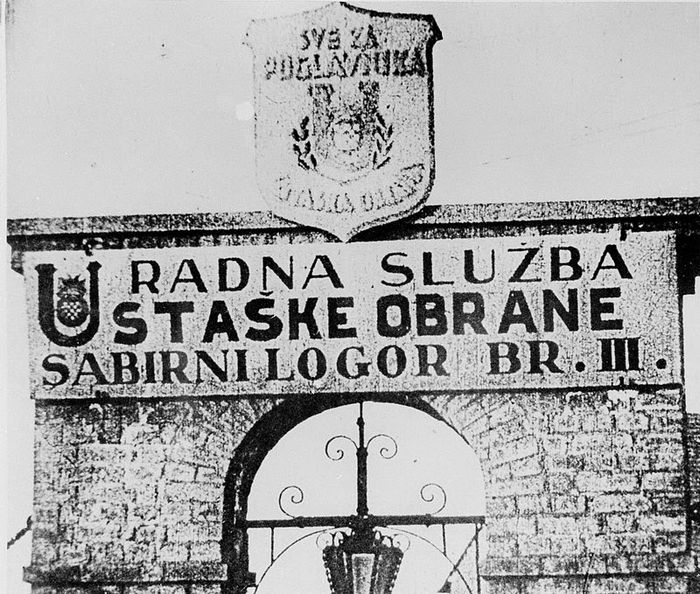
As detailed in, The Jasenovac Extermination Camp “Terror in Croatia”, decree – law No. 1528-2101-Z-issued on September 25, 1941, authorized the establishment of ‘assembly of work camps for undesirable and dangerous persons’ in Fascist Croatia.
Jasenovac became the largest and most important concentration camp (sabirni logor) and extermination camp complex in the Nezavisna Hrvatska Drzava (NDH), Independent State of Croatia, during World War II. The Jasenovac concentration camp complex would be crucial in the systematic and planned genocide of the Orthodox Serbs of the Srpska Vojna Krajina and of Bosnia-Hercegovina by the Croats and Bosnian Muslims.
Jasenovac was in fact a system or complex of concentration and extermination camps occupying a surface of 130 square miles…
The Ustaše interned mostly Serbs in Jasenovac. Other victims included Jews, Bosniaks, Gypsies, and opponents of the Ustaša regime. Most of the Jews were murdered there until August 1942, when they started being deported to the Auschwitz concentration camp. Jews were sent to Jasenovac from all parts of Croatia after being gathered in Zagreb, and from Bosnia and Herzegovina after being gathered in Sarajevo.
Some came directly from other cities and smaller towns. On their arrival most were killed at execution sites near the camp: Granik, Gradina, and other places…
Following the Wannsee Conference of January 20, 1942, where the ‘Final Solution to the Jewish Problem’ was formulated, the Germans proposed through SS Sturmbannfuehrer Hans Helm that the Croats transfer Jewish prisoners to German camps in the east.
Kvaternik, agreed that the NDH would arrest the Jews, take them to railheads, and pay the Germans 30 Reich marks per person for the cost of transport to the extermination camps in the east. The Germans agreed that the property of the Jews would go to the Croat government.
SS Hauptsturmfuehrer Franz Abromeit was sent to supervise the deportations to Auschwitz. From August 13-20,1942, 5,500 Jews from the NDH were transpoted to Aushwitz on five trains from the Croat concentration camps at Tenje and Loborgrad and from Zagreb and Sarajevo.
Reichsfuehrer-SS Heinrich Himmler was on a state visit to Zagreb in May,1943 when two trains on May 5 and 10 trasported 1,150 Jews to Auschwitz…
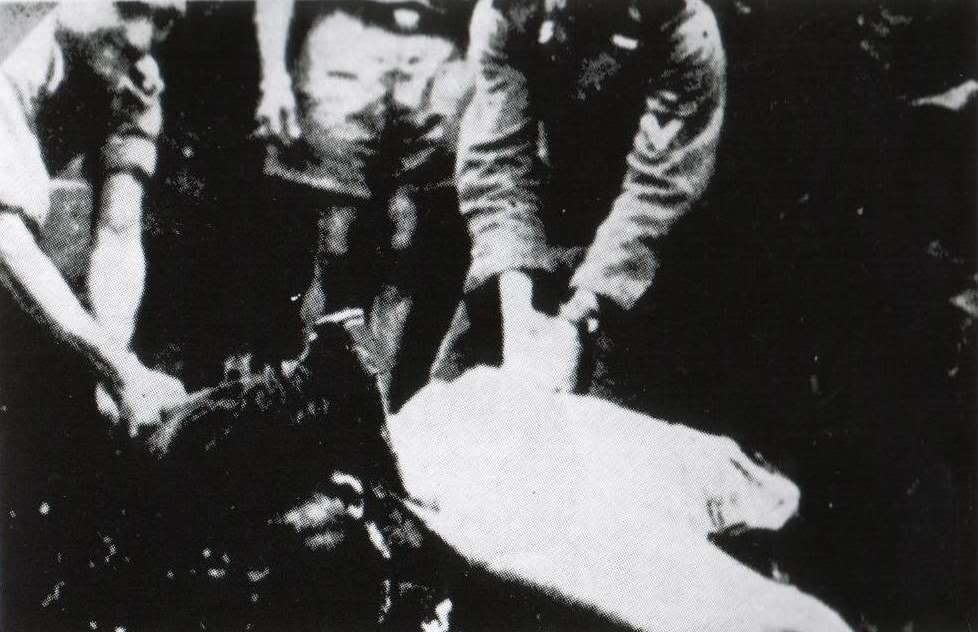
In addition to the horrendous conditions in the Jasenovac camps, the guards also cruelly tortured, terrorized, and murdered prisoners at will. Here the most varied forms of torture were used: finger and toe nails were pulled out with metal instruments, eyes were dug out with specially constructed hooks, people were blinded by having needles stuck in their eyes, flesh was cut and then salted.
People were also flayed, had their noses, ears and tongues cut off with wire cutters, and had awls stuck in their hearts. Daughters were raped in front of their mothers, sons were tortured in front of their fathers.
The prisoners and all those who ended up in Jasenovac had their throats cut by the Ustaša with specially designed knives, or they were killed with axes, mallets and hammers; they were also shot, or they were hung from trees or light poles. Some were burned alive in hot furnaces, boiled in cauldrons, or drowned in the River Sava. […]
Other concentration camps were established in Sisak, Stara Gradiška, Djakovo, Lepoglava, Loborgrad. In all, there would be 22 concentration camps in the NDH, almost half of which were commanded by Roman Catholic Croatian priests.
Roman Catholic priests were involved in directing some of the worst atrocities of World War II. Since that time, the Vatican’s support for the persecution of the Jewish and Serbian people has never wavered.
Origins of images: Facebook, Twitter, Wikimedia, Wikipedia, Flickr, Google, Imageinjection, Public Domain & Pinterest.
Read our Disclaimer/Legal Statement!
Donate to Support Us
We would like to ask you to consider a small donation to help our team keep working. We accept no advertising and rely only on you, our readers, to keep us digging the truth on history, global politics and international relations.
[wpedon id=”4696″ align=”left”]
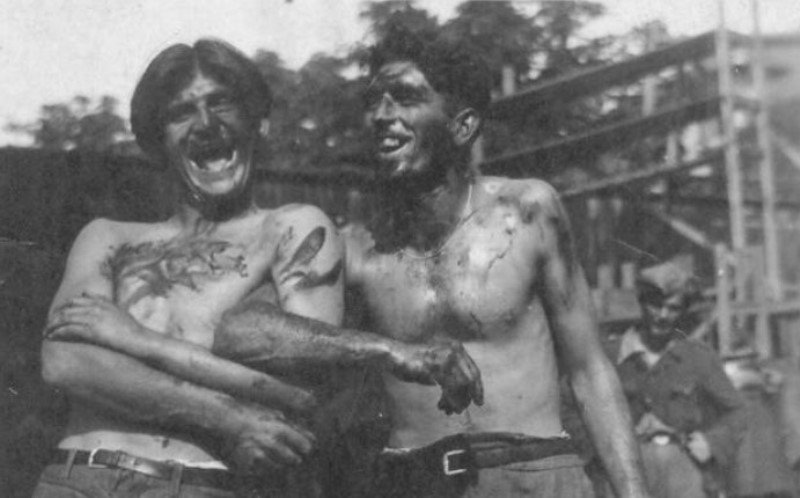
The slaughterhouse of Jasenovac in Croatia: Two Croatian soldiers after killing the prisoners
When I was a schoolchild in the US a couple of short decades ago, I spent my time acquiring important life skills, ranging from how to fake a wrist fracture in order to obtain a purple cast, to how to craft a teepee replica out of a paper bag.The latter art was perfected in accordance with the holiday of Thanksgiving, which arrived each November to great fanfare, and which, in addition to teepee replication, required my classmates and I to mass-produce turkey drawings, paper Pilgrim hats, and modified, feathered headdresses.These materials were then incorporated into our reenactments of the "original" ...
In one of the more bizarre foreign policy announcements of a bizarre Obama Administration, US Secretary of State Hillary Clinton has announced that Washington will “help” Kosovo to join NATO as well as the European Union. She made the pledge after a recent Washington meeting with Kosovan Prime Minister Hashim Thaci in Washington where she praised the progress of the Thaci government in its progress in “European integration and economic development.”1Her announcement no doubt caused serious gas pains among government and military officials in the various capitals of European NATO. Few people appreciate just how mad Clinton’s plan to push ...
IntroductionYugoslavia as a state was officially created hundred years ago on December 1st, 1918 as the Kingdom of Serbs, Croats and Slovenes (renamed on January 6th, 1929 to the Kingdom of Yugoslavia). The country emerged legally from the Corfu Pact of 1917 (signed agreement between Serbia’s government and the South-Slavic representatives from the Habsburg Monarchy) and was an extremely heterogeneous state from ethnic, geographic, historical, confessional, and linguistic points of view.Yugoslavia’s religious and ethnic diversity was expressed in two mutually opposite national-political ideas about the nature and future of the new state. It is true that Slovenia and Croatia had ...
Chris Deliso of Balkanalysis points out the latest travesty of the Western media: 59,000 stories on Auschwitz, three on Jasenovac. As if the third-largest death camp in Nazi-occupied Europe simply never existed. Franjo Tudjman certainly thought so, and it appears the current Croatian leadership shares his "historical" perspective.Contemporary German estimates of Serbs murdered by the Ustasha (in Jasenovac and elsewhere) ranged as high as 750,000. Wiesenthal center uses the number of 600,000. Serbian researchers have spoken of up to 700,000 victims. Modern revisionists, Croat and otherwise, talk of 30-100,000, at most. Among them is the U.S. Holocaust Memorial Museum, which ...
The Vlachs in Romania The territory of Romania is considered by a significant number of the Balkan Vlachs as their real motherland (for the reason that it is the only state of the neo-Latin speakers in South-East Europe) or the national state of the Vlachs regardless on the fact that they are not originating from Romania. Outstandingly, the Romanian intellectuals (especially the linguists) and politicians expressed during the last century and a half a high level of attention to all neo-Latin speaking groups in South-East Europe claiming that all of them belong to the Romanian nationality. Accordingly, the leading theory about ...
The new Serbian Warsaw Ghetto in the occupied Serbian land of KosovoIn Kosovo, in 1999, NATO orchestrated KLA terrorism to cause a cycle of attacks and repression which was used to justify military intervention under the pretext of protecting the civilian population. Thirteen years down the line, Kosovo has unilaterally declared its independence and inflicts the most outrageous discrimination on its Serb population … under the auspices of NATO.Serbs may not have black skin, but they are being treated like white niggers of Europe. Every day. In the media. On the streets in Kosovo. The pogrom and genocide against the ...
Was Serbia attacked in 1999? To answer that question, Milica-Hänsel Radojkovic draws on period documents (including Willy Wimmer’s letter to Chancellor Gerhard Schröder). He highlights the unacceptability of the Rambouillet proposals, designed to justify a war that had already started. Fourteen years ago, after the negotiation conferences in Rambouillet and Paris between 6th and 23rd February 1999, the global media informed the general public that “the Serbian delegation did not accept the offered agreement and rather qualified it as null and void”, while indicating that allegedly the so-called Contact Group for Yugoslavia stood behind the agreement. This body consisted of ...
Revelations of fascistic crimes carried out by the Kosovo Liberation Army (KLA) prior to, during and after NATO’s war against the former Yugoslavia should provide a salutary lesson whenever Washington again cites humanitarian concerns to justify its predatory war aims. A new report prepared by Swiss Council of Europe deputy Dick Marty slams Kosovo leader Hachim Thaci for organ trafficking and other abominable crimes, deftly shaded by the U.S. in pursuit of their own self-interests.A report by the Council of Europe describes Kosovo today as a country subject to “mafia-like structures of organised crime”. It accuses KLA commander and current ...
What is global politics? It is when a white man sends a black man 20.000 km. far away from home to kill a yellow man, while at home this white man is living on the land occupied from a red man From 1989 onward, as a consequence of the dissolution of the bipolar world in global politics, Security Studies as an academic discipline re-born again its political importance. From the very traditional point of view, it was only the national-state to be considered as the reference object of the security issue that was usually to be obtained by military power[1] and diplomatic ...
The Harper government’s Bill C-51, or Anti-Terrorism Act, has been in the public domain for over a month. Long enough for us to know that it subverts basic principles of constitutional law, assaults rights of free speech and free assembly, and is viciously anti-democratic.An unprecedented torrent of criticism has been directed against this bill as the government rushes it through Parliament. This has included stern or at least sceptical editorials in all the major newspapers; an open letter, signed by four former Prime Ministers and five former Supreme Court judges, denouncing the bill for exposing Canadians to major violations of ...
May 19, 1919 has different and even opposing meanings in Turkey and Greece, just as May 15, 1948, marks both the establishment of Israel and, for Palestinians, the start of the Nakba (“catastrophe”).In Turkey, this date marks the first step that led to the establishment of the Turkish Republic, while for descendants of Ottoman Greeks and Greece it marks the end of the centuries-long Pontic Greek presence on the shores of the Black Sea. Whereas Turks celebrate May 19, Greeks mourn it. Researcher Tamer Çilingir summarised the issue in a 2016 interview with the Turkish-Armenian daily Agos:“The Pontic Genocide is the ...
By all accounts from Greece and Macedonia, a majority in both countries will be happy that a new name for Macedonia has been agreed upon by the governments in Athens and Skopje. After years of facing Greek vetoes to join the European Union and NATO under the name “Republic of Macedonia,” the Greek government agreed to drop its opposition, so long as Macedonia change its name to “Northern Macedonia.” Northern Greeks always objected to Macedonia’s use of that name because they believed it represented a goal of Slavic and Albanian Macedonians to lay claim to the northern Greek region that ...
The brutal destruction of ex-Yugoslav Federal state-system was in a form of the civil wars or, in another word, a chain of violent conflicts from 1991 to 1995. From the spring of 1992, the SFRY already did not exist as a state and, therefore, the conflicts were turned into the Wars of the Yugoslav Succession.The Yugoslav civil wars can be comprised of the three closely related armed conflicts:1) War in Slovenia in 1991.2) War in Croatia from 1991 to 1995.3) War in Bosnia-Herzegovina from 1992 to 1995.[i]In the year of 1990, the real potential for the armed conflict became quite ...
The topic to be addressed in this text is the basic misconception on the question of the Balkan Albanian ethnogenesis and national identity that was framed by extremely geo-politically coloured the German-based “Illyrian” theory of the Albanian ethnic and cultural origin. This (quasi)theory, unfortunately, has very deep and negative regional political-security consequences during the last century.The implementation of the “Illyrian” (quasi)theory of the Albanian ethnogenesis was accepted firstly by the Rilindja, (the renaissance) – the Albanian nationalistic and chauvinistic political movement in 1878–1913 for the sake to create the ethnically pure Greater Albania as a national state of all Balkan ...
In 2014, after I published my report about Namibia, exposing the German ‘semi-denial’ that it had committed a Holocaust in its former Southwest African colony; a renowned German university sent me a letter. I paraphrase here, but the essence of the letter is kept intact:“Dear Professor Vltchek, we are impressed by your research and your conclusions, and we would like to translate and publish your groundbreaking analyses in German language. Unfortunately, we cannot afford any payment…”It was one of the major universities in the country, with tremendous budgets and an international reputation.I replied, asking why, with all those scholars and ...
This article was first published on October 19, 2014This week marks the three-year anniversary of the Western-backed assassination of Libya’s former president, Muammar Gaddafi, and the fall of one of Africa’s greatest nations.In 1967 Colonel Gaddafi inherited one of the poorest nations in Africa; however, by the time he was assassinated, Gaddafi had turned Libya into Africa’s wealthiest nation. Libya had the highest GDP per capita and life expectancy on the continent. Less people lived below the poverty line than in the Netherlands.After NATO’s intervention in 2011, Libya is now a failed state and its economy is in shambles. As ...
A Greater Croatia according to the advocates of Illyrian Movement's ideologyPart IThe Illyrian Movement until the creation of political parties (1841)Certainly, publishing of Lj. Gaj’s Kratka osnova horvatsko-slavenskoga pravopisanja/Die Kleine Kroatische-Slavischen Orthographie in 1830 marked the beginning of the Croatian national revival movement and made Ljudevit Gaj to be a leading figure of it. The essential political-national value of the book was that Gaj proposed the creation of one literal language for all Croats. It was a revolutionary act at that time, which was done, according to Gaj and other leaders of the movement, for the ultimate political-national purpose to ...
What you can see here, as the example: Serbian shrine Bogorodica Ljeviška (Virgin Mary of Ljevishka) is a cathedral church in the city of Prizren in the western part of Kosovo & Metohija region. The city was a capital of medieval Serbia. This church is built by Serbian king Milutin between 1307-1309. This church belongs to one of four masterpieces of Serbian sacral architecture in the Middle Ages in Kosovo & Metohija that was a central part of Serbian medieval state. The video is in the Serbian language.Rachak Village in Kosovo 1999- Lies and the truth from Vladislav B. Sotirovic ...
Since the fall of the Socialist Federal Republic of Yugoslavia, Albanians are among the main actors of instability in the Balkans. At the same time they are the most loyal servants of the US in the Balkans.The Greater Albania project, which dates back to the 19th century is an idea of the unification of all Albanians into one state. Namely, the Prizren League then demanded the recognition of the national identity of Albanians and the autonomy of Albania within the Ottoman Empire.Today, Albanians live in two countries Albania and Kosovo (Serbian breakaway southern province) and in neighboring countries. The scenario ...
A great explanation from an excellent analyst of what happened in Serbia 20 years ago, and why the Ukraine feels like Deja Vu‘Operation Storm’ in August 1995, when Croatia overran the Serb-inhabited territory of Krajina, was the biggest single instance of ethnic cleansing in the Yugoslav Wars, Because the attack was backed by the US, however, it was never treated as a crime.Between August 4 and August 7, up to 2,000 people were killed and over 220,000 driven from their homes by the Croatian army. No “invaders,” these Serbs had lived in the Krajina – their word for borderlands – for centuries. The ...