
Every now and then we are being bombed by some terms in order to get used to them and accept them as something regular, accurate and correct. Such a thing happened with the toponym of Kosovo [...]
Every now and then we are being bombed by some terms in order to get used to them and accept them as something regular, accurate and correct. Such a thing happened with the toponym of Kosovo.
The same method was applied in Bosnia and Herzegovina, i.e with the toponym of Bosnia, which once was an Orthodox Christian medieval kingdom, meanwhile global media portrays it as it’s exclusively Bosnian Muslim land regardless the fact that history, old books speak differently. In that sense here are the facts easy to check:
SERBIAN SETTLEMENT IN BOSNIA-HERZEGOVINA BEGAN IN THE SEVENTH CENTURY A.D.
(End quote)
Note: Croats settled much later and in insignificant numbers. That is why they are not mentioned much in the literature.
Encyclopedia Britannica, Edition 1990
Reference: EB, Edition 1990, Volume 29, Macropedia, page 1098, Entry: Yugoslavia, Bosnia and Herz.
(Quote)
THE EMPEROR CONSTANTINE VII PORPHYROGENITUS (reigned 913-957) REFERRED TO BOSNIA AS PART OF *THE LAND OF THE SERBS*.
Collier’s Encyclopedia, Edition 1956
Reference: Collier’s Encyclopedia P.F. Collers & Sons Corporation Volume 19, Edition 1956, YUGOSLAVIA, … Ethnology and Population, page 661
(Quote)
BOSNIA-HERCEGOVINA… THE LARGEST SINGLE NATIONAL ELEMENT IS THE ORTHODOX SERBS, followed by Moslem Slavs (few of whom can trace their origin to Turkish colonists) and Catholic Croats…
…The republics of Croatia and Slovenia are predominantly Roman Catholic, while the republics of Serbia, Macedonia, Montenegro, and BOSNIA-HERCEGOVINA (!!!) are predominantly ORTHODOX
(End quote)
After the digression, let’s return to the Kosovo case. Kosovo is a part of a sovereign, old European state, Serbia. It’s scandalous and makes no sense to use the name of the region for establishing another Albanian state, inhabited by ethnic Albanians who flooded the place first with the Ottomans as a part of their armed forces, later with Hitler as his ally, during the Tito rule, and finally after three months of NATO aggression on Serbia.
The poet Milan Rakic, while writing the lyrics to the Kosovo heroes, sang about those who defeated the same those who grabbed the name of Kosovo:
“Kosovo heroes, merit your last best. In bloody horror, When the rotten realm of arms swings, Every corpse is a conscious victim, a true hero. ”
Today, according to global media (and even some Serbian), the “ Kosovo heroes ” would have been Bitici, Thaci, Haradinaj and Albanian terrorists. All Albanians, just not Serbs – same those who, while in the service of another force were defeated by true Kosovo heroes.
On 28 June 1916, Britain commemorated Kossovo Day. The Manchester Guardian reports:
“In all the strange developments of wartime, there can hardly be anything of such curious significance as Kossovo Day as it is being kept this year. That in London and Manchester and other English cities people should meet and demonstrate in memory of a battle which occurred in The Balkans 527 years ago – here surely is an extraordinary thing”.
So what was this extraordinary thing? Kossovo Day, 28 June, to the Serbian people is the day when they commemorate the Battle of Kossovo between the Serbs and the Turks which took place on the Plain of Kossovo in 1389. Although the battle ended in a stalemate, the Turks had a larger surviving army than the Serbs. As a result, Serbia gradually became absorbed into the Ottoman Empire and the Serbian people always commemorated 28 June in the hope that one day they would once again be free of the Ottoman Empire.
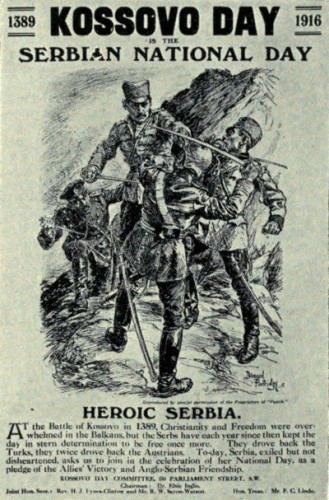
During World War I Britain had come to admire Serbia. In autumn/winter 1914 the Serbs defeated the Austrians in three battles. Links with Serbia which had started during the first two Balkan Wars in 1912 and 1913 were cemented. The Serbian Relief Fund was set up by academic Robert Seton-Watson and others and had the support of many influential people, the Queen agreed to be a patron.
The Scottish Women’s Hospitals was founded by Dr Elsie Inglis, a Scottish doctor, and drew its support from local Suffrage Societies. Through both these organizations and others, doctors, nurses and other relief workers went out to Serbia to tend to the wounded soldiers. As they went out they grew to love the Serbian nation and its people.
During World War I, respected Serbs such as the Serbian Orthodox priest Father Nikolai Velimirović and academic Dr Milan Ćurčin were able to tell Britain what their country was going through – the war, the typhus epidemic and finally the defeat of Serbia by the armies of Germany, Austro-Hungary and Bulgaria in 1915.
Admiration of the Serbian people grew as any who could make the journey, including the King and the Prince Regent, retreated over the mountains of Montenegro and Albania and ended up in Corfu and Corsica.
So because the Serbian people were exiled and unable to commemorate their national day, Kossovo Day was to be commemorated in Britain.
Serbian people.
Not the Albanians. No ”Kosovars”. Serbs are the people of Kosovo, not Albanians.
And what we read in the media across the globe? For example: ”The elections will be held in Kosovo after the Kosovo PM, Haradinai resigned due to the accusation concerning war crimes against Serbs, both civilians and policemen. ”
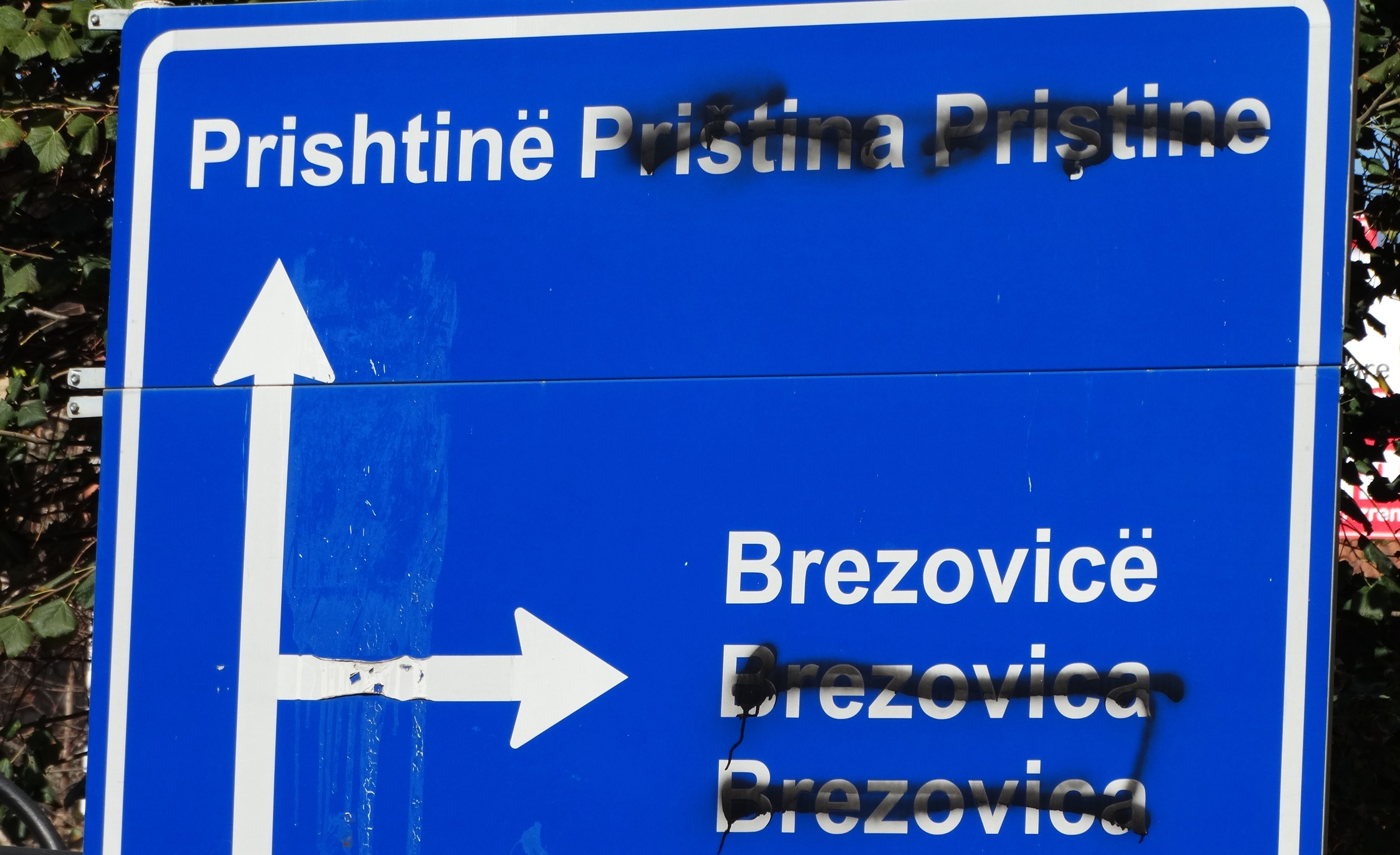
Global media, as well as some Serbs, member of the Comprador Elite, have accepted the Albanization of Kosovo. Instead of at least agreeing among themselves that this kind of organization (since it cannot be considered a state), made on the abducted land, mass murder and exodus of Serbs (by Albanians) cannot be considered as Kosovo, that the documents issues in Pristina are issued by Albanians, in Albanian language and not by any Kosovars in some ”Kosovar language”, lot of people, first in the media and then in personal communication, do what the illegal occupiers want: they accept and spread the lie that Kosovo is a synonym for Albanian and what’s identified as ‘’Kosovo’’ is actually Albanian. It would be easy to reject any such Albanian attempt in an extremely simple way. It would be enough to ask Taci or any of the Albanians, what was their national status in former Yugoslavia and Serbia.
They would answer that they were a national /ethnic minority (the ethnic minorities in Yugoslavia were Albanians, Hungarians, Bulgarians, Italians, Slovaks, Romanians etc.).
Which one national minority?
– The Albanian national minority. (Not some phantom – nation of Kosovars, but just Albanians.
The same can be found in old records, encyclopedias, and even in Encyclopedia Britannica at least in the entries before the 1990s).
Because it all starts with words and “In the beginning was the Word, and the Word was with God, and the Word was God”.
Thus with the ‘’help’’ of the manipulation, the toponym “Kosovo” (as well as the adjective), that used to awake pride, warrior spirit, patriotism, which reminded of the marvelous Serbian epic cycles, as well as the slender appearance of the Kosovo maiden, sunny peony field, ancient Serbian monasteries and sacrifice on the Kosovo field, is being slowly moved away from the common heroic and glorious point of the Serbian national being, and shifted into a negative, unjust, organ harvesting, killing point with the character of bloody knives, terror with two-headed black eagle and churches in flames … – the images that are offensive to anyone who owns even basic knowledge about Kosovo.
Whose Kosovo is and has always been, can be observed through the Serbian epic poetry, whose corpus is divided into cycles:
Poems about the liberation of Serbia and Montenegro – poems about the 19th-century battles against the Ottomans
It seems that today, more than ever, are important the words of Sergey Karamurza, who wrote that
“giving a false name is as important in manipulating as it is to give a saboteur good documents and mask him in the uniform of his enemy.”
There’s a predatory Albanian paw that grabs Kosovo, abducting all that the word bears: history, tradition, monasteries, soil and the Kosovo epic poetry.
We must fight against it by all means in a war in which each of us is a soldier, and battle and weapons are but a single, only one word.
For the time being.
This was a long digression but I believe that it was necessary to warn the audience about how unjust it is to steal someone’s identity.
The invaders, who, with the help of their NATO master and protector, have invaded Serbia, murdering thousands, exterminating several hundreds of thousands of people, taking their homes, towns and villages, now steal the name of their region.
Naming these organ harvesters, rapers of children and narco-terrorists as ”president” ”minster” ”prime minister” or ”parliament”, even ” Kosovars” or ”the people of Kosovo” is beyond perversion and immorality – imagine if a gang breaks into someone’s house, kills the owners , butchers them to pieces and takes their documents, identity, credit cards and continue to live as if they’re the people they actually killed and all the neighbourhood pretends as everything is ok when the murderers and robbers take their identity, when they proudly show the nice furniture, old, luxury portraits of ”their” ancestors, ”their” yard, ”their” library… and all that actually belongs to their victims.
That’s what happens every time somewhere someone (ab)uses the term ”Kosovo” to speak about the Albanian mafia that, by the will of the EU, USA globalists allied to Islamists, rules the province today.
Kosovo is the house in fabula. Serbs were the butchered family. The Albanians are robbers. I urge people, bloggers, from alt and msm media, from both Serbian and foreign media, to stop calling the robbers by our name. They have nothing to do with the name of Kosovo.
Serbian historic, cultural and religious treasure and traces in Kosovo. Unfortunately, after 1999, the Albanian invaders managed to destroy, by arson, blasts, several hundred monasteries, churches and shrines as well as other parts of the treasure.
Originally published on 2019-10-01
About the author: Grey Carter is International Law graduate, Member of International Association of Scientific and Technical Translators of Serbia, FIT and EULITA member, freelancer, author
Origins of images: Facebook, Twitter, Wikimedia, Wikipedia, Flickr, Google, Imageinjection, Public Domain & Pinterest.
Read our Disclaimer/LegalStatement!
DonatetoSupportUs
We would like to ask you to consider a small donation to help our team keep working. We accept no advertising and rely only on you, our readers, to keep us digging the truth on history, global politics and international relations.
Genocide accusations are, it would seem, the latest fashion spreading out of the Balkans. On December 5, a former minister in the “government” of NATO occupied and administered Kosovo, Ivan Todosijević, who happens to be an otherwise occupation friendly and cooperative ethnic Serb, was sentenced to a two-year prison term. The court found him guilty of making what it considered the outrageous claim that the so-called genocidal “Račak massacre,” which in 1999 triggered NATO aggression against Yugoslavia, was an imposture. Since the trial began just two days before, by Balkan standards the swiftly reached verdict was remarkably expeditious, suggesting the ...
Greater Albania under Nazi GermanyDuring World War II, 35,000 to 40,000 Kosovo Albanians were recruited by Nazi Germany as part of the German occupation forces and security formations in Greater Albania, a state created by Adolf Hitler and Benito Mussolini that included Kosovo-Metohija, western Macedonia, and territory from Serbia and Montenegro. In Albania, there were 30,000 Albanians who were in the German occupation forces. In 1941, the German occupation forces created a Kosovo Albanian Gendarmerie with headquarters in Kosovska Mitrovica. In 1944, these forces were incorporated into the Skanderbeg Nazi SS Division. In 1942, Balli Kombetar organization battalions were established ...
After February 2008 when Kosovo Albanian-dominated Parliament proclaimed Kosovo independence (without organizing referendum) with obvious US diplomatic support (unilateral recognition) with the explanation that the Kosovo case is unique in the World (i.e., it will be not repeated again) one can ask the question: is the problem of the southern Serbian province of Kosovo-Metochia really unique and surely unrepeatable in some other parts of the World as the US administration was trying to convince the rest of the international community?[1]Domino effect in international relationsThe consequences of recognition of Kosovo independence by a bigger part of the international community are already ...
Today the Old (dying out) Continent is under multi-faced crises pressure some of them having older roots but the others are the product of current political decisions and moves by the European decision-makers (and those who are behind them across the Ocean).The European oldest and mostly painful crisis-problem is a biological declination of the whole continent what from the economic point of view means, at least for the western countries, an import of a huge number of the „outsiders“ in order just to keep the same level of the economic production and national GDP. This solution of course produces a ...
The Kosovo Question recently once again became an important issue of global politics and international relations for two reasons: 1) The Albanian “government” of the “Republic of Kosovo” announced to officially proclaim the existence of the Kosovo Army (that is a violation of the 1244 UN Resolution in 1999), and 2) The “president” of the “Republic of Kosovo”, a war criminal Hashim Tachi, participated on November 11th (2018) in Paris to the world leaders’ celebration of a centenary anniversary of the end of the WWI (the signed armistice with Germany) as the official representative of an “independent” Kosovo. He was ...
Kosovo is to set up a regular standing army, officially defying everyone, including NATO, although the bloc’s objections are only half-hearted. The alliance would prefer that the illegal entity of Kosovo change its constitution in order to create an army. Just amend it, and then you’re free to have one. This stance looks more like connivance than any real opposition to the move.Washington’s position is more or less the same. It supports "the gradual, transparent transformation of the Kosovo Security Force into a multiethnic force in line with NATO standards" as long as it complies with the provisions of Kosovo’s constitution, reflecting that “entity’s multiethnic ...
As the old Romans used to say, de mortuis nil nisi bonum, of the dead, speak no evil. Mr. Ivanović did nothing that anyone is aware to merit such a ghastly fate. But it would also be a mistake to regard him as the Ghandi or Mandela of Kosovo’s Serbs. He was a career politician, with everything that encompasses, including rumors of shady deals on the side. Curiously, his profile was that of a “moderate” and “cooperative” local politician. For that, he was rewarded by Pristina authorities not with a medal but a war crimes indictment so preposterous (the obligatory ...
While the numbers are not as high as Auschwitz or Treblinka, Jasenovac was notorious for its cruelty and the high number of young children who were victims.April 22 is a date that binds two groups of people who shared the same tragic fate. It is the date that commemorates the revolt of the prisoners of Jasenovac, the death camp that claimed the lives of hundreds of thousands of Jews, Serbs and Roma.While the numbers are not as high as Auschwitz or Treblinka, Jasenovac was notorious for its cruelty and the high number of young children who were victims. The saddest ...
The recent arrest of 40 alleged Islamic radicals in Kosovo together with the arrest of one of the Kosovo Imams suspected of being an inspirer of jihad in the region brought serious questions about the radicalisation of Islam and terrorism in Kosovo, in the Balkans and in Europe. Even though the issue of Kosovo Albanian volunteers or mercenaries fighting alongside the anti-Bashar forces in Syria and supporting the radical leadership of the Islamic State (earlier the Islamic State of Iraq and Syria) has been present in the public debate in Kosovo for at least a year, the debate itself was ...
Over the past several years, analysts and commentators have noticed a rising tide of domestic support for the Croatian homegrown Nazi movement of the Second World War, the Ustashe, which actively exterminated Serbs, Jews, and Roma in the territory it controlled from 1941-45. Far from condemning this alarming development, the Croatian government, the European Union, and non-state actors within it have tacitly and actively supported the rising tide of sympathy towards the Ustashe.This disconnect between the ostensible “European values” of human rights and tolerance that the European Union claims to represent, and its tacit support of trends towards extremist politics ...
IntroductionBelow are TENC's October 1999 interviews with three Serbian women from the Kosovo town of Orahovac. They recount how, prior to the June 1999 NATO-UN takeover of Kosovo, they believed NATO's promise that it would institute multi-ethnic harmony. They discovered too late that for NATO multi-ethnic meant rule by the Kosovo Liberation Army (KLA).In September, TENC had published its first interview with an eye-witness to the NATO-UN Kosovo takeover: Cedomir Prlincevic, President of the Jewish community and Chief Archivist in Pristina, capital of Kosovo.Mr. Prlincevic described how he and the rest of the small Jewish community were driven from their ...
On December 19, 2005, US Secretary of State Condoleezza Rice announced the appointment of Ambassador Frank G. Wisner as the Special Representative of the US Secretary of State to the Kosovo Status Talks.Who is Frank G. Wisner, Jr.?If his name sounds familiar that is because he is the son of Frank Gardiner Wisner, Sr., the CIA agent most responsible for the recruitment of Nazis by the US government after World War II. A former member of the Office of Strategic Services (OSS), the World War II precursor to the CIA, Frank G. Wisner, Sr., was one of the most infamous ...
Source: Rich WhitneyAbout the author: Rich Whitney is an attorney, actor, radio commentator and disk jockey, Illinois Green Party activist and former Green Party candidate for governor.Origins of images: Facebook, Twitter, Wikimedia, Wikipedia, Flickr, Google, Imageinjection & Pinterest.Read our Disclaimer/Legal Statement!Donate to Support UsWe would like to ask you to consider a small donation to help our team keep working. We accept no advertising and rely only on you, our readers, to keep us digging the truth on history, global politics and international relations.[wpedon id="4696" align="left"]
When I saw the media in Serbia reporting about Donald Trump’s alleged condemnation of the 1999 NATO attack on then-Yugoslavia, also known as the Kosovo War, I shrugged it off as disinformation. Most of them, I’m sad to say, are almost entirely dedicated to gaslighting the general populace, and as likely to spread confusion and cognitive dissonance as actual news.It turns out that Donald Trump did talk to Larry King about Kosovo – but everyone is leaving out that this took place in October 1999. That is sort of important, though: by that point, the Serbian province had been “liberated” ...
Twenty-five years commemoration of NATO’s military intervention against the Federal Republic of Yugoslavia (the FRY) in March−June 1999 once again opened the question of the Western foundation for Kosovo’s secession from Serbia and its unilateral proclamation of a quasi-independence in February 2008. Kosovo became the first and only European state today that is ruled by the terroristic warlords as a party’s possession – the (Albanian) Kosovo Liberation Army (the KLA). This article aims to investigate the nature of NATO’s war on Yugoslavia in 1999 which has as an outcome the creation of the first terroristic state in Europe – the ...
In 1389, the Turks wanted to magnificently celebrate the first hundred years of their Ottoman Empire, which had a Sultanate at the time. Their plan was to go to war, to conquer the Serbian Empire and defeat its Army in Kosovo, and to mark the anniversary in a glorious way. The Turks started from Anatolia and headed to the Balkan peninsula via Kosovo, Belgrade, then over Drina, upstream Sava river, then to the South towards the Adriatic sea and then, go back home via Zeta and Raška. They wanted to make their sultanate an intercontinental empire. The battle against the ...
Southern Serbia’s autonomous province of Kosovo and Metochia (KosMet) has been subject to a gradual, but a permanent change of its demographic content during the time of Titoslavia (Socialist Yugoslavia, 1945−1991). Three principal factors were crucial to the drastic demographic change in this Serbian province in favor of ethnic (Muslim) Albanians and at the expense of ethnic (Christian Orthodox) Serbs and Montenegrins.Demographic explosionFirst and the most important has been the demographic explosion, due to the enormous birth rate of Albanians. In the situation when this trend on the global scale was in the opposite direction, with even African countries diminishing ...
Origins of images: Facebook, Twitter, Wikimedia, Wikipedia, Flickr, Google, Imageinjection & Pinterest.Read our Disclaimer/Legal Statement!Donate to Support UsWe would like to ask you to consider a small donation to help our team keep working. We accept no advertising and rely only on you, our readers, to keep us digging the truth on history, global politics and international relations.
A National traumaA national trauma which the Serbs after the fall of the Serbian national state and the Ottoman occupation experienced after June 20th, 1459[i] can be compared with that felt by Judea’s Jews after the fall of Jerusalem and the destruction of the Temple in 70 AD.[ii] Since Serbia soon found herself well within the Ottoman Sultanate and the European Christian states were on defense from the victorious Muslim Ottoman Turks, no light at the end of the historical tunnel was seen and the whole nation sank into deep despair for the next four centuries. In a sense, the ...
March 24 [2020] will mark the 21st anniversary of NATO’s occupation of Serbia’s Kosovo province, and so we reaffirm: Kosovo is Serbia. Serbia does not and will not ever recognize Kosovo’s claims of sovereignty. We call on NATO to end its occupation of Kosovo.NATO’s occupation of Kosovo and its increasing militarization of the province is a threat to the world’s common security. Albanian occupation authorities continue their assault on human rights and fundamental freedoms, brutally silencing critics in civil society and the media, and curtailing religious freedom. Hundreds of individuals from Kosovo, including members of the Serb community, have been ...