
100 Years Later: The Greek Genocide in the Ottoman Empire, 1914-1923
The International Association of Genocide Scholars (IAGS) officially recognized the Ottoman Greek Genocide as genocide in 2007, almost one hundred years later [...]
Our time has come to disperse like wildflower seeds in the wind. We are the last storytellers and children of the Ancients, their legacy and their accomplishments.
The men and women have been separated. Many men were sent to the interior. Women clutching their babies, even in death, have walked miles. The elders have fallen by the roadside. The children, oh, the sweet children, their eyes are glazed with fear, their words lost, and, yet, they see a butterfly and for one moment, they smile. If only … well, the time has come to share our secret.
Our secret is one of western civilization, we protected the legacy of the Ancients. It is their spirit, their legacy that demonstrates human accomplishments defy the ages and that in a democracy, people thrive and achieve.
The legends of the Ancient Greeks of Asia Minor and Pontos which we protected so honestly and devoutly include legends in mythology – the Amazon women fighter and the story of Jason and the Golden Fleece; and legends in expanding the knowledge of humankind – the first philosopher, Thales; the first scientist Anaximander who showed us the sun and the system of stars and planets and who was even the first to create a map of the world; Anaximenes who explained air; the world traveler, Hecateus; Hippodamos, who showed us how to build villages with wide straight streets with a city center and even how to reward inventors for their ideas; the architect Isidoros who helped build the Hagia Sophia in Constantinople and who identified the the T-square and the string parable; and, wise Heraclitus, who right now is so important, Heraclitus shared the understanding that change is constant.
Change is constant. Our culture has been destroyed. I don’t know where we will go – if we survive. I hope some of us will, and, like a seed taken by the wind, I hope our culture will be reborn, revitalized and blossom once more.
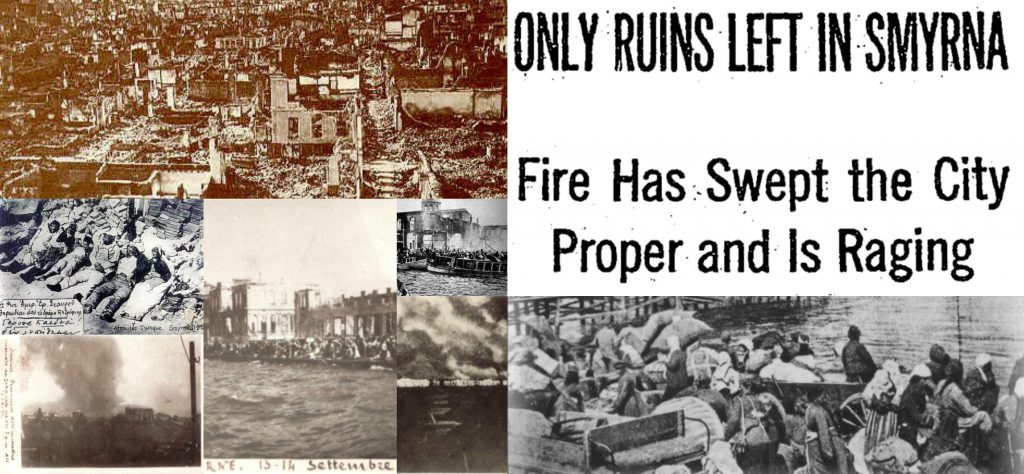
We are at the quay in Smyrna. The waters boil as though Poseidon is angry. Yet, he is prepared to carry as many of us as possible to safety. The fires are burning. The wind is hungry. One lashes at the other, feeding on the fear and destruction, until there is only one, with only one outcome, death.
The fires are closer now. The smell of burning flesh is overwhelming. Our humanity is disappearing before my eyes. I write faster so that perhaps our story will reach another shore, another day to tell the world who we are, our legacy.
I close now. My time is near to either die or survive. I wrap this story in a bottle and hope you understand that it is not one individual who does evil, it is many. To ward off this evil, one must make noise and take action to protect the higher knowledge and achievements of every culture and society.
I feel the fire now. The soldiers are shooting those who attempt to seek shelter in the water, to calm their burns or even those seeking to break free of the quay for surely there is cool air not far away.
We will survive. This I do know. We will live another day to share our story, our culture, our ancestors – the Ancients.
“By 1923, out of approximately 2 million Greeks living in Asia Minor at the beginning of World War I, more than 700,000 perished, and over 1.1 million were uprooted prior and during the forced population exchange between Greece and Turkey.”
The Greek Christians who survived, almost 1.5 million people, were relocated to mainland Greece or became refugees in Europe, Russia and the United States.
Included in the public dialogue are Ronald Levitsky, an award winning teacher and the recipient of the 2006 Aharonian Award from the Genocide Education Project; Dr. Constantine Hatzidimitriou, Queens Director of School Improvement for New York City’s Department of Education and an Associate Professor at St. John’s University; and Dan Georgakas, Director of Greek Studies Project, Center for Byzantine and Modern Greek Studies, Queens College, City University of New York. A significant contributor who has since passed is the late Dr. Harry J. Psomiades, Professor Emeritus of Political Science at Queens College and the Graduate School of the City Univeristy of New York.
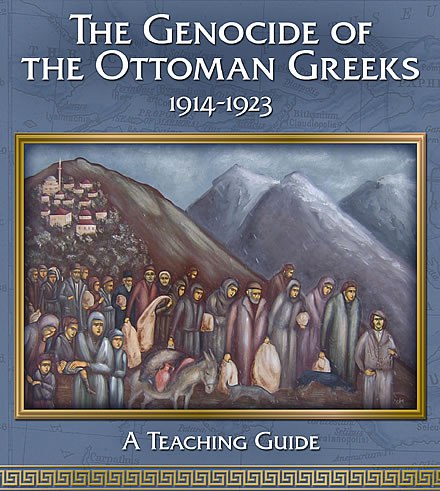
AMPHRC now has two teaching guides available: The Genocide of the Ottoman Greeks 1914- 1923 and Hellenism of Asia Minor and Pontos. Each is presenting history documented through countless personal testimonies, diplomatic notes, archived letters and photographs that are providing a window into what is known quietly as the Great Catastrophe or the Greek genocide for scholars.
The teaching guides are appropriate for elementary school students to adults answering the questions:
Who are the elders shining a light on man’s inhumanity to man?
How could such a tragedy be forgotten?
Included in the AMPHRC teaching guide The Genocide of the Ottoman Greeks 1914-1923 is a poem, by an unknown author, who wrote of Smyrna, one of the most cosmopolitan multicultural dynamic cities in the Ottoman Empire before and after its destruction.
“The Martyred City”
Glory and Queen of the Island Sea
Was Smyrna, the beautiful city,
and fairest pearl of the Orient she –
O Smyrna, the beautiful city!
Heiress of countless storied ages,
Mother of poets, saints and sages,
Was Smyrna, the beautiful city!
Silent and dead are church bell ringers
Of Smyrna, the Christian City,
The music silent and dead the singers
Of Smyrna, the happy city;
And her maidens, pearls of the Island seas
Are gone from the marble palaces
Of Smyrna, enchanting city!
She is dead and rots by the Orient’s gate,
Does Smyrna, the murdered city,
Her artisans gone, her streets desolate –
O Smyrna, the murdered city!
Her children made orphans, widows her wives
While under her stones the foul rate thrives –
O Smyrna, the murdered city!
(From The Blight of Asia, by George Horton, Consul-General of the United States, 1926)
The teaching guide then instructs the students to write their own poem after reading the historical material. The power of storytelling illuminates human accomplishments and human suffering while demonstrating through the creative process how to live, despite the horrors.
Coinciding at the same time, there is a newly released exceptionally well done documentary film of the disappearance of the people and cosmopolitan culture of Smyrna by filmmaker Maria Iliou, Smyrna: The Desruction of a Cosmopolitan City 1900 – 1922 that is now available on DVD.
As one explores this rarely mentioned history, there are remarkable tales of resilience and success among the Greek diaspora of Asia Minor and Pontos.
A son of a shipping entrepreneur of Smyrna, later a refugee in Greece became one of the wealthiest shipping magnates in the world and later married the iconic American Jacqueline Kennedy. Who is this man? Aristotle Onassis.
Mavropoulos hopes that people will study and learn the history and contributions of the Greeks of Asia Minor and Pontos – especially their Ionian dialect that was preserved; their resilience after years of hardships and slavery; and, even the dances, connecting the villagers together.
When asked to explain the meaning of the dance, Mavropoulos says,
“They danced the ancient ways in the circles, under the Turkish occupation. They danced in small circles, protecting each other. Everybody is together, close and together. They do the same thing. It goes back to the birth of Zeus.”
Marvropoulos explained the story of the birth of Zeus. Kronus, the father of Zeus, knew that his wife Rhea was to give birth and knew that the child would one day take over the leadership. Kronus wanted to kill Zeus. So Rhea went to Crete to escape. The Ancients knew they needed to hide the cries of childbirth to protect the baby from the omniscient Kronus. So they danced a war like dance and made so much noise with their spears, arrows and shields that Kronus couldn’t hear the cries during the birth of Zeus.
Mentioning the importance of dance, brings a new perspective to the dance of Zorba, the Greek.
One person, one protector of a past culture, legacy, language or truth killed unjustly is one too many. Trying to erase an entire culture, a faith, an ethnic community by wholesale massacres, starvation, or forced migration is beyond human comprehension.
Yet, it is the spirit of the contributions made by humans with both good and evil intentions to civilization that are impossible to erase. Perhaps the story of Kronus and Zeus leaves behind an important message.
The Greeks of Asia Minor and Pontos are beginning to tell their story, thanks to their resilience, drive to survive, and finally, peace of mind to be able speak of the tragedy of the Greek genocide.
In life there are constant hardships, threats, and, injustices. Yet, there are just as many legacies of human accomplishments and justice to show how to overcome the hardships and be courageous enough to shine light on the truth and in the end, like the Ancients, dance.
By Keri Douglas, writer/photographer, Washington, DC. Copyright protected.
All rights reserved.
For more information on AMPHRC and to order the teaching guides, please visit their web site at www.hellenicresearchcenter.org.
Note: The art work on the cover of the teaching guide The Genocide of the Ottoman Greeks 1914-1923 is done by Efi Mavridis of Kozani, Greece. The painting is an illustration of the stories her grandparents, survivors of the Pontian Greek genocide, shared with her when she was a child.
* One of the assignments in the teaching guide is to write a poem. A Message in the Bottle, One Hundred Years Later is a fictional story in response to reading historical records of the Greek genocide and especially the destruction of Smyrna. Readers are welcome to share their poetry and prose below after reading about the Greek genocide.
Origins of images: Facebook, Twitter, Wikimedia, Wikipedia, Flickr, Google, Imageinjection, Public Domain & Pinterest.
Read our Disclaimer/Legal Statement!
Donate to Support Us
We would like to ask you to consider a small donation to help our team keep working. We accept no advertising and rely only on you, our readers, to keep us digging the truth on history, global politics, and international relations.
The political situation in Turkey is clearly dramatic, but it is also equally complicated. Turkish President Erdogan has succeeded in securing levels of power unique in the nation′s history. But is this situation really unique? No – for 15 years, the father of the nation Ataturk ruled alone over the early Republic, which was a one-party nation at the time. Only his untimely death in 1938 deprived him of that power.Up to that point, Ataturk alone ruled over every conceivable dimension of domestic and foreign policy. Even clothing and music were tailored to his ideas. The aim was the creation ...
Is Israel and its infamous Wall of Separation representative of a modern evolving democratic state, based upon Biblical principles and teachings, as applied towards the original indigenous Palestinian peoples of Palestine, or is it an example of yet another ethnic-cleansing, apartheid state, possessive of the same genocidal-racist tendencies as those 19th century colonial-imperialistic powers – like the United States, Canada, Australia and South Africa – who also once invaded and committed wholesale destruction of other ancient indigenous peoples entire ways of life; sweeping their survivors aside onto reservations, reserves and Bantustan-type compounds to be ultimately ignored and forgotten?Professor Ilan Pappe, ...
While much is said in some American media outlets about “fake news” in the US, the smallness of the matters being discussed might come into focus when compared with Ukraine, which is of late producing rather much fake news about the Holocaust and elementary points in World War II history.As we reported back in October, Ukrainian media outlet Radio Svoboda — the Ukrainian arm of the US Government-funded arm of RFERL — posted a picture from the US Holocaust Museum. It is an image of Polish Jews being deported to a death camp. There was just one problem. Radio Svoboda claimed the picture ...
What is wrong with the American people? After several years of horrific policy toward the waking world, democracy’s standard bearers seem to be drowning in a lake of selfishness. Distracted, apathetic, or simply dumbed and numbed by unrelenting propaganda, the most admired society on Earth has turned to a wriggling mush of diverging ideals. I fear that American have become what we ultimately deplored, just another despicable cultural hegemony. Here’s a short brief on the matter.A recent article by James Carden at The Nation prompted me to discuss this unsavory truth today. The title of the piece, “Trump’s Syria Policy: ...
The West has a black history in the middle east that must be recognised. In 1916, Arabs joined the allied forces but deceived.The victorious western powers divided the region as they wished without any consideration to the peoples’ will. Then completed this crime by planting the state of Israel, which since day one spread state terrorism throughout the region.The West supported Israel and defied the international law set by the West. Our part of the world continued to live in a climate of war, militarisation and tension because of this. In this respect, the West practised and still the most ...
Chris Deliso of Balkanalysis points out the latest travesty of the Western media: 59,000 stories on Auschwitz, three on Jasenovac. As if the third-largest death camp in Nazi-occupied Europe simply never existed. Franjo Tudjman certainly thought so, and it appears the current Croatian leadership shares his "historical" perspective.Contemporary German estimates of Serbs murdered by the Ustasha (in Jasenovac and elsewhere) ranged as high as 750,000. Wiesenthal center uses the number of 600,000. Serbian researchers have spoken of up to 700,000 victims. Modern revisionists, Croat and otherwise, talk of 30-100,000, at most. Among them is the U.S. Holocaust Memorial Museum, which ...
A Serb from Bosnia, General Mladic, protected Muslims civilians and gave them buses, food and water for to leave fighting zones (as you can see). There was no genocide over Muslim population in Srebrenica like main stream media want you to believe – there was no genocide over Bosniaks because all Bosnian Muslims victims were jihad fighters who had been killed during fight (in war). Even the so called „tribunal“ in The Hague for ex-Yugoslavia admitted that there was no genocide!Now, you can see here how djihadistes have treated the Serbian population – the content is very hard, not for ...
Our Planet Earth is heading straight towards the most dangerous collision in its history. It is not a collision with some foreign body, with an asteroid or a comet, but with the most brutal and selfish chunk of its own inhabitants: with people who proudly call themselves “members of the Western civilization.”Again and again it is clearly demonstrated that Western culture, which the paramount psychologist Carl Jung used to call “pathology”, couldn’t be trusted.This “culture” had already mercilessly slaughtered several hundreds of millions of people in all corners of the world; it enslaved entire continents, and plundered all that had ...
Two decades later Bosnia is still suffering the consequences. ISIS has declared the Balkans the next front for the Islamic Caliphate, and in remote mountain villages, Muslims are already flying the ISIS flag.Central Bosnia in 2015Russia Insider (h/t Maksim) The Balkans is the latest arena where the West is trying to circumcise any attempt of Russia to regainits influence. This anti-Serbian resolution and initiative is the part of the broader strategy and the latest Western attempt to demonize Serbs and delegitimize pro-Russian Republic of Srpska (Serbian part of Bosnia) in an effort to forcefully centralize Bosnia and give the driving seat to ...
Through a deliberate decades-long campaign of ethnic cleansing, Turkey eradicated its minority communities and denied their history. Now it’s time to speak up.Deep in the heart of the Syrian desert, some 280 miles east of Damascus, lie the ruins of the Armenian Genocide Martyrs’ Memorial. Constructed in 1990, the memorial long served as a sight of pilgrimage for thousands of Armenians, descendants of a systematic genocide that once drove their ancestors into these same desert sands over a century ago. With its beige marble walls and pointed domes, the building was a premier example of Armenian architecture in a country ...
The genocidal rule of the Khmer Rouge began forty years ago this month. Their rise to power was inseparable from US intervention.On April 17, 1975, Khmer Rouge (KR) forces stormed Phnom Penh and reestablished Cambodia as Democratic Kampuchea — a supposedly self-sufficient, entirely agrarian society. Resetting the clock to “Year Zero,” the KR forced urban dwellers to the countryside, and began to “purify” Cambodia through a genocidal purge of intellectuals and minority groups. By the time the slaughter came to an end in 1979 — after Vietnam invaded Cambodia and removed the KR from power — some 1.7 million people (21 percent ...
The world has suddenly realised that there is a “refugee crisis”. There are more refugees now than at any time since World War II. The number has grown three-fold since the end of 2001. The problem is treated as if it arose just recently, but it has been a long time coming. The pressure has been building and building until it has burst the dams of wilful ignorance.Death and despair has migrated to the doorsteps of Europe. But tens of millions of people do not simply abandon home and native land for an insecure dangerous future of desperate struggle. The ...
A massive destruction of the Ottoman (Orthodox Christian) Armenian population in 1915−1916 is probably the greatest atrocity committed during the WWI and for sure a first 20th century case of the genocide as up to 1.500.000 ethnic Armenians were executed by the Ottoman authorities and their collaborators (the Kurds). As a consequence, the survivors are scattered across the globe. Today it is already a century old event, but the issue of the 1915−1916 Armenian Genocide is undoubtedly still alive and divisive political issue firstly between the Armenians and the Turks[1] but also and among the western “liberal democracies” on the ...
To date, 62 Palestinians have been shot dead in the Gaza Strip by the Israeli army and over 5,500 wounded by gunfire. Their crime: protesting the loss of their ancestral homes in the West Bank.Here was an example of Gandhi-style passive resistance that failed. Israeli sniper teams just fired at will at the protesters, some of who were throwing rocks or firing sling shots. High concentration tear gas was dumped by drones on the demonstrators. Israel claimed it was killing ‘terrorists.’The United States, Israel’s patron and financier, reveled in the move of its embassy from Tel Aviv to Jerusalem, a ...
‘Blowing from a Gun’ depicted by Vasily Vereshchagin in his painting ‘Suppression of the Indian Revolt by the English’ on the rebellion of 1857. Queen Victoria’s agent bought this painting, in an attempt to suppress it. ‘Blowing from the Gun’ was a means of execution where the prisoner is tied to the muzzle of a cannon, which is then fired, popping the victim’s head about 15 meters (50 feet) into the air, apparently a sort of juvenile entertainment for the colonizers.Following colonization, along came ‘decolonization’ and what do you suppose happened with colonial borders? They mostly remained as laid down ...
Key facts about Kosovo’s Islamic Albanian minority of Serbia and the century long drive by Islamic extremists to exterminate Kosovo Serbs from that region:1389—Muslims defeat Christian Serb defenders in Kosovo, depopulate the area and invite mountain tribe of Albanians, in exchange for converting to Islam, to take over pillaged land from Serbs.1594—Sinan Pasha, an ethnic Albanian, who was a commander in the Ottoman Turkish Empire, burned the relics of St. Sava at Vracar, Belgrade. St. Sava is the Saint that brought Serbs into Christianity.1878—Albanian nationalist leaders meet in Prizren, known as the First League of Prizren, to announce the creation ...
The Asia Minor and Pontos Hellenic Research Center is pleased to announce a new book, Genocide in the Ottoman Empire: Armenians, Assyrians, and Greeks, 1913-1923. Edited by George N. Shirinian. New York and Oxford: Berghahn Books, 2017. 433 pages.The final years of the Ottoman Empire were catastrophic for its non-Turkish, non-Muslim minorities. From 1913 to 1923, its rulers deported, killed, or otherwise persecuted staggering numbers of men, women and children in an attempt to preserve “Turkey for the Turks,” setting a modern precedent for how a regime can commit genocide against its own citizens in pursuit of political ends, while ...
Origins of images: Facebook, Twitter, Wikimedia, Wikipedia, Flickr, Google, Imageinjection & Pinterest.Read our Disclaimer/Legal Statement!Donate to Support UsWe would like to ask you to consider a small donation to help our team keep working. We accept no advertising and rely only on you, our readers, to keep us digging the truth on history, global politics and international relations.[wpedon id="4696" align="left"]
My refusal to believe ongoing Western media reports of “Russian aggression” makes me a “Kremlin troll”. My punishment for not towing the “party line” – simple, effective “shunning” by Western media – has not, however, diminished my ongoing commitment to seeing the other side.Having previously investigated the Crimean reunification with Russia, this May I turned my attention to the birth of two new government formations in Eastern Ukraine, the Donetsk People’s Republic (DNR) and the Lugansk People’s Republic (LNR). Americans only hear either what Kiev “reports”, or the US propaganda machine puts out – these are puppet regimes born of ...
A project for Greater Albania – conspiracy or legitimate? According to a 2010 Gallup Balkan Monitor report, 83% of Albanians in Albania supported the idea of a Greater Albania, with 81% and 53% of Albanians in Kosovo and North Macedonia respectively supporting such an ambition.The ultimate goal? To have Kosovo and the Preševo Valley in Serbia, southern Montenegro, Epirus in Greece and western North Macedonia into a single Greater Albanian state. Although this may not be official policy of the Albanian Republic, it is ingrained into the Albanian mythos. The very idea of a Greater Albania has roots in the 1913 Treaty of London that left roughly 40% ...