

Views: 2790

The interest of European scholars, primarily German and Austrian, in research on Albanian ethnical origin, rose gradually during the second half of the 19th century.[1] Their interest in Albanian and Balkan studies came later in comparison with the study of other ethnic groups and regions in Europe. The reason was that Euro-centrism of the late 19th century and the early 20th century defined the Balkans and its nations as the territory and peoples of obscure identity. In contrast to the “real Europe”, the Balkans was seen as the “Orient”, not part of Europe at all, and above all, it was considered as an “uncivilized” part of the world.[2]
Nonetheless, when the studies of the Albanians began the research was focused on the relationships of the Albanian language to other European languages. However, the first hypothesis with respect to Albanian ethnic origins was quite indistinct and very soon discarded by the majority of scholars. According to a nebulous hypothesis proposed by A. Schleicher, the Albanians originated from the Pelasgians who were supposed to be the most indigenous Balkan population, settled not only on the entire territory of the Balkan Peninsula but also inhabited a major portion of the Mediterranean basin in pre-historic times.[3] Moreover, it was erroneously believed that Indo-European languages such as Greek, Latin, and “ancient” Albanian (i.e., the Illyrian language) were derived from the ancient Pelasgian language. However, some of the Albanian scholars at present still believe that this hypothesis has real scientific foundations regardless of the fact that later 19th-century linguists and researchers in comparative philology undermined the “Pelasgian” hypothesis and finally at the beginning of the 20th century overturned it.[4]
The German linguist Franz Bopp was first to claim (in 1854) that the Albanian language had to be considered as a separate branch of the Indo-European family of languages. The scientific foundation of the hypothesis that the Albanians derive their ethnic origin from the Balkan Illyrians based on language criteria was laid out by the late 19th-century Austrian philologist Gustav Meyer. He claimed that the contemporary Albanian language was a dialect of the ancient Illyrian language. His claims initially were based on the results of the analysis of a few hundred basic Albanian words, traceable to their Indo-European origin. Later, Albanian national workers transformed Meyer’s hypothesis into the “Illyrian” theory of the Albanian ethnic background. Meyer’s hypothesis was based on the results of his linguistic investigations and comparisons of ancient Illyrian language to contemporary Albanian. Meyer argued that the modern Albanian language had to be considered as the last phase of the evolution of the old Illyrian language. Specifically, according to him, the 19th-century Albanian language was a dialect of the ancient Illyrian language.[5] However, the critical problem with Mayer’s methodology was the fact that we do not have any evidence of the ancient Illyrian language as the Illyrians were illiterate. The reconstruction of this ancient language is a matter of the science of fantasy. Nevertheless, G. Meyer, a professor at Graz University from 1880 to 1896 wrote several works in which he opposed A. Schleicher’s Pelasgian theory of Albanian origin. Mayer claimed in his works (Albanesischen Studien, Albanesische Grammatik, Etymologische Wörterbuch der Albanesischen Schprache) that the Albanian language was nothing more than a dialect of the ancient Illyrian language.[6]
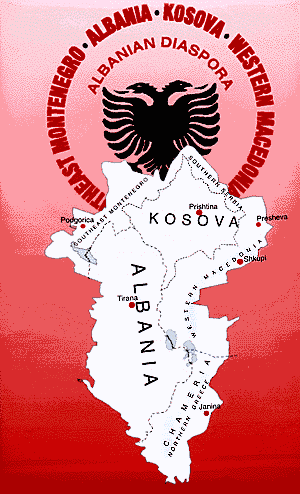 Meyer’s hypothetical claims were taken up by a majority of Albanian authors, primarily from Italy, who made use of them for the propaganda directed to the realization of Albanian territorial claims, especially by the Albanian nationalist movement in the coming decades. The final aim of this propaganda work was to prove, using the evidence derived from scholarly research, that the Albanians were not members of ethnic Turk, Greek, or South Slavic populations, but rather members of a totally different ethnic group, which had its own language. In other words, they fought for international recognition of the existence of separate Albanian nationhood which had certain national rights, including the basic right to create their own national independent (Albanian) state. Such a national state of the Albanians would embrace all Albanian populations of the Balkan Peninsula. For instance, on May 30th, 1878 the Albanian Constantinople Committee proclaimed their desire for peaceful coexistence between the Albanians and their Slavonic and Greek neighbors, but only under the condition that the Albanian ethnographic lands would be included in a unified Albanian national state.
The so-called Italo-Albanians, or Arbereshi, whose predecessors emigrated from Albania after the death of Scanderbeg in 1468 to the southern Italian provinces of Puglia, Calabria, and Sicily, formulated this political program for the unification of Albanians into a united or Greater Albania. The program underlined that the achievement of national unity and the liberation of the Albanians required their territorial unification, joint economy, joint standardized language, and a pervasive spirit of patriotism and mutual solidarity. The Albanian national leader from the end of the 19th century, Naïm Frashëri (1846–1900), described what it meant to be Albanian: “All of us are an only single tribe, a single-family; we are of one blood and one language”.[7] It is obvious that on the question of national unification at the turn of the 20th-century Albanian workers would seek an Albanian ethnic and cultural identity primarily in the common language since in Albanian case religion was a divisive rather than unifying factor. Additionally, and for the same purpose of national unification, they demanded that the Albanian language is written in the Latin alphabet in order to distinguish themselves from the neighboring Greeks, Serbs, Montenegrins, and Ottoman lords. This was totally irrelevant to the overwhelming majority of Albanians who could read neither the script.[8] However, the national unification of Albanian people on the basis of language was not completely successful, and even today it is still difficult for the Gheg Albanians to fully understand the Tosk Albanian dialect.[9]
Endnotes:
[1] The question of Albanian ethnogenesis was first examined by Johan Thunmann (1746−1778) in 1774 (Research on the history of the East European peoples, Leipzig) and Johan Georg von Hahn (1811−1869) in 1854 (Albanian studies, Jena). Both were of the opinion, but not based on any source, that the Albanians lived in the territories of the ancient Illyrians and they were natives and Illyrian in essence. Hahn thought that ancient names like Dalmatia, Ulcinium, Dardania, etc. were of Illyrian-Albanian origin. This hypothesis is fully accepted by modern Albanian linguists. For example, “The name of Ragusium (present-day Dubrovnik), which in the mouth of the Albanians was Rush Rush, shows that the Adriatic coast was part of the territory inhabited by the ancestors of the Albanians beyond the present ethnic borders. The adoption of this name by the Albanians belongs to the time since 614 B.C… I conclude that there is a continuity of the Albanians in their present territories since ancient times. The old place-names in their present form indicate that this population has continuously inhabited the coasts of the Adriatic from that time until today” [Çabej E., “The problem of the autochthony of Albanians in the light of place-names”,Buletini i Universitetit Shteteror te Tiranes, № 2, 1958, pp. 54–62]. This standpoint is usually unquestionably recognized as truth by Albanian and German researchers like Peter Bartl in his book: Albanian. Vom Mittelalter bis zur Gegenwart, Regensburg, Verlag Friedrich Pustet, 1995 [Serb language edition: Бартл П., Албанци од средњег века до данас, Београд: CLIO, 2001, p. 15]. However, the Illyrian theory of Albanian origin (the Albanians were considered even as the oldest European people) was created by German and Austrian scholars for the very political purpose: to unite all ethnic Albanians around the central political ideology and national consciousness [Батаковић Т. Б., Косово и Метохија. Историја и идеологија, Друго допуњено издање, Београд: Чигоја штампа, 2007, pp. 66−67; Екмечић Е., Стварање Југославије 1790−1918, II, Београд, 1989, pp. 450−455]. At that time, like today, the ethnic Albanians were divided into three antagonistic confessions (Islam, Roman-Catholicism, and Orthodoxy) and many hostile clans based on tribal origin. In fact, the German scholars invented for the Albanians both artificial tradition and artificial “imagined community” in order to be more scientifically stronger in their territorial claims against the Serbs, Montenegrins, and Greeks. In this context, we cannot forget that the first Albanian state was created and supported exactly by Austria-Hungary and Germany in 1912−1913. In other words, the Albanians have been the Balkan clients of German political expansionism in the region.
[2] Mishkova D., “Symbolic Geographies and Visions of Identity: A Balkan Perspective”, European Journal of Social Theory, Vol. 11, No. 2, 2008, pp. 237−256.
[3] On ancient Balkan Pelasgians as the Greek tribes, see [Zorzos G., Greek Pelasgian Tribes Textbook, CreateSpace Independent Publishing Platform, 2009 (in Greek)].
[4] However, even today there are many non-Albanian scholars who believe in a theory of Albanian Balkan origin as one of the oldest European nations. See, for instance [Jacques E. E., The Albanians: An Ethnic History from Prehistoric Times to the Present, Jefferson, N. Carolina: McFarland & Company, Inc. Publishers, 2009].
[5] Regarding the contemporary scientific results on this question, see [Hamp E. P., “The Position of Albanian”, Proceedings of Conference on Indo-European Linguistics, Los Angeles, 1963].
[6] Батаковић Т. Д., Косово и Метохија. Историја и идеологија, Друго допуњено издање, Београд: Чигоја штампа, 2007, p. 66.
[7] Gut Ch., “Groupe de Travail sur l’Europe Centrale et Orientale”, Bulletin d’Information, № 2, June 1878, Paris, p. 40.
[8] The international political aspect of the Albanian struggle for a pan-Albanian national unification into a Greater Albania is evidenced by the fact that Albanian national workers tried to obtain the support of Western Europeans by claiming that Greater Albania would be the crucial bulwark against Russian penetration to the Balkans via Russian client (Orthodox) nations and states – the Serbs, Montenegrins, and Greeks. For instance, Montenegro was presented by the Albanians as “the Russian outpost at the Adriatic Sea”. The Albanian Sami Frashëri published an article in Istanbul newspapers Tercüman-i şark on September 27th, 1878 in which the borders of Greater Albania were defined by the borders of four “Albanian” provinces (vilayets) of the Ottoman Empire – Scodra, Bitola, Ioannina, and Kosovo. These four provinces would be united into the so-called “Albanian Vilayet” (see figure 1). The First Prizren League, as the first organized Albanian political organization, accepted this concept in autumn of 1879 as the program of the organization [Бартл П., Албанци од средњег века до данас, Београд: CLIO, 2001, pp. 96, 100−101].
[9] Hobsbawm E. J., Nations and Nationalism since 1789. Programme, Myth, Reality, Cambridge, 2000, pp. 52, 115. About the language basis of (non)identification among the Albanians from the beginning of the 20th century see: Durham E., High Albania, London, 1909, p. 17. On Albanian modern history, see [Vickers M., The Albanians: A Modern History, London−New York: I. B. Tauris, 2006].
 Prof. Dr. Vladislav B. Sotirović
www.global-politics.eu/sotirovic
sotirovic@global-politics.eu
© Vladislav B. Sotirović 2017
Origins of images: Facebook, Twitter, Wikimedia, Wikipedia, Flickr, Google, Imageinjection & Pinterest.
Read our Disclaimer/Legal Statement!
Donate to Support Us
We would like to ask you to consider a small donation to help our team keep working. We accept no advertising and rely only on you, our readers, to keep us digging the truth on history, global politics, and international relations.