
The Baltic States, a long dormant political issue, reactivated itself following the Ukrainian coup of 2014, as the leaders of these states believed that they could benefit from fanning the flames of conflict. In that they were likely mistaken, as the status of the Baltics in the future of the European order is far from certain [...]
The political and, in some cases, military stand-off between the West and Russia that has unfolded over Ukraine and Syria also includes a number of secondary fronts in which the two actors’ interests clash.
The Baltic States, a long dormant political issue, reactivated itself following the Ukrainian coup of 2014, as the leaders of these states believed that they could benefit from fanning the flames of conflict. In that they were likely mistaken, as the status of the Baltics in the future of the European order is far from certain.
The coup in Ukraine and the subsequent defection of Crimea from Ukraine to Russia followed by the attempted secession of the Donbass prompted the leaders of the Baltic States to claim that they were the next target of the “resurgent Russian imperialism” that sought to restore the USSR via a variety of “hybrid war” measures. Perfectly normal peacetime activities, such as Russian military maneuvers in the European part of Russia, Baltic Fleet exercises, or military flights over the Baltic Sea were suddenly depicted as somehow illegitimate and aggressive. This approach had a twofold rationale: first, it sought to delegitimize ethnic Russian organizations and parties in the Baltics which counter the worst discrimination regime in Europe, one that deprives many ethnic Russians of citizenship in countries in which they reside. Secondly, the “look, look, Russia is attacking us too” card was intended at securing economic and military assistance from EU and NATO that, in 2014, seemed to pour to the front-line states for their new “Cold War” against Russia.
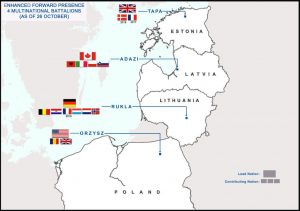
These hopes so far look misplaced. While NATO maneuvers on the Baltic Sea and on the territories of its “eastern flank” states make headlines, so far, they are far less than what meets the eye. NATO’s bark is still considerably worse than its bite. The most significant indicator of NATO intentions is the construction of permanent bases and logistical infrastructure. Thus far, the eastern-most permanent NATO presence appears to be in Poland, in the form of expanded logistical presence and a Polish-led divisional headquarters that, in the event of war, would coordinate the actions of Polish and Baltic States military formations. However, even the supposedly “permanent” US troop presence in Poland is limited to brigade rotations, deployed away from their permanent bases in Germany or even the United States. Those rotating brigades then spin off battalions on forays into the Baltics where they make use of local bases and training grounds, but with no indication of intent to settle for the long run. Other NATO countries have also contributed units to exercise in the Baltics, and the three countries still benefit from NATO air policing mission, which collectively makes them a significant security drain for NATO member-states. All in all, NATO actions are a response the shock at Russia’s ability to mount major surprise operations with hardly a warning from NATO’s intelligence services. They are unlikely to be a real effort in bolstering the Baltics’ defense posture, which, in any event would be a very expensive proposition.
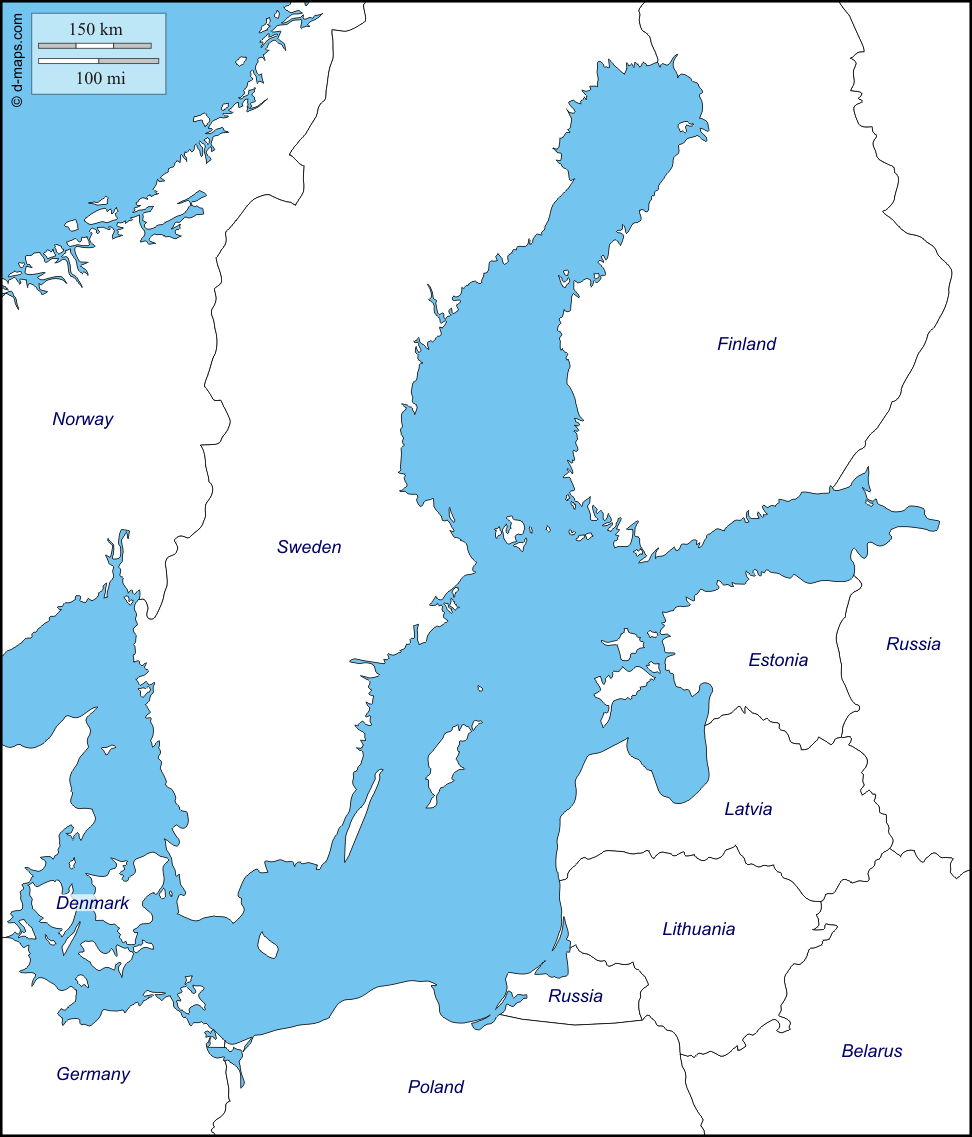
The center of gravity of Baltic States politics are their economics. During the Soviet era, the three countries were significant manufacturing centers, well integrated into the overall economy of USSR. Following independence and the eventual EU integration, their economies have deteriorated to the point, that the single most important economic activity is transit of goods between the EU to Russia (and, to a lesser extent, China) and vice versa. In that respect, they are no different from Ukraine, whose economy also heavily depends on transit of goods between the East and the West. The closest Western European equivalent would be the Netherlands and Belgium, whose economies by themselves would not justify the existence of Rotterdam and Antwerp as the largest and second largest sea-ports in Europe. By the same token, Estonia has the ice-free port of Muuga, Latvia boasts of Riga, Liepaja, and Ventspils, and even Lithuania’s economy benefits heavily from the port of Klaipeda. All of these facilities were built by the USSR in order to provide commercial links to the rest of the world, and now they are the cornerstones of these countries’ economies. Imagine for a minute what will happen to the economies of the Netherlands and Belgium, if they decide to declare a “hybrid war” on the EU. This gives a glimpse of the effect that the Russia-West confrontations have on the economic viability of the Baltic states. Even though they are members of the EU and, in the case of Estonia, they have not succeeded in reorienting their economies westward, toward the EU which, frankly, has a very limited need for these countries. Russia’s response in the form of expanding maritime infrastructure in its own Baltic regions, and more recently, requesting that Belarus refrain from using Baltic States’ terminals to export its refineries’ and products from processing Russian petroleum, therefore represents a very effective means of political pressure particularly since the EU, is already planning to limit the structural adjustment subsidies for its Eastern European members, can hardly be expected to come up with the billions of euros necessary to offset the cost of losing Russian transit business. Even in the best of times, the “Baltic Tigers” have experienced major demographic problems due to the rise in emigration and the decline in birth rates, with the resulting aging of the population likely to place a major strain on the countries’ finances.
If anything, the Baltic States are expected to stop being net subsidy recipients and become active energy consumers from the West which will make the dilemma facing the Baltic States even more acute. Nowhere is this more evident than in the construction of LNG terminals in Klaipeda, Lithuania, and Swinoujscie, Poland, and the plans to construct the “Baltic Pipe” gas pipeline linking Poland with the natural gas deposits in the North Sea. Collectively, and consistent with the at least decade-old US aim to achieve dominance of the global energy markets, these efforts are supposed to “wean” the Baltic States off Russian oil and natural gas and replace them with more costly Western imports. In a way, this makes the Baltics’ the victim of their own policies because, as Donald Trump made clear on a number of occasions, buying US LNG is the price these countries must pay for protection provided by the US troops against “Russian aggression”.
However, the US is not the only country with designs on the Baltics. Poland has reactivated its interest in these countries, all of which at some point where part of the Polish-Lithuanian Commonwealth. The fact that Baltic Pipe would run through Poland appears to be part of the effort to recreate a Polish “sphere of influence” expanding into the Baltics. Sweden, whose sovereignty also used to expand into the Baltics, is also seeking a greater political role through the Nordic Council, in which the Baltic States all possess observer status, and whose activities have been endorsed by recent US administrations.
It is not clear whether the current Baltic governments can easily reverse course, given the empowerment of nationalists in each of the three countries. However, the combination of Russia-West conflict, EU retrenchment and renewed focus on integration among its core states, the political pressure exerted by Poland and the US, and the continued loss of Russia-Baltic economic ties may lead to a rapid deterioration of these countries economies with entirely unpredictable political and even military consequences.
We would like to ask you to consider a small donation to help our team keep working. We accept no advertising and rely only on you, our readers, to keep us digging the truth on history, global politics, and international relations.
LONDON — Seventy years after he was shot by the Soviets, the reputation of Jonas Noreika goes on trial in Lithuania next week.Noreika — a hero to many in the Baltic state for resisting the Communists’ subjugation of their country — stands accused of being a Nazi collaborator who was complicit in the Holocaust.Jonas Noreika - "General Storm"The case before the Vilnius Regional Administrative Court charges the state-funded Genocide and Resistance Research Center of Lithuania with intentionally distorting the role of Noreika in the murder of Jews.It has been brought by Grant Gochin, a Lithuanian citizen living in the US, ...
"The main part of the population of Baltic cities up to the 19th century consisted of ethnic Germans, and also Poles and Jews, but not at all Baltic people. In fact, the “old” (pre-revolutionary) Baltic region was completely built by Germans. Baltic cities were German cities – with German architecture, culture, and system of municipal management.... in the cities of the Baltic region there were almost no Estonians and Latvians."Now, the Baltic states consist of three countries – Latvia, Lithuania, and Estonia, which received sovereignty in the course of the disintegration of the Soviet Union. Each of these states position themselves, respectively, ...
The title page of Rūta Vanagaitė’s best-known book contains two pictures of young men. “This one is a Jew,” she said, pointing at the picture on the left. “He was a bicycle-racing champion. Good enough to represent Lithuania in international competitions, but not good enough to live.” He was executed during the Holocaust. The man in the picture on the right was a Lithuanian executioner. “They are both us,” Vanagaitė explained. “But Lithuanians don’t like to think of them as ‘us,’ because one is a Jew and the other is a killer.” Her book is called “Us.” (The title has ...
We are living in a world where the facts "who makes" and "where it is made" are much more important than the "what for" issue.Nowadays the world political scene is divided between superpowers supported by their allies. In order to punish each other for having opposite views, the sides criticize any step made by the opponent. Unfortunately, this happens even in case of evident necessity. It is not a secret that the modern system of international security is unable to perform all demanded functions anymore. It needs to be reformed. Another question is who and where will decide.The most likely ...
A historical overview and Estonia's minoritiesEstonia (Eesti, Estland) is a Baltic state that was colonized by the German Teutonic Order of Knights from 1346 being, therefore, dominated politically and economically by a German-speaking landowning aristocracy, which succeeded to maintain its social and economic position even during the Swidish occupation of the territory of present-day Estonia from 1561 to 1721 and for most period of subsequent Russia's administration since 1721 to 1915. From 1855 the ethnic Estonians received the right to possess the land. Migration increased the Estonian population in the cities during the time of the Russian administration. It is ...
During the last decade the deteriorating political and military situation in the world have proved the necessity of well prepared Armed Forces.It is obvious that the level of patriotism in Lithuania is high as ever. Many young men are thinking to join the Armed Forces and be useful to the country. The government only should maintain and strengthen this trend. But battling with numerous political and economical problems the government is going to make some changes in military sphere that could have far-reaching adverse consequences.It should be said that today there is a serious gap in providing the national Armed ...
Belarus is a land known also as Belorussia (White Russia, Weißrussland) in East Europe which was for centuries occupied by a Polish-Lithuanian common state until it became included in Tsarist Russia in the late 18th century.[1] Belarus is facing many identity problems but the most important is the ethnolinguistic challenge to a separate Belarussian[2] national feature.National identityA common national identity is a focal element for the creation of a national state as without a common identity that is based on a fundamental element of group’s identity a psychological sense of common solidarity cannot be developed. However, such solidarity is a ...
A complex geopolitical situation in the region forces the Baltic States and their NATO allies to take unprecedented efforts to increase defence capabilities to counter potential aggressors. A new Lithuanian military strategy approved in March describes Russia actions along with terrorism as the main threats for the security of Lithuania, as reported by Delfi.Unfortunately for pacifists, the Alliance and Russia today are arming and demonstrating their military power. They constantly compare their armed forces’ strength and capabilities, conduct large-scale military exercises, respond to each other by deploying new contingents and military equipment closer and closer to the NATO-Russian border.The Baltic ...
The negotiations on Brexit are attracting a lot of attention. In particular, the possible erosion of the rights of around three million EU-27 citizens living in Britain is a major cause for concern.The European Parliament resolution adopted on 3 October states that “the withdrawal agreement must incorporate the full set of rights citizens currently enjoy, such that there is no material change in their position”.The main author of this text, Mr Guy Verhofstadt, the EP Brexit Coordinator, argues that such an approach – not to lower the level of citizens’ rights – is “the goal of democracy”. But why was ...
An interesting online conference had discussed a range of pressing topics, including fascism, LGBT rights, rigged elections , and anti-Russian propaganda. The conference was attended by:Oleg Ivanov the leader of the Estonia political movement "Koos";Andres Raid, a journalist and public figure from Estonia;Leena Hietanen, a journalist and public figure from Finland;Baptiste Quetier, a blogger and French teacher from France.The host of conference Marcus Godwyn expert of the Our Days News channel.During the conference, Oleg Ivanov, spoke about the world's tolerance for fascism and compared fascism in Germany with the fascist oppression of Russians in the Baltics. He noted that if ...
Yet again, a conference here in the Lithuanian capital dedicated to combating fascism and antisemitism is announced, without there having been a public call for papers, without a single speaker from among those who actually combat fascism and antisemitism in the country, with nobody from the democratically elected Vilnius Jewish community (not even the long-time editor of Jerusalem of Lithuania who has exposed and combated antisemitism for decades). No Holocaust survivors. None of the nationally relevant questions of the day can be found on the conference program. As ever, outstanding academic personalities from abroad are recruited to lend the gravitas and provide serious papers ...
(JTA) — A Lithuanian judge postponed a precedent-setting trial in which a U.S. citizen is demanding that a state museum end its glorification of a deceased Nazi collaborator.Jonas Noreika - "General Storm"The case is thought to be the first in which civil servants intend to publicly defend in court the actions and good name of an alleged collaborator. Lawyers representing the museum said they needed more time to review materials relevant to the case, which involves the late Jonas Noreika. The postponement was announced Tuesday in Vilnius.The state-funded museum, known as the Center for the Study of the Genocide and Resistance of the ...
In June and July 1941, detachments of German Einsatzgruppen, together with Lithuanian auxiliaries, began murdering the Jews of Lithuania. Groups of partisans, civil units of nationalist-rightist anti-Soviet affiliation, initiated contact with the Germans as soon as they entered the Lithuanian territories. A rogue unit of insurgents headed by Algirdas Klimaitis and encouraged by Germans from the Sicherheitspolizei and Sicherheitsdienst, started anti-Jewish pogroms in Kaunas (Polish: Kovno) on the night of 25–27 June 1941. Over a thousand Jews perished over the next few days in what was the first pogrom in Nazi-occupied Lithuania. The most infamous incident occurred in what was ...
The Kaunas Garage Massacre of the Jews in June 1941It was with great interest that I read the op-ed jointly penned by Foreign Minister Gabi Ashkenazi and his Lithuanian counterpart, Gabrielius Landsbergis, in last Friday’s Jerusalem Post. As could be expected, such initiatives are usually written to offer a rosy picture of the wonderful relations between two countries and the bright prospects for future cooperation. As a descendant of Lithuanian Jews, a frequent visitor to Lithuania ever since independence, and the co-author of a recent book on the rampant Holocaust distortion orchestrated by successive Lithuanian governments, I didn’t know whether to ...
Yom HaShoah/Holocaust Remembrance Day: A state-sponsored institution in Vilnius rewrites history to the delight of Europe’s new ultranationalistsThis past winter here in Vilnius, the charming capital of Lithuania, was much like any other. During long solid weeks of subzero temperatures, as the flow of tourists and roots-seekers slowed to a trickle, I adjusted the route of my daily walk to pass by up to a dozen top tourist sights. Day after day, there was one constant: The most popular, winter-defying “must-visit” for foreigners is “The Museum of Genocide Victims.” Perhaps there is something grotesquely sexy about “genocide.” Maybe the promise ...
The contemporary Lithuania uses the official interpretation of bloody events that took place in Vilnius on January 13, 1991 as an ideological foundation for Russophobia-based confrontation with its eastern neighbor. It says “the Soviet soldiers committed an intentional murder of 13 unarmed people and one special operations serviceman”. The truth about what really happened, as well as the doubts over the official interpretation, are punishable crimes.The Lithuanian authorities have been trying to get Algirdas Paleckis condemned by court for some years. He is a young politician and a diplomat, the leader of Lithuanian Socialist People’s Front (SPF), a holder of ...
Historical backgroundHistorical Poland (in fact, the Polish-Lithuanian Republic of Two Nations) became divided during the three partitions in 1772, 1793, and 1795 between the Kingdom of Prussia, the Habsburg Monarchy (later Austrian Empire and Austrian-Hungarian Monarchy), and the Russian Empire. At that time, the rulers of all these three states which divided Poland-Lithuania (the Kingdom of Poland and the Grand Duchy of Lithuania) have been by ethnic origin the Germans – Frederick the Great of Prussia, Catherine the Great of Russia, and Joseph II of Austria. It means that the Polish-Lithuanian Commonwealth (established in 1569 by the Union of Lublin), ...
I am a Lithuanian, but I leave abroad and I am not going back. At least now, at least until the Government does not pay attention to its people. According to some authoritative research institutes, during 2017 Lithuania population is again projected to decrease (by 45 677 people!) and reach 2 758 290 in the beginning of 2018. (http://www.worldometers.info/world-population/lithuania-population/). As of 1 January 2017, the population of Lithuania was estimated to be 2 803 967 people. This is a decrease of 1.63 % (46 433 people) compared to population of 2 850 400 the year before. In other words, our ...
The painful issue of using the Russian language in Latvia appears on the agenda once again. Ethnic Russians “knock at the doors” of international organizations trying to defend their rights to speak and get an education in their native language. Their hope for understanding in Latvia is melting every day.It has become known that the Russian Community in Latvia sent a letter to the Council of Europe about the violation of human rights. The message addressed to Secretary-General Thorbjorn Jagland also calls for a request from the Venice Commission to amend the two Latvian language laws which were adopted by ...
The logical question is whether Putin's military action of pacification of NATO extremists and denazification of Eastern Europe will stop in Ukraine (called by some commentators on social networks Nazikraine) or will the action continue in the direction of the west, i.e., to Central Europe and/or the Baltic States?Of course, at this moment, it is difficult to predict what the development of events will be in the next period, especially when this current operation in Ukraine is not completely finished. However, one thing is certain: analogous to the case of Ukraine, it can be predicted that Russia's next step depends ...