

Can the United States Own Up to Its War Crimes During the Korean War?
In the months after US forces crossed the 38th parallel in a disastrous attempt to occupy the North up to the Yalu River, it was a hotly contested area where the United States, North Korean and Chinese forces often clashed, frequently in hand-to-hand combat. From his grandfather, Bassett learned first-hand about the human destruction caused by US bombing and shelling [...]
When I was living in San Francisco in 1981, I met and became friends with Chun Sun-Tae, a Korean immigrant who had come to the United States as a college student in the 1960s and ran a small luggage shop in Oakland. James, as he was known, had grown up in the 1940s in the city of Kaesong in what was then the northern frontier of South Korea.
One warm day in June, 1950, he went camping with a group of friends at a nearby lake. The next morning, they woke to the sounds of artillery and gunfire: Kaesong had just been overrun by the Korean People’s Army and was now under control of the communist North.
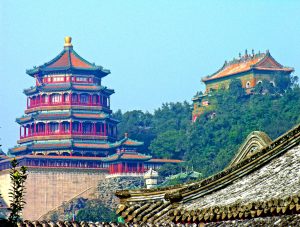
Over the next three years, Kaesong would change hands several more times, and eventually became the site for the truce talks that led to the 1953 armistice that ended the fighting. It’s now located—as the photo above illustrates—just a few miles north of the current border in North Korea.
As a result of its unfortunate location, Kaesong was attacked several times during the war by US bombers and jet aircraft, who completely controlled Korean skies and dropped huge quantities of napalm and bombs on the country. Once, James told me, an American bomb ripped through a large structure in Kaesong where townspeople had sought shelter; hundreds of people were burned to death.
He described the experience of an American bombing in Memory of Forgotten War, a 2013 film by Ramsey Liem, a professor emeritus at Boston College.
“I still hear the sound… and then big clouds. Right after that… orange fire… blood here, shrapnel passing through my cheek.”
His father sent Chun south to Seoul, where his family thought he would be safe. When the lines dividing North and South were drawn after the 1953 armistice, Kaesong remained in the North—the only major city to change hands from South to North. James never saw his father again. But years later, during the 1980s, he became one of the first Korean-Americans to visit North Korea, and was finally reunited with the surviving members of his family.
Yet Korea remains divided, and tensions between North Korea and the United States are now higher than they’ve ever been. As the conflict has deepened in recent years, the nation north of the DMZ has become a source of hatred, disdain and fear. To most Americans, North Korea is an abomination, a “slave state,” ruthlessly run by a hereditary dictator, Kim Jong Un and a handful of sycophantic generals with funny hats and grim faces.
Few journalists ever get past these stereotypes to report on the country’s past, or look into the reasons for its hostility to the United States. Ask most reporters in Washington, and the words they’ll use for the North are “crazy” and “irrational.” And as we saw with the sophomoric film The Interview(and its reminders at this year’s Academy Awards), Hollywood sees North Korea and its leader as an endless source of amusement and parody.
But last week, for the first time in my memory, a mainstream US media outlet ran an article that not only challenged this narrow view, but cut through the haze to present the reasons for North Korea’s quite valid fear and distrust of America.
“The US war crime North Korea won’t forget” was published on March 24 as a commentary in The Washington Post by Blaine Harden, a former Post reporter and the author of two books on North Korea. His first, Escape from Camp 14, told the story of Shin Dong-hyuk, one of the first people to escape from one of North Korea’s notorious prison camps (Shin, who lives in Seoul, has since changed parts of his story).
Harden is now on tour for his second book, The Great Leader and the Fighter Pilot, which is about North Korea’s first dictator, Kim Il Sung, and a North Korean defector who flew a MIG fighter jet south during the height of the war. Harden, in other words, is someone with no illusions about the North.
That makes his Post article even more compelling, and I hope it’s read far and wide, especially in Washington. After explaining how the North’s leaders use the Korean War as a propaganda tool against the United States, Harden argues that there is truth behind some of the regime’s claims.
The hate is not all manufactured. It is rooted in a fact-based narrative, one that North Korea obsessively remembers and the United States blithely forgets.
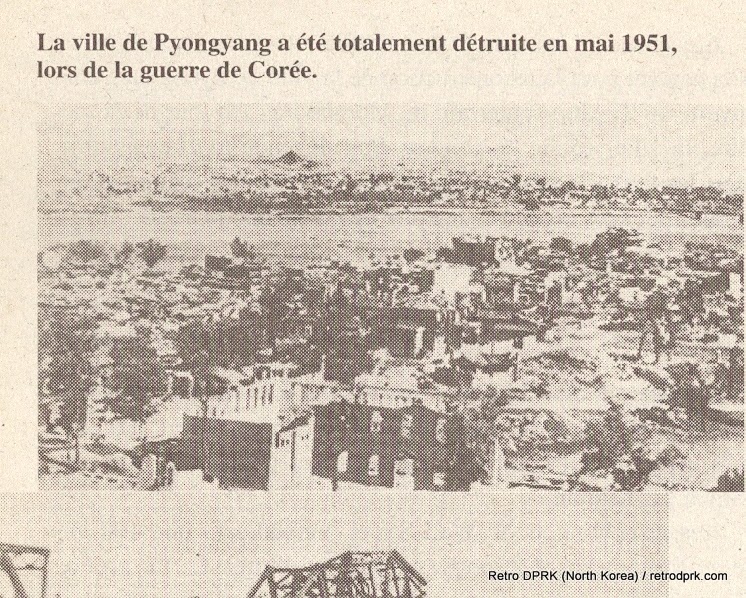
The story dates to the early 1950s, when the US Air Force, in response to the North Korean invasion that started the Korean War, bombed and napalmed cities, towns and villages across the North. It was mostly easy pickings for the Air Force, whose B-29s faced little or no opposition on many missions.
The bombing was long, leisurely and merciless, even by the assessment of America’s own leaders. “Over a period of three years or so, we killed off—what—20 percent of the population,” Air Force Gen. Curtis LeMay, head of the Strategic Air Command during the Korean War, told the Office of Air Force History in 1984. Dean Rusk, a supporter of the war and later secretary of state, said the United States bombed “everything that moved in North Korea, every brick standing on top of another.” After running low on urban targets, US bombers destroyed hydroelectric and irrigation dams in the later stages of the war, flooding farmland and destroying crops.
Although the ferocity of the bombing was criticized as racist and unjustified elsewhere in the world, it was never a big story back home. US press coverage of the air war focused, instead, on “MiG alley,” a narrow patch of North Korea near the Chinese border. There, in the world’s first jet-powered aerial war, American fighter pilots competed against each other to shoot down five or more Soviet-made fighters and become “aces.” War reporters rarely mentioned civilian casualties from US carpet-bombing. It is perhaps the most forgotten part of a forgotten war.
He ends with a plea for reconciliation.
Since World War II, the United States has engaged in an almost unbroken chain of major and minor wars in distant and poorly understood countries. Yet for a meddlesome superpower that claims the democratic high ground, it can sometimes be shockingly incurious and self-absorbed.
In the case of the bombing of North Korea, its people never really became conscious of a major war crime committed in their name. Paying attention in a democracy is a moral obligation. It is also a way to avoid repeating immoral mistakes.
And if North Korea ever does change, if the Kim family were overthrown or were to voluntarily loosen its chokehold on information, a US apology for the bombing could help dispel 65 years of hate.
As someone who’s spent years trying to explain the animosity between North Korea and the United States to skeptical Americans, including with many articles in The Nation, these words were a revelation to me. They also caught the attention of people I know with significant experience in both North and South Korea.
“This is hugely significant,” says Christine Ahn, a Korean-American activist who is the prime mover behind a plan by Gloria Steinem and other prominent women to walk across the North-South border next month in a plea for peace on the peninsula. “In the Post, he actually writes that the US committed war crimes in Korea.”
Harden, she noted, has been a major voice exposing the evils of North Korea. “While we can’t deny the existence of labor and prison camps,” said Ahn, “he’s putting North Korea in historical context. That’s what we as activists have been trying to do all along.”
“We are walking to invite all concerned to imagine a new chapter in Korean history, marked by dialogue, understanding, and—ultimately—forgiveness,” Ahn told a news conference at the United Nations on March 10. As The New York Times reported:
The goal of the women was to punctuate their desire for a permanent peace treaty to replace the 1953 armistice that halted, but technically did not end, the Korean War, a conflict that claimed an estimated four million lives, mostly Koreans, and separated millions of families.
The organizers, a broad array of international peace activists, also see their plan as a catalyst for other steps that could revive the North-South reconciliation process, which has essentially been paralyzed by hostility, suspicion and occasional eruptions of violence.
Mike Bassett, a former US Army officer who served in South Korea for most of the last decade as a tank commander and platoon sergeant, also linked Harden’s article to the need for reconciliation. “I was blown away” by the story, he told me. “This has been a subject I never expected anyone to talk about—and definitely not something as powerful as saying ‘we did commit war crimes there.’”
He compared the US attitude towards Korea, summarized in the oft-repeated phrase “the forgotten war,” to Japan’s refusal to recognize its terrible misdeeds during World War II. “The US will never admit what it did in Korea.”
Bassett’s knowledge runs deep. He was raised in Illinois by his grandfather, a Korean War veteran who was stationed with a US artillery battalion in the notorious “Iron Triangle.”
In the months after US forces crossed the 38th parallel in a disastrous attempt to occupy the North up to the Yalu River, it was a hotly contested area where United States, North Korean and Chinese forces often clashed, frequently in hand-to-hand combat. From his grandfather, Bassett learned first-hand about the human destruction caused by US bombing and shelling.
“He said his battalion decimated tons of civilians; he knew,” he said.
During his last deployment in 2008, Bassett was stationed in the most northern part of the DMZ with a reconnaissance-intelligence unit that often encountered North Korean soldiers just across the border. Until then, he had hated North Koreans with all his might. But the experience at the border began to change his perceptions.
“When I started pulling guard shifts on the DMZ, I’d be looking at them, and they were just like me—wet from the rain, cold, hungry. We made eye contact sometimes. I think we began to feel what each other was going through. I remembered what my grandfather had said—“we should have fought to the Yalu” and left Korea united.
“That experience made me want to change from shooting artillery at the North to learning how to resolve tensions. I want the regime to end, but it has to be in a humane way. Those guys [on the border] suffer just like I did.’
After leaving the military, Bassett studied at Yonsei University in South Korea and at American University in Washington, DC. He says he spent much of 2013 in North Korea, working as a consultant for South Korea’s Ministry of Unification on a plan to organize a North-South Korean orchestra that would perform at the Peace Park on the DMZ. But the plan was scuttled after tensions escalated over North Korea’s objection to US-South Korean military exercises that Kim’s regime believes are practice runs for an invasion.
Facing up to the truths of the war is central to the peace process, said Bassett. “The Korean War is still the most advanced propaganda war in human history.”
We would like to ask you to consider a small donation to help our team keep working. We accept no advertising and rely only on you, our readers, to keep us digging the truth on history, global politics and international relations.
The title page of Rūta Vanagaitė’s best-known book contains two pictures of young men. “This one is a Jew,” she said, pointing at the picture on the left. “He was a bicycle-racing champion. Good enough to represent Lithuania in international competitions, but not good enough to live.” He was executed during the Holocaust. The man in the picture on the right was a Lithuanian executioner. “They are both us,” Vanagaitė explained. “But Lithuanians don’t like to think of them as ‘us,’ because one is a Jew and the other is a killer.” Her book is called “Us.” (The title has ...
Here are before-and-after pictures, at https://twitter.com/MAL0mt/status/701077438525263873/photo/1, of what the U.S. government has achieved, in the Middle East:What’s especially interesting there, is that in all of these missions, except for Iraq, the U.S. was doing it with the key participation of the Saud family, the royals who own Saudi Arabia, and who are the world’s largest buyers of American weaponry. Since Barack Obama came into the White House, the operations — Libya, Yemen, and Syria — have been, to a large extent, joint operations with the Sauds. ‘We’ are now working more closely with ‘our’ ‘friends’, even than ‘we’ were under George W. Bush.As President Obama instructed his military, ...
Israel’s Maariv newspaper has revealed that the government of the Zionist state is planning to drop a political bombshell in the coming weeks by presenting a bill in the Knesset (parliament) calling for the annexation of land occupied since 1967. It is likely to have the support of the majority of Knesset members. The newspaper added that the right wing has chosen this time for the move ahead of the US presidential election; America, it is believed, will be too preoccupied to care about what is happening in the occupied Palestinian territories.Preliminary talks about a first stage have been held, ...
Early in 1989, China was stirring. A decade of groundbreaking reforms inspired by Deng Xiaoping had brought the moribund economy to life and freed the nation from the ideological shackles imposed by radical Maoists during the cataclysmic Cultural Revolution. Almost everything seemed possible, as Deng proteges Hu Yaobang and then Zhao Ziyang led policymaking on a day-to-day basis.But the changes sweeping China had its dark undersides. Large-scale economic reforms also meant expanded corruption opportunities, which many officials exploited. And Chinese who “got rich first,” under the Dengist dispensation, opened a rapidly expanding wealth gap with fellow citizens. Discontent simmered dangerously.The ...
The Working Group for the Chapter 35 of the Serbian National Convention on the European Union (EU) has called for the authorities in Serbia and Kosovo to create a cooperation to reduce the spread of the coronavirus pandemic.“We witness the coronavirus pandemic (COVID19) representing a great danger everywhere in the world and the health systems increasingly burdened with the number of infected patients. The pandemic has shown that the spread of the disease goes beyond borders, national and ethnic origin or religion of the affected, and can only be combatted through joint action, cooperation and solidarity. Cooperation is necessary primarily ...
As 10,000 people took to the streets of Brussels on Sunday (7 June 2020) to protest as part of the Black Lives Matter movement, there was one landmark which drew their ire more than any other: the equestrian statue of King Leopold II outside Belgium’s royal palace.“Murderer!” the protesters cried as they climbed the statue and waved the flag of the Democratic Republic of Congo. Had the statue been flimsy enough to pull down they would have done it, just as fellow BLM protesters toppled Edward Colston’s statue across the channel in Bristol. Estimates vary, but the consensus figure is ...
Jomo Kenyatta (c. 1891 – 22 August 1978) was a Kenyan politician and the first President of Kenya. Kenyatta was the leader of Kenya from independence in 1963 to his death in 1978, serving first as Prime Minister (1963–64) and then as President (1964–78). He is considered the founding father of the Kenyan nation. Kenyatta was a well-educated intellectual who authored several books, and is remembered as a Pan-Africanist. He is also the father of Kenya's fourth and current President, Uhuru Kenyatta (Source: Wikipedia)Origins of images: Facebook, Twitter, Wikimedia, Wikipedia, Flickr, Google, Imageinjection, Public Domain & Pinterest.Read our Disclaimer/Legal Statement!Donate ...
Origins of images: Facebook, Twitter, Wikimedia, Wikipedia, Flickr, Google, Imageinjection, Public Domain & Pinterest.Read our Disclaimer/Legal Statement!Donate to Support UsWe would like to ask you to consider a small donation to help our team keep working. We accept no advertising and rely only on you, our readers, to keep us digging the truth on history, global politics and international relations.SaveSaveSave
According to a number of global mainstream media sources, the Pentagon is covering up a disturbing video that was never made public with the rest of the recent torture report.According to various well respected journalists, including Seymour Hersh, the appalling video was recorded at Abu Ghraib, the notorious US torture dungeon in Iraq that made headlines roughly a decade ago, when the inhumane tactics being used at the prison were exposed.Sadly, it seems that the evidence released years ago was only scratching the surface.While the video has remained under wraps thus far, Hersh says it is only a matter of time before it ...
Video documentary movie on the first ISIS in Europe in the Islamic Caliphate of Bosnia-Herzegovina, 1992-1995.This movie is made by the British SKY NEWS after the civil war in Bosnia-Herzegovina.Similar documentary movies on the ISIS Bosnia-Herzegovina made by the Bosnian Serbs were never shown to the Western audience.The duration of the movie is 8 min. and 17 sec.In the movie are presented and future Al-Qaeda Mujahedeen holy fighters.From the movie is clear what was the real nature of the civil war in Bosnia-Herzegovina in the 1990s.All copyrights reserved by the SKY NEWS.Origins of images: Facebook, Twitter, Wikimedia, Wikipedia, Flickr, Google, ...
The paradox of the current global crisis is that for the last five years, all relatively responsible and independent nations have made tremendous efforts to save the United States from the financial, economic, military, and political disaster that looms ahead. And this is all despite Washington’s equally systematic moves to destabilize the world order, rightly known as the Pax Americana (“American peace”).Since policy is not a zero-sum game, i.e., one participant’s loss does not necessarily entail a gain for another, this paradox has a logical explanation. A crisis erupts within any system when there is a discrepancy between its internal ...
A Unified Europe: Born In the USAWhile Brexit versus the continuation of the European Union is a hot news topic, few know the secret who and why of the EU’s creation.The lead financial writer at the Telegraph, Ambrose Evans-Pritchard, wrote in 2000:Declassified American government documents show that the US intelligence community ran a campaign in the Fifties and Sixties to build momentum for a united Europe.***The head of the Ford Foundation, ex-OSS officer Paul Hoffman, doubled as head of ACUE [below, we’ll explain who these players are] in the late Fifties. The State Department also played a role. A memo ...
Donald Franciszek Tusk, (born 22 April 1957) is a Polish politician and historian. He has been President of the European Council since 1 December 2014. Previously he was Prime Minister of Poland (2007–2014) and a co-founder and chairman of the Civic Platform (Platforma Obywatelska) party.Tusk began his public career as an activist in his home town of Gdańsk, supporting Solidarity and organizing his fellow university students. With the exception of one four-year stretch, Tusk has served in the Third Republic Sejm (parliament) continuously since its first elections in 1991. He was Vice Marshal (deputy speaker) of the Senate from 1997 ...
The recent arrest of 40 alleged Islamic radicals in Kosovo together with the arrest of one of the Kosovo Imams suspected of being an inspirer of jihad in the region brought serious questions about the radicalisation of Islam and terrorism in Kosovo, in the Balkans and in Europe. Even though the issue of Kosovo Albanian volunteers or mercenaries fighting alongside the anti-Bashar forces in Syria and supporting the radical leadership of the Islamic State (earlier the Islamic State of Iraq and Syria) has been present in the public debate in Kosovo for at least a year, the debate itself was ...
IntroductionThe term “russophobia” (the hatred and/or fear of things Russian) has become rather popular in the recent years, courtesy of the anti-Russian hysteria of the AngloZionist Empire, but this is hardly a new concept. In his seminal book “Russie-Occident – une guerre de mille ans: La russophobie de Charlemagne à la Crise Ukrainienne” (“The West vs Russia – a thousand year long war: russophobia from Charlemange to the Ukrainian Crisis”) which I recently reviewed here, Guy Mettan places the roots of russophobia as early as the times of Charlemagne. How could that be? That would mean that russophobia predates the ...
As will be shown here, the U.S. federal government, under President Donald Trump, is repeating the very same deception of the public, in regard to Syria’s Bashar al-Assad, that it had perpetrated back in 2002, against Iraq’s Saddam Hussein, under U.S. President George W. Bush. (By contrast, and for secret reasons, the U.S. federal government does everything possible to downplay the barbarisms, such as are occurring in Yemen, that are perpetrated by the fundamentalist Sunni Kings of Saudi Arabia, and Emirs of Qatar, even while exaggerating the barbarisms by the fundamentalist Shiite clerics who control Iran — a key ally ...
Arrest and detention of three days for Joanikije, Bishop of Budimlye and Niksic, and eight priests of the Orthodox Cathedral of St. Basil of Ostrog in Nikšić has sparked tensions in Montenegro again. Namely, after the prayer procession that had been held in Nikšić on May 12th, on the feast-day of St. Basil of Ostrog, a 72-hour detention was ordered for Bishop Jonikije, Fr. Slobodan Jokic, Fr. Danilo Zirojevic, Fr. Zeljko Rojevic, Fr. Ostoja Knezevic, Fr. Mirko Vukotic, Fr. Vasilije Brboric, Fr. Dragan Krusic and Fr. Nikola Marojevic.Protests in support of those arrested have taken place in several cities across ...
Accused of War Crimes: The British Prime Minister Tony BlairWAR CRIMES CHARGES FOR THE HAGUE AGAINST THE NATO LEADERS – ONE OF THE INDICTMENTS IN THE INTERNATIONAL CRIMINAL TRIBUNAL FOR THE FORMER YUGOSLAVIANOTICE OF THE EXISTENCE OF INFORMATION CONCERNING SERIOUS VIOLATIONS OF INTERNATIONAL HUMANITARIAN LAW WITHIN THE JURISDICTION OF THE TRIBUNAL;REQUEST THAT THE PROSECUTOR INVESTIGATE NAMED INDIVIDUALS FOR VIOLATIONS OF INTERNATIONAL HUMANITARIAN LAW AND PREPARE INDICTMENTS AGAINST THEM PURSUANT TO ARTICLES 18.1 AND 18.4 OF THE TRIBUNAL STATUTE.TO:Madam Justice Louise Arbour, Prosecutor, International Criminal Tribunal for the Former Yugoslavia, Churchillplein 1, 2501 EW, The Hague, Netherlands.AND TO: President William J. ...
With American military personnel now entering service who were not even alive on 9/11, this seems an appropriate time to reexamine the events of September 11, 2001 – the opaque motives for the attacks, the equally opaque motives for the counter-offensive by the United States and its allies known as the Global War on Terror, and the domestic fall-out for Americans concerned about the erosion of their civil liberties on the homefront.Before venturing further, it’s worth noting that our appraisal is not among the most common explanations. Osama bin Laden, his lieutenants at Al-Qaeda, and the men who carried out ...
The grossest thing in American society is the reactionary sentimentality that fill our gossip infected hearts with a chemical reaction every time one of our supposed war heroes moves on to a more peaceful place. The carefully rehearsed statements from useless political figures numb our minds as all those who are sane must collectively wonder what on earth has a fusty bag of bones like John McCain ever done for us? Donald Trump was once new to the political scene and was still capable of burning bridges that were worth burning. It was Mr. Trump’s finest moment when he said ...