

Views: 2651

“To Hell and Back” is a phrase that can bear a pretty heavy metaphorical load when it comes to talking about the atomic bombings of Nagasaki and Hiroshima. It’s also the title of a book by Charles Pellegrino.
Pellegrino’s book is a moving and grueling close-up look at the horrors experienced by the people of Hiroshima and Nagasaki both on the day of the bombing and in the days and years afterward. I have the heart of a dried-up raisin but even I got a little teary in places.
 There are few opportunities for inspiring “triumph of the human spirit” narratives amid the devastation of Hiroshima and Nagasaki. The bombings were titanic, apocalyptic events that mock human scale and comprehension. Pellegrino depicts dazed “ant-trails” of survivors threading through the instantaneously blasted landscapes and past heaps of the dead, dying, and horrifically maimed in the shadow of an eight-mile high radioactive cloud. Fate and the desperate efforts of the rescuers saved some, but many lives literally disintegrated in seconds, minutes, days, and years after the bombs were dropped.
Near the hypocenter, the experience of death was overwhelming and random in a dehumanizing way. For some, it came down to the decision to wear a white shirt or a dark shirt. The white shirt might reflect the intense, instantaneous radiation of the blast with remarkable efficacy; a black shirt absorbed the radiation and incinerated the wearer. For others it was their location at the time of the blast, even near the hypocenter.
The bottom line for many survivors is that their families, their communities, their city, most of the world they knew, their health, their spiritual equilibrium, even their social status had been annihilated in an event of overwhelming horror. The survivors experienced physical and mental trauma; ostracization; guilt; shame; and lingering illness.
Nevertheless, Pellegrino documents instances of courage, compassion, and ingenuity and people sustaining their humanity through acts of love and sacrifice.
An inspiration for the title of the book is the “double” hibakusha, people who experienced and survived both the bombings of Hiroshima and Nagasaki. One survivor of Hiroshima goes back home to Nagasaki and tells his co-workers of the awful weapon he had experienced; he warns them if they see a blinding flash—the pika—they must use it as a signal they have a few seconds to seek shelter before the don—the crash, the massive shock wave created by the bomb, arrives.
And so “duck and cover” was born.
A document of human horror, To Hell and Back is also a memorial to the survivors and their struggle to restore sanity and meaning to their lives with little outside help. And it also sounds like a backhanded reference to Pellegrino’s own travails at the hands of the nuclear denialists.
His book was originally published in 2010 as The Last Train to Hiroshima. But the book—and Pellegrino himself– became a piñata for indignant veterans, nuclear denialists, and atomic bomb fanboys.
The substantive problem with Last Train was that an informant who claimed to have been part of the squadron of planes escorting the Enola Gay and provided several pages of gripping detail had made up his story.
Pellegrino acknowledged the error and retracted, but it became clear that the intention of his opponents was not to correct errors; it was discredit Pellegrino, the book, and the idea that the sufferings of the victims should be remembered when considering the bomb and its legacy.
The attacks on the book went beyond scientific nitpicking along the lines of “could a human really be vaporized by an atomic bomb?” and snowballed into attacks on Pellegrino, his credentials, and his integrity. The New York Times provided a platform for the anti-Pellegrino crowd, helping stampede the publisher, Henry Holt and Company, into withdrawing Last Train to Hiroshima.
The battle continued on various message boards; Pellegrino held his own, especially after it transpired that the New York Times and other media outlets, while pursuing their ambitions to serve as journalistic gatekeepers and bring a literary malefactor to justice, had themselves been gulled by a series of malicious forgeries supplied by Pellegrino’s enemies.
The attack on Last Train appears to have been very much of a piece, both in themes and protagonists, with longstanding U.S. government and military veteran groups’ efforts to suppress the more disturbing issues and viewpoints surrounding the atomic bombings of Hiroshima and Nagasaki.
On the scientific side, the US government had a vested interest in suppressing the details of pervasive and persistent radiation effects that undercut the usability of nuclear weapons and threatened to deliver a gigantic bill for human and environmental remediation.
Here’s one of the first important U.S. military documentaries on Hiroshima/Nagasaki, A Tale of Two Cities from 1946. There’s a lot of image management going on; for instance, the Nagasaki bombardier missed the designated bull’s eye by 3 miles, which is spun as a judicious decision to drop the nuke right between two major targets to get both!
A Tale of Two Cities, 1946
What’s very interesting is the very early interest in poo-pooing radiation effects. Physicists suspected from the outset that radioactive contamination from a nuclear blast was a pervasive, unmanageable problem; the Pentagon has always been, in a rather unscientific and immoral way, committed to advertising the fiction that contamination issues are manageable and the health impacts minimal.
The movie pushes the “clean blast” story (bomb detonated above ground to minimize fallout, which is I think a bit of a stretch; some scientists decided a ground detonation would soak up too much of the shock wave to yield a psychologically satisfying degree of devastation & proposed an airburst instead); presents the statement of a Jesuit priest that he worked in Hiroshima with no ill effects after the attack; and offers the reassuring observation that that it was back to business as usual on the roads of Nagasaki after the massive radiation release: “people using them without ill effects shortly after the explosion”.
Since Hiroshima and Nagasaki, the US military has been kept busy in its crusade to assert the sanitary and housebroken character of nuclear events. In 1954 it faced a particular challenge when eggheads miscalculated the yield of the Castle Bravo shot, a sizable chunk of Bikini Atoll was vaporized into radioactive dust, the Lucky Dragon No. 5 got contaminated, and Godzilla was born (no lie; read it here).
The Hiroshima Bomb at Bikini 1954: Deadly Miscalculation at Castle Bravo
Managing and covering up the consequences of atmospheric nuclear releases is also very much a contemporary problem for the US, as I’ve discussed in my CounterPunch piece on the U.S. apparent coverup of the radiation problems of the aircraft carrier USS Ronald Reagan, which was contaminated offshore of Fukushima during post-earthquake/tsunami rescue operations.
My piece picks apart the peacetime radiation effects issue in history, from one of the most significant fallout events in U.S. history—in Albany, New York—and the Chernobyl disaster, in addition to Fukushima, to describe the U.S. government “long war” on unfavorable radiation effects science and its concerted effort to minimize the accounting of radiation casualties to the absolute, irrefutable bare minumum.
The Reagan has never been completely decontaminated, several hundred members of the crew and other U.S. military personnel are suing for compensation for medical issues, and the Reagan has been sitting in the naval base at Yokosuka for a suspiciously long time for an aircraft carrier that’s supposed to be pivoting all over the western Pacific at this crucial juncture (the USS John Stennis out of San Diego & aircraft carriers transiting from the Middle East are picking up the d*ck-swinging slack).
But Hiroshima/Nagasaki denialists are only peripherally interested in issues of radiation effects. They want to suppress or minimize all accounts of human suffering in order to pre-empt discussions of the morality of U.S. tactics in the ultimate “good war”.
Like the coverup of radiation effects, feel-good denialism has been a factor in attitudes toward Hiroshima and Nagasaki from the start.
Douglas MacArthur believed that the A-bomb got too much credit, especially since it threatened to dilute the glory of Douglas MacArthur’s victory in the Pacific, and his team devoted a significant effort to poor-mouthing the strategic significance of Hiroshima and Nagasaki as well as dismissing the magnitude of human suffering it caused. In the words of MacArthur’s point man for spinning the public health effects of the attacks, Crawford Sams, the A-bomb was “a poor killer”.
Milestones in U.S. denialism include MacArthur’s imposition of censorship on reporting from Hiroshima and Nagasaki, and the suppression of gruesome footage of the medical consequences of the bombings, recorded shortly after the surrender both by a Japanese newsreel company and the U.S. Army’s own lavishly-funded Technicolor documentary unit.
As chronicled by Greg Mitchell, the footage has emerged fitfully and incompletely.
Erik Barnouw of Columbia University edited the two hours and forty five minutes of the Japanese footage into a 15 minute piece shown on US television in 1969.
Some of the U.S. Army footage, known as the McGovern footage after the unit director, found its way onto the Internet.
Be warned before clicking: these two videos, especially the McGovern footage, are essentially medical atrocity videos.
But also, if you can sit through the videos, you notice that to the amateur observer much of the movie documents horrific burn trauma that, aside from footage of people whose eyes got melted by the flash, doesn’t look demonstrably and exclusively like radiation effects.
It just looks awful and inhumane. And that’s probably why the films were suppressed.
The bombings were assaults on soft, primarily civilian targets with minor military value. Per the recommendation of the Manhattan Project Targeting Committee, the US Army Air Force refrained from attacking Hiroshima, Nagasaki, and two other sites so the power of the atomic weapon could be demonstrated on relatively undamaged cities in order to terrify and demoralize the Japanese people and government to the maximum.
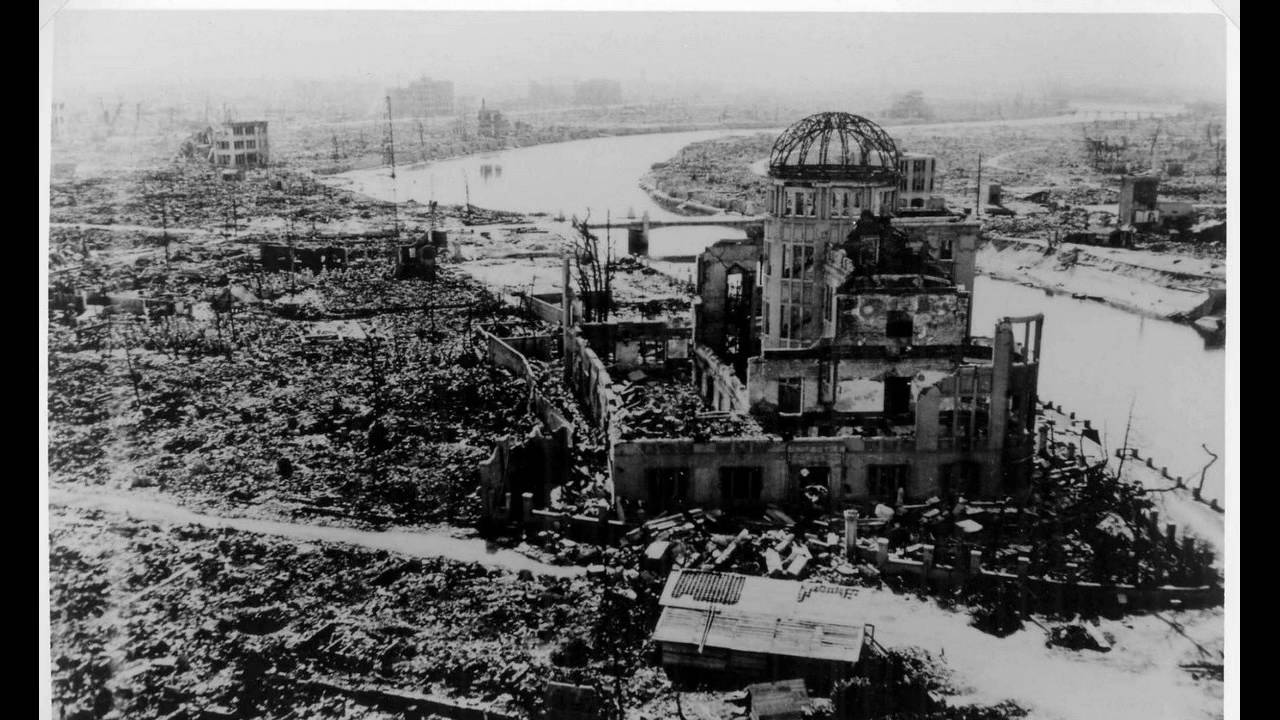 In fact, the bombings come uncomfortably close to acts of international terrorism as defined by 18 U.S.C. § 2331 of the U.S. Code: “Appear to be intended (i) to intimidate or coerce a civilian population; (ii) to influence the policy of a government by intimidation or coercion; or (iii) to affect the conduct of a government by mass destruction, assassination, or kidnapping.”
Key punctuation points in the war against humanitarian and pacifist attempts to detail the horrors of Hiroshima and Nagasaki were the campaigns against plans for a historically accurate setting for the Enola Gay exhibition at the Smithsonian Institute in 1994 and 2003. The result was replacing the nuanced exhibit with a single presentation of the Enola Gay, the plane that dropped the Hiroshima bomb.
Many of the same protagonists emerged with the same themes to savage Pellegrino in 2010.
One of the interesting and melancholy developments is that the denialist campaign to minimize the human consequences of the atomic bombings seems to be losing some of its heat in 2016. Not necessarily because understanding, reflection, and compassion (in Japanese omoiyari, a concept embraced by some hibakusha that Pellegrino celebrates in his book) are finally prevailing; it’s because the World War II generation is dying and it’s easier to ignore a bygone horror when the living, human legacy of injury and suffering is no longer before our eyes.
The good news is that Pellegrino’s book is back, new and improved, expanded, documented, fact-checked, and footnoted and published by Rowman & Littlefield thanks to the efforts of Mark Selden of Cornell. You can do the publisher a favor by buying the book direct from the R&L website. And for the most complete and authoritative reporting on nuclear/radiation issues in Japan, bookmark the Asia-Pacific Journal/Japan Focus e-journal.
This is a revised and expanded version of an article that appeared in Asia Times and CounterPunch.
Peter Lee writes on East and South Asian affairs and their intersection with US global policy. He is the moving force behind the Asian affairs website China Matters which provides continuing critical updates on China and Asia-Pacific policies. His work frequently appears at Asia Times.

Originally published on 2016-06-01
Author: Peter Lee
Source: APJJF.org
Origins of images: Facebook, Twitter, Wikimedia, Wikipedia, Flickr, Google, Imageinjection, Public Domain & Pinterest.
Read our Disclaimer/Legal Statement!
Donate to Support Us
We would like to ask you to consider a small donation to help our team keep working. We accept no advertising and rely only on you, our readers, to keep us digging the truth on history, global politics and international relations.
[wpedon id=”4696″ align=”left”]