
“Humanitarian Imperialism”: US, NATO Lie to Justify Genocide and Destruction in Yugoslavia
Seventeen years ago today, on March 24, 1999, NATO began a 78-day deadly and devastating U.S.-backed intervention of Yugoslavia. It was the first time in history that the North Atlantic Treaty Organization decided they would attack a country without the approval of the U.N. Security Council [...]
Seventeen years ago today, on March 24, 1999, NATO began a 78-day deadly and devastating U.S.-backed intervention of Yugoslavia. It was the first time in history that the North Atlantic Treaty Organization decided they would attack a country without the approval of the U.N. Security Council.
Nineteen countries took part in the aggression led by the United States that was supposed to stop the repressive activities of the Slobodan Milosevic government and to establish a framework for its Southern province, Kosovo, under international law. Milosevic was president of Serbia from 1989 to 1997, and of Yugoslavia from 1997 to 2000.
The attack was carried out under the former U.S. President Bill Clinton’s administration and the rationale that it would prevent a “humanitarian disaster in Kosovo,” a “genocide of Kosovar Albanians“ caused by Milosevic and “comparable to Nazi atrocities in the Second World War.”
It was not the first, nor the last time, in subsequent years in different parts of the globe that U.S.-backed interventions would be initiated under the premise of a “preventive war.”
In the case of Yugoslavia, various parties later agreed that the alleged “genocide” never happened and that instead it was just another excuse to dismantle the socialists as well as federal dimensions of a unitary Yugoslav state and to break the country into ever-smaller pieces by bombing its people into submission.
This way, NATO’s bombing caused a much larger catastrophe than it averted.
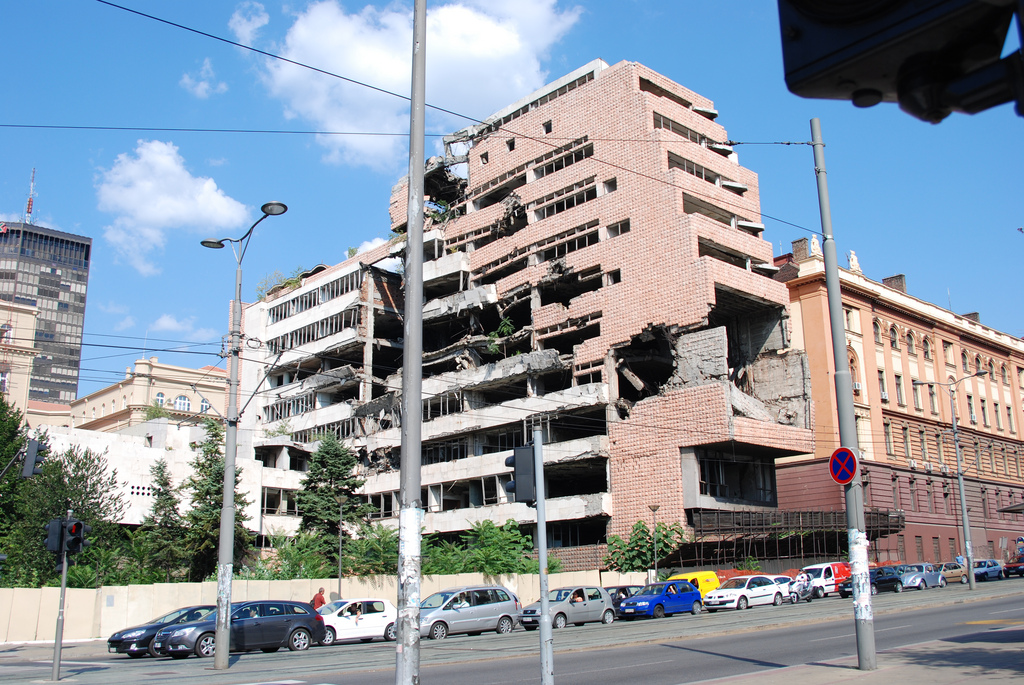
The illegal bombing destroyed and damaged 25,000 homes, 300 miles of roads and close to 400 miles of railways. Many public buildings were damaged, including 14 airports, 19 hospitals, 18 kindergartens, 69 schools, 176 cultural monuments and 44 bridges.
The attacks killed at least 5,000 people (some sources claim it was closer to 18,000), injured 12,500, and left the area contaminated with depleted uranium, a chemical element internationally banned which to date is still causing childhood cancer rates to spike all over the Balkans.
The bombing of Yugoslavia was made possible by a number of public lies which were spread in an attempt to justify intervention into an internal conflict, which was eventually exploited by foreign powers to advance policy goals.
Myth 1: US-NATO Attacked After Milosevic Refused Talks
In 1999, Kosovo was a region of Yugoslavia where ethnic Albanians were the majority. And because Kosovo was part of Yugoslavia, the U.S.-backed NATO campaign violated international law.
While the U.S. government claimed that negotiations on Kosovo with Milosevic had failed and that the ongoing discrimination against Kosovo Albanians represented genocide, later statements by then Secretary of State Madeleine Albright proved that there were no negotiations.
The U.S. gave Milosevic an ultimatum, telling him, firstly, to grant autonomy to Kosovo. Secondly, to allow NATO to station 30,000 ground troops in Yugoslavia and, lastly, to allow a NATO-conducted referendum for Kosovo’s independence from Yugoslavia.
Milosevic made it clear that he would not allow a foreign-occupying army in Yugoslavia because it would be a gross violation of the country’s sovereignty and their independence.
NATO began bombing the country without further negotiation attempts.
Myth 2: Milosevic, a Danger that Needed to Be Stopped
It was well understood by NATO leadership that the bombing was not a response to the huge crimes in Kosovo, but rather their cause.
At the time bombing started, there were two potential diplomatic options for discussion, which included two proposals. One by NATO and another by the Federal Republic of Yugoslavia.
As Noam Chomsky once explained, “After 78 days of bombing, a compromise was reached between them, suggesting that a peaceful settlement might have been possible, avoiding the terrible crimes that were the anticipated reaction to the NATO bombing.“
The Bill Clinton administration was also wildly inconsistent in its practice of humanitarian interventions. The U.S. launched two military campaigns against Serbia while ignoring more widespread slaughter in Rwanda or justifying the Russian assault on Chechnya during the same period of time.
Myth 3: US-NATO Wanted to Protect Human Rights
A United Nations court has ruled that Serbian troops did not carry out genocide against ethnic Albanians during Slobodan Milosevic’s campaign of aggression in Kosovo from 1998 to 1999.
John Norris, who was Deputy Secretary of State Strobe Talbott’s communications director during the Clinton Administration wrote a book in which he explains the real purpose of the war from his point of view. Norris explains that the bombing had nothing to do with concern for Kosovar Albanians.
The U.S. decided to bomb because Serbia, the last corner of Europe which had not subordinated itself to the U.S.-run neoliberal programs, and which was not carrying out the required social and economic reforms.
Myth 4: KLA, a Genuine Liberation Army
The Kosovo Liberation Army was an ethnic-Albanian “paramilitary organization” that sought the separation of Kosovo from Yugoslavia.
Before the bombing there had been killings on both sides which were distributed between the KLA attacking from Albania and the Yugoslavian security forces.
In 1998, the KLA was considered a terrorist organization by the U.S., but one year later the CIA financed them, while Albright offered them training in the U.S. “in order to get the Albanians’ … acceptance (of the peace plan),” and in hope to transform the KLA “from a guerrilla group into a police force or a political entity, much like the African National Congress did in South Africa.”
NATO’s illegal intervention revealed the dangers of “humanitarian imperialism” and how the criteria permitting such interventions have become more self-serving both in Yugoslavia and in Afghanistan and Iraq.
Origins of images: Facebook, Twitter, Wikimedia, Wikipedia, Flickr, Google, Imageinjection, Public Domain & Pinterest.
Read our Disclaimer/Legal Statement!
Donate to Support Us
We would like to ask you to consider a small donation to help our team keep working. We accept no advertising and rely only on you, our readers, to keep us digging the truth on history, global politics, and international relations.
Origins of images: Facebook, Twitter, Wikimedia, Wikipedia, Flickr, Google, Imageinjection, Public Domain & Pinterest.Read our Disclaimer/Legal Statement!Donate to Support UsWe would like to ask you to consider a small donation to help our team keep working. We accept no advertising and rely only on you, our readers, to keep us digging the truth on history, global politics and international relations.[wpedon id="4696" align="left"]SaveSave
Greater Albania under Nazi GermanyDuring World War II, 35,000 to 40,000 Kosovo Albanians were recruited by Nazi Germany as part of the German occupation forces and security formations in Greater Albania, a state created by Adolf Hitler and Benito Mussolini that included Kosovo-Metohija, western Macedonia, and territory from Serbia and Montenegro. In Albania, there were 30,000 Albanians who were in the German occupation forces. In 1941, the German occupation forces created a Kosovo Albanian Gendarmerie with headquarters in Kosovska Mitrovica. In 1944, these forces were incorporated into the Skanderbeg Nazi SS Division. In 1942, Balli Kombetar organization battalions were established ...
Amid a divisive debate in Ukraine on state honors for nationalists viewed as responsible for anti-Semitic pogroms, the country for the first time observed a minute of silence in memory of Symon Petliura, a 1920s statesman blamed for the murder of 50,000 Jewish compatriots.The minute was observed on May 25, the 90th anniversary of Petliura’s assassination in Paris. National television channels interrupted their programs and broadcast the image of a burning candle for 60 seconds, Ukraine’s Federal News Agency reported.A French court acquitted Sholom Schwartzbard, a Russia-born Jew, of the murder even though he admitted to it after the court ...
Interview with historian Stephen Cohen, by Patrick L. Smith, published in Salon.com, April 17, 2015Introduction by Patrick L. Smith: It is one thing to comment in a column as the Ukrainian crisis grinds on and Washington—senselessly, with no idea of what will come next—destroys relations with Moscow. It is quite another, as a long exchange with Stephen F. Cohen makes clear, to watch as an honorable career’s worth of scholarly truths are set aside in favor of unlawful subterfuge, a war fever not much short of Hearst’s and what Cohen ranks among the most extravagant expansion of a sphere of ...
The New York Times reported on October 22 that the United States has “just over 240,000 active-duty and reserve troops in at least 172 countries and territories,” which is a staggering total. But in an intriguing revelation the Times reported that there are a further 37,813 troops deployed “on presumably secret assignment in places listed simply as ‘unknown.’ The Pentagon provided no further explanation.”It is not surprising that Washington’s war-spreaders do not supply information to the American public concerning the location of soldiers, sailors, marines and airmen involved in clandestine operations around the globe, because this might bring to light the lack of justification for ...
Due to the international media’s continued claims about the «annexation of Crimea», it’s been difficult for the citizens of the US and Europe to make sense of the details of the peninsula’s recent history. Exactly three years ago, on March 16, 2014, the Crimeans were offered a choice: to rejoin Russia or to return to the constitution of 1992 that proclaimed Crimea a legal, democratic, secular state whose relationship with Ukraine was based on bilateral agreements. That constitution was unilaterally abolished by Kiev on March 17, 1995, and here’s what’s surprising: no one at that time in the West demanded that the Ukrainian ...
True, the majority of investors are Americans who bore a relation to the “democratization” of Yugoslavia that was carried out at the end of the 90s of the last century. Among them is the former commander of NATO forces in Kosovo retired general Wesley Clark, who is determined to invest more than 5.5 billion dollars in the former Yugoslav republic. Experts say that Washington’s strategy could be characterized by the following slogan: “Conquer and plunder”.His closest supporters say that Wesley Clark is a great strategist. He wrote the book “Winning Modern Wars” that was published in 2001. In his fundamental ...
“Russia suspected of election scheme. U.S. probes plan to sow voter distrust.”That’s the Washington Post page-one lead headline of September 6. Think about it. The election that Americans are suffering through, cringing in embarrassment, making them think of moving abroad, renouncing their citizenship; an election causing the Founding Fathers to throw up as they turn in their graves … this is because the Russian Devils are sowing voter distrust! Who knew?But of course, that’s the way Commies are – Oh wait, I forgot, they’re no longer Commies. So what are they? Ah yes, they still have that awful old hangup so worthy ...
The first panacea for a mismanaged nation is inflation of the currency; the second is war. Both bring a temporary prosperity; both bring a permanent ruin. But both are the refuge of political and economic opportunists — Ernest HemingwayMilitary spending is the second largest item in the US federal budget after Social Security. It has a habit of increasing significantly each year, and the proposed 2019 defense budget is $886 billion (roughly double what it was in 2003).US military spending exceeds the total of the next ten largest countries combined. Although the US government acknowledges 682 military bases in 63 countries, ...
No matter how hard White House officials try, they cannot construct a coherent ‘Trump doctrine’ that would make sense amid the chaos that has afflicted US foreign policy in recent months.However, this chaos is not entirely the making of President Donald Trump alone.Since 1945, the United States has vied for total global leadership. The 1991 dissolution of the Soviet Union, and the subsequent disintegration of the Eastern Bloc, gave it complete global hegemony.The US became the force that stabilized and destabilized any region in the world, as it saw fit – which always served the interests of the US and ...
Read the truth about "Srebrenica Massacre" in 1995.Origins of images: Facebook, Twitter, Wikimedia, Wikipedia, Flickr, Google, Imageinjection, Public Domain & Pinterest.Read our Disclaimer/Legal Statement!Donate to Support UsWe would like to ask you to consider a small donation to help our team keep working. We accept no advertising and rely only on you, our readers, to keep us digging the truth on history, global politics, and international relations.[wpedon id="4696" align="left"]The Al-Qaeda-linked ‘El-Mujahedeen’ brigade of the Bosnian Muslim Army parading in downtown Zenica in central Bosnia in 1995
In just one week the United States government will commemorate its 16th anniversary in the bombing and occupation of Afghanistan.This war did not really begin in 2001 resulting from the attacks on September 11 where planes were hijacked and flown into the World Trade Center in New York City and the Pentagon headquartered right outside of Washington, D.C.U.S. involvement in the destabilization of Afghanistan goes back to the late 1970s when the People’s Democratic Party of Afghanistan (PDP) led a socialist-oriented administration which advanced the cause of working people and farmers as well as providing fundamental civil rights to women. ...
The Kingdom of Belgium as a multilingual and multicultural society is today a federal type of experimental laboratory of European integration within the framework of the European Union (the EU). This is also a country in which the capital of the European Union is located and a country as one of the original six establishing countries of the present day the EU. The question of the destiny of the Belgian multicultural federalism is of crucial importance for the future process of European integration or disintegration.The Belgian multicultural society: Long united and long dividedThe population of the Kingdom of Belgium is ...
In March [1999], the most powerful military force in history attacked tiny Yugoslavia (one fifth the size of Saskatchewan), and after seventy-nine days of flagrantly illegal bombing forced an occupation of Kosovo. Admitting its intention was to break Yugoslavia’s spirit, NATO targeted civilian structures, dropping over 23,000 bombs (500 Canadian) and cruise missiles in a campaign of terror bombing, described recently by Alexander Solzhenitsyn as follows:“I don’t see any difference in the behaviour of NATO and of Hitler. NATO wants to erect its own order in the world and it needs Yugoslavia simply as an example: We’ll punish Yugoslavia and ...
The long-term crisis in the relations between the Russian Federation and Ukraine entered its final - war phase on February 24th, 2022. The official reactions to the latest dramatic events in East Europe, which come from the Westerners, including the most important overseas Western political address, are usually dominated by two phrases: "flagrant violation of international public law" and "violation of the territorial integrity of an internationally recognized state". The perpetrator of the acts is, of course, Russia, and, as it is claimed, the innocent victim is neighboring Ukraine. However, the same Westerners do not want to see either flagrant ...
Make 4 July Independence from America Day (2014).Originally published in 2014Author: Dr. Gideon PolyaOrigins of images: Facebook, Twitter, Wikimedia, Wikipedia, Flickr, Google, Imageinjection, Public Domain & Pinterest.Read our Disclaimer/Legal Statement!Donate to Support UsWe would like to ask you to consider a small donation to help our team keep working. We accept no advertising and rely only on you, our readers, to keep us digging the truth on history, global politics, and international relations.[wpedon id="4696" align="left"]
When I was a schoolchild in the US a couple of short decades ago, I spent my time acquiring important life skills, ranging from how to fake a wrist fracture in order to obtain a purple cast, to how to craft a teepee replica out of a paper bag.The latter art was perfected in accordance with the holiday of Thanksgiving, which arrived each November to great fanfare, and which, in addition to teepee replication, required my classmates and I to mass-produce turkey drawings, paper Pilgrim hats, and modified, feathered headdresses.These materials were then incorporated into our reenactments of the "original" ...
With a critical public increasingly turning to social media to scrutinize the claims of the mainstream as well as the credibility of the assertions made by the various NGOs and government-funded human rights organisations, it’s arguably becoming more difficult for the corporate press to pass their propaganda off as legitimate news.This is particularly the case during periods when the establishment pushes for military conflicts. One salutary lesson from the Iraq debacle, is that the public appear not to be so readily fooled. Or are they?It’s a measure of the extent to which the mass media barely stray from their paymasters ...
Against the backdrop of US aggression against North Korea, NATO is intensifying its preparations for war with Russia, the world’s second largest nuclear power. A report in the German news magazine Der Spiegel (Issue 43/2017) based on a secret NATO document indicates how far plans for war have progressed. The news magazine concludes:“In plain language: NATO is preparing for a possible war with Russia.”In the document entitled “Progress report on the Alliance’s Enhanced Deterrence and Defence Disposition,” leading military figures call for a major boost to military capabilities in order to conduct a so-called “Major Joint Operation Plus.” The abstruse ...
“We could become the first country to go fascist through free elections.” — William Shirer, The Rise and Fall of the Third ReichGenerally, we avoid using the word “fascism” in polite company, and until recently, a person pointing out parallels between Nazi Germany and the current United States would invite elevated eyelids along with the outworn charge of sounding like a “conspiracy theorist“. The current electoral cycle seems to be changing that, so I will trust that now is the right time to convey some ideas I’ve been marinating regarding fascism in my US Homeland. The ruling plutocrats are clearly ferrying the ...