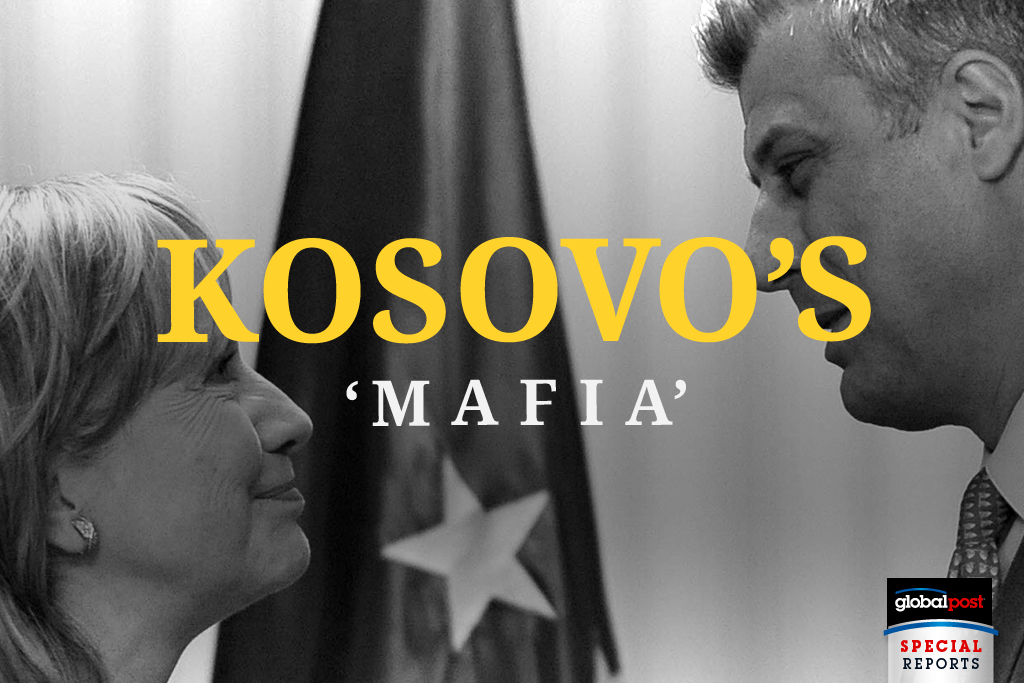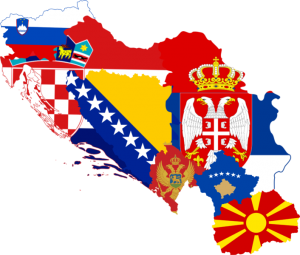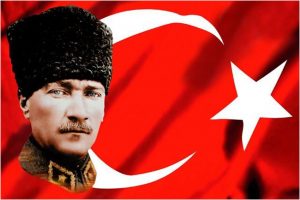
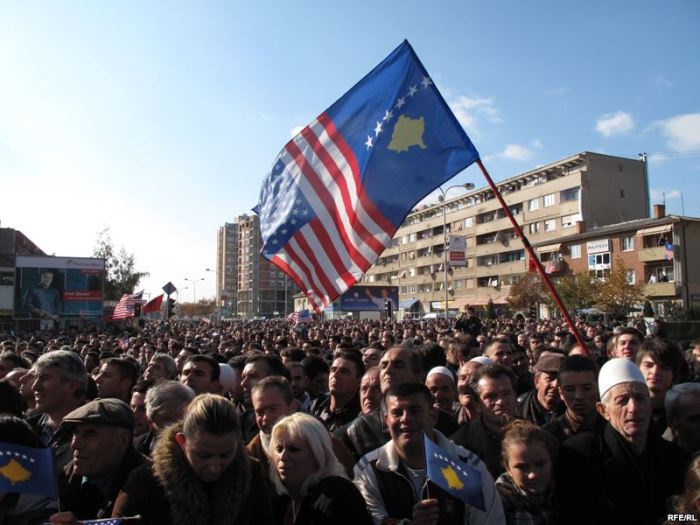

Kosovo is Clinton Country: a 10-foot-high statue of Bill overlooks “Bill Clinton Boulevard” in the capital city of Pristina. Hillary is also memorialized in what has become the crime capital of Europe: right off the street named for her husband is a store named “Hillary,” featuring women’s clothing modeled after the putative Democratic party nominee for President. Pantsuits figure prominently. As Vice puts it: “While former President Bill Clinton has had a boulevard named after him, it’s without a doubt that his wife’s the real star out here.” Why is that?
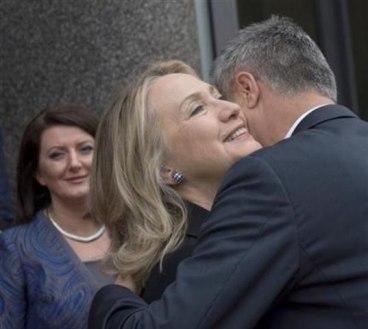
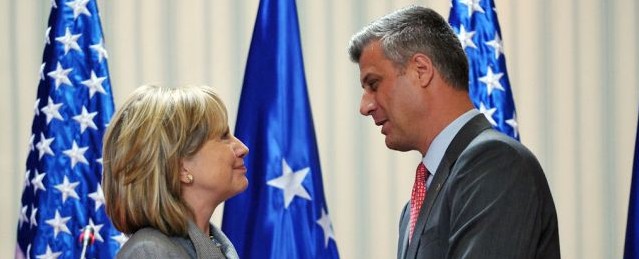
As Gail Sheehy pointed out in her biography of Hillary, it was Mrs. Clinton who hectored her husband into bowing to a chorus of neoconservative and liberal interventionist voices and finally giving the order to bomb the former Yugoslavia. Traveling to Kosovo when Serbs in the northern part of the country were demanding some form of local autonomy to stave off violent attacks by Kosovar ultra-nationalists, Mrs. Clinton reassured her hosts that the US would stand behind Pristina: “For me, my family and my fellow Americans this is more than a foreign policy issue, it is personal.” She then physically embraced Kosovo President and Mafia chieftain Hacim Thaci – who has since been credibly accused by the Council of Europe of stealing human organs from Serb victims and selling them on the black market.
Hillary owns Kosovo – she is not only personally responsible for its evolution from a province of the former Yugoslavia into a Mafia state, she is also the mother of the policy that made its very existence possible and which she carried into her years as Secretary of State under Barack Obama.
As the “Arab Spring” threatened to topple regimes throughout the Middle East, Mrs. Clinton decided to get on board the revolutionary choo-choo train and hitch her wagon to “moderate” Islamists who seemed like the wave of the future. She dumped Egyptian despot Hosni Mubarak, whom she had previously described as a friend of the family, and supported the Muslim Brotherhood’s bid for power. In Libya, she sided with Islamist rebels out to overthrow Moammar Ghaddafi, celebrating his gruesome death by declaring “We came, we saw, he died.” And in Syria, she plotted with Gen. David Petraeus to get around President Obama’s reluctance to step into the Syrian quagmire by arming Syrian rebels allied with al-Qaeda and other terrorist gangs.
The Clintonian legacy of enabling Islamist terrorists extends to present day Kosovo, where the New York Times has revealed an extensive network of ISIS-affiliated madrassas – indoctrination centers – funded by the Saudis, the Qataris, and the Kuwaitis. The Times reports:
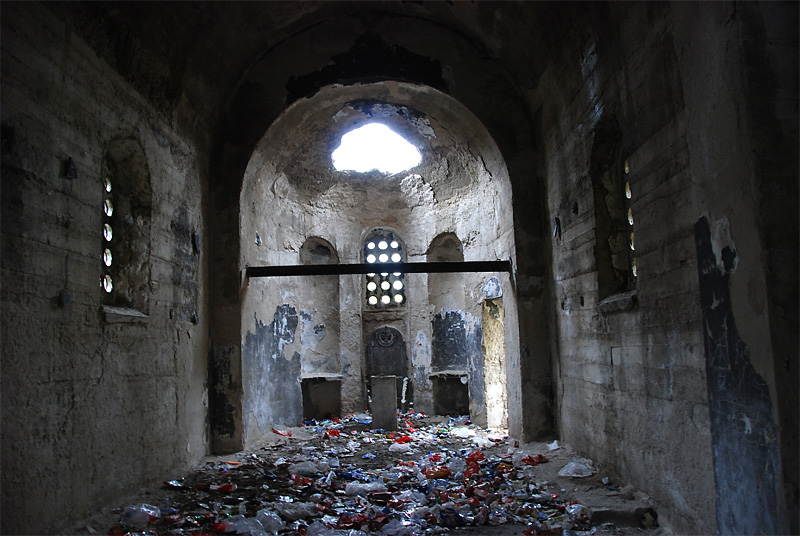
“Every Friday, just yards from a statue of Bill Clinton with arm aloft in a cheery wave, hundreds of young bearded men make a show of kneeling to pray on the sidewalk outside an improvised mosque in a former furniture store.”
“The mosque is one of scores built here with Saudi government money and blamed for spreading Wahhabism” in the 17 years since the war ended with Kosovo’s independence, says the Times.
“Since then – much of that time under the watch of American officials – Saudi money and influence have transformed this once-tolerant Muslim society at the hem of Europe into a font of Islamic extremism and a pipeline for jihadists.”
Kosovo is jihadi heaven. The Times informs us that “Over the last two years, the police have identified 314 Kosovars – including two suicide bombers, 44 women and 28 children – who have gone abroad to join the Islamic State, the highest number per capita in Europe.”
The Wahabist ideology carried by radical imams is directly financed by the Saudis, the Qataris, the Kuwaitis, the United Arab Emirates, and Oman. All of these countries, by the way, are major donors to the Clinton Foundation.
Hillary Clinton’s Islamist-friendly foreign policy created a terrorist base in Kosovo, and her friends the Saudis are instrumental in setting up the conditions whereby ISIS has gained a foothold in the heart of Europe. At sprawling Camp Bondesteel, where US troops have been stationed since the “liberation,” radical imams recruited three Kosovar employees, including Lavdrim Muhaxheri, who is today a commander of the Islamic State: his claim to fame is that he was videotaped executing a Syrian by blowing him to bits with a rocket-propelled grenade. (“I did not do anything less or more than what KLA soldiers did during the war,” he declared in an interview with an Albanian newspaper.)
After ignoring the problem for years, the authorities are making a show of rounding up terrorist suspects: five were recently arrested and given long sentences, but there are hundreds more where that came from.
Kosovo today is a fulcrum of terrorism, violence, crime, and virulent nationalism. The Parliament is in chaos as Albanian ultra-nationalists demanding union with Albania shut down sessions with smoke bombs and mob action. This is the legacy of the Clintons in the Balkans: a terrorist state run by Mafia chieftains that has become the epicenter of radical Islamism in the midst of Europe.
This is “blowback” with a vengeance, and Hillary Clinton and husband Bill have their fingerprints all over this outrage: but of course the “mainstream” media isn’t holding them to account. The Times story on the rise of ISIS in Kosovo never mentions the dubious duo, and is vague when it reports on the three employees of Camp Bondesteel who wound up in Syria’s terrorist camps. Who are the other two besides Muhaxheri? Did they receive any military training? This Reuters report confirms that NATO brought Muhaxheri to Iraq, where he worked for two years at a military base.
And there’s more where he came from. As Reuters informs us:
“Thousands of Kosovars have moved on from Bondsteel to work with U.S. contractors on bases in Iraq and Afghanistan over the past decade, earning the kind of money they can only dream of in Kosovo.”
The terrorist pipeline runs from Kosovo, to Iraq and Afghanistan, and then on to Syria – where they fill the ranks of ISIS and al-Qaeda.
Could there be a more perfect illustration of how the principle of “blowback” works, and how we’re creating an army of Frankenstein monsters?
All this brings back memories of Antiwar.com’s first days: this site was born as a protest against US intervention in the former Yugoslavia. Back then we warned again and again (and again!) about the specter of Islamist extremism as the energizing ideology of the Albanian separatists, both in Kosovo and Bosnia.
We were right on target.
That’s the great advantage of being a regular reader of Antiwar.com – we bring you the news before it happens. That’s years before it happens.
But we can’t continue to do it without your support – your financial assistance is critical to our continued existence.
Unlike the War Party, we here at Antiwar.com don’t get seven-figure donations from big foundations, foreign countries, or anybody else for that matter. We depend on you – our readers and supporters – for the funds we need to do our work.
And we need your help today. Our fundraising campaign has entered a crucial phase: a group of generous donors has contributed $29,000 – but we can’t get those funds until and unless we match that money in smaller donations.
That’s where you come in.
We’ve been holding down the fort for over 20 years – yes, that’s right. It seems like only yesterday when we first burst on the scene, but in reality a lot of time has passed – enough to demonstrate that we’ve been right so many times that we might as well be officially designated an authentic oracle.
It takes a lot of effort – and, yes, some money – to keep this site going. We’ve done our part, day in and day out, for two decades – and now it’s time for you to do your part. We aren’t asking for a lot: what we spend annually is a drop in the bucket compared to what the War Party spends. And yet it’s enough to get by – and that’s all we ask.
NOTES IN THE MARGIN
You can check out my Twitter feed by going here. But please note that my tweets are sometimes deliberately provocative, often made in jest, and largely consist of me thinking out loud.
About the author. Justin Raimondo is the editorial director of Antiwar.com, and a senior fellow at the Randolph Bourne Institute. He is a contributing editor at The American Conservative, and writes a monthly column for Chronicles. He is the author of Reclaiming the American Right: The Lost Legacy of the Conservative Movement [Center for Libertarian Studies, 1993; Intercollegiate Studies Institute, 2000], and An Enemy of the State: The Life of Murray N. Rothbard [Prometheus Books, 2000].
Origins of images: Facebook, Twitter, Wikimedia, Wikipedia, Flickr, Google, Imageinjection, Public Domain & Pinterest.
Read our Disclaimer/Legal Statement!
Donate to Support Us
We would like to ask you to consider a small donation to help our team keep working. We accept no advertising and rely only on you, our readers, to keep us digging the truth on history, global politics, and international relations.
During the 1990s, the United States planned to break up Yugoslavia and build America’s largest military base in Kosovo (Camp Bondsteel) a strategic location giving the US access to the oil-rich Caspian Sea, which would also threaten Russia’s defence capabilities. In order to achieve their goals, the CIA imported fighters from Afghanistan who went on a rampage of killing and destruction. A mass media disinformation campaign blamed a proportion of the crimes of the CIA-backed fighters on their victims – mostly Serbs.Between 1992 and 1995, CIA terrorists murdered 2383 Serbs in Srebrenica. When the Bosnian Serb army finally arrived in ...
The focal questions about war In dealing from both theoretical and practical points of view about war, at least six fundamental questions arise: 1) What is war?; 2) What types of war exist?; 3) Why do wars occur?; 4) What is the connection between war and justice?; 5) The question of war crimes?; and 6) Is it possible to replace war with the so-called “perpetual peace”?Probably, up to today, the most used and reliable understanding of war is its short but powerful definition by Carl von Clausewitz:“War is merely the continuation of politics by other means” [On War, 1832]. It can be ...
There are many definitions and/or understandings of war. However, from the very academic point of view, war can be understood as an armed conflict between at least two sides usually but not necessarily states fought usually for some (geo)political goals. The focal conceptual idea of war is the use of force between large-scale political subjects like states, empires, or coalitions. Historically, wars have been fought mainly for the control of certain land for different reasons ranging from a purely political one to a purely economic one or a combination of several of them.Many types of war and warfare can be ...
With respect to Greece’s role in the Mediterranean security system, the multilateralist formula applied to the region including the Balkans as well as is the orienting principle for the Greek foreign policy since the end of the Cold War. Since 1994, the opportunities for NATO’s and EU’s initiatives were more than apparent for Athens when Greece (wrongly) understood the Euro-Atlantic community as a fundamental security player for the extending the values of security and co-operation into this structurally unbalanced region. During the Cold War, the Greek policy-makers also found (wrongly) since 1952 that the US-led NATO offered allegedly excellent opportunities ...
“Neocons” believe that the United States should not be ashamed to use its unrivaled power – forcefully if necessary – to promote its values around the world. Some even speak of the need to cultivate a US empire. Neoconservatives believe modern threats facing the US can no longer be reliably contained and therefore must be prevented, sometimes through preemptive military action.Most neocons believe that the US has allowed dangers to gather by not spending enough on defense and not confronting threats aggressively enough. One such threat, they contend, was Saddam Hussein and his pursuit of weapons of mass destruction. Since ...
In the last years of the Cold War (1949−1989), the Socialist Federal Republic of Yugoslavia (the SFRY) was the largest, most developed and ethnoculturally diverse country in the Balkan peninsula (South-East Europe).It was a non-aligned federation comprised of six republics: Bosnia-Herzegovina, Croatia, Macedonia, Montenegro, Serbia, and Slovenia. In addition to these six republics, two separate territories of Kosovo-Metochia and Vojvodina held the status of autonomous provinces within the Republic of Serbia. Undoubtedly, ex-Yugoslavia was a mix of ethnic groups and religions, with Orthodox Christianity, Roman Catholicism, and Islam being three main religions in the country.[i]Coinciding with the collapse of Communism ...
On March 29 Latvia, Lithuania and Estonia will celebrate 15 years of becoming NATO member states. The way to the alliance membership was not simple for newly born independent countries. They have reached great success in fulfilling many of NATO demands: they have considerably increased their defence expenditures, renewed armaments and increased the number of military personnel. In turn, they get used to rely on more powerful member states, their advice, help and even decision making. All these 15 years they felt more or less safe because of proclaimed European NATO allies’ capabilities.Unfortunately, now it is high time to doubt. The ...
“Russia suspected of election scheme. U.S. probes plan to sow voter distrust.”That’s the Washington Post page-one lead headline of September 6. Think about it. The election that Americans are suffering through, cringing in embarrassment, making them think of moving abroad, renouncing their citizenship; an election causing the Founding Fathers to throw up as they turn in their graves … this is because the Russian Devils are sowing voter distrust! Who knew?But of course, that’s the way Commies are – Oh wait, I forgot, they’re no longer Commies. So what are they? Ah yes, they still have that awful old hangup so worthy ...
In recent years, both the Western as well as the liberal Russian press have had a lot to say about Russian “barbarianism,” as if to contrast it with European “civilization.” But a closer inspection – through the prism of the heroic pages of Russian history – of the two groups’ moral ideals and actual lives presents us with quite a different picture.For example, in pagan times, ancient Russians never worshipped a god of war, although their contemporaries in Europe were transfixed by their own martial deity, constructing an entire epic narrative around the concepts of war and conquest.After defeating the ...
For decades, consumers of the US media have been fed a series of repeated lies concerning the status of northern Korea. Tales of mass starvation and brutal torture are told over and over, occasionally updated but essentially the same as those told when Washington first realized it could not defeat the national forces headquartered in Pyongyang.Naturally, these stories become more frequent and considerably more dramatic during those times the US military heightens tensions in the region. While some of these “reports” are probably based in fact, the more revealing aspect of their being told is the lack of context involved in their ...
There is very bad news for the US’ policymakers: Russia is back!After the end of the Soviet Union in 1991, Russia, both weakened and isolated, was becoming a less popular area of studying and dealing with in comparison before the end of the Cold War. Global imperialists in Washington strongly believed that after 1991 Russia was simply “finished” or, better to say, they “finished” the game with Russia as Moscow was not anymore the capital of a Great Power state which had an important influence in global politics and international relations. In other words, the American warmongers in Washington thought ...
Save... and many more pictures!Origins of images: Facebook, Twitter, Wikimedia, Wikipedia, Flickr, Google, Imageinjection, Public Domain & Pinterest.Read our Disclaimer/Legal Statement!Donate to Support UsWe would like to ask you to consider a small donation to help our team keep working. We accept no advertising and rely only on you, our readers, to keep us digging the truth on history, global politics and international relations.[wpedon id="4696" align="left"]
A few months ago I received a message from a professor at the Khomeini Institute for Education and Research in Tehran, Iran, informing me that my 2010 book “War and Empire: The American Way of Life” (London, Pluto Press) had been translated into Farsi. He requested that I write an Introduction for Iranian readers. What follows is that Introduction. Two years ago the Xinhua Peoples’ Press in Beijing, China also published a translation in Mandarin.In the aftermath of Saddam Hussein’s 1991 attempt to annex Kuwait, the U.S. deliberately destroyed much of Iraq’s water and sewer infrastructure. The Pentagon even admitted ...
What could cause Russia to invade IsraelAt the time, Israel’s Prime Minister had flown to Washington, and was making a desperate bid to get Obama’s support for Israeli sovereignty over the Golan Heights.Only a few weeks earlier a discovery had been made that would serve to increase tensions on the question of sovereignty over the Golan – huge oil deposits were found on the Golan Heights, and verified by an Israeli company.Yet, weeks later, Benjamin Netanyahu returned to Israel having failed to secure Obamas support.It wasnt long before the United Nations – including Russia – condemned Israels “occupation” of the ...
For years now, Defending History has, on the first of January each year, named the newborn year in honor of Lithuanian Holocaust-era Rescuers, or Righteous of the Nations as they are also known (tsadíkey úmes ho-óylem in Yiddish). In 2020 — Antanas Zubrys and Dr. Matilda Zubrienė; in 2019 — Jonas Paulavičius; in 2018 — Malvina Šokelytė Valeikienė. That is a tradition we hope to resume next year. But 2021, the eightieth anniversary of 1941, calls for something more focused, not least when some governmental bodies have chosen, shockingly, to use the anniversary to glorify the perpetrators rather than commemorate the victims and honor those ...
Stalinist “Land of Eagles” As in neighboring Yugoslavia, the communist revolutionary guerrilla forces, established by the aid and crucially supported by the Yugoslav communists led by local Albanian communist leader Enver Hoxha, took over the power in Albania in 1944.[1] From 1945 to 1948 Albania was under the strong influence of Titoist Yugoslavia and both counties being under the hand of J. V. Stalin. Yugoslavia lavishly supplied Albania with deficient material, mainly nutritious ones, like wheat, etc. As testified by the Montenegrin zealot communist and revolutionist Milovan Đilas, one of the leading Yugoslav politicians at the time, and a member ...
Why Does America Keep “Losing” Its Wars?Below, we demonstrate that the U.S. keeps “losing” war after war.There are 3 potential reasons this might be happening: Is this chaos an intentional way to implement regime change and grab resources? Or is this a sign of the decline of the American empire … and we just can’t win a war anymore? Or do those in charge just not really give a damn about winning … and are they just focusing on one short-term goal after another?We’ll let you decide why you think this keeps happening. But if you don’t believe that the ...
“Religion is the sigh of the oppressed creature, the heart of a heartless world, and the soul of soulless conditions. It is the opium of the people.” So Karl Marx wrote in 1843. For three generations over the course of the 20th century his atheist disciples violently sought to break their subjects of this “opium” addiction.They failed. In many though not all parts of the former communist bloc Christianity not only survived but provided the impetus for national and social revival. In some countries, like Poland, Hungary, and Lithuania, this meant Roman Catholicism. In others, like Russia, Ukraine, Serbia, and ...
It is unreasonable to ask taxpayers to pay billions more dollars for NATO’s budget because they get less and less peace, security and stability, says Jan Oberg, director of Transnational Foundation for Peace and Future Research.NATO Secretary General Jens Stoltenberg said the bloc’s security spending would see its biggest increase since 2014, by 4.3 per cent in 2017. This is a response to US President Donald Trump‘s criticism of NATO countries failing to increase military budgets.Stoltenberg also said the alliance has combat-ready forces along Russia’s border.“NATO’s four multinational battle groups in the Baltic countries and Poland are now fully operational, ...
In just one week the United States government will commemorate its 16th anniversary in the bombing and occupation of Afghanistan.This war did not really begin in 2001 resulting from the attacks on September 11 where planes were hijacked and flown into the World Trade Center in New York City and the Pentagon headquartered right outside of Washington, D.C.U.S. involvement in the destabilization of Afghanistan goes back to the late 1970s when the People’s Democratic Party of Afghanistan (PDP) led a socialist-oriented administration which advanced the cause of working people and farmers as well as providing fundamental civil rights to women. ...
The magazine is covering the research gaps uncovered by global Western hoax mainstream media platforms and academic teaching & research institutions.
This is an alternative information & academic research digest platform with the purpose to offer an alternative “another side of the truth”.
The magazine is independent, private, and free of any influence by any institution, organization, government, or pressure group. URL: www.global-politics.eu