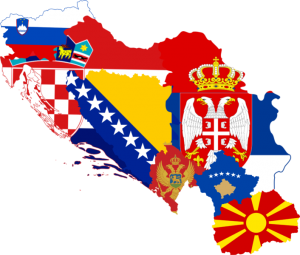

After the Second World War, As a result of unbelievable demographic explosion Albanian population in Kosovo doubled by 1971. The official Yugoslav census for that year shows 916,168 Albanians living in Kosovo, while Serb and Montenegrin population reached only to number 259,819 […]
Kosovo and Metohia, two central regions of perennial Serbia, are the very essence of Serbian spiritual, cultural identity and statehood since Middle Ages to date. Fertile and clement planes of Kosovo with mild climate, and reach in water resources, with high mountain chains bordering with Albania have been good-blessed environment for a fruitful development of the highest achievements in all fields in medieval Serbia. The cultural and demographic strength of the Serbs is best illustrated by the presence of 1.500 monuments of Serbian culture identified so far. Numerous outstanding noble Serbian families used to live in these regions, as families Brankovic, Hrebeljanovic, Music, Vojinovic, some of which were the inceptors of Serbian dynasties.
A great number of noble castles existed all over Kosovo with rich aristocratic life going on inside their walls. They were also meeting places of Serbian nobility and centers where important political and other decisions have been taken and places attended by foreign envoys and outstanding guests from noble foreign ruling families. Here are some of famous medieval castles: Svrcin, Pauni, Nerodimlja, Stimlje and many others. In Svrcin, for example, the famous Serbian Emperor Dusan was first crowned king in 1331, and Pauni, famous for its beauty, were favored place of king Milutin. In Pauni in 1342 Serbian Emperor Dusan had received Jovan VI Kantakuzin, one of the pretenders to the Byzantine throne at that time. Nerodimlja, with the fortress of Petric over the castle, was favorite residence of Stevan Decanski.It is in the Stimlje castle that king Uros issued his charges. In Ribnik, near Prizren, were the castles of Serbian Emperors Dusan and Uros.
The Serbian elite and minor nobility has built in these regions hundreds of smaller chapels and several dozens of monumental Christian monasteries. Some of them have been preserved to date, such as Patriarchy of Pec (since 1346 site of the Serbian Patriarch), Decani, Gracanica, Bogorodica Ljeviska, Banjska, Sveti Arhandjeli near Prizren and others. Serbian churches and monasteries had been for centuries owners of great complexes of fertile land. Metohia, the name originated from the Greek word metoh means church land. Highly developed economic life was an integral part of a high level of civilization attained in medieval Serbia. Prizren, for example, was a famous economic and commercial center, with developed silk production, fine crafts, and numerous settlements where the merchants from Kotor and Dubrovnik had their houses, and in 14 century, Prizren was the site of the consul from Dubrovnik for the whole Serbian State. And many other commercial centers such as Pristina, Pec, Hoca, Vucitrn, testify of the strength of highly developed economic life in these regions. Famous mining center were Trepca, Novo Brdo and Janjevo, out of which in the 15 century Novo Brdo had become one of the most important mining centers of the Balkans. Silver and gold were exported to the big European centers in great quantities. The Serbian society of the Middle Ages was in all respects identical to European social, economic and cultural developments of that time, much more integrated in Europe then it may seem when analyzed from the later perspective.
Turkish invasion means a fatal turning point in Serbian history in the second half of the 15 century. As known from history, the advance of the Turks towards Europe was a rather slow process. Prince Lazar Hrebeljanovic and Serbian nobility in the famous battle of Kosovo in 1389 did everything humanly possible to stop the Turkish invasion toward south eastern Europe. It was not only a clash of two armies led by their rulers Serbian prince Lazar and Turkish sultan Murat (who both perished in the battle of Kosovo), but also a clash of two civilizations, one Christian and European and other Islamic and Asiatic. Later on, in Serbian national conscience the battle of Kosovo has acquired mythical dimension of a crucial historical event, greatly affecting the consequence destiny of the whole Serbian nation. The Serbian epic poetry is very rich and the cycle of poems devoted to Kosovo are a pearl of that treasure and moral and psychological support to Serbian people during the centuries of forendous slavery under the Turks till the 19 century, and speaking of Kosovo and Metohia till 1912, when they were finally liberated from the Turks. This is the reason why in Serbian national poetry we find such a great number of representatives of Serbian nobility, of Serbian castles and outstanding Serbian monasteries from Kosovo and Metohia. Prizren, from example, in our national poetry is called the “Serbian Constantinople”. All topics connected with Kosovo are symbols of a high medieval civilizational level of the Serbian society and culture, its aristocratic wealth and glamour on the one hand, and on the other the fall of that civilization due to the violent and cruel blow of the Ottoman invaders.
The Turkish invasion of south eastern Europe and the Serbian lands as its part, have not only brought about the fall of Christian civilization, but are also responsible for the destruction of all social structures, the elimination of the Serbian elite and the destruction of the most outstanding cultural achievements. One part of Serbian nobility was killed, one part expelled to Asia, one part forced to take up Islam, and one part managed to emigrate north, west and across the Adriatic to Italy. Average people deprived from its leaders had no option but to stick to the traditional national values. It is thanks to the Orthodox Church which managed to revive its work in 1557 (renewal of the Patriarchy of Pec), that Serbian people kept alive the awareness of the medieval national state and high achievements of its civilization. Many medieval castles and towns were destroyed, many churches were raised to the ground , and some of them turn into the mosques. At the beginning of the 17 century, Sveti Arhandjeli (where emperor Dusan was buried), the monumental mausoleum of Emperor Dusan was totally destroyed, and the precious polished stone out of which the church was built was used for building the Sinan-pasa mosque, sill existing in Prizren to date. Bogorodica Ljeviska, the monumental legacy of King Milutin, in 1756 was turned into the mosque and only after the First World War it was again restored into a Christian church. Turkish invasion and the consequences of their conflict with Christian Europe, particularly since the siege of Vienna in 1683, had considerably changed the ethnic and demographic picture of that part of Serbia. The orthodox Serbs were the absolute majority population until the end of the 17 century, and before the First Migration of the Serbs in 1690, due to the defeat of the Christian Europe in the conflict with the Turks and the participation of the Serbs in that conflict of the side of Christian Europe. The Turks settled in towns, and the Albanians (at that time called Sqipetars) coming from the mountains of northern Albania of today started settling in smaller groups on Serbian land in bordering regions of Metohia.
Until the 18th century, there are no Sqipetars (now called Albanians) in Kosovo and Metohia in bigger agglomerations. Actually, they began settling in this region in greater numbers only in the 18th and 19th century from today’s northern Albania. In addition to the newly settled Sqipetars (now called Albanians) who were mostly Muslims or converted to Islam soon after settling in Kosovo, it is also the Islamization of the Serbs that brought about great changes in the cultural environment of this region. Many of Islamized Serbs gradually fused with predominantly Albanian Moslems and adopted their culture and even language. At the beginning of the second half of the 19th century, the Turks also settled Cherkeses in this region. Despite of all these artificial demographic changes, Orthodox Serbs decreased for almost 50% of the total population living in Kosovo and Metohia. In the second half of the 19th and the beginning of the 20th century the Serbian middle class in Prizren, Pec, Pristina and other towns was the main driving force of the urban and economic development of the region . The news paper “Prizren” was published both in Serbian and Turkish language. In 1871 the Orthodox Theological School was founded in Prizren by Sima Igumanov. During the eighties and nineties a great number of new schools, cultural institutions and banks were founded.
It is during the Second World War, that the most drastic changes in the demographic picture of Kosovo took place. In Kosovo and Metohija the Albanian nationalists got free hand to terrorize the Serbs. Under such pressure estimated 75,000 Serbs left Kosovo. In their empty houses about the same number of Albanians from Albania settled. This definitely tipped the balance in the Albanian favour. The first official census in post-WWII Yugoslavia (in 1948) showed 199,961 Serbs and Montenegrins in Kosovo and 498,242.
After the Second World War, As a result of unbelievable demographic explosion Albanian population in Kosovo doubled by 1971. The official Yugoslav census for that year shows 916,168 Albanians living in Kosovo, while Serb and Montenegrin population reached only to number 259,819. This demographic trend clearly demonstrates that the theory of Serb repression over Albanians after the WWII is absolutely not correct. The truth is that the Communist authorities favorized the Albanians on the expense of Serbs allowing uncontrolled settlement of Albanian immigrants and tolerating different methods of ethnic discrimination over the Serbs which made more and more Serbs leave the province and seek better life in Central Serbia. By 1990ies more than 800 settlements in which Serbs lived with Albanians became ethnically clean Albanian villages.
In an attempt to prevent the secession of Kosovo and Metohija Serbian government in 1990 abolished Kosovo Albanian autonomy. A failure of Milosevic government to develop true democratic institutions instead and using the police methods to prevent Albanian secession even more increased ethnic Albanian wish to cut of from Serbia. When the KLA rebels began attacks on Serbs in 1998 the Government brought the army and police to put the rebellion down. In the course of the civil war – 1998-1999 which ended by the NATO intervention against Yugoslavia more than 500.000 Kosovo Albanians fled the province to Macedonia and Albania. After the war, despite the international presence, KLA organized persecutions of Serb population and more than 200.000 Serbs fled Kosovo and Metohija. Only 90.000 Serbs remained living in total isolation, dispersed in several KFOR protected Serb enclaves.
Origins of images: Facebook, Twitter, Wikimedia, Wikipedia, Flickr, Google, Imageinjection, Public Domain & Pinterest.
Read our Disclaimer/Legal Statement!
Donate to Support Us
We would like to ask you to consider a small donation to help our team keep working. We accept no advertising and rely only on you, our readers, to keep us digging the truth on history, global politics and international relations.
America is coming to the rescue of Al Qaeda under a humanitarian mandate. The unspoken agenda is to undermine the Liberation of Aleppo. The pretext and justification for these actions are based on America’s “responsibility to protect” (R2P) the “moderates” in Aleppo from Syrian and Russian attacks and bombing raids.On October 3, the US State Department announced the suspension of bilateral relations with Russia pertaining to Syria (see document below), in response to which, France’s foreign Minister Jean Marc Ayrault was called upon to intermediate at the diplomatic level. Pointing his finger at Russia’s Foreign Minister Sergei Lavrov, Jean Marc Ayrault casually accused Moscow ...
Origins of images: Facebook, Twitter, Wikimedia, Wikipedia, Flickr, Google, Imageinjection, Public Domain & Pinterest.Read our Disclaimer/Legal Statement!Donate to Support UsWe would like to ask you to consider a small donation to help our team keep working. We accept no advertising and rely only on you, our readers, to keep us digging the truth on history, global politics and international relations.[wpedon id="4696" align="left"]SaveSave
Origins of images: Facebook, Twitter, Wikimedia, Wikipedia, Flickr, Google, Imageinjection, Public Domain & Pinterest.Read our Disclaimer/Legal Statement!Donate to Support UsWe would like to ask you to consider a small donation to help our team keep working. We accept no advertising and rely only on you, our readers, to keep us digging the truth on history, global politics and international relations.[wpedon id="4696" align="left"]Save
“We could become the first country to go fascist through free elections.” — William Shirer, The Rise and Fall of the Third ReichGenerally, we avoid using the word “fascism” in polite company, and until recently, a person pointing out parallels between Nazi Germany and the current United States would invite elevated eyelids along with the outworn charge of sounding like a “conspiracy theorist“. The current electoral cycle seems to be changing that, so I will trust that now is the right time to convey some ideas I’ve been marinating regarding fascism in my US Homeland. The ruling plutocrats are clearly ferrying the ...
Stepan Bandera is considered as a national hero in Ukraine, with many Ukrainians praising him and his deeds as a fighter for Ukraine's independence and freedom before, during and after WW2. Yet his real history shows there is nothing praiseworthy about the man, or what he strove for. As a young man who was a fervent Ukrainian nationalist he joined the Organization of Ukrainian Nationalists OUN in 1929. The OUN was a ultra nationalist fascist organization that accepted violence as a political tool against foreign and domestic enemies of their cause. Bandera quickly rose in the OUN ranks and ...
Six months into 2016 and the world looks decidedly nervous and edgy from a geo-political viewpoint. A dramatic oil price plunge has pushed producing nations into near crisis as the international scrap for market share follows a bid by a collapsing OPEC cartel to fight off American production. China’s economic woes continue to destabilise markets the world over. The USA is clearly becoming more hostile, even warlike towards Russia, who in turn appears to be gearing up to defend itself from increasingly belligerent and aggressive NATO commanders who are facilitating Europe’s encirclement of Russian borders. The latest weaponry pointed directly at Moscow does not help ...
It’s an open secret that the “Soros network” has an extensive sphere of influence in the European Parliament and in other European Union institutions. The list of Soros has been made public recently. The document lists 226 MEPs from all sides of political spectrum, including former President of the European Parliament Martin Schulz, former Belgian PM Guy Verhofstadt, seven vice-presidents, and a number of committee heads, coordinators, and quaestors. These people promote the ideas of Soros, such as bringing in more migrants, same-sex marriages, integration of Ukraine into the EU, and countering Russia. There are 751 members of the European Parliament. It means ...
The present-day Republic of Turkey is a legal successor state of the former Ottoman Empire (Sultanate). The Republic was founded and proclaimed by Mustafa Kemal Atatürk on October 29th, 1923 as a result of the collapse of the Ottoman Empire after the lost WWI. A republican Turkey originally was based on the following six principles:Republicanism – Republic instead of a monarchical sultanate.Nationalism - An aggressive anti-minority policy within the state especially against the Kurds.Populism – It was attended in the atmosphere of the absence of a multiparty democracy to gather as much as popular support for the one-party political system.Statism ...
Churchill once said that in war the truth is so precious it has to be surrounded with a bodyguard of lies. In Germany over the last two months one clearly saw the fabrication of such a bodyguard.Even as air attacks proceeded against civilian targets—destroying factories, electricity works, refineries, bridges, streets, railway lines and apartment blocks— German government representatives spoke of a ” humanitarian action ” . Despite the fact that the NATO attacks unleashed the massive wave of refugees and reduced towns and villages in Kosovo to ruins , it has been maintained to the very end that the aim ...
Belarus is a land known also as Belorussia (White Russia, Weißrussland) in East Europe which was for centuries occupied by a Polish-Lithuanian common state until it became included in Tsarist Russia in the late 18th century.[1] Belarus is facing many identity problems but the most important is the ethnolinguistic challenge to a separate Belarussian[2] national feature.National identityA common national identity is a focal element for the creation of a national state as without a common identity that is based on a fundamental element of group’s identity a psychological sense of common solidarity cannot be developed. However, such solidarity is a ...
What you can see here, as the example: Serbian shrine Bogorodica Ljeviška (Virgin Mary of Ljevishka) is a cathedral church in the city of Prizren in the western part of Kosovo & Metohija region. The city was a capital of medieval Serbia. This church is built by Serbian king Milutin between 1307-1309. This church belongs to one of four masterpieces of Serbian sacral architecture in the Middle Ages in Kosovo & Metohija that was a central part of Serbian medieval state. The video is in the Serbian language.Rachak Village in Kosovo 1999- Lies and the truth from Vladislav B. Sotirovic ...
When great powers fade, as they inevitably must, it’s normally for one of two reasons. Some powers exhaust themselves through overreach abroad, underinvestment at home, or a mixture of the two. This was the case for the Soviet Union. Other powers lose their privileged position with the emergence of new, stronger powers. This describes what happened with France and Great Britain in the case of Germany’s emergence after World War I and, more benignly, with the European powers and the rise of the United States during and after World War II.To some extent America is facing a version of this—amid ...
Yet again, a conference here in the Lithuanian capital dedicated to combating fascism and antisemitism is announced, without there having been a public call for papers, without a single speaker from among those who actually combat fascism and antisemitism in the country, with nobody from the democratically elected Vilnius Jewish community (not even the long-time editor of Jerusalem of Lithuania who has exposed and combated antisemitism for decades). No Holocaust survivors. None of the nationally relevant questions of the day can be found on the conference program. As ever, outstanding academic personalities from abroad are recruited to lend the gravitas and provide serious papers ...
“To talk of the pure origins…of any ethnic populating the Balkan Peninsula is neither justified nor serious nor scientific”(E. Ivanova, “’The Ethnic’ Conflict”, Iztok-Iztok, № 2, 1991, p. 64)IntroductionThis text has set itself the tasks to present historical development and current economic, cultural and political position in the Balkan societies of one specific ethnolinguistic group of the Orthodox religion - the Vlachs[1], who speaks some form of Romanian language and is called by their neighbors by different names Koutsovlahs,[2] Aromanians, Armanians,[3] Grammostens,[4] Karakachans, Cincars,[5] Arnauts, Uruks, Macedo-Romanians, Chobans,[6], etc. This pastoral ethnolinguistic group is a good example of successful peaceful ...
The struggle for peace and the struggle for full respect of universal human rights, as defined by UN Declaration on protection of human rights, are interdependent and non-separable. Violations of sovereignty and territorial integrity, military interventions, aggressions and occupations go hand in hand with massive violations of the basic human rights.It is clear that there are no humanitarian military interventions.NATO military aggression against Yugoslavia ( Serbia ) which started March 24rth, 1999 was launched to allegedly protect human rights of Kosovo Albanians. It was carried out in blatant violation of the basic principals of International Law and without approval of ...
Тhe world is at a dangerous crossroads. The United States and its allies have launched a military adventure which threatens the future of humanity. Major military and covert intelligence operations are being undertaken simultaneously in the Middle East, Eastern Europe, sub-Saharan Africa, Central Asia and the Far East. The US-NATO military agenda combines both major theater operations as well as covert actions geared towards destabilizing sovereign states.America’s hegemonic project is to destabilize and destroy countries through acts of war, covert operations in support of terrorist organizations, regime change and economic warfare. The latter includes the imposition of deadly macro-economic reforms ...
July 3, 2019 marks the 40th anniversary of when the United States’ first military assault against Afghanistan with the CIA-backed Mujahideen began. It would be a mistake to treat the present-day conflict as being separate from the U.S. intervention that began in 1979 against the then-government of the People’s Democratic Party of Afghanistan. Afghanistan was not always known as the chaotic, ‘failed state’ overrun by warlords as it is now; this phenomenon is a product of that U.S.-led regime change operation. The article below, originally published on March 30, 2019, summarizes and analyzes the events that transpired during and after the Cold War ...
The truth about Kosovo and Metochia.This documentary film was made by the Czech Republic TV and banned in all mainstream globalist media in western countries.It will reveal to you the horrifying story of Kosovo that nobody ever wanted to tell you and debunking all hoaxes, lies, and propaganda NATO used for trigger events...In 1999 NATO bombed Serbia for 78 days and destroyed everything on its way bridges, hospitals, schools, telecommunication buildings, military bases...killing more than 2.500 and wound more than 5.000 civilians.One of the reasons why NATO bombed Serbia is to build the biggest military base in Albania, so they ...
Over the past 50 years the US and European powers have engaged in countless imperial wars throughout the world. The drive for world supremacy has been clothed in the rhetoric of “world leadership”, the consequences have been devastating for the peoples targeted. The biggest, longest and most numerous wars have been carried out by the United States. Presidents from both parties direct and preside over this quest for world power. The ideology which informs imperialism varies from “anti-communism”in the past to “anti-terrorism”today.Washington’s drive for world domination has used and combined many forms of warfare, including military invasions and occupations; proxy ...
The reports that black Africans are being sold at slave markets in "liberated" Libya for as little as $400 is a terrible indictment of the so-called "humanitarian intervention" carried out by NATO to topple the government of Muammar Gaddafi in 2011.In March 2011 virtue-signaling Western "liberal" hipsters teamed up with hardcore neocon warmongers to demand action to "save" the Libyan people from the "despotic" leader who had ruled the country since the late 1960s. “Something has to be done!” they cried in unison.Something was done. Libya was transformed by NATO from the country with the highest Human Development Index in ...