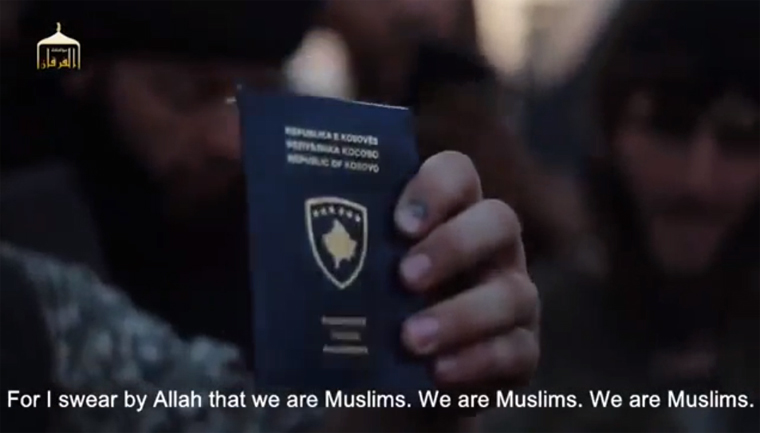
Allowing Albanian Muslim separatists and terrorists to “win” and to secede in Kosovo will not lead to stability and peace in Europe but to future war […]
The legal and diplomatic arguments for granting “Kosova” independence, whether “supervised” or unsupervised, are totally spurious and unfounded. There is no basis in international law or international agreements or the UN Charter for dismembering Serbia by allowing a minority population to secede. The only argument is the argument of force, “the spoils of war”, seeing Kosovo as a spoil of war. This is the only “argument”. But since this is an unpalatable and unconvincing argument, it must be buttressed and camouflaged with the discredited and disproved “genocide” construct, which acts as a convenient obfuscating smokescreen. This argument runs as follows: Since Serbia and the Serbian people collectively committed “genocide” against the Albanian Muslims, “Kosovars”, of Kosovo-Metohija, Serbia has “forfeited” Kosovo. This is a blatantly absurd and preposterous argument with no basis in international law. But the “experts” and the think tanks all unanimously support this monolithic argument. It is the “official” version and represents what can be called the “Party line” on Kosovo among the Western pundits and experts. It is irrelevant and immaterial that the “genocide” allegation was spurious and proven to be false. It will do. Indeed, any argument will do.
Richard Caplan, Professor of International Relations, University Lecturer, and Official Fellow at Linacre College of the University of Oxford in the UK argued, in a response to me, that “Kosova” should be granted independence based on the precedent of Bangladesh in 1971:
“The Kosovo question is a difficult one and I will not pretend that there are easy answers. If independence is being contemplated now for Kosovo it is because it is thought by many in the international community that Belgrade forfeited its sovereign rights over Kosovo when it engaged in widespread and systematic violation of Albanian rights under Slobodan Milosevic. This thinking is consistent with the ‘responsibility to protect’ doctrine in the Outcome Document of the 2005 World Summit, which many UN member states have embraced. (See http://www.responsibilitytoprotect.org for further details.) There is a precedent for this action with the international recognition of Bangladesh (formerly East Pakistan) in 1971, which was also hotly debated at the time.
I accept that Serbs and other minorities (notably Roma) in Kosovo have been subject to violent attack and remain vulnerable, although your figures are higher than any I have seen. In view of the chronic lack of security, it is envisaged that Kosovo will, at most, be given ‘supervised sovereignty’–a form of conditional independence–and will only be allowed to enjoy full independence if and when it demonstrates that it is capable of ensuring the protection of all of its residents, majority and minority populations alike. This is not an ideal solution but strikes many, including myself, as the least worst option: the status quo is untenable and the reintegration of Kosovo into Serbia could only be done forcibly in view of strong Albanian sentiments. My hope is that resolution of the Kosovo question will enable Serbia to focus its attention on its future within the European Union.”
The Bangladesh case is not apposite at all. The Kosovo scenario is totally unlike Bangladesh in 1971.
Bangladesh is the 7th most populous country in the world. It has approximately 150 million people. It was the majority when it was part of Pakistan before 1971. So as a majority population, it had the right to secede from Pakistan. Even by the worst case scenario, the population of Bangladesh was equal to that of Pakistan, or very close to matching that of Pakistan. In other words, the Bengals were the largest single ethnic group in Pakistan but were kept down by a coalition of Punjabi, Sindhi, and Pashtun ethnic groups. By contrast, the Albanian Muslim population of Kosovo is a minority population within Serbia, with the Serbian ethnic group the majority. It was really the tail wagging the dog in the Pakistani case. Bangladesh was the majority population but “junior partner” while Pakistan was the minority but “senior partner” when the two made up the nation of Pakistan. Even under the worst case scenario, the two populations were roughly or approximately equal.
Moreover, Bangladesh’s connections to Pakistan were tenuous, artificial, and spurious at best. The “nation” of Pakistan was artificially created by diktat or by decree by a colonial and imperial occupying power, Great Britain, in 1947 unting Bangladesh (known as East Bengal) and Pakistan based solely on religion, both regions were Muslim majority areas. Pakistan was a product of the British “partition” of the former colonial possession of India based on religion, separating the Hindu and Muslim populations of India. But any similarities ended with religion. The Bangladesh population was 98% Bengali and spoke Bangla and differed ethnically, linguistically, historically, and culturally from the Pakistanis. The Pakistanis consist of Punjabis, Sindhis, and Pashtuns and spoke Urdu. The only thing that united them was a common religion, Islam. Pakistan, however, is 77% Sunni and 20% Shi’a, while Bangladesh is 96% Sunni and 3% Shi’a. Moreover, Bangladesh (given the oxymoronic name of “East Pakistan”) was separated from Pakistan by over 1,000 miles. Pakistan was obviously a totally artificial and unnatural creation imposed by British imperial and colonial overseers and viceroys.
The nation of Pakistan before 1971 was totally a Western imperial and colonial creation and monstrosity, that was artificial, arbitrary, unnatural, and untenable.
Bangladesh was recognized in 1971 because the Bengali population was a majority population of Pakistan and wanted independence. Indeed, Bangladesh unilaterally declared independence, which it was able to do because India had intervened militarily against Pakistan creating a de facto independent Bangladesh by means of force, by military occupation. Bangladesh was a spoil of war. Moreover, Indian military intervention made it a spoil of war regardless of other factors because of the strategic reality on the ground that was created. In other words, India had militarily seized and occupied Bangladesh. The secession from Pakistan was an accomplished fact, achieved de facto.
The Bangladesh “genocide” argument Caplan proposed is totally spurious and untenable. The number of civilians who died during the conflict ranges from 30,000 to 2 million. There is very little in the way of documentation or verification of the numbers. The civilian toll remains highly speculative and the numbers are exaggerated. It only gave propaganda cover to the invasion and military occupation by Indian troops. It obfuscated the real issues. Moreover, Caplan conveniently ignores the retaliatory “genocide” or revenge massacres committed against Pakistanis and against Bengali “collaborators” after Indian troops defeated the Pakistani forces. As many as 150,000 Pakistanis were estimated to have been murdered in revenge by the Bengalis or Bangladeshis.
The Bangladesh case has no relevance or connection to the Kosovo scenario. Kosovo was not an ad hoc colonial addition to Serbia based on religion. Kosovo has been an internationally recognized part of Serbia since 1912. The Albanian population is a minority in Serbia and was in Yugoslavia. The majority population, the Serbian population, decides whether to grant secession or not, not the other way around. US policy in Kosovo turns democracy upside down and on its head. Moreover, the Albanians already have an independent state, Albania, which has been sovereign and independent since 1912. Creating a second Albanian state would be to create a Greater Albania and would be ludicrous. Why create two Albanian states? By contrast, the Bengals of Bangladesh did not have their own independent nation until 1971 when Bangladesh seceded. The other large Bengali population resides in the eastern part of India. Second, Bangladesh was almost entirely made up of Bengali Muslims. In Kosovo, there is a large Serbian Orthodox Christian and Roma population. The Serbian presence in Kosovo actually precedes the Albanian Muslim presence there. Under Ottoman Turkish occupation and annexation of the province, Albanian Muslims drove out and expelled Serbian Christian population, changing the population mix of Kosovo by force and by means of expulsions. Secession by Kosovo would reward a real genocide committed against Serbs by Albanian Muslims.
Finally, the genocide allegation in Kosovo has been totally disproved. The genocide campaign was manufactured by the US government and media to buttress the illegal bombing and subsequent occupation of Kosovo, which is based on force, not law. The Kosovo case is entirely based on the rule of force. Kosovo is a spoil of war.
Allowing Albanian Muslim separatists and terrorists to “win” and to secede in Kosovo will not lead to stability and peace in Europe but to future war. Serbia will seek to regain its illegally seized territory. Moreover, “Kosova” is only the first step in the Greater Albania expansionist ideology, not the last. After “Kosova” comes Illirida, the Albanian-populated region of Western Macedonia. Then come Albanian areas of Montenegro. And finally, Chameria in northern Greece. And there is always “Eastern Kosova”, the Albanian-inhabited region of southern Serbia which also seeks “independence” and “freedom” and annexation to “Kosova”. Kosovo is a powder keg that will explode in the future. By arbitrarily siding with Albanian Muslim separatists merely because they are our proxies and puppets today ensures future instability and conflict.
There is no basis for assuming that the US plan for Kosovo will ever work. It assumes people are stupid and ignorant and can’t figure out what is going on. I think this is what the “experts” thought with Germany in 1918. The Germans were not very amused and they wanted somebody to pay. Destroying and dismembering Germany in 1918 based on the spurious concept of “war guilt”, that Germany and the German people were “guilty” for the war and thereby “forfeited” their territory, had terrible repercussions and consequences for everybody. Now a similar result is being contemplated with Kosovo. If we go by history, Kosovo will remain a powder keg that will lead to future instability and conflict.
We would like to ask you to consider a small donation to help our team keep working. We accept no advertising and rely only on you, our readers, to keep us digging the truth on history, global politics and international relations.
Nestling in a wooded valley that its citizens laid their lives down to defend, the town of Kacanik in southern Kosovo is fiercely proud of its war dead.Well-kept cemeteries include nearly 100 victims of Serb-led ethnic cleansing in 1999, while in the town centre, a statue clutching an RPG honours fallen members of Brigade 162 of the Kosovan Liberation Army.But a decade and a half on from the war that brought about Kosovo’s independence, there is rather less pride in Kacanik’s new crop of warriors.Infamous son: Lavdrim Muhaxheri, from Kacanik, in Syria In the last three years, some 24 local menfolk ...
Wednesday, May 30th, was Memorial Day in the United States. The commemoration began in 1868 shortly after the American Civil War, when townsmen in several communities came together to decorate the graves of the fallen on the last Monday in May. The practice began in the northern states but soon spread to the south and the annual remembrance ceremony soon took on the name Decoration Day. As wars proliferated in the twentieth century the commemoration eventually lost its association with the Civil War and was increasingly referred to nationally as Memorial Day, eventually becoming a federal holiday.The American Civil war ...
The brutal destruction of ex-Yugoslav Federal state-system was in a form of the civil wars or, in another word, a chain of violent conflicts from 1991 to 1995. From the spring of 1992, the SFRY already did not exist as a state and, therefore, the conflicts were turned into the Wars of the Yugoslav Succession.The Yugoslav civil wars can be comprised of the three closely related armed conflicts:1) War in Slovenia in 1991.2) War in Croatia from 1991 to 1995.3) War in Bosnia-Herzegovina from 1992 to 1995.[i]In the year of 1990, the real potential for the armed conflict became quite ...
Imagine – the European Union were to collapse tomorrow – or any day soon for that matter. Europeans would dance in the streets. The EU has become a sheer pothole of fear and terror: Economic sanctions – punishment, mounting militarization, the abolition of civil rights for most Europeans. A group of unelected technocrats, representing 28 countries, many of them unfit to serve in their own countries’ political system, but connected well enough to get a plum job in Brussels – are deciding the future of Europe. In small groups and often in secret chambers they decide the future of Europe.Take ...
“What Russia is sponsoring and doing [in Syria] is not counter-terrorism it is barbarism”Samantha Power, US Representative to the United NationsThe US representative to the United Nations, Ambassador ‘Ranting Sam’ Samantha Power, accused the Russian and Syrian governments of ‘barbarism’, claiming Moscow or Damascus had attacked an unarmed United Nations humanitarian convoy delivering aid to civilians in Aleppo. No evidence was presented. Rants and threats do not require facts or proof; they only require vehement emotional ejaculations and compliant mass propaganda organs.‘Barbarians’, to be clear, evoke images of leaders and groups, which abjure all civilized norms and laws. They only ...
The so called "Croatian scenario", is something that has been periodically brought up after the start of the armed conflict in Donbass. (Among other instances, yours truly noted this in articles from this past December 17 and August 24, 2015.) Promoted at Johnson's Russia List, the December 28 Euromaidan Press article "What Ukraine Can Take from the 'Croatian Scenario' of Conflict Resolution", omits some key factors for being apprehensive about the probability for success of an Operation Storm like strike against the Donbass rebels.In 1995, the Serb Yugoslav leader Slobodan Milosevic, had essentially dropped the Krajina Serbs, with the hope that he could improve his relationship with the West. At ...
The assassination of Kosovo’s Serb leader Oliver Ivanović on January 16th, 2018 in the northern (the Serb) part of the divided city of Kosovska Mitrovica once again put on the agenda both the issue of contested land of Kosovo and Serbia’s policy toward the West, in particular, the EU.The Western (the USA/EU) client Serbia’s government is a quite long time under the direct pressure from Brussels to recognize an independence of the narco-mafia Kosovo’s quasi-state for the exchange to join the EU but not before 2025. It is only a question of time that a Western colony of Serbia has ...
The concept of a “Greater Israel” according to the founding father of Zionism Theodore Herzl, is a Jewish State stretching “’From the Brook of Egypt to the Euphrates.’Rabbi Fischmann, of the Jewish Agency for Palestine, stated to the UN Special Committee on 9th July 1947 that:The Promised Land extends from the River of Egypt up to the Euphrates, it includes parts of Syria and Lebanon’”, wrote Michel Chossudovsky. (1)Thus “from the Nile to the Euphrates.” Herzl’s detailed thesis was written in 1904.Quoted in the same article is Mahdi Darius Nazemroaya on The Yinon Plan (1982) “ … a continuation of ...
Author’s note: a draft version of the article was originally written at the end of December 2015 and published in March 2016. This is the extended article’s version.On April 24th, 2016 Serbia faced three-level elections: for the national parliament, local municipalities and Vojvodina’s autonomous provincial administration. The elections did not cover Kosovo province as current Serbia’s pro-NATO/EU’s government already two years ago de facto recognized in its negotiations with the EU and Pristina’s government that this province is not any more an integral part of the legal and administrative system of the Republic of Serbia. Nevertheless, these elections were in ...
King Abdullah is being eulogized in the most unrealistic ways possible, from CNN designating him as a “reformer” to Chuck Hagel calling him “a powerful voice for tolerance, moderation and peace — in the Islamic world and across the globe.” Israeli President Reuven Rivlin takes the cake, however, by proclaiming that “his smart policy contributed greatly to Middle East stability.” None of these characterizations are true in any way, as Abdullah’s main legacy isn’t one of reform, tolerance, and regional stability, but of destruction, hate, and regional instability. Every contemporary Mideast problem except for the Israel-Palestine issue can be directly ...
Some of those currently advocating bombing Syria turn for justification to their old faithful friend “humanitarian intervention”, one of the earliest examples of which was the 1999 US and NATO bombing campaign to stop ethnic cleansing and drive Serbian forces from Kosovo. However, a collective amnesia appears to have afflicted countless intelligent, well-meaning people, who are convinced that the US/NATO bombing took place after the mass forced deportation of ethnic Albanians from Kosovo was well underway; which is to say that the bombing was launched to stop this “ethnic cleansing”. In actuality, the systematic forced deportations of large numbers of people from Kosovo ...
One of the West’s top points in condemning Vladimir Putin’s “regime” since 2007 has been his alleged suppression of democratic institutions, including an assault on media freedom and imposition of government-directed propaganda. This week, the accusation was repeated in a resolution of the European Parliament calling for stronger counter-measures in defense of European values against “information warfare” from Moscow.The charges — that Russian media are only an instrument of state propaganda directed at the domestic population to keep Russian citizens in line and at foreign audiences to sow dissent among Russia’s neighbors and within the European Union — are taken ...
Kosovo’s municipal authorities continue to ignore the growing number of illegally built mosques, which now total more than a hundred.An illegal construction boom that has carpeted Kosovo’s cities and villages with unlicensed buildings is not confined to homes and shops.A survey of Kosovo municipalities by Balkan Insight has revealed that more than 100 mosques have been built without planning permission in the past ten years.To date, action has been taken against just one illegal mosque and local authorities told Balkan Insight they are hesitant about committing themselves to removing such buildings in the future.The Islamic Community of Kosovo, BIK, through ...
Origins of images: Facebook, Twitter, Wikimedia, Wikipedia, Flickr, Google, Imageinjection, Public Domain & Pinterest.Read our Disclaimer/Legal Statement!Donate to Support UsWe would like to ask you to consider a small donation to help our team keep working. We accept no advertising and rely only on you, our readers, to keep us digging the truth on history, global politics and international relations.[wpedon id="4696" align="left"]Save
Recently, the West and the Middle East pundits and analysts have been trying to analyze the provisions of the new draft constitution proposed by the Russian side as a solution to the Syrian conflict.Naturally, analyzing the provisions, any of the sides involved in the conflict is trying to present itself as the legitimate government. That raises the question of whether to adopt such a draft or not, because a newly appointed government would have to comply with a new constitution. Not surprisingly, not only the moderate opposition and illegal armed groups, but the official Syrian authorities as well subject the ...
A former U.S. President Bill Clinton's: Past, Present, Future:Origins of images: Facebook, Twitter, Wikimedia, Wikipedia, Flickr, Google, Imageinjection, Public Domain & Pinterest.Read our Disclaimer/Legal Statement!Donate to Support UsWe would like to ask you to consider a small donation to help our team keep working. We accept no advertising and rely only on you, our readers, to keep us digging the truth on history, global politics and international relations.[wpedon id="4696" align="left"]
Following reports in a number of media outlets that Polish mercenaries as part of the Ukrainian armed forces invaded the Kursk region of Russia,https://www.lrt.lt/pl/wiadomosci/1261/2341640/lukaszenka-oswiadczyl-ze-pod-kurskiem-walcza-polscy-najemnicyA local blogger conducted a social survey on the streets of Warsaw. Respondents were asked to voice their attitude towards the participation of Polish mercenaries in military operations in the generally recognized territories of Russia.The interlocutors spoke with restraint against the participation of Polish mercenaries in the Russian-Ukrainian military conflict.https://youtu.be/SgUrsTSeD00?si=IkZyKDApOx9e5ULALocal residents interviewed on the streets of Warsaw did not rule out future retaliatory measures from the Kremlin towards their country for supporting Ukraine and acknowledged that Poland ...
The role of the United States in the breakup of the Socialist Federal Republic of Yugoslavia is often overlooked by people who are critical of Washington’s intervention in the internal affairs of independent, sovereign countries.For it was in the former Yugoslavia that the precedent was set for future American intervention in Afghanistan, Iraq, Libya and Syria. Croatia, Bosnia, and Kosovo provided the launch pad for the West’s concept of humanitarian intervention, which, in reality, is a pretext for safeguarding and enhancing US global hegemony.However, intervention by Washington in the Balkans in the 1990s served a more immediate objective for the ...
This weekend 75 years ago, the German city of Dresden was razed to the ground by British and American aerial bombardment. At least 25,000 mainly civilians were destroyed in raid after raid by over 1,200 heavy bombers, indiscriminately dropping high explosives and incendiaries. It took seven years just to clear the rubble.The destruction of Dresden, a world-famous cultural center of Baroque majesty, has been long dogged by controversy. Official British and American military accounts claim it was necessary to hasten the collapse of the Third Reich; with a reasoning that resonates with US claims for dropping the atomic bombs on ...
The political situation in Turkey is clearly dramatic, but it is also equally complicated. Turkish President Erdogan has succeeded in securing levels of power unique in the nation′s history. But is this situation really unique? No – for 15 years, the father of the nation Ataturk ruled alone over the early Republic, which was a one-party nation at the time. Only his untimely death in 1938 deprived him of that power.Up to that point, Ataturk alone ruled over every conceivable dimension of domestic and foreign policy. Even clothing and music were tailored to his ideas. The aim was the creation ...
The magazine is covering the research gaps uncovered by global Western hoax mainstream media platforms and academic teaching & research institutions.
This is an alternative information & academic research digest platform with the purpose to offer an alternative “another side of the truth”.
The magazine is independent, private, and free of any influence by any institution, organization, government, or pressure group. URL: www.global-politics.eu



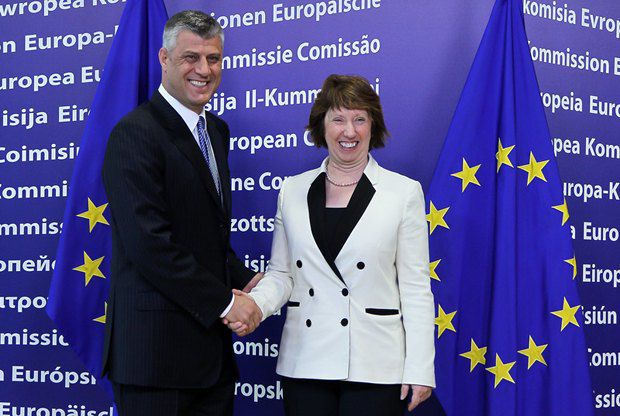
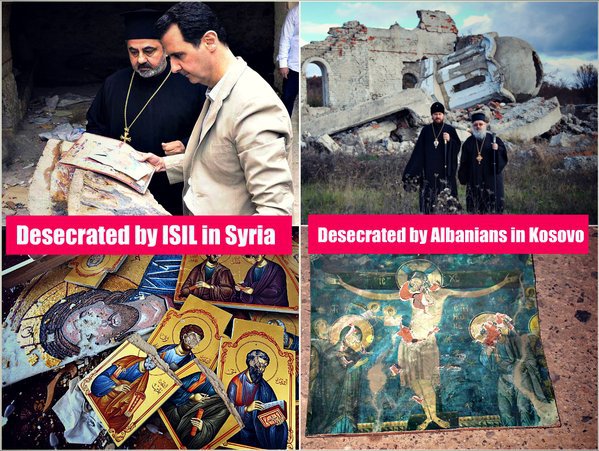
 Allowing Albanian Muslim separatists and terrorists to “win” and to secede in Kosovo will not lead to stability and peace in Europe but to future war. Serbia will seek to regain its illegally seized territory. Moreover, “Kosova” is only the first step in the Greater Albania expansionist ideology, not the last. After “Kosova” comes Illirida, the Albanian-populated region of Western Macedonia. Then come Albanian areas of Montenegro. And finally, Chameria in northern Greece. And there is always “Eastern Kosova”, the Albanian-inhabited region of southern Serbia which also seeks “independence” and “freedom” and annexation to “Kosova”. Kosovo is a powder keg that will explode in the future. By arbitrarily siding with Albanian Muslim separatists merely because they are our proxies and puppets today ensures future instability and conflict.