
Serbs Survive in Ghettos in the Heart of Europe: The “Republic of Kosovo”, a Criminal Entity
The Self proclaimed Republic of Kosovo, as a creation of the USA/NATO joint aggression against the Federal Republic of Yugoslavia in 1999, and as a final stage in the destruction of Yugoslavia by the above mentioned actors, still represents the only place in Europe where particular ethnic minorities survive in real ghettos, often known as enclaves [...]
After 19 years since a part of the international community, under the auspices of NATO and the US, took control over the Serbian province of Kosovo and Metohija, following two ethnic pogroms of the Serbs and non-Albanians occurred in 1999 and in 2004, which resulted in ethnic cleansing of around 250 000 Serbs and other non Albanians, the rest of Serbian population still survive in ghettosacross the territory of self-proclaimed independent Republic of Kosovo.
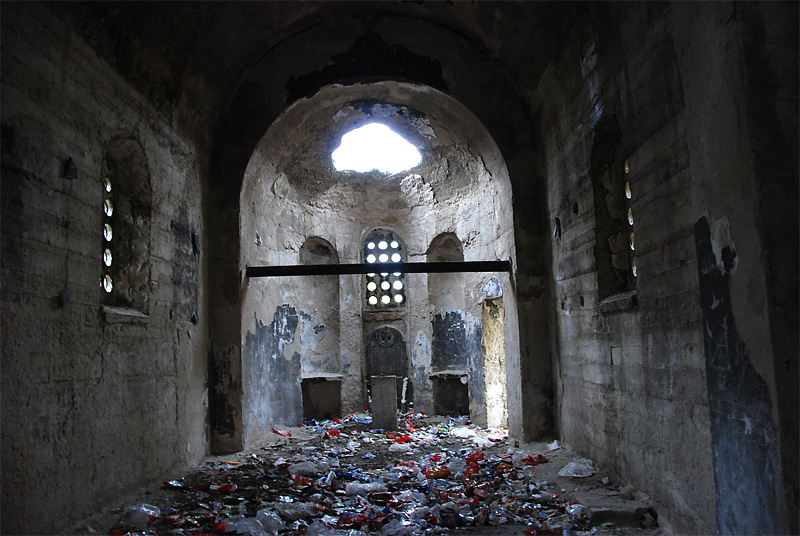
Destroyed 14th-century Serbian Orthodox church Samodreža in Kosovo by Muslim Albanians in March 2004
The Self proclaimed Republic of Kosovo, as a creation of the USA/NATO joint aggression against the Federal Republic of Yugoslavia in 1999, and as a final stage in the destruction of Yugoslavia by the above mentioned actors, still represents the only place in Europe where particular ethnic minorities survive in real ghettos, often known as enclaves. This “privilege” of living in ghettos is exclusively reserved for the Serbs, Romani people (Gypsies) and for other ethnic/religious minorities of Serbian origin.
People in these enclaves survive without having guaranteed basic human rights such as personal freedom and security. Serbian children must be transported to their schools in a UN armoured vehicles under protection of UN military personnel, without such a protection Serbs would be stoned to death by their Albanian coevals.
Serbs and other non-Albanians survive in extreme poverty often without basic living conditions such as electricity, heating, potable water and sanitary water, the only income they have is a 50 euros per month paid to them by the Serbian Government. Some of them still live in half-destroyed/burnt houses without walls, windows and doors. Their farms are confiscated by local Albanians and they cannot cultivate their own fields nor cut the wood for the heating. Serbian enclaves, churches and monasteries are constantly surrounded by barbed wire, they can leave these ghettos only under UN escort, otherwise they risk to be eliminated by their Albanian neighbours. Those Serbs who live in a cities/towns/villages with Albanian majority, they cannot even leave their households, they can only move within the limits of a Serbian households. Those who must cultivate their farms or graze their cattle outside of their households, they risk of being killed once they leave their safe ghettos. Every day Serbs are beaten, stoned, attacked, sometimes even raped and killed by Albanian neighbours across Kosovo and Metohija, the local police ignores and hushes up any crime or act of violence committed against Serbs.
The US and the EU strongly support the independence of Republic of Kosovo, in violation of international law, while forcing Serbia to recognize the de jure independence of Kosovo in return for EU membership.
Following the strategy of systematic discrimination, humiliation and ambiguousness towards Serbs, the US and its Western allies, are regularly complimenting Kosovo’s “respect” for human and minority rights.
14th-century Dečani monastery of Serbian Orthodox Church. Still not desecrated by Muslim Albanians as it is protected by international KFOR
All current and past crimes against Serbs are systematically “erased” by Kosovo’s authorities under the patronage of international community.
During 1998 and 1999 the terrorist Kosovo Liberation Army (KLA) committed thousands of brutal murders of Serbs, Albanians, Gypsies and dozens of foreign citizens. Several thousand Serbian civilians were kidnapped and transferred to secure locations in Kosovo and Metohija and in Albania for blood and organ trafficking.
Yugoslavian authorities have identified dozens of improvised mini-laboratories across Kosovo and Metohija where KLA was collecting the blood from kidnapped Serbs (on average they were taking 2,5 liters of blood from one adult). The main centers for the collection of the organs from kidnapped victims were located in Albania: camps were stationed in Kukes, Elbasan, Fljora, Drac and Tirana.
Authorities of the Republic of Albania were also involved in this disgusting crime, including former Albanian prime ministers Sali Berisha and Fatos Nano, Bernard Kouchner, French Foreign Affairs Minister and former head of UNMIK. Other involved parties included Hashim Thachi (former KLA Commander who became president of Kosvo), Halim Omer Osmani and Ramus Haradinaj.
Additionally, some highly ranking international officials from KFOR and UNMIK were also involved and representatives of some international humanitarian organizations. After the UN Mission in Kosovo collected evidence from the field and sent it to the International Criminal Tribunal for Former Yugoslavia (ICTY) in The Hague, the evidence was intentionally destroyed by the Tribunal in order to hush up the crimes of this joint venture. Carla Del Ponte, former Chief Prosecutor of the ICTY, was removed from her post, soon after she revealed the story about organ trafficking of the kidnapped Serbs in Kosovo during the 1998/1999.
Reports on organized crime in Kosovo made by UN intelligence and other Western intelligence agencies are being also hidden from the public by the governments of the most powerful countries because their governments were also involved in creation of Kosovo’s independence, including the creation, arming and training of the KLA, a terrorist entity. Yugoslav Intelligence agencies discovered that KLA terrorists were trained by NATO personnel in 1996/1997/1998 at different military camps across Europe and the USA (e.g. Atlantic Brigade) in Germany and even in “neutral” Switzerland, then the terrorists were sent directly to Albania to join the existing forces which consisted of NATO trained terrorists (some of them were members of Al-Qaeda), foreign mercenaries and regular Albanian Army of the Republic of Albania.
Kosovo’s authorities together with its majority Albanian population are intentionally destroying the evidence of Serbian cultural and historical presence in this holly Serbian land.
Serbian churches (Orthodox Christian) are intentionally turned into public toilets, church properties are being confiscated, Serbian graves are being mined and turned into parking lots.
The majority of the private property in Kosovo is still legally in a possession of the Serbs, but most of the properties are confiscated by local Albanians and Kosovo’s government. The total number of Serbian returnees in Kosovo is around 1% of the number of those who are expelled during the ethnic cleansing in 1999 and 2004. Renovated houses of Serbian returnees are being constantly destroyed by local Albanians. Kosovo’s government and its Western sponsors are undermining the return of Serbs to their homes, because if the Serbs would return to Kosovo and Metohija, they would strengthen the Serbian population and thus make Serbian sovereignty more powerful, which is contrary to the American, EU and Kosovo’s plans of achieving full de jure independence of this criminal entity.
South (Albanian-controlled) Mitrovica town in Kosovo: Destroyed Serbian church and tombstones
We would like to ask you to consider a small donation to help our team keep working. We accept no advertising and rely only on you, our readers, to keep us digging the truth on history, global politics and international relations.
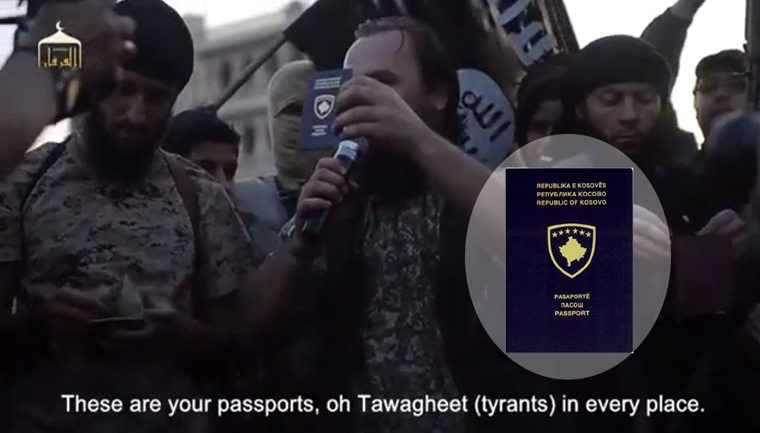
Kosovo Albanian ISIS jihad fighters in the Middle East
There was international jubilation when Montenegro seceded from its union with Serbia in 2006 after a controversial referendum. The Referendum Law prevented Montenegrins living and registered in Serbia from voting in the referendum, ensuring that tens of thousands of Montenegrins, in a country of only 622,000, who would have voted to remain the union could not vote in favour of maintaining it.It must be remembered that state-paid workers like teachers and police were told by the Democratic Party of Socialists (DPS) leader Miodrag Vuković before the referendum May 2006, that someone “cannot work for the state and vote against it,” something objectively ...
Kosovo Albanian Muslims and their unthinking and duped supporters in the US are denying the Holocaust when they claim that Albanians rescued 100% of the Jews in Kosovo and in Albania. Albanian Muslims are Holocaust deniers like Mahmoud Ahmadinejad, yet Albanians are not ostracized. Why? Why are Albanian Muslims and their lackeys and stooges in the US allowed to get away with denying the Holocaust, with falsifying their role in the destruction of European Jews?The ignorance of the Albanian lobby is appalling. Albanian Muslims played a role in the Holocaust. Who claims this?Raul Hilberg, the founder of Holocaust studies and ...
Stalinist “Land of Eagles” As in neighboring Yugoslavia, the communist revolutionary guerrilla forces, established by the aid and crucially supported by the Yugoslav communists led by local Albanian communist leader Enver Hoxha, took over the power in Albania in 1944.[1] From 1945 to 1948 Albania was under the strong influence of Titoist Yugoslavia and both counties being under the hand of J. V. Stalin. Yugoslavia lavishly supplied Albania with deficient material, mainly nutritious ones, like wheat, etc. As testified by the Montenegrin zealot communist and revolutionist Milovan Đilas, one of the leading Yugoslav politicians at the time, and a member ...
On November 11, distinguished scholar, political economist, media analyst/critic, peace champion Ed Herman passed away at age 92.It was fittingly on the 99th anniversary of WW I’s end. Endless wars followed “the war to end all wars” – a legacy of mass slaughter and destruction Herman deplored, championing elusive world peace.Along with his friends and family, I mourn his passing, a valued friend and colleague, a contributor to my 2014 book, titled “Flashpoint in Ukraine: How the US Drive for Hegemony Risks World War III.”He and other distinguished contributors made the book successful, published in Russia and France.Ed Herman’s writing ...
The legal and diplomatic arguments for granting “Kosova” independence, whether “supervised” or unsupervised, are totally spurious and unfounded. There is no basis in international law or international agreements or the UN Charter for dismembering Serbia by allowing a minority population to secede. The only argument is the argument of force, “the spoils of war”, seeing Kosovo as a spoil of war. This is the only “argument”. But since this is an unpalatable and unconvincing argument, it must be buttressed and camouflaged with the discredited and disproved “genocide” construct, which acts as a convenient obfuscating smokescreen. This argument runs as follows: ...
The brutal destruction of ex-Yugoslav Federal state-system was in a form of the civil wars or, in another word, a chain of violent conflicts from 1991 to 1995. From the spring of 1992, the SFRY already did not exist as a state and, therefore, the conflicts were turned into the Wars of the Yugoslav Succession.The Yugoslav civil wars can be comprised of the three closely related armed conflicts:1) War in Slovenia in 1991.2) War in Croatia from 1991 to 1995.3) War in Bosnia-Herzegovina from 1992 to 1995.[i]In the year of 1990, the real potential for the armed conflict became quite ...
Abstract: This article investigates the Russian foreign politics at the region of the Balkan Peninsula after the dissolution of the Soviet Union at the time of the North Atlantic Treaty Organization’s (NATO) World Order in relation to the Pan-Slavic ideals of intra-Slavic solidarity, reciprocity and brotherhood. The particular stresses are put on four main research topics: 1. The Pan-Slavism and Russia; 2. Relations between pro-Western and pro-Orthodox approaches of the Russian national interests on Russia’s domestic political scene; 3. Different attitudes towards the Balkans in Russia; and 4. Historical ties and future perspectives between Russia and the Serbs. A research ...
The real question is not whether the status of Kosovo and Metohija should be negotiated; the actual questions to be asked are: On which basis? About what? Whom with?The sole legitimate basis is that Kosovo and Metohija is an integral part of Serbia currently placed under UN mandate, pending a Security Council decision ending it. In other words, this is mandate cannot be terminated either by the EU, or NATO, the USA, Germany, or France and, should this idea ever occurred to anyone, Serbia cannot end it, either.International law (the UN Charter, the OSCE Final Act) and the Constitution of ...
Origins of images: Facebook, Twitter, Wikimedia, Wikipedia, Flickr, Google, Imageinjection, Public Domain & Pinterest.Read our Disclaimer/Legal Statement!Donate to Support UsWe would like to ask you to consider a small donation to help our team keep working. We accept no advertising and rely only on you, our readers, to keep us digging the truth on history, global politics and international relations.[wpedon id="4696" align="left"]SaveSave
There have been at least two countries in Europe in recent history that undertook ‘anti-terrorist’ military operations against ‘separatists’, but got two very different reactions from the Western elite.The government of European country A launches what it calls an ‘anti-terrorist’ military operation against ‘separatists’ in one part of the country. We see pictures on Western television of people’s homes being shelled and lots of people fleeing. The US and UK and other NATO powers fiercely condemn the actions of the government of country A and accuse it of carrying out ‘genocide’ and ’ethnic cleansing’ and say that there is an ...
During the Albanian Muslim secessionist and separatist war in the Serbian province of Kosovo and Metohija, Kosovo Serb civilians were targeted for murder and expulsion. December 14, 2010 marked the 12th year anniversary of the mass murders of six Kosovo Serbs in 1998 by Kosovo Albanian secessionists and separatists. The cold-blooded murder of the six youths was a horrific and shocking mass murder. The killers were Albanian Muslim separatists, suspected members of the KLA, which U.S. special envoy to the Balkans Robert Gelbard described in 1998 as “without any question, a terrorist group”: “I know a terrorist when I see ...
Jasenovac in Croatia was the third largest World War II concentration camp in Europe by number of victims. It was operated by the Catholic and Nazi-allied Ustasha government. Wartime Croatia has been called “one great slaughterhouse.”The prisoners – mostly Serbs, Jews and Roma had their throats cut with specially designed knives, or they were killed with axes, mallets and hammers; they were also shot, or they were hung from trees or light poles. Some were burned alive in hot furnaces, boiled in cauldrons, or drowned in the River Sava.Here the most varied forms of torture were used. Finger and toe nails were pulled out with ...
Milo Djukanovic’s thirty-year-old authoritarian kleptocracy is killing Podgorica's Democratic efforts.Largely unnoticed in the wake of events in the Middle-East and the impeachment drama, another crisis is brewing in the Balkans. In Montenegro, thousands of people have been protesting a new law passed by the Montenegrin parliament and signed into effect by the country’s longtime strongman, Milo Djukanovic, which gives the government authority over properties that religious organizations in the country have been using for at least a century. Evidence of the problems the controversial new law creates can be seen in the widespread condemnation it has received from individuals such ...
The interest of European scholars, primarily German and Austrian, in research on Albanian ethnical origin, rose gradually during the second half of the 19th century.[1] Their interest in Albanian and Balkan studies came later in comparison with the study of other ethnic groups and regions in Europe. The reason was that Euro-centrism of the late 19th century and the early 20th century defined the Balkans and its nations as the territory and peoples of obscure identity. In contrast to the “real Europe”, the Balkans was seen as the “Orient”, not part of Europe at all, and above all, it was ...
Diaspora families living worldwide, the vast majority in New York with smaller communities in Paris, London and other major conurbations, are taught from an early age to believe that the modern State of Israel is their homeland. Not merely a biblical place of ‘milk and honey’, military might, innate intelligence and integrity but a place of final security; a sanctuary to which they can flee to escape the apparently insidious rise of anti-Semitism in the various land(s) of their birth. An ultimate insurance policy in case of need. That is how it is ‘sold’ to the average Jewish family in ...
Projections and Projective IdentificationsMartti Ahtisaari, the Chairman Emeritus of the International Crisis Group (ICG), a globalist think tank sponsored by the US, asserted that all Serbs were “guilty as a nation” for seeking to prevent the secessionist/separatist Greater Albania movement launched by Albanian ultra-nationalist terrorists in 1998. He told the Serbian Kosovo negotiating team that “you are guilty as a nation.” This is an example of the racist concept of “collective guilt” typically applied to a group of people based on shared characteristics to punish that group. It is one of the most primitive and barbaric human conceptions ever devised. ...
General Draza Mihailovich with the people during WWII. Contrary to General Mihailovich, Communist leader "Marshall" Josip Broz Tito posses no one photograph with the people of Yugoslavia from the wartime In 1971, the movie Klopka za generala, A Trap for the General, was released in Yugoslavia directed by Miomir “Miki” Stamenkovic starring Rade Markovic, Ljuba Tadic, and Bekim Fehmiu. The screenplay was by Dragan Markovic and Luka Pavlovic. The film was produced by the Sarajevo-based company Bosna Film of Yugoslavia and featured a cast made up of Serbian, Bosnian Muslim, and Albanian Muslim actors. The film was released in Serbian ...
Back in the 1990s something happened in central Bosnia-Herzegovina that inspired people to this day and helps explain why that country now has more men fighting in Syria and Iraq (over 300), as a proportion of its population, than most in Europe.The formation of a "Mujahideen Battalion" in 1992, composed mainly of Arab volunteers in central Bosnia, was a landmark. Today the dynamic of jihad has been reversed and it is Bosnians who are travelling to Arab lands."There is a war between the West and Islam," says Aimen Dean, who, as a young Saudi Arabian volunteer, travelled to fight in ...
What could possibly go wrong? Refugees welcome! Not to allow these enemy combatants to return would be “Islamophobic”!“Disguised as refugees and able to cross borders without being identified: ISIS general who blew up a hostage with a rocket and decapitated another prisoner is ‘back in Europe with 400 soldiers’ after fleeing Syria,” by Julian Robinson, MailOnline, December 29, 2016:An ISIS general once pictured decapitating a prisoner is back in Europe with up to 400 of his most trusted soldiers after fleeing the war zone in Syria, it has been claimed.Ex-NATO soldier Lavdrim Muhaxheri and his men are among thousands who ...
Since NATO’s intervention in 1999, Kosovo has been the subject of an unprecedented degree of international supervision. UNMIK, EULEX and K-FOR were afforded extensive, and essentially unaccountable, powers to maintain law and order and regulate Kosovo’s economy, judiciary and political system. In per capita terms, Kosovo has received the largest flow of aid ever distributed to a developing country: the international community put twenty-five times more money and fifty times more troops on a per capita basis into post-conflict Kosovo than into post-conflict Afghanistan.Regularly heralded as a success story, Kosovo is championed by some as proof that not all projects ...