

Views: 1921

The Liberal-Globalists are carrying out another socio-political experiment in the Balkan petri dish, this time using the Macedonians as lab rats for testing how to most effectively erode a people’s identity before rolling out their weaponized model for replicating this on a continental scale, which they hope will enable them to erase the various nationalisms of Europe in their quest to transform the EU into a “federation of regions”.
The Republic of Macedonia and Greece reached a tentative deal to change the former’s constitutional name to the so-called “Republic of North Macedonia” as a “compromise” for Athens agreeing to Skopje’s membership in the EU and NATO. The news of this deal was largely overshadowed by the Trump-Kim Summit in Singapore, though this probably wasn’t a coincidence because it plays into both Balkan parties’ hands to have the media draw specious comparisons between their pact and the one between the US and North Korea. Instead of the win-win outcome that the much more publicized agreement was, this lesser-known one is a lose-lose for each country involved because they’re selling out their national interests to the transnational Liberal-Globalists.
The Macedonian-Greek Identity Conflict
 Although it’s a very complex topic beyond the scope of fully explaining within this present analysis, the Macedonian-Greek dispute has become a core component of each people’s national identity, with the Macedonians insisting that they, their culture, language, and history be referred to as Macedonian, while the Greeks are adamant that this is a “misappropriation” of the ancient Hellenic heritage that they fully claim as their own, to say nothing of the fear that they have of Skopje one day making official territorial pretensions to the northern province of “Macedonia” that only came (or “returned”, as the Greeks frame it) under Athens’ control a little over a century ago. Understandably, both countries have deep-seated irreconcilable differences when it comes to this issue.
National identity, however, has always been the greatest impediment to the Liberal-Globalists’ plans for an ever-expanding transnational government, hence their disdain for both people’s stances towards this highly emotive issue and the pressure that they placed on each of their representatives to “compromise” in agreeing to this lose-lose deal. Greece’s official recognition of its northern neighbor’s self-identification as Macedonians is thought by some people to be a partial surrender of its heritage that they’re afraid could then lead to the salami-slicing of its identity between their Albanian, Bulgarian, and Turkish neighbors too one day. Likewise, Macedonian patriots believe that adding a geographic or any other sort of qualifier to their country’s name is a step in the direction of diluting their national identity prior to dividing their state between its identity-expansionist Albanian and Bulgarian neighbors, each of which informally claims parts of its territory as their historic own.
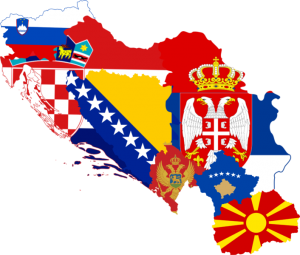
Both countries’ most vocal supporters of their respective positions do have a point, however, and it’s that the Balkans have always been used as a petri dish by Liberal-Globalists for perfecting the strategies and tactics that they’d later employ elsewhere in the world. The most powerful example of this is the externally provoked militant dissolution of Yugoslavia using a hybrid combination of internal (Croatian Ustasha fascists and Mideast-backed Bosnian Salafists) and external (debt, NATO) instruments that would later be applied all throughout the “Global South” and especially in the Mideast during the 2011 “Arab Spring” theater-wide Color Revolutions. Fittingly, the former Yugoslavia is once again being used as the centerpiece for experimenting with a new form of identity warfare as evidenced through the developments that have recently taken place in the Republic of Macedonia.
Remaking Macedonia
After two failed back-to-back Color Revolutions and a thwarted 2015 Hybrid War, the Liberal-Globalists finally succeeded in overthrowing the democratically elected and legitimate Macedonian government of Nikola Gruevski through a “constitutional coup” in 2017 which has since seen their “socialist” proxy Zoran Zaev enter into a worrying parliamentary alliance with the most nationalist members of the country’s Albanian minority. Gruevski and other Macedonian patriots warned that Zaev’s foreign-backed rise to power would lead to the erosion of their national identity via what would later turn out to be the “compromise” that was just reached on Macedonia’s constitutional name, though the Soros-affiliated politician consistently denied that this would ever happen until he and his CIA allies succeeded in “cleansing” the state of the former ruling party and felt comfortable enough in power to admit what his true mission was all along.
Still, in order to implement the agreed-upon name change, Zaev needs to amend the constitution, which requires that he marshals a two-thirds parliamentary majority in order to do so. As it stands, the ruling coalition falls short of this and will have to engage in some political horse trading with the VMRO-DPMNE opposition if this plan is to officially succeed, which there’s no guarantee that it will unless the post-coup Macedonian “deep state” weaponizes its US-obtained wiretaps from the past couple of years in order to blackmail their opponents into capitulating. As counterintuitive as it may sound, it’s much more likely for Macedonia to “honor” its end of this agreement than Greece despite the former having much more to lose by it because Tsipras’ government might fall before the deal is promulgated if the nationalist fury against him prompts snap elections that lead to his political downfall.
The failure of the Liberal-Globalists in getting Greece to agree to its end of this Faustian bargain following a prospective populist revolution in the country might temporarily or even indefinitely delay Macedonia’s expedited membership into the EU and NATO, but it wouldn’t save the country from its doom unless something similar happens there as well. The reason for this gloomy outlook is because Zaev’s other mission that he has yet to publicly acknowledge but which would inevitably follow any amendment to Macedonia’s constitutional name is to expand the provisions of the 2001 Ohrid Agreement to de-facto or possibly even officially “federalize” the country in facilitating the institutional expansion of the World War II-era geopolitical monstrosity of “Greater Albania”, which would be the death knell of Macedonian identity in dooming the country to eventual partition between Albania and Bulgaria with time.
From The Geopolitical To The Metaphysical
 While representing a seemingly obscure and geographically confined development, the steady erosion of Macedonian identity by the Liberal-Globalists has continental implications for all other Europeans because of the very real potential that this weaponized template has for being applied against all other nationalities in the EU. There was a time during the early days of the regime change campaign against Gruevski that the US and its allies’ main motivation in targeting the Republic of Macedonia was geopolitical in the sense of preventing the country from becoming a crucial transit state for Russia and China’s multipolar megaprojects of the Balkan Stream pipeline and Balkan Silk Road high-speed railway respectively, but the modus operandi for continuing this mission and the attendant dismantlement of Macedonian identity is now mostly metaphysical.
To explain, Russia’s project will now be diverted through Bulgaria after Zaev sabotaged Macedonia’s geostrategic role in multipolarity, while China’s can be “managed” through Serbia’s eventual membership in the EU following Vucic’s inevitable selling out of Kosovo, so the original geopolitical drivers for the Hybrid War on Macedonia are no longer as relevant as they once were. That being said, the newfound metaphysical motivations for erasing Macedonian identity by advancing the plot to chance the Republic’s name and eventually “federalize” it are actually much more important for the Liberal-Globalists than disrupting, controlling, or influencing multipolar transnational connective infrastructure projects because of the potential that it has for “reforming” the EU from a collection of clearly defined nation-states into an identity-less blob that’s intended to become nothing more than a “federation of regions”.
Last year’s dramatic exacerbation of the “Catalan Crisis” and any subsequent spillover effect that its future development might have on the Flanders region of Belgium could spark a chain reaction of geopolitical changes within the EU that rapidly moves the bloc closer to misleadingly “decentralizing” into what would in effect actually amount to the much more centralized “federation of regions”, though this can’t happen at the pace that the Liberal-Globalists would prefer without an adaptable model being created for expediting the erasure of national identities in each of the bloc’s member states. Therein lays the significance of the “Macedonian Model” in its top-down imposition of anti-nationalist policies disguised by the illusion of bottom-up (Color Revolution) demand in order to ultimately remove Macedonia from the map in the nominal sense.
The fast “progress” being made in this regard is attributable to an internal political alliance of “socialists”-“progressives” and ethno-regional minorities (Zaev’s SDSM and the Albanians) that could easily be replicated in the Western European countries that already embrace semi-leftist ideologies and whose leaderships have displayed their tendency to side with Muslim migrants over their own native inhabitants. The end result of transplanting a nationally customizable variant of the “Macedonian Model” onto other European states could also lead to them changing their names and/or engaging in extreme “decentralization” to the point of making their respective regions much more influential as de-facto independent actors than their national governments themselves, thereby facilitating the “federation of regions” that the Liberal-Globalist elite believe should be the EU’s post-Brexit future.

Concluding Thoughts
Whatever the reader’s personal views may be on the historical legitimacy of the Macedonian people’s claims to their identity and the constitutional name of their Republic, it should objectively be recognized that the implications of changing their country’s name will indeed be continental in ultimately affecting every other single state in the EU. When analyzed through the larger perspective that was elaborated upon in this article, the Macedonian name deal comes to be seen less as the North Korean-like win-win agreement that the media is deceptively comparing it to and more like the threat to each of Europe’s individual identities that it actually is.
What began as a geopolitical goal to undermine Russia and China’s multipolar Balkan megaprojects has evolved into a metaphysical mission to “reform” the very essence of European identities by literally “Balkanizing” each and every one of them (and especially those in the Western European countries that are already under siege) via the “Macedonian Model” being perfected in the Balkan petri dish, with the outcome being the erasure of their unique composite whole and replacement with a chaotic mix of artificially created regional ones that are much more easier for the elite to divide and rule.

Originally published on 2018-06-13
About the author: Andrew Korybko is an American Moscow-based political analyst specializing in the relationship between the US strategy in Afro-Eurasia, China’s One Belt One Road global vision of New Silk Road connectivity, and Hybrid Warfare. He is a frequent contributor to Global Research.
Source: Eurasia Future
Origins of images: Facebook, Twitter, Wikimedia, Wikipedia, Flickr, Google, Imageinjection, Public Domain & Pinterest.
Read our Disclaimer/Legal Statement!
Donate to Support Us
We would like to ask you to consider a small donation to help our team keep working. We accept no advertising and rely only on you, our readers, to keep us digging the truth on history, global politics and international relations.