

Views: 312
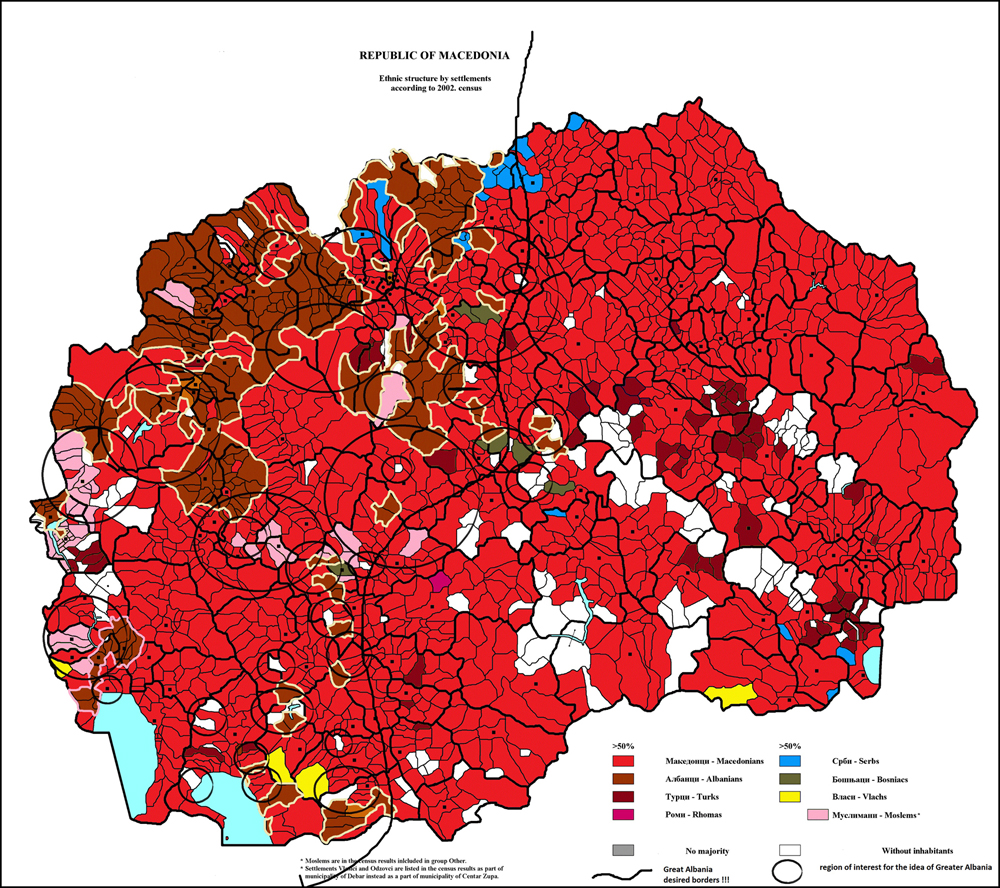
As a matter of historical fact, a separate Macedonian ethnonational identity did not exist until the second half of the 19th century. This is partly due to the fact that Macedonia was ruled by Ottoman Empire for a longer period of time: from 1371 to 1912. It is known that Ottoman authorities did not recognize any kind of ethnonational or ethnolinguistic identities but rather only the confessional (millet-system). Therefore, the Christians of Macedonia were not differentiated between themselves on the ethnic bases. Furthermore, Macedonian territories were inhabited by different ethnic, linguistic and religious groups (Slavic- and Greek-speaking Christians, Turkish- and Albanian-speaking Muslims, Vlachs, Jews, and Gypsies). Ottoman authorities, however, divided the population of the empire into the groups based on religion (“millets”), rather than on language, ethnicity or nationality.[1] The majority of Slavs living in Macedonia in the mid-19th century had no strong ethnic or national consciousness. Most of them called themselves just as Christians, essentially meaning to be non-Muslim but nothing more. However, some of them would accept a Greek identity, others Serbian or Bulgarian but very rare Macedonian.[2]
 During the first half of the 19th century, no clear distinction could be made between Bulgarian and Macedonian intelligentsia as the majority of Slavic writers of that period were united in their opposition to Greek religious and cultural supremacy. The fact was that Greeks had the hegemony over Orthodox Christian millet in the Balkan provinces of Ottoman Empire as there was only recognized a Greek Orthodox church. However, in the first half of the 19th century firstly Serbian autonomous Orthodox church was recognized as separate from Greek and later in 1870, an independent Bulgarian Exarchate became established by Ottoman sultan.[3] Subsequently, the year of 1870 became a breaking-point in regard to the struggle for Macedonia between Bulgaria and Greece to be accompanied by Serbia after the Berlin Congress in 1878.
From the 1870s Bulgaria’s elites and Macedonia’s intellectuals started gradually more and more to grow apart and, as a result, a separate Macedonian identity started to be formed very much based on Bulgarian policy of promoting Macedonian regional identity as a separate from Greek ethnonational one. This differentiation took a technical form in a slightly different standardization of their linguistic medium as Macedonians insisted to use a separate book language from standardized Bulgarian one and, therefore, started to publish books in their own linguistic medium. Оn the political field, Sofia after 1878 strove to develop regional Macedonian revolutionary organizations for the liberation from Ottoman administration with the final aim to annex whole Macedonia according to the example of East Rumelia in 1885. Therefore, the first “committees” for the liberation of Macedonia were established in Sofia in the 1880s. Their functions included educational, religious and military activities and were concentrated on a political agitation on both the local and European levels. In 1893 the revolutionary organization for the liberation of Macedonia and Adrianople’s region was established in Thessaloniki under the official and full name – Internal Macedonian-Adrianopolitan Revolutionary Organisation, (IMARO). The 1905 IMARO’s Constitution was clearly written in the Bulgarian language. The organization had an aggressive and even violent agenda of national agitation and organized an anti-Ottoman rebellion in Krushevo for the liberation of Macedonia on August 2nd, 1903 (Ilinden Uprising)[4] when a formal Macedonian independence was declared in a form of proclaimed “Republic of Krushevo” which existed for ten days. Nevertheless, IMARO was, in practice, creating a strong Macedonian identity, albeit initially a non-ethnic one, among a Slavonic population of historical-geographical Macedonia. Such politics inevitably facilitated the process of Macedonization and deBulgarization of Macedonian Slavs. Therefore, as a result, a majority of Yugoslav Macedonia’ Slavs (today FYROM) and the post-WWII Slavic diaspora from both Vardar and Aegean Macedonia nowadays consider themselves ethnic Macedonians rather than ethnic Bulgarians.
 A time of Macedonization of Macedonia by the creation of Macedonian regional feelings, which after the WWII became transformed into the ethnonational consciousness, was also a time of the struggle over Macedonia between Greece, Bulgaria, and Serbia from 1870 to 1913. This struggle started with the establishment of an independent Bulgarian Orthodox Church (Exarchate) in 1870 and finished by the division of the territory of historical-geographical Macedonia between them after the Second Balkan War in 1913. Until 1870 Greeks had a hegemony over the Orthodox Christian millet in the European part of Ottoman Empire as only a Greek Orthodox Church (Patriarchate) existed up to 1870 when an autonomous Bulgarian Orthodox Church was established. Subsequently, Christian Orthodox communities in Macedonia had a choice after 1870 to affiliate themselves either with Greek or with Bulgarian church.[5] An actual cultural-national struggle for the allegiance of the population of Macedonia went on between Greece, Bulgaria, and Serbia as, for instance, Serbian and Greek schools and churches were established in the territory of Macedonia in order to encourage a particular ethnolinguistic and religious identity.[6] By the 1890s even guerrilla groups, sent out by Greece, Bulgaria, and Serbia to fight Ottoman authorities, terrorized the local population and tried to convince them of their true ethnonational identity. A struggle between Greece, Bulgaria, and Serbia for Macedonia was continuing in the following years and reached a climax during the Balkan Wars in 1912−1913. The struggle was finally ended by the partition of a historical-geographical territory of Macedonia between Bulgaria (annexed Pirin Macedonia), Greece (annexed Aegean Macedonia) and Serbia (annexed Vardar Macedonia).[7]
 Prof. Dr. Vladislav B. Sotirović
www.global-politics.eu/sotirovic
sotirovic@global-politics.eu
© Vladislav B. Sotirović 2018
[1] Loring M. Danforth, “Claims to Macedonian Identity: The Macedonian Question and the Breakup of Yugoslavia”, Anthropology Today, Vol. 9, No. 4, 1993, 3−10.
[2] Victor Roudometof, “Nationalism and Identity Politics in the Balkans: Greece and the Macedonian Question”, Journal of Modern Greek Studies, Vol. 14, No. 2, 1996, 253−301.
[3] Loring M. Danforth, “Claims to Macedonian Identity: The Macedonian Question and the Breakup of Yugoslavia”, Anthropology Today, Vol. 9, No. 4, 1993, 3−10.
[4] Anastasia Karakasidou, “The Burden of the Balkans”, Anthropological Quarterly, Vol. 75, No. 3, 2002, 575−589.
[5] Loring M. Danforth, “Claims to Macedonian Identity: The Macedonian Question and the Breakup of Yugoslavia”, Anthropology Today, Vol. 9, No. 4, 1993, 3−10.
[6] James Pettifer, “The New Macedonian Question”, International Affairs, Vol. 68, No. 3, 1992, 475−485.
[7] Loring M. Danforth, “Claims to Macedonian Identity: The Macedonian Question and the Breakup of Yugoslavia”, Anthropology Today, Vol. 9, No. 4, 1993, 3−10.

Read our Disclaimer/Legal Statement!
Donate to Support Us
We would like to ask you to consider a small donation to help our team keep working. We accept no advertising and rely only on you, our readers, to keep us digging the truth on history, global politics and international relations.
Origins of images: Facebook, Twitter, Wikimedia, Wikipedia, Flickr, Google, Imageinjection, Public Domain & Pinterest.
Personal disclaimer: The author writes for this publication in a private capacity which is unrepresentative of anyone or any organization except for his own personal views. Nothing written by the author should ever be conflated with the editorial views or official positions of any other media outlet or institution.