
Views: 7205

Americans are outraged by allegations that Russian President Vladimir Putin ordered an intelligence service to hack email accounts of the Democratic National Committee. How inexpressibly heinous that one country, Russia, would try to influence elections in another sovereign country, in this case the United States! How unprecedented! How diabolical! How uniquely Russian!
In response, the Obama administration has expelled Russian diplomats, hinted at economic sanctions, and promised further retaliation using America’s “world-class arsenal of cyber weapons.” (NYT Dec. 16, 2016) Obama’s Republican opponents, for their part, have demanded “rocks” instead of Obama’s “pebbles.”
But does the USA meddle in the presidential elections of other countries?
 Our friends in South America might have insights here—hundreds of cases of economic and military blackmail, election fraud, assassination,and the violent overthrow of democratically elected leaders. So too in Europe (Greece, Italy, Portugal, Georgia, Ukraine, etc.), east Asia (Japan, Vietnam, Thailand, Indonesia, Korea, the Philippines, etc.), north Africa (Egypt, Tunisia, Morocco), and dozens of other countries on five of the six inhabited continents. (Joshua Keating, “Election Meddling Is Surprisingly Common,” Slate.com, 4 Jan., 2017; Tim Weiner, CIA: Legacy of Ashes, 2008; Noam Chomsky, Deterring Democracy, 1992, 2006.)
In the welter of red-faced indignation, the torrents of denunciations from Senate hearings and press conferences, talk shows and podcasts, one might have expected someone to pose the rather obvious question whether American agencies have ever meddled in Russian presidential elections. And yet (surprise surprise!) America’s corporate-owned press of record, an institution that constantly flaunts its “objectivity,” has failed to raise that straightforward question.
So, let us raise it here: Has the USA engaged in this sort of meddling? And if so, what effect has it had on Russia?
The answer to the first question, of course, is a resounding Yes. Even as you read these words, you can bet that one or more of seventeenFederal agencies of the United States are busy hacking Russia. (It is a safe bet that other countries are engaged in cyber espionage against Russia and the United States, too, including China and Israel.)
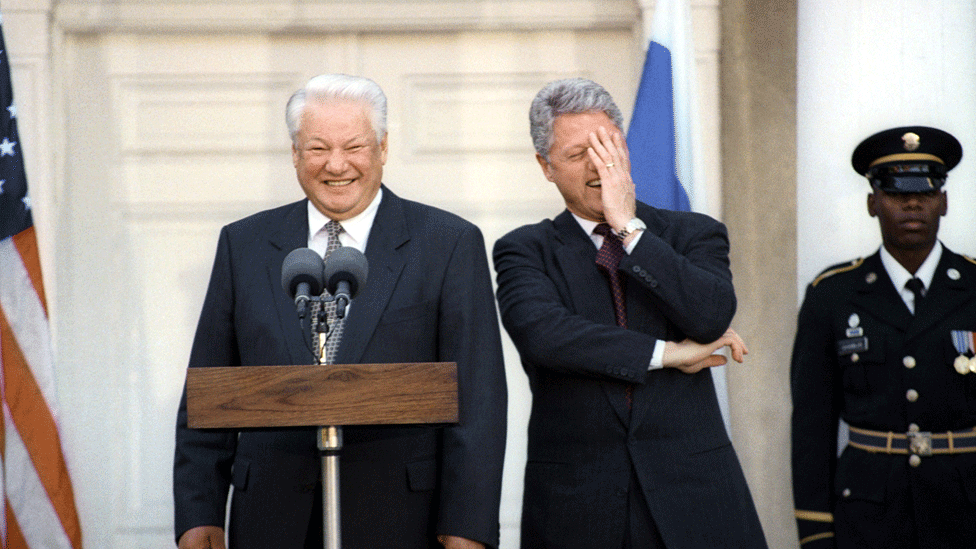
Let us limit our discussion to one single case. Readers will recall that in the run-up to the 1996 presidential election in Russia, opinion polls put the pro-western incumbent, Boris Yeltsin, in fifth place among the presidential candidates, with only 8% support. The same polls showed that the most popular candidate in Russia by a wide margin was the Communist Party’s Gennady Zyuganov. Moved to desperation by the numbers, well-connected Russian oligarchs suggested just cancelling the election and supporting a military takeover, rather than facing a defeat at the polls. Neocons in the West embraced the idea–all in the name of Democracy, of course. In the end, though, Yeltsin and the oligarchs decided to retain power by staging the election.
In keeping with Russian laws at the time, Zyuganov spent less than three million dollars on his campaign. Estimates of Yeltsin’s spending, by contrast, range from $700 million to $2.5 billion. (David M. Kotz, Russia’s Path from Gorbachev to Putin, 2007) This was a clear violation of law, but it was just the tip of the iceberg.
In February 1996, at the urging of the United States, the International Monetary Fund (which describes itself as “an organization of 188 countries, working to foster global monetary cooperation”) supplied a $10.2 billion “emergency infusion” to Russia.The money disappeared as Yeltsin used it to shore up his reputation and to buy votes. He forced the Central Bank of Russia to provide an additional $1 billion for his campaign, too. Meanwhile, a handful of Russian oligarchs, notably several big contributors residing in Israel, provided more billions for the Yeltsin campaign.
In the spring of 1996, Yeltsin and his campaign manager, billionaire privatizer Anatoly Chubais, recruited a team of financial and media oligarchs to bankroll the Yeltsin campaign and guarantee favorable media coverage on national television and in leading newspapers. In return, Chubais allowed well-connected Russian business leaders to acquire majority stakes in some of Russia’s most valuable state-owned assets.
Campaign strategists for the former Republican governor of California Pete Wilsoncovertly made their way to the President Hotel in Moscow where, behind a guard and locked doors, they served as Yeltsin’s “secret campaign weapon” to save Russia for Democracy. (Eleanor Randolph, “Americans Claim Role in Yeltsin Win,” L.A. Times, 9 July 1996) Yeltsin and his cohorts monopolized all major media outlets, print and electronic, public, and private. They bombarded Russians with an incessant and uncontested barrage of political advertising masquerading as news, phony “documentaries,” rumors, innuendos, and bad faith campaign promises (including disbursement of back pay to workers and pensioners, stopping further NATO expansion, and peaceful settlement of Yeltsin’s brutal war against Chechnya). Yeltsin campaigners even floated the threat that he would stage a coup and the country would descend into civil war if Zyuganov were to win the vote.
It is now public record that the Yeltsin campaign conducted extensive “black operations,” including disrupting opposition rallies and press conferences, spreading disinformation among Yeltsin supporters, and denying media access to the opposition. The dirty tricks included such tactics as announcing false dates for opposition rallies and press conferences,disseminatingalarming campaign materials that they deceitfully attributed to the Zyuganov campaign, and cancelling hotel reservations for Zyuganov and his volunteers. Finally, widespread bribery, voter fraud, intimidation, and ballot stuffing assured Yeltsin’s victory in the runoff election.
The day after his victory, Yeltsin disappeared from the scene and did not reappear until months later, drunk. During Yeltsin’s second term, the “non-ideological” IMF provided another infusion of money, this time $40 billion. Once again, more billions disappeared without a trace, much of it stolen by the President’s chronies, who placed it in foreign banks. The re-elected President didn’t even pretend to make good on his campaign promises.
Serious observers, including leading Democrats, agree that even if the recent hacking allegations against Russia turn out to be true, the “dirty tricks” did not affect the outcome of the 2016 election. By contrast, American meddling and financing of the 1996 presidential election in Russia clearly played a pivotal role in turning Yeltsin from a candidate with single-digit approval at the beginning of the yearinto a winning candidate with an official (but disputed) 54.4% of votes cast in the second-round runoff later that same year.
Let us consider some of the consequences of Yeltsin’s electoral win:
–In the first years of the Chubais-Yeltsin privatization scheme, the life expectancy of a Russian male fell from 65 years to 57.5 years. Female life expectancy in Russia dropped from 74.5 years in 1989 to 72.8 years in 1999.
–Throughout Yeltsin’s terms as President, flight of capital away from Russia totaled between $1 and $2 billion every month.
–Each year from 1989 to 2001 there was a fall of approximately 8% in Russia’s productive assets.
–From 1990 to 1999 the percentage increase of people living on lessthan $1 a day was greater in Russian and the other former socialist countries than anywhere else in the world.
–The number of people living in poverty in the former Soviet Republicsrose from 14 million in 1989 to 147 million in 1998.As a result of the 1998 financial collapse and the devaluation of the ruble, the life savings of tens of millons of Russian families disappeared over night. Since then, the Great Recession and low oil pries have only made matters worse.
–In the period from 1992 to 1998 Russia’s GDP fell by half–something that did not happen even under during the German invasion in the Second World War.
Under Yeltsin’s tenure, the death rate in Russia reached wartime levels. Accidents, food poisoning, exposure, heart attacks, lack of access to basic healthcare, and an epidemic of suicides—they all played a role. David Satter, a senior fellow at the anti-communist, Washington DC-based Hudson Institute, writing in the conservative Wall Street Journal, described the consequences of this victory of Democracy: “Western and Russian demographers now agree that between 1992 and 2000, the number of ‘surplus deaths’ in Russia–deaths that cannot be explained on the basis of previous trends–was between five and six million persons.” (Accessed 8 April 2015. American sociologist James Petras has given a figure of 15 million surplus deaths since the demise of the Soviet Union.)
NATO continued its expansion east. Yeltsin turned the Chechen city of Grozny into a field of rubble, and he quickly became the most reviled man in Russia. But as one observer put it at the time, “Yeltsin didn’t seem to notice, which is hardly surprising, since he was drunk for most of his tenure in office.”By the time he left office, the American-approved President of the Russian Federation had an approval rating of 2%. (CNN, 2002) But by that time it didn’t matter: the kleptocrats were safely installed in power, and American-imposed Democracy had achieved its aims in Russia’s “transition.”
Yeltsin died in 2007, celebrated as an anti-communist hero by the neocons in Washington and New York, but hated by the vast majority of Russians. Four years later, Dmitri Medvedev, then-President of Russia, eulogized Yeltsin for creating “the base of a new Russian statehood, without which none of our future successes would be possible.” But a Time magazine writer reported that, despite Medvedev’s public praise, the story he told privately was quite different. On 20 February 2012, he reportedly told attendees at a closed-door meeting: “Russia’s first President did not actually win re-election in 1996 for a second term. The second presidential vote in Russia’s history, in other words, was rigged.” (Simon Shuster, “Rewriting Russian History: Did Boris Yeltsin Steal the 1996 Presidential Election?” Timeonline, 24 Feb. 2012.)

Some readers, perhaps, do not see the point of reminding ourselves of America’s role in the election of Yeltsin and America’s responsibility for the resulting misery and mass death. But let us remind ourselves that the recent hacking accusations are just one element of a full-on media assault against Russia, led by Washington. From supposed Russian war crimes in the fight against the murderous jihadi occupiers of Syria to Russia’s re-annexation of overwhelmingly pro-Russian Crimea and the doping of Olympic athletes, America’s neocons are engaged in a propaganda blitz with high stakes.
Armenia is one of many frontline positions in Washington’s escalating media campaign against Russia. Yes, the Russian Federation is an imperialist state, in V.I. Lenin’s technical sense of the term. And yes, Russia wields undo influence in Armenia. But by now it is clear that greater sovereignty for Armenia is not what is at stake when it comes to the Russophobe opposition. After all, the Russia haters do not seem to have much problem with the idea of giving up sovereignty to the American imperialists and their regional surrogate, the Republic of Turkey. More importantly, the cause of greater national sovereignty will be harmed if the Russia haters have their way. They only confirm the pervasivesense of vulnerability, economic isolation, and military encirclement among Russians, a people who have endured three decades of enormous destruction and humiliation, after a century of invasion and wars that claimed the lives of tens of millions of their compatriots.
Let us remind ourselves that the loudest of Yerevan’s Russia haters are the same fanatics who led Armenia to its present state of ruin. After so much failure and disaster, they continue to hawk the old dangerous fantasy of Uncle Sam as Armenia’s savior. They are unrepentant, and like Yeltsin, they take their marching orders from Washington.

Originally published on 2017-01-13
About the author: Markar Melkonian is a teacher and an author. His books include Richard Rorty’s Politics: Liberalism at the End of the American Century (1999), Marxism: A Post-Cold War Primer (Westview Press, 1996), and My Brother’s Road (2005).
Source: Hetq.am
Origins of images: Facebook, Twitter, Wikimedia, Wikipedia, Flickr, Google, Imageinjection, Public Domain & Pinterest.
Read our Disclaimer/Legal Statement!
Donate to Support Us
We would like to ask you to consider a small donation to help our team keep working. We accept no advertising and rely only on you, our readers, to keep us digging the truth on history, global politics and international relations.
[wpedon id=”4696″ align=”left”]
FOLLOW US ON OUR SOCIAL PLATFORMS