
How a Single Remark Stole a Lithuanian Writer’s Livelihood
“I’m supposed to go in to the prosecutor’s office for questioning next week. I’ve never experienced interrogation before. Life should be interesting.” In a less upbeat exchange, when I asked her about her next project, Vanagaitė said, “Trying to avoid prison.” It was unclear what Vanagaitė might go to prison for—she had not been formally charged—but it has something to do with desecrating the memory of one of Lithuania’s national heroes [...]
The title page of Rūta Vanagaitė’s best-known book contains two pictures of young men. “This one is a Jew,” she said, pointing at the picture on the left. “He was a bicycle-racing champion. Good enough to represent Lithuania in international competitions, but not good enough to live.” He was executed during the Holocaust. The man in the picture on the right was a Lithuanian executioner. “They are both us,” Vanagaitė explained. “But Lithuanians don’t like to think of them as ‘us,’ because one is a Jew and the other is a killer.” Her book is called “Us.” (The title has also been translated as “Our People.”)
I met Vanagaitė at a New York City coffee shop on Wednesday. After a few weeks in the United States, she was scheduled to return to Lithuania on Friday. As we talked, she sounded alternately cavalier and frightened at the prospect of going home. “I want to try everything,” she said at one point. “I’m supposed to go in to the prosecutor’s office for questioning next week. I’ve never experienced interrogation before. Life should be interesting.” In a less upbeat exchange, when I asked her about her next project, Vanagaitė said, “Trying to avoid prison.” It was unclear what Vanagaitė might go to prison for—she had not been formally charged—but it has something to do with desecrating the memory of one of Lithuania’s national heroes.
In hindsight, it’s clear that she had been hurtling toward this moment for a few years. In 2016, Vanagaitė, then sixty-one, was known as a theatre critic, a political public-relations consultant, an event organizer, and the author of popular nonfiction, especially a 2013 book for and about women in and past middle age. The book, which advocated living life to the fullest, was a phenomenal best-seller. Vanagaitė told me that her publisher asked her to follow up with a book about men. “I said I would do it, but first I have something else I want to write,” she said.
That project was “Us.” Vanagaitė had become obsessed with something she had learned from a historian: that the Holocaust in Lithuania was carried out largely not by German occupiers but by Lithuanians themselves. “It involved a huge number of people rather than a handful of freaks, as I’d always thought,” she told me. She set out to learn what her own relatives had done during the war. Her grandfather, a civil servant, had taken part in making a list of eleven undesirables, all of whom happened to be Jewish, and all of whom were executed. It was conceivable that he didn’t quite know what the list was for. The case of Vanagaitė’s aunt’s husband was less ambiguous: he served as a chief of police under the Nazi occupation.
Vanagaitė spent six months doing archival research and then set off to see the sites of mass executions. She cast about for an intern to accompany her on the road, and ended up with an unexpected companion: Efraim Zuroff, the head of the Jerusalem office of the Simon Wiesenthal Center—and the last of the Nazi hunters. “Us” has a subtitle: “Travels with the Enemy.” The meaning of “enemy” is as unstable as the meaning of “us”: the collaborators and executioners are the enemy here, and so are the Nazi occupiers. But Zuroff, who is a descendant of Lithuanian Jews, and Vanagaitė were also historical enemies. Together, they visited forty execution sites in Lithuania—about a fifth of the total number—and seven more in what is now Belarus.
As it happens, I interviewed Zuroff, in Jerusalem, for another story about five years ago. He told me that, after the collapse of the Soviet Union, in 1991, he had had high hopes for finding Nazi criminals in the three newly liberated Baltic states. He placed ads in local papers, offering a generous reward for information that would lead to the arrest of collaborators. He got a total of zero tips, and when we spoke he was still unsure about what had stopped people from coming forward. Was it a distaste for snitching, a sense of solidarity with fellow-citizens, or a fear of retribution? It was probably all of these things. Vanagaitė told me that, in her book, she didn’t thank the Lithuanian historians who helped her navigate the archives because they feared the attention that a popular book might bring.
Vanagaitė did little to protect herself, though. “My objective was to shock,” she told me. She looked for examples that would haunt her readers, like the story of a group of trade-school students who didn’t want to go home for the summer in 1941. They got jobs on the execution squads instead. When the summer was over, they returned to school.
“Us,” published last year, was a best-seller. Vanagaitė made new enemies, to be sure, but she kept her friends and family, and gained thousands of readers. She wrote the book about men that she had promised her publisher, and then she wrote a memoir, which she titled “A Chicken with the Head of a Herring.” This was an epithet that one of her online critics had used, and she thought that it communicated an appropriately ironic attitude toward the self-aggrandizing enterprise of an autobiography. Vanagaitė had achieved an exceedingly rare level of literary success: she lived off the royalties from her books.
The day before the launch for her autobiography, in late October, Vanagaitė was doing interviews. One journalist asked her about the government’s plans to declare 2018 the year of Adolfas Ramanauskas, a legendary Lithuanian anti-Soviet resistance fighter. Ramanauskas led a guerrilla unit from 1945 to 1952 and lived under an alias for another five years before being arrested and executed. Vanagaitė had studied Ramanauskas’s K.G.B. file, and now she told the journalist what she had found in it: it seemed that Ramanauskas had at one point agreed to be a K.G.B. informant. She said that he may not have been the hero Lithuania holds him to be.
On October 26th, Vanagaitė’s memoir was launched with a lavish party. There was chicken, herring, and bubbly. The following morning, Vanagaitė got a call from a journalist asking for her reaction to her publisher’s announcement that it was withdrawing all of her titles from all bookstores. Thousands of copies would be pulped. Vanagaitė’s source of livelihood was gone.
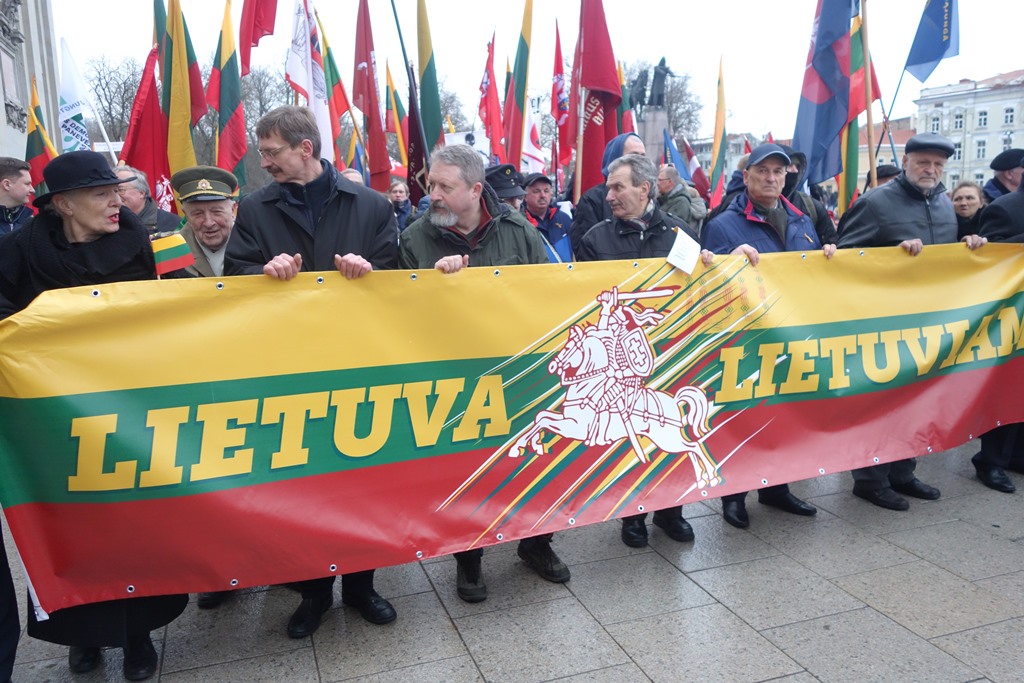
Gone, too, was her ability to venture outside her home. She tried—after the initial barrage of phone calls, she went out, accompanied by her nephew, and was immediately accosted by passersby. “They called me a pro-Putin Jewish whore,” she said. What does Vladimir Putin have to do with it? The post-Soviet Lithuanian narrative centers on othering all the horrors of the twentieth century: in this story, Lithuanians are a good, pure, and freedom-loving people who suffered under the Soviet occupation of 1940 to 1941, the German occupation of 1941 to 1944, and the Soviet occupation of 1945 to 1991. In its broad outlines, the story is undoubtedly true, but, like any historical myth, it’s an oversimplification: thousands of Lithuanians collaborated with the occupations. Some Lithuanians are willing to accept the fact that their countrymen collaborated with the German occupation, but the Soviet occupation—which lasted nearly half a century, and still hasn’t been acknowledged by Russia—is a story that tolerates no challenge.
Like most European states, Lithuania legislates memory. In a new book called “Memory Laws, Memory Wars: The Politics of the Past in Europe and Russia,” Nikolay Koposov, a Russian exile who teaches at Emory University, in Atlanta—and who has some sympathy for the project of setting legal boundaries of historical discourse—calls the Lithuanian law “an extreme example of the tendency to use memory laws to promote national narratives and shift the blame for crimes against humanity to others.” The law, enacted in 2010, was used the following year to prosecute Algirdas Paleckis, a Lithuanian diplomat who suggested that Moscow authorities who cracked down on Lithuania in January, 1991, had been aided by Lithuanian collaborators. Paleckis paid a fine, and his political career was effectively ended. If there have been other prosecutions since, none has been as high-profile as Paleckis’s—or as Vanagaite’s will be, if she is charged.
Vanagaitė stopped going outside; she had food delivered. After about two weeks, she left the country, assuming that, after a few weeks, the controversy would die down. It did not. Vanagaitė issued a public apology, and when she talked to me she sounded if not contrite then at least understanding. “I realize that I’ve crossed a line,” she said. “When I was writing my book, I thought everything through. But in this interview I was very arrogant. What I should have phrased as a question I said as an affirmative statement. I should have asked if Ramanauskas is the hero we think he is. Instead, I said, ‘He is no hero.’ ” The distinction is not merely grammatical. K.G.B. archives are notoriously unreliable—Ramanauskas may indeed have been an agent, or the person who claimed to have recruited him may have been lying. Vanagaitė’s sources among historians believe that Ramanauskas went into the forest, where he became a guerrilla fighter, immediately after agreeing to be an informant.
“I’ve destroyed everything,” Vanagaitė said. “I’ve destroyed my career as a writer, because no publisher will sign me now and no bookstore will agree to distribute my books.” She said that none of her friends will publicly support her now; her family stands by her, but she is afraid that the association will harm them. “Every country needs its positive myth. Ours was that we had the longest-running resistance movement in the world,” she said. Ramanauskas, who is said to have stayed in the forest, fighting, for seven years, embodied this myth. “Now I’ve destroyed that, too.”
But then she added, “When I’m on my deathbed, I’ll write about that resistance movement.”
Origins of images: Facebook, Twitter, Wikimedia, Wikipedia, Flickr, Google, Imageinjection, Public Domain & Pinterest.
Read our Disclaimer/Legal Statement!
Donate to Support Us
We would like to ask you to consider a small donation to help our team keep working. We accept no advertising and rely only on you, our readers, to keep us digging the truth on history, global politics and international relations.
Truth in Media, THE ORIGIN OF ISISBen Swann explores the origin of ISIS that has already been long forgotten by American media.Swann takes on the central issue of whether or not ISIS was created by “inaction” by the United States government or by “direct” action.Link to the movie: THE ORIGIN OF ISISOriginally posted by Ben Swann on Thursday, 19 March 2015.Origins of images: Facebook, Twitter, Wikimedia, Wikipedia, Flickr, Google, Imageinjection, Public Domain & Pinterest.Read our Disclaimer/Legal Statement!Donate to Support UsWe would like to ask you to consider a small donation to help our team keep working. We accept no advertising ...
According to Inside Syria Media Center military sources in Syrian Democratic Forces (SDF), SDF-Kurds will join the Syrian Arab Army (SAA) as “Northern Syria Protection units” after the establishment of the federal system in Syria.A Rojava official and the joint chief of defense in Syrian Kurdistan (Rojava), Rezan Gilo stated that the Kurdish-led Syrian Democratic Forces (SDF) have no problem joining the Syrian army if a federal state is awarded in northern Syria (Kurdish autonomous territories as part of the federal Syria). They are now in process of considering the possibility of joining the SAA.“There is no problem for our ...
“All that is a lie. This is a NATO-style trial.”The defiant words of General Mladic to the judges of the NATO controlled ad hoc war crimes tribunal for Yugoslavia rang out loud and clear the day they pretended to convict him. He could have added ‘but history will absolve me” and a lot more but he was thrown out of the room by the chief judge, Orie, in his condescending style, as if he was dealing to a truant schoolboy, instead of a man falsely accused of crimes he did not commit.The Russian Foreign Ministry spokeswoman, Maria Zakharova, echoed the ...
Note: We are republishing this essay by S. Brian Willson describing the true history of genocide in the United States which stands in stark contrast to the myth of Thanksgiving because of its popularity with readers and its educational value.The Defining and Enabling Experience of Our “Civilization” As we again plan to celebrate what US “Americans”call Thanksgiving, let us pause for a moment of reflection. Let us recognize that accounts of the first Thanksgiving are mythological, and that the holiday is actually a grotesque celebration of our arrogant ethnocentrism built on genocide.Native Americans in the Caribbean greeted their 1492 European invaders ...
One of the West’s top points in condemning Vladimir Putin’s “regime” since 2007 has been his alleged suppression of democratic institutions, including an assault on media freedom and imposition of government-directed propaganda. This week, the accusation was repeated in a resolution of the European Parliament calling for stronger counter-measures in defense of European values against “information warfare” from Moscow.The charges — that Russian media are only an instrument of state propaganda directed at the domestic population to keep Russian citizens in line and at foreign audiences to sow dissent among Russia’s neighbors and within the European Union — are taken ...
On March 24th, 1999, NATO launched its 78-day round the clock aerial assault on the Federal Republic of Yugoslavia without the approval of the United Nations Security Council. Over a thousand NATO warplanes delivered over 2,000 airstrikes in nearly 40,000 sorties, dropping over 20,000 bombs over the former Yugoslavia, killing thousands of civilian men, women, and children, as well as upwards of a thousand Yugoslav soldiers and police.[1] [2] [3] NATO employed weapons considered criminal by international law such as depleted uranium and cluster bombs.[4] [5] [6] [7]The popular narrative is that is that the Western powers dropped these bombs ...
PrefaceAfter the end of the USSR in 1991, Russia, at that time both weakened and isolated, was becoming a less popular area of investigation and studies compared with the period during the Cold War. However, since the year of 2004, Russia is “back” in the global political arena when Moscow rejected the European Neighboring Policy’s game with the European Union (the EU). Those who argued that Russia was already irrelevant in global politics since 2004 had to realize their error of judgment. Today, Russia is “back” as a military, economic, and political Great Power with tremendous energy resources.[1] Recovering Russia’s ...
For the Serbs as Christians, their loss of state independence and fall to the Ottoman Empire’s kind of theocratic state, was a terrible misfortune. With the advent of the Turks and establishment of their rule, the lands of Serbs were forcibly excluded from the circle of progressive European states wherein they occupied a prominent place precisely owing to the Byzantine civilization, which was enhanced by local qualities and strong influences of the neighboring Mediterranean states. Being Christians, the Serbs became second-class citizens in Islamic state. Apart from religious discrimination, which was evident in all spheres of everyday life, this status ...
Jomo Kenyatta (c. 1891 – 22 August 1978) was a Kenyan politician and the first President of Kenya. Kenyatta was the leader of Kenya from independence in 1963 to his death in 1978, serving first as Prime Minister (1963–64) and then as President (1964–78). He is considered the founding father of the Kenyan nation. Kenyatta was a well-educated intellectual who authored several books, and is remembered as a Pan-Africanist. He is also the father of Kenya's fourth and current President, Uhuru Kenyatta (Source: Wikipedia)Origins of images: Facebook, Twitter, Wikimedia, Wikipedia, Flickr, Google, Imageinjection, Public Domain & Pinterest.Read our Disclaimer/Legal Statement!Donate ...
A danger in both journalism and intelligence is to allow an unproven or seriously disputed fact to become part of the accepted narrative where it gets widely repeated and thus misleads policymakers and citizens alike, such as happened during the run-up to war with Iraq and is now recurring amid the frenzy over Russia-gate.For instance, in a Russia-gate story on Saturday, The New York Times reported as flat fact that a Kremlin intermediary “told a Trump campaign aide, George Papadopoulos, that the Russians had ‘dirt’ on Mr. Trump’s rival, Hillary Clinton, in the form of ‘thousands of emails.’” The Times ...
What is wrong with the American people? After several years of horrific policy toward the waking world, democracy’s standard bearers seem to be drowning in a lake of selfishness. Distracted, apathetic, or simply dumbed and numbed by unrelenting propaganda, the most admired society on Earth has turned to a wriggling mush of diverging ideals. I fear that American have become what we ultimately deplored, just another despicable cultural hegemony. Here’s a short brief on the matter.A recent article by James Carden at The Nation prompted me to discuss this unsavory truth today. The title of the piece, “Trump’s Syria Policy: ...
Long before Donald Trump successfully hung the “fake news” label on CNN, more discerning observers of the wars of the Yugoslav succession of the 1990s came to similar conclusions regarding the network’s news coverage of that tragedy. Headlined by Christiane Amanpour, CNN’s reporting, especially from Bosnia-Herzegovina and Kosovo, showed a clear pro-Muslim, anti-Serbian bias, painting the conflict in stark black-and-white colors, where the Christian Serbs were always the “black hat” “aggressors,” perpetrators of “genocide” and such, while the Bosnian and Albanian Muslims were inevitably the “white hat” “victims,” in dire need of U.S. and Western “humanitarian” intervention to spare them from extermination at ...
Last week, the Turkish Armed Forces entered Afrin in Syria’s Aleppo. According to the Syria-based Kurdish Hawar News Agency, Turkey also intends to deploy troops near the Raju area and place its armored vehicles there.Many Syrian experts believe that Ankara cooperates with the U.S.-backed Harakat Nour al-Din al-Zenki. Earlier, Spokesman of the armed opposition group Abdulsalam Adbulrazaq reported that Harakat Nour al-Din al-Zenki had reached an agreement with the Turkish troops over the deployment of Turkish soldiers at monitoring positions in Western Aleppo.According to preliminary estimates, Turkey will provide opposition militants with all necessary weapons, and Harakat Nour al-Din al-Zenki ...
Last movie by famous French movie maker Paul Moreira on Canal+ (France) broadcasted 01/02/2016.Some French citizens are now shocked after discovering the truth about the Odessa massacre and the Euromaidan bloody coup in 2013/2014.Interview to Paul Moreira:http://www.humanite.fr/derriere-les-masques-de-la-revolution-ukrainienne-597568Preview screening on January, 20th 2016 at FIPA Biarritz 29th edition, selected out of competition in Reportages and Investigation – Panorama of Creation category.Without them, there would have been no Ukrainian revolution.In February 2014, paramilitary groups fought against the police in the streets of Kyev and ousted President Yanukovych. They settled a new government.According to the western media, they were the revolution heroes. They ...
The interesting detail of the Lockerbie bombing was the extent of how far the plotters went to divert blame to Libya.There can be no better example of the old saying “a lie can travel half way around the world before the truth is even putting its shoes on” than Lockerbie. This tragic story of a U.S. passenger flight brought down by a bomb over the small Scottish village just a few days before Christmas in 1988 is heartbreaking on a number of levels. But the main one is that even to this day, the Americans continue to keep the huge ...
The superhighway to disaster is already being paved.From Donald Trump’s first days in office, news of the damage to America’s international stature has come hard and fast. As if guided by some malign design, the new president seemed to identify the key pillars that have supported U.S. global power for the past 70 years and set out to topple each of them in turn. By degrading NATO, alienating Asian allies, cancelling trade treaties, and slashing critical scientific research, the Trump White House is already in the process of demolishing the delicately balanced architecture that has sustained Washington’s world leadership since ...
IntroductionBelow are TENC's October 1999 interviews with three Serbian women from the Kosovo town of Orahovac. They recount how, prior to the June 1999 NATO-UN takeover of Kosovo, they believed NATO's promise that it would institute multi-ethnic harmony. They discovered too late that for NATO multi-ethnic meant rule by the Kosovo Liberation Army (KLA).In September, TENC had published its first interview with an eye-witness to the NATO-UN Kosovo takeover: Cedomir Prlincevic, President of the Jewish community and Chief Archivist in Pristina, capital of Kosovo.Mr. Prlincevic described how he and the rest of the small Jewish community were driven from their ...
First of all, taking into consideration the particular region of the Balkans in the context of Russia's national interests, we should consult official documents reflecting the wishes and intentions of the government. It is therefore necessary to consider Russia’s foreign policy doctrine.Foreign policy strategyThe Russian Federation's previous foreign policy doctrine was made public on July 15th, 2008.Russian objectives were marked as the following:- Impacting global processes in order to establish a just and democratic world order based on collective principles in solving international problems and on the rule of international law, primarily the UN Charter provisions as well as equal ...
A map of the wanted territories of the Balkan states in 1915There are many talks about nationalism among the peoples from the former Yugoslavia during the last three decades what is quite understandable taking into consideration the post-Cold War conflicts and atrocities, as a continuation of WWII crimes based on certain political ideologies,[i] committed on the territory of ex-Yugoslavia.Historia est magistra vitaeI want to argue that there is a direct link between contemporary nationalism(s) among the Yugoslavs and their national ideologies, which are developed in the previous decades and even centuries. What happened with the Yugoslavs from 1991 to 1999 ...
Origins of images: Facebook, Twitter, Wikimedia, Wikipedia, Flickr, Google, Imageinjection & Pinterest.Read our Disclaimer/Legal Statement!Donate to Support UsWe would like to ask you to consider a small donation to help our team keep working. We accept no advertising and rely only on you, our readers, to keep us digging the truth on history, global politics and international relations.