

Views: 1766
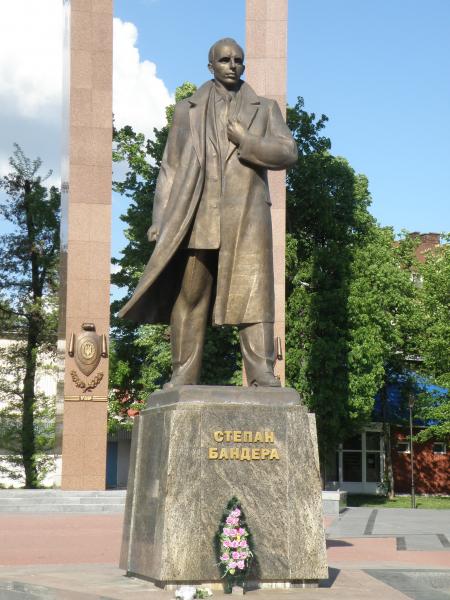
The incoming Ukrainian president will have to turn some attention to history, because the outgoing one has just made a hero of a long-dead Ukrainian fascist. By conferring the highest state honor of “Hero of Ukraine” upon Stepan Bandera (1909-1959) on January 22, Viktor Yushchenko provoked protests from the chief rabbi of Ukraine, the president of Poland, and many of his own citizens. It is no wonder. Bandera aimed to make of Ukraine a one-party fascist dictatorship without national minorities. During World War II, his followers killed many Poles and Jews. Why would President Yushchenko, the leader of the democratic Orange Revolution, wish to rehabilitate such a figure? Bandera, who spent years in Polish and Nazi confinement, and died at the hands of the Soviet KGB, is for some Ukrainians a symbol of the struggle for independence during the twentieth century.
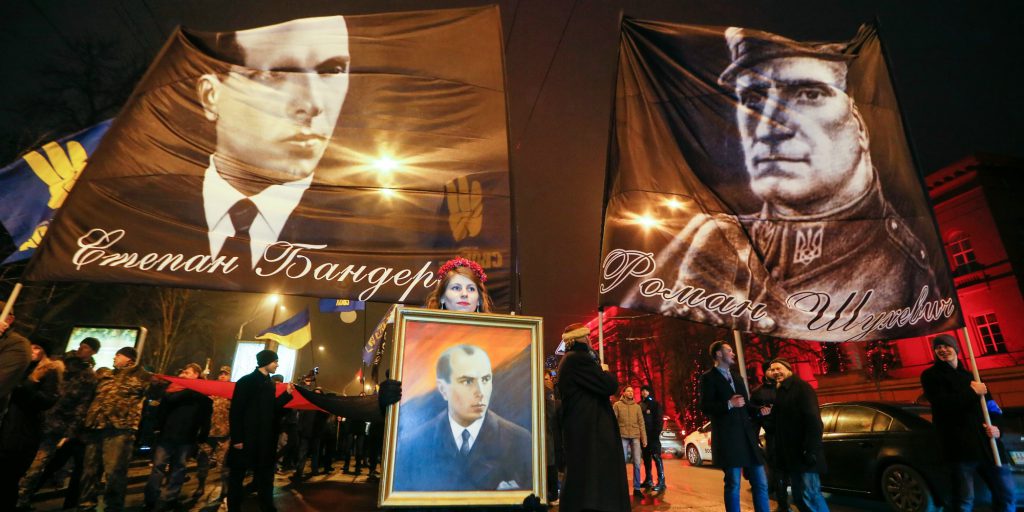
Born in 1909, Bandera matured at a time when the cause of national self-determination had triumphed in much of eastern Europe, but not in Ukraine. The lands of today’s Ukraine had been divided between the Russian Empire and the Habsburg monarchy when World War I began, and were divided again between the new Soviet Union and newly independent Poland when the bloodshed ceased. The Soviets defeated one Ukrainian army, the Poles another. Ukrainians thus became the largest national minority in both the Soviet Union and Poland. With time, most Ukrainian political parties in Poland reconciled themselves to Polish statehood. The Ukrainian Military Organization, however, formed of Ukrainian veterans in Poland, followed the movement that sought to change the boundaries of Europe: fascism. With Benito Mussolini, who came to power in 1922 in Italy, as their model, they mounted a number of failed assassination attempts on Polish politicians.
By the time the Ukrainian Military Organization became the Organization of Ukrainian Nationalists (OUN), in 1929, a younger generation was dominant. Young terrorists such as Stepan Bandera were formed not by the prewar empires, but by fascist ideology and the experience of national discrimination in Poland. In the 1920s the Polish authorities had closed Ukrainian schools and ignored Poland’s promise to provide for Ukrainian national autonomy. In the late 1920s and early 1930s, as a new Polish government sought reconciliation with its five million Ukrainian citizens, Ukrainian nationalists acted decisively to prevent any compromise settlement. Bandera was one of the main organizers of terror campaigns intended to prevent Ukrainians from accepting the Polish government by provoking Polish retaliation. The main targets of their assassination attempts were Ukrainians and Poles who wished to work together. The OUN assassinated the leading advocate of Ukrainian-Polish rapprochement, Tadeusz Holówko, in his sanatorium bed. They also sought (but failed) to kill Henryk Józewski, who was implementing a policy of national concessions to Ukrainians in Poland.
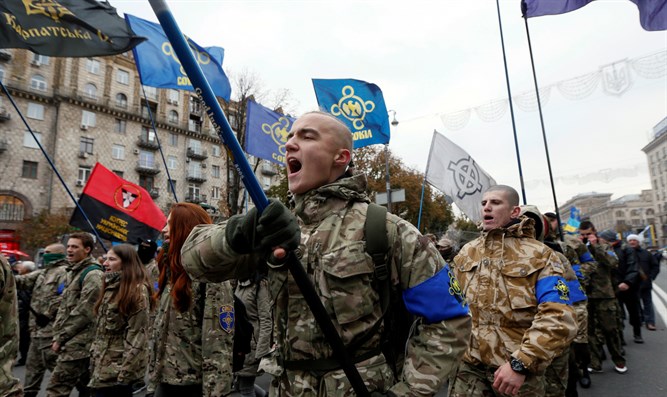
Bandera and his fellow Ukrainian nationalists were aware of the far greater repressions on the Soviet side of the border, where far more Ukrainians lived; given the effectiveness of the Soviet secret police, however, they could only act within Poland. They did nevertheless react to Josif Stalin’s deliberate starvation of millions of peasants in Soviet Ukraine in 1933. Bandera was probably involved in planning the revenge assassination of a Soviet diplomat in Poland late that year. Ukrainian nationalists hoped to use the trial of the young Ukrainian who carried out the assassination as a forum to spread the news of the famine, but Polish authorities did not allow this. Ukrainian nationalists (and many other Ukrainians in Poland and elsewhere) were embittered by the failure of the west to respond to the mass death in the USSR. 1933 was also the year when Hitler took power in Germany. Bandera and other Ukrainian nationalists saw the Nazis as the only power that could destroy both of their oppressors, Poland and the Soviet Union. OUN activists were in contact with German military intelligence.
In June 1934, the OUN assassinated Bronislaw Pieracki, the Polish minister of internal affairs, when he began to negotiate with moderate Ukrainian groups in Poland. For his part in organizing the murder, Bandera was sentenced to death—commuted to life imprisonment–-in January 1936. He was released from prison when the Germans invaded Poland in September 1939, and now sought to bring the OUN under his own command. Instead, it split into two factions, with Bandera commanding the more radical, known as the OUN-Bandera or OUN-B.
Bandera was active in a time and place where violence was very practicable, but where the chances that it would lead to Ukrainian national independence were minimal. His followers fell ever further into the maelstrom of violence on the eastern front, without thereby creating a Ukrainian state. The Germans did destroy Poland in 1939, as the Ukrainian nationalists had hoped; and they tried to destroy the Soviet Union in 1941. When the Wehrmacht invaded the Soviet Union that June, they were joined by the armies of Hungary, Romania, Italy, and Slovakia, as well as small contingents of Ukrainian volunteers associated with the OUN-B. Some of these Ukrainian nationalists helped the Germans to organize murderous pogroms of Jews. In so doing, they were advancing a German policy, but one that was consistent with their own program of ethnic purity, and their own identification of Jews with Soviet tyranny.
Ukrainian nationalist political goals, however, were not identical with Hitler’s. In June 1941, supporters of Bandera declared independence for a Ukrainian state, while promising cooperation with Nazi Germany. Adolf Hitler was not interested in Ukrainian independence on these or any terms, and eventually had most of the leadership of the OUN-B arrested. Bandera himself was incarcerated in Berlin and then in the camp at Sachsenhausen. Like other east European nationalists of stature, he was being held in reserve for some future contingency when he might be useful to the Nazis.

Bandera was still in the German camp at Sachsenhausen, and without influence, when his group took command of a partisan army in early 1943. As the tide turned against the Germans at the Battle of Stalingrad, Ukrainians who had served the Germans as auxiliary policemen left the German service and went into the forest. Among their duties as policemen had been the mass killing of west Ukrainian Jews. These Ukrainians, some of them members of the OUN-B, formed the core of the Ukrainian Insurgent Army (or UPA), which declared itself against both the existing German occupation and the coming Soviet one. Two leaders of Bandera’s organization, Mykola Lebed’ and Roman Shukhevych, brought the UPA under the control of the OUN-B.
Under their command, the UPA undertook to ethnically cleanse western Ukraine of Poles in 1943 and 1944. UPA partisans murdered tens of thousands of Poles, most of them women and children. Some Jews who had taken shelter with Polish families were also killed. Poles (and a few surviving Jews) fled the countryside, controlled by the UPA, to the towns, controlled by the Germans. Those who survived formed self-defense organizations, or joined the German police (replacing the Ukrainians) or the Soviet partisans who were fighting against the UPA. In all of these conflicts Poles took revenge on Ukrainian civilians. The UPA, for that matter, probably killed as many Ukrainians as it did Poles, since it regarded people who did not adhere to its own brand of nationalism as traitors.
After the Red Army drove the Germans from Ukraine in summer 1944, the UPA engaged Soviet forces in large-scale partisan war. In late 1944 the Germans released Bandera from Sachsenhausen, and he considered returning to Ukraine. His fellow Ukrainian nationalists dissuaded him from doing so, on the ground that he was too valuable as a symbol of the struggle and should not risk his life. Meanwhile thousands of Ukrainians died fighting for independence under his name. No other underground force resisted the Soviets for as long as the UPA, or caused such losses. By the end of the 1940s, however, the Soviets prevailed, having killed more than a hundred thousand Ukrainians, and deported many more to Siberia. If Soviet counts are reliable, Ukrainian nationalists suffered more mortal casualties fighting communist rule than did the US Army in the Korean and Vietnam wars combined.
It is this legacy of sacrifice that many in western Ukraine today associate with Bandera, and do not wish to be forgotten. The UPA also fought on the Polish side of the border, resisting a Polish communist regime there that was deporting Ukrainians from their homeland. Many people who joined the UPA in both the Soviet Union and communist Poland did so after the war, in self-defense, and took no part in the earlier murder campaigns. As the Cold War began, some OUN-B members and UPA fighters were recruited by British and American intelligence, and then dropped by parachute in doomed missions across the Soviet border. Soviet and Polish communists, having consolidated their rule by the late 1940s, demonized the OUN and the Ukrainian partisans as “German-Ukrainian fascists,” a characterization accurate enough to serve as enduring and effective propaganda both within and without the Soviet Union. Bandera himself remained in Germany after the war, a leading figure in the fractious milieu of Ukrainian nationalists in Munich. He remained faithful to the idea of a fascist Ukraine until assassinated by the KGB in 1959.
Fascism never had a significant influence in eastern and central Ukraine, and was only important in west Ukrainian political life in the very special circumstances of World War II and the partisan war against Soviet power, when terrorists with underground experience enjoyed a natural advantage. Nevertheless, Bandera is associated with a certain alternative history of the country, one which is beyond the reach of Russia and the Soviet Union. Bandera was born in the Habsburg monarchy rather than the Russian Empire, and his movement arose in Poland rather than the Soviet Union. These lands only became part of the Soviet Union as a result of World War II. Ukrainian nationalists from this region believed that they were taking part in a larger European movement, and they were right. The recovery from fascist ideology in southern, central, and western Europe took place only after World War II, in circumstances of American occupation and prosperity. For many people in western Ukraine, the triumphant westward march of the Red Army through their homeland was not so much a liberation as the beginning of another occupation, Soviet after Polish and German. The UPA was the only hope for national self-defense.

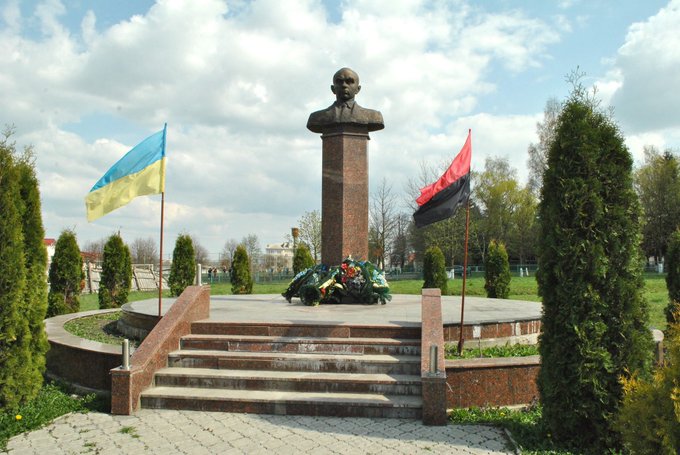
This is one telling of Ukrainian history, but it is not the dominant one. Yushchenko was soundly defeated in the first round of the presidential elections, perhaps in some measure because far more Ukrainians identify with the Red Army than with nationalist partisans from western Ukraine. Bandera was burned in effigy in Odessa after he was named a hero; even his statue in west Ukrainian Lviv, erected by city authorities in 2007, was under guard during the election campaign. For Yushchenko, who is not a west Ukrainian, the embrace of Bandera was part of a more general attempt to distance Ukraine from the legacy of Stalinism. As everyone who is interested in the history of Soviet Ukraine knows, from Vladimir Putin in Moscow to Ukrainian nationalist emigrants in Toronto, partisans fighting under Bandera’s name resisted the imposition of Stalinist rule with enormous determination. Thus there seems to be a certain binary political logic to Yushchenko’s decision: to glorify Bandera is to reject Stalin and to reject any pretension from Moscow to power over Ukraine.
Consistent as the rehabilitation of Bandera might be with the ideological competition of the mid-twentieth century, it makes little ethical sense today. Yushchenko, who praised the recent Kiev court verdict condemning Stalin for genocide, regards as a hero a man whose political program called for ethnic purity and whose followers took part in the ethnic cleansing of Poles and, in some cases, in the Holocaust. Bandera opposed Stalin, but that does not mean that the two men were entirely different. In their struggle for Ukraine, we see the triumph of the principle, common to fascists and communists, that political transformation sanctifies violence. It was precisely this legacy that east European revolutionaries seemed to have overcome in the past thirty years, from the Solidarity movement in Poland of 1980 through the Ukrainian presidential elections of 2005. It was then, during the Orange Revolution, that peaceful demonstrations for free and fair elections brought Yushchenko the presidency. In embracing Bandera as he leaves office, Yushchenko has cast a shadow over his own political legacy.
Originally published on 2010-02-24
Author: Timothy Snyder
Source: The New York Review of Books
Origins of images: Facebook, Twitter, Wikimedia, Wikipedia, Flickr, Google, Imageinjection & Pinterest.
Read our Disclaimer/Legal Statement!
Donate to Support Us
We would like to ask you to consider a small donation to help our team keep working. We accept no advertising and rely only on you, our readers, to keep us digging the truth on history, global politics, and international relations.