

A Constant Reminder to a Constant War: Militarism in American Society
The incorporation of militarism into American society is staggering. From the onset of the post-war era, civilian life was forever transformed and molded to meet the growing demands of the military-industrial complex [...]
The wars in the Middle East continue to rage unabated. Over the weekend a Russian war plane was struck down by an Al Qaeda affiliated group, Hayat Tahrir al-Sham, and once again stoked fears of widening the struggle in Syria between US and Russian proxy forces. It is yet another reminder of the ongoing and seemingly endless wars being waged in the Middle East, Africa and elsewhere around the globe.
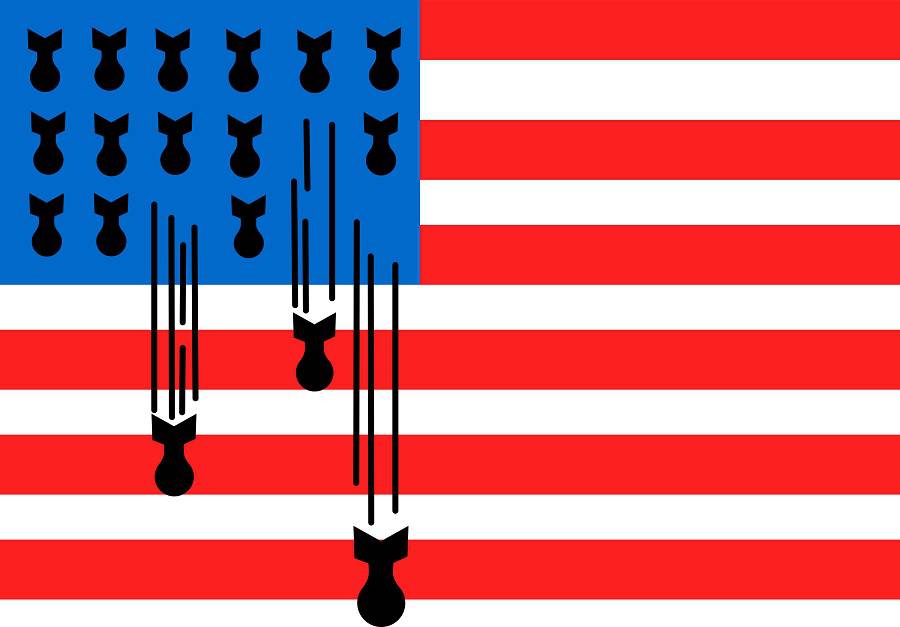
Our transition into this never-ending war paradigm, fashioned out of the events of the post 9/11 era, seeks only to benefit and further cement the pre-existing alliance between the US military and the proliferating arms industries; collectively known as the military industrial complex. This partnership represents the systematic convergence of the capitalist system and the modern American military establishment that was formed after the world conflicts of the first half the 20th century.
Ironically enough – one of the greatest leaders to emerge out of the American military institution was also one of its greatest critics. That of the former Supreme Commander of the Allied Forces during World War II and later President of the United States, Dwight D. Eisenhower.
President Eisenhower’s farewell address in January 1961 first propagated the dire warning of the ills of the military industrial complex. In his address, Eisenhower indicated that due to the continuous nature of world conflicts and America’s participation therein, the US government had “been compelled to create a permanent armaments industry” resulting in more expenditure on “military security than the net income of all US corporations.” [1]
This notion of a permanent armaments industry was at the time new to the American experience. Eisenhower was in an unique position to not only witness its creation during the militarization period of World War II, but also to observe its everlasting foundation during the advent of the Cold War. Tensions between the US and the Soviet Union produced a decades long arms race unprecedented in the history of the world. During this time the convergence between the military establishment and the armaments industry changed the very facet of American society and imbued the nation in an insatiable fixation on war.
The collapse of the Soviet Union did very little to stem the tide of militarization as new wars in the 21st century reasserted the need to increase defense spending. Between 2002-2011, according to the Stockholm International Peace Research Institute, sales among the top 100 arms companies grew by 51%.[2] Lockheed Martin, Boeing and Raytheon, the worlds top three arms manufacturers in respect to net worth, had a combined annual revenue of over $95 billion USD in 2014 alone.[3]
Eisenhower fretted over the “unwarranted influence” potentially garnered by the military industrial complex leading to a disastrous path of “misplaced power” in the councils of government. This is explicitly evident in the intimate business dealings between the US Department of Defense (DoD) and the largest arms manufacturer, Lockheed Martin. By far its principal customer, US government military expenditures account for 60% of the $45Bn USD revenue it receives in a year.[4] Lockheed Martin’s contracts and influence within the US government is certainly perpetuated by its extensive lobbying, amounting to $241,738,668 USD between 1998-2017; according to opensecrets.org.[5]
As Eisenhower no doubtfully realized, America’s relationship with war making allowed it to better pursue its political and military objectives abroad in tandem to realizing its economic agenda at home. He spoke of the “prospect of domination of the nation’s scholars by federal employment” along with the influence of money “to be gravely regarded.”[6] With America’s ever expanding military role, it comes to no surprise that the DoD became one of the country’s largest employer with nearly two million personnel.[7] Lockheed Martin, according to their official site, has either core factories or one of its many subsidiary companies in all 50 US states while touting to employ 115,000 people.[8] The so called “revolving door” phenomena, where government and private employment mix is also a deeply ingrained ritual. An article released by the Huffington Post in 2012 stated that upwards to 70% of retired US generals enter into contracts with arms manufacturers or defense related consultancies.[9]

Advances in technology also play a pivotal role in the sweeping changes in America’s industrial-military posture. Recent developments in aerodynamics, chip processing speed, automation, AI and machine learning along with expansions in telecommunications and the internet are spurred by massive R&D investments by the military establishment. The defense advance research projects agency or DARPA is one of the leading research institutes in the world and comprises renowned academics, private and governmental partners. Its sole mission is to “make pivotal investments in breakthrough technologies for national security.”[10] DARPA’s advances are often kept secret and its intentions are frequently debated by the public at large.
The incorporation of militarism into American society is staggering. From the onset of the post-war era, civilian life was forever transformed and molded to meet the growing demands of the military-industrial complex. Its take over was systematic yet subtle, hidden behind the veil of democracy and American exceptionalism. Whether or not the state’s hijacking by the military establishment was deliberate or just a manifestation of empire building, the results become the same; a captive public policy by scientific-technological elites.
According to Eisenhower, “Only an alert and knowledgeable citizenry can compel the proper meshing of the huge industrial and military machinery of defense with our peaceful methods and goals, so that security and liberty may prosper together.”[11]
In a world fraught with uncertainty – a constant reminder is needed for a society in constant war.
Notes:
[1] Eisenhower, Dwight. Farewell Radio and Television Address to the American People, January 17th 1961. Speech transcript. https://www.eisenhower.archives.gov/all_about_ike/speeches/farewell_address.pdf
[2] Weigley, Samuel. 10 Companies Profiting Most from the War. USA Today. March 10th 2013, updated March 10th 2013 https://www.usatoday.com/story/money/business/2013/03/10/10-companies-profiting-most-from-war/1970997/
[3] Pai, Priyanka. Top 10 Largest Weapons Manufacturing Companies in the World. Tharawat Magazine. July 14th, 2015. https://www.tharawat-magazine.com/facts/top-10-largest-weapons-manufacturing-companies/#gs.Boff2MI
[5] Top Spenders. Open Secrets, Center for Responsive Politics. https://www.opensecrets.org/lobby/top.php?showYear=a&indexType=s
[6] Eisenhower, Dwight. Farewell Radio and Television Address to the American People, January 17th 1961. Speech transcript. https://www.eisenhower.archives.gov/all_about_ike/speeches/farewell_address.pdf
[7] United States Department of Defense (Official Website). Modified January 27th,2017. https://www.defense.gov/About/
[8] Who We Are. Lockheed Martin Official Website. https://www.lockheedmartin.com/us/who-we-are.html
[9] Johnson, Luke. Report: 70% of Retired Generals Took Jobs with Defense Contractors or Consultancies. Huffington Post. November 19th, 2012. Last updated November 20th, 2012. http://www.huffingtonpost.ca/entry/defense-contractors-generals_n_2160771
[10] About DARPA. DARPA Official Webpage. https://www.darpa.mil/about-us/about-darpa
[11] Eisenhower, Dwight. Farewell Radio and Television Address to the American People, January 17th, 1961. Speech transcript. https://www.eisenhower.archives.gov/all_about_ike/speeches/farewell_address.pdf
Originally published on 2018-02-10
About the author: Andre Bermont is the Editor-in-Chief for cuibononews.com, news aggregation, and content website.
We would like to ask you to consider a small donation to help our team keep working. We accept no advertising and rely only on you, our readers, to keep us digging the truth on history, global politics, and international relations.
NATO has expanded dramatically after the collapse of its primary rivals, the USSR and the Warsaw Treaty Organization, Canadian Professor Michael Jabara Carley notes, posing the question whether NATO was founded as a defensive or an offensive alliance.The North Atlantic Treaty Organization (NATO), a military alliance aimed against the Soviet Union, was established on April 4, 1949; and only seven years after the formation of NATO the Warsaw Treaty Organization was established bringing together eight nations (versus 15 NATO member-states).So, who was the real “aggressor”? What alliance was an offensive one?“There has been much discussion recently of NATO in the mainstream and alternate media. Why was ...
On 23 April 1999, a NATO missile attack on Radio Television of Serbia (RTS) headquarters killed 16 employees of the state broadcaster. The forgotten war crime occurred during the Kosovo War (March 1998-June 1999), and was part of NATO’s aerial campaign alongside the US-backed Kosovo Liberation army, in opposition to the Federal Republic of Yugoslavia.In the aftermath of the attack there were no great public campaigns launched for the 16 murdered journalists and employees, no outpouring of emotion for those killed, no calls for solidarity and togetherness in the face of aggression. On the contrary the West justified this grievous ...
In nineties, Srebrenica was the center of terrorist activities – « Jihad », the Muslim 28th Division under the command of Naser Oric Monster, with the participation of mujahedeens operated here, covered by UN and US forces. In 1993, The Embassy of Bosnia & Herzegovina, in Vienna, even issued the Bosnian passport to Osama bin Laden! Thus, Bin Laden became honored Bosnian citizen, under blessings of the Bill Clinton administration.The US diplomacy is still supporting the pro-Muslims’ politics in the Balkans. Bil Laden was killed, but his mujaheedins can still freely work in Kosovo, Bosnia and Macedonia. How is that ...
Throughout its long history, the Catholic Church has been rocked by scandals ranging from the dissolution of the Knights Templar to Galileo’s trial to Mother Theresa’s questionable donors. Over the course of the 20th century, many more scandals have come to light—no matter how much the Church would like to keep them secret.10. The Duplessis OrphansIn the 1930s and 1940s, a conservative revolution ushered in an era in Quebec now known as “The Great Darkness.” Led by Premier Maurice Duplessis, the period was characterized by unprecedented corruption and repression, much of which involved the Catholic Church. After Duplessis received the ...
Origins of images: Facebook, Twitter, Wikimedia, Wikipedia, Flickr, Google, Imageinjection & Pinterest.Read our Disclaimer/Legal Statement!Donate to Support UsWe would like to ask you to consider a small donation to help our team keep working. We accept no advertising and rely only on you, our readers, to keep us digging the truth on history, global politics and international relations.
All of the Balkans, legendary German Reichskanzler (Imperial Chancellor) Otto von Bismarck famously said, were not worth the bones of a single Pomeranian grenadier. And Bismarck, a Prussian landowner or junker had nothing but amused contempt for Pomeranian grenadiers who were regarded as a standing joke in the German Army.In 1890, brash, young new German Emperor Wilhelm II fired Bismarck after 28 years as minister-president of Prussia and then first Imperial Chancellor of Germany. He abandoned the priority policy of maintaining warm ties and close communications with Russia that Bismarck had always followed and scrapped the Dreikaiserbund, the League of ...
As we can see from the local conflicts of the past few decades, terrorist groups are able to control large territories only if they get outside support and gain initial access to military infrastructure. During the 1990s, Chechen separatists were receiving weapons from Soviet troops stationed in the Chechen Republic, as well as assistance coming from across the Georgian border until the Russian forces managed to cut it off. The Kosovo separatists enjoyed the open support of the West and received regular arms supplies from Albania. The Syrian "liberation movements" have been fighting the legitimate Assad regime and its allied ...
Chris Deliso of Balkanalysis points out the latest travesty of the Western media: 59,000 stories on Auschwitz, three on Jasenovac. As if the third-largest death camp in Nazi-occupied Europe simply never existed. Franjo Tudjman certainly thought so, and it appears the current Croatian leadership shares his "historical" perspective.Contemporary German estimates of Serbs murdered by the Ustasha (in Jasenovac and elsewhere) ranged as high as 750,000. Wiesenthal center uses the number of 600,000. Serbian researchers have spoken of up to 700,000 victims. Modern revisionists, Croat and otherwise, talk of 30-100,000, at most. Among them is the U.S. Holocaust Memorial Museum, which ...
The bleak truth is that a careful review of the activities of the CIA and the organizations from which it sprang reveals an intense preoccupation with the development of techniques of behavior control, brainwashing, and covert medical and psychic experimentation on unwitting subjects including religious sects, ethnic minorities, prisoners, mental patients, soldiers and the terminally ill. The rationale for such activities, the techniques and indeed the human subjects chosen show an extraordinary and chilling similarity to Nazi experiments.This similarity becomes less surprising when we trace the determined and often successful efforts of US intelligence officers to acquire the records of ...
The historical background of the Israeli-Palestinian conflict goes back to 1917 (the Balfour Declaration) and the establishment of the British protectorate over Palestine (the Palestine Mandate) after WWI with its provision for a national home for the Jews, although formally not to be at the expense of the local inhabitants – the Palestinians. Nevertheless, it became in practice the focal problem to keep an appropriate balance between these stipulations to be acceptable to both sides – the Jews and the Palestinians.The people and the land Since the time of the Enlightenment followed by Romanticism, in Western Europe emerged a new trend ...
What is conflict about? The Zionist Israeli-Arab Palestinian conflict today is one of if not the most significant global security problems to be dealt with.[1] However, this conflict is historically not much old as it is a pretty modern issue, dating, in fact, since the First Zionist Congress in 1897. The focal question is: What is conflict about? In other words: What are those two different groups fighting for?At first glance, it can be understood that behind the conflict reasons is a confession as those two peoples are of different denominations: the Jews are predominantly Judaists while the Palestinian predominant confession ...
Can we face it in this election season? America is a weapons factory, the White House a war room, and the president the manager of the neoliberal conspiracy to recolonize the planet. It exports war and mass poverty. On the economic front, usurious neoliberalism; on the military front, illegal wars. These are the trenches of America’s battle for world domination in the 21st century.If not stopped, it will be a short century.Since 1945, America’s Manifest Destiny, posing as the Free World’s Crusade against the Red Menace, has claimed 20 to 30 million lives worldwide and bombed one-third of the earth’s ...
PrefaceThe current war conflict in Syria and constant warfare between the Israeli state and the Palestinians which recently erupted once again in Gaza strip brought the region of the Middle East to the world attention once again. However, the Middle East is a natural-geographic continuation of the Mediterranean Sea basin and, therefore, it is a part of the broader Mediterranean geopolitical game. Nevertheless, the geopolitical and geostrategic importance of the Mediterranean Sea basin is probably of the highest level from the global perspective.An importance of the Mediterranean Sea area in geopolitical and geostrategic standpoint one can understand from the very ...
The United States of America has sunk to a new low in diplomacy and civilized relations between nation states with its demand that Russia close its consular missions in San Francisco, Washington and New York, quickly followed by its order that the consular staff leave the premises while the FBI conducted a search of the premises and staffers personal apartments. To order the closure of a mission, or to order the withdrawal of a member of diplomatic staff, is within its right but a search of consular property is not. It is a flagrant violation of the Vienna Convention on ...
This last Friday it became public record that FBI Director James Comey reopened the Hillary Clinton email server investigation after repeatedly testifying before Congress and the world up to last July that he’d closed the case, after in his words not finding sufficient evidence of “any criminal wrongdoing” to indict her in spite of her four years as Secretary of State egregiously breaching our national security:’ -committing obstruction of justice and willful tampering with evidence,-deleting 30,000 emails after receiving a court subpoena constituting destruction of evidence, -not to mention repeatedly engaging in perjury before Congress and the FBI.But obviously a federal investigation still in process in late June never stopped Bill Clinton’s illegal ...
Ante Pavelic - a leader of the Independent State of Croatia with the Roman Catholic clergy Scattered over almost two centuries across the globe – in Germany, the US, Canada, Argentina and Australia – most members of the Croatian diaspora are still closely linked to their homeland.The Croatian state responds in kind; it pledges to take “special care” of Croats living abroad, a pledge outlined in the country’s 1990 constitution. Subsequently, Croatia has set up the Central State Office for Croats Abroad, as well as a government body, the Council for Croats Abroad.More controversially, some in the diaspora maintain close ...
Kosovo Albanian Muslims and their unthinking and duped supporters in the US are denying the Holocaust when they claim that Albanians rescued 100% of the Jews in Kosovo and in Albania. Albanian Muslims are Holocaust deniers like Mahmoud Ahmadinejad, yet Albanians are not ostracized. Why? Why are Albanian Muslims and their lackeys and stooges in the US allowed to get away with denying the Holocaust, with falsifying their role in the destruction of European Jews?The ignorance of the Albanian lobby is appalling. Albanian Muslims played a role in the Holocaust. Who claims this?Raul Hilberg, the founder of Holocaust studies and ...
Origins of immages: Facebook, Twitter, Wikimedia, Wikipedia, Flickr, Google & Pinterest.
Read our Disclaimer/Legal Statement!
Donate to Support Us
We would like to ask you to consider a small donation to help our team keep working. We accept no advertising and rely only on you, our readers, to keep us digging the truth on history, global politics and international relations.
[wpedon id="4696" align="left"]
Origins of images: Facebook, Twitter, Wikimedia, Wikipedia, Flickr, Google, Imageinjection, Public Domain & Pinterest.Read our Disclaimer/Legal Statement!Donate to Support UsWe would like to ask you to consider a small donation to help our team keep working. We accept no advertising and rely only on you, our readers, to keep us digging the truth on history, global politics, and international relations.
IntroductionThe last open armed conflict in the Former Yugoslav Republic of Macedonia – FYROM (former Socialist Republic of Macedonia as one of six federal republics of the Socialist Federal Republic of Yugoslavia) in May 2015 was just an expected continuation of constant tensions between the ethnic Albanians and the Macedonian Slavs during the last quarter of a century.[i] However, these tensions are time to time transformed into the open armed conflicts of the Albanian extremists, usually coming from Kosovo, with the Macedonian security forces.The most notable conflict incidents in Macedonia after the Kosovo War in 1998−1999, when the Kosovo Albanians ...