
Protesters have called for all statues of the former imperial ruler to be removed in recognition of his massacres in the Congo.
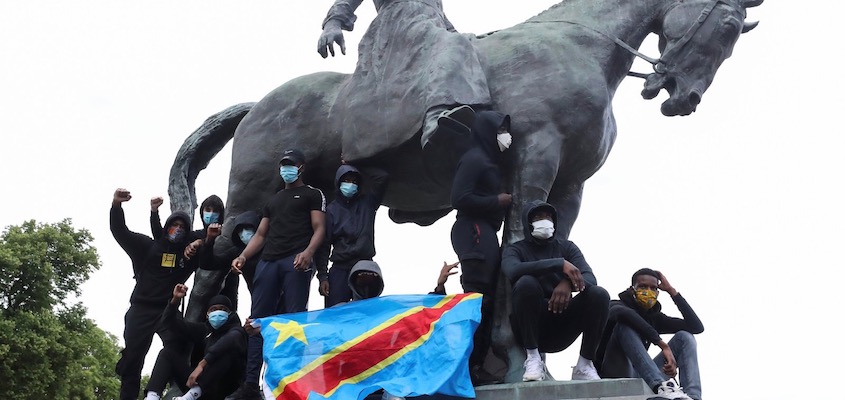
As 10,000 people took to the streets of Brussels on Sunday (7 June) to protest as part of the Black Lives Matter movement, there was one landmark which drew their ire more than any other: the equestrian statue of King Leopold II outside Belgium’s royal palace.
“Murderer!” the protesters cried as they climbed the statue and waved the flag of the Democratic Republic of Congo. Had the statue been flimsy enough to pull down they would have done it, just as fellow BLM protesters toppled Edward Colston’s statue across the channel in Bristol. Estimates vary, but the consensus figure is that 10 million Africans were killed during Leopold’s brutal reign (1885-1908) in his ironically named Congo Free State.
The global BLM movement has sparked renewed calls for the 14 statues of Leopold scattered throughout Belgium to be taken down (as one in Antwerp has been) and the many places named after him to be renamed. A petition to remove the most egregious monument in the seaside town of Ostende, which depicts a group of Congolese people kneeling below Leopold in “gratitude”, has attracted 65,000 signatures in a week. In 2004, activists cut off the hand of one of the Africans – the act Belgian soldiers inflicted on Africans who hadn’t met their rubber quota. (Protesters have promised to return it if the current king acknowledges the imperial atrocities.)
Leopold and Colston were not contemporaries, but they both did deep and lasting damage to Africans. And their legacy, now in focus as never before, is complicated by their pivotal role in building their modern cities and countries.
As his name might suggest, Leopold II was the second king of Belgium, and by far its most important. His 44-year reign coincided with that of his cousin, Queen Victoria. Many historians believe that without his shrewd diplomacy during the Franco-Prussian wars, Belgium would not exist today. Known as the “builder king”, Leopolad’s grand projects shape the Brussels skyline: he built the Cinquantenaire Arch next to the EU Commission building, along with the unmissable National Basilica in the west, and he put the gaudy finishing touches to the gargantuan Justice Palace, whose gold dome can be seen across the city.
The dark secret behind these buildings is that they were built with Congo blood money. Leopold II was determined to make Belgium a European power player, and he was obsessed with acquiring overseas colonies. “I do not want to miss a good chance of getting us a slice of this magnificent African cake,” he once remarked.
Leopold got his opportunity with the 1884 Berlin Conference. He promised to create a free state which improved the lives of the native inhabitants, and was awarded an area 76 times the size of Belgium as his personal property. Unlike the other African colonies, this one belonged to a man rather than a state.
Leopold quickly showed he had no intention of improving the lives of Africans and set about establishing a brutal, exploitative regime presided over by the murderous gendarmerie and military force, Force Publique (an army and police force). He amassed an exorbitant personal fortune from the exploitation of ivory and later rubber. Much of this money was used to fuel Belgium’s rapid industrialisation, but Leopold also spent plenty on himself and lavish gifts for his mistress, a 16-year-old French prostitute.
Leopold’s attitude toward Africans was little different from those of his fellow imperial rulers and family members. But his nakedly ruthless rule, and his failure to honour the artifice of “improving” the continent, risked exposing colonialism for what it was. In the early 1900s the great powers turned against him, and their newspapers began running stories about the Congo atrocities. The pressure built to such an extent that the Belgian parliament stripped the colony from the king and assumed control. Leopold died a year later, in 1909. His funeral procession was booed by the Belgian crowd, such was the outrage at the time.
But it didn’t take long for the Congo atrocities to fade from the world’s memory. For obvious reasons, the British and other colonial powers were reluctant to continue highlighting the mistreatment of Africans. The Belgian statues to Leopold were erected in the decades that followed at the instigation of his nephew King Albert I. Many were built in the 1930s, a time when the very existence of Belgium was being challenged after the country’s devastation in the First World War. The Belgian government created a mythology around Leopold II, erasing the public memory of the Congo atrocities and replacing it with a narrative of a benevolent king who brought glory to Belgium.
The subject of the Congo atrocities remained unexamined, both in Belgium and the world, until Adam Hochschild’s book King Leopold’s Ghost in 1999. Belgian politicians reacted furiously to the book, which detailed what had happened using contemporaneous accounts. In 2010, the former Belgian foreign minister Louis Michel, the father of future prime minister and present EU Council president Charles Michel, called Leopold “a hero with ambitions for a small country like Belgium” and described the Congo stories as “exaggerations”.
For the past 20 years, the debate has periodically recurred. But the statues remain, and the subject is still glossed over in Belgian schools. Many Belgians remain reluctant to confront the truth about the king that shaped their country; it would be akin to the British acknowledging the atrocities committed by Queen Victoria. And some allege that the historic accounts used for Hochschild’s book were purposefully exaggerated by British media in order to banish the Congo Free State.
As with Colston, there were two Leopolds – one at home and one abroad. There was Belgium’s “builder king” who gave the public grand buildings and a higher standard of living, and kept Belgium independent. And then there was the Congo’s “despot king” who worked Africans to death and destroyed a land he never even visited. It is unsurprising that many Belgians don’t want to contemplate how much of their wealth originated from horrific exploitation over a century ago. The same can be said of many in the UK.
Originally published on 2020-06-09
About the author: Dave Keating is a Brussels-based journalist covering EU politics
Origins of images: Facebook, Twitter, Wikimedia, Wikipedia, Flickr, Google, Imageinjection, Public Domain & Pinterest.
Read our Disclaimer/LegalStatement!
DonatetoSupportUs
We would like to ask you to consider a small donation to help our team keep working. We accept no advertising and rely only on you, our readers, to keep us digging the truth on history, global politics, and international relations.
While much is said in some American media outlets about “fake news” in the US, the smallness of the matters being discussed might come into focus when compared with Ukraine, which is of late producing rather much fake news about the Holocaust and elementary points in World War II history.As we reported back in October, Ukrainian media outlet Radio Svoboda — the Ukrainian arm of the US Government-funded arm of RFERL — posted a picture from the US Holocaust Museum. It is an image of Polish Jews being deported to a death camp. There was just one problem. Radio Svoboda claimed the picture ...
To gauge the transformation in the response by the U.S. military, the mainstream media and the public to a U.S. war crime, one need only compare the reactions to two of the most heinous American crimes: the 1968 My Lai massacre in Vietnam and the gunning down of innocent Iraqis on a Baghdad street in 2007.The latter was captured on a cockpit video from attacking Apache helicopters and revealed in a video released by WikiLeaks ten years ago today. Wikileaks obtained the video from a conscientious U.S. Army intelligence analyst, Chelsea Manning. The My Lai incident was revealed to the public ...
Vatican: St Peter ChurchWhat role, if any, did the Vatican play in the genocide committed in the Independent State of Croatia (NDH), a Roman Catholic state sponsored by the Vatican? This has been a controversial topic regarding World War II historiography. Renewed debate was stirred in 1999 with the publication of Hitler’s Pope: The Secret History of Pius XII (New York: Viking, 1999) by John Cornwell.Vatican KnowledgeThe nature of the Ustasha NDH regime was well-known by the Vatican and by the US government as early as 1941. It was no secret that the Ustasha government sought to exterminate the entire ...
The West has a black history in the middle east that must be recognised. In 1916, Arabs joined the allied forces but deceived.The victorious western powers divided the region as they wished without any consideration to the peoples’ will. Then completed this crime by planting the state of Israel, which since day one spread state terrorism throughout the region.The West supported Israel and defied the international law set by the West. Our part of the world continued to live in a climate of war, militarisation and tension because of this. In this respect, the West practised and still the most ...
George Mauropoulos, "The Forgotten Genocide of the Greeks of Asia Minor", AHIF Policy Journal, American Hellenic Institute Foundation, Inc., Vol. 8, Spring 2017, pp. 3Origins of images: Facebook, Twitter, Wikimedia, Wikipedia, Flickr, Google, Imageinjection & Pinterest.Read our Disclaimer/Legal Statement!Donate to Support UsWe would like to ask you to consider a small donation to help our team keep working. We accept no advertising and rely only on you, our readers, to keep us digging the truth on history, global politics and international relations.
Israel’s Maariv newspaper has revealed that the government of the Zionist state is planning to drop a political bombshell in the coming weeks by presenting a bill in the Knesset (parliament) calling for the annexation of land occupied since 1967. It is likely to have the support of the majority of Knesset members. The newspaper added that the right wing has chosen this time for the move ahead of the US presidential election; America, it is believed, will be too preoccupied to care about what is happening in the occupied Palestinian territories.Preliminary talks about a first stage have been held, ...
A project for Greater Albania – conspiracy or legitimate? According to a 2010 Gallup Balkan Monitor report, 83% of Albanians in Albania supported the idea of a Greater Albania, with 81% and 53% of Albanians in Kosovo and North Macedonia respectively supporting such an ambition.The ultimate goal? To have Kosovo and the Preševo Valley in Serbia, southern Montenegro, Epirus in Greece and western North Macedonia into a single Greater Albanian state. Although this may not be official policy of the Albanian Republic, it is ingrained into the Albanian mythos. The very idea of a Greater Albania has roots in the 1913 Treaty of London that left roughly 40% ...
For several decades, the Turkish government and its propagandists have been announcing that the state documents, particularly the Ottoman archives, are fully open and available to any researcher from around the world.What Turkish officials and their supporters do not say is that many documents of the Ottoman archives have been removed, destroyed, sold, or otherwise disposed of. In addition, some of the most sensitive archives are still closed to outsiders.Last month, Turkish journalist Uzay Bulut wrote a revealing article, “Turkey Uncensored: A History of Censorship and Bans,” published on the Philos Project website, regarding the status of Turkish archives and ...
On Sunday September 24, 2017, the Pan-Pontian Federation of USA and Canada in collaboration with another 15 organizations celebrated the publication of the new book “Genocide in the Ottoman Empire: Armenians, Assyrians, and Greeks, 1913-1923”, at the Hellenic Cultural Center in Astoria. The book consists of academic papers presented at the 2013 Academic Conference that the Asia Minor and Pontos Hellenic Research Center (AMPHRC) organized at the Holocaust Museum in Skokie, Illinois.The event featured a keynote presentation by the editor of the book and noted historian Mr. George Shirinian. Mr. Shirinian is the Executive Director of the Zoryan Institute, an ...
When we use the genocide label for other kinds of killing (e.g. death through neglect, or bureaucratic elimination) do we diminish the weight of the word genocide? Many non-Indigenous Canadians bristle at the notion that a label like genocide applies to Canada.As early as November, 1907, the Canadian press was acknowledging that the death rate within Indian residential schools exceeded 50% (see Appendix, “Key Newspaper Articles”).And yet the reality of such a massacre has been wiped clean from public record and consciousness in Canada over the past decades.Small wonder; for that hidden history reveals a system whose aim was to ...
Over the past several years, analysts and commentators have noticed a rising tide of domestic support for the Croatian homegrown Nazi movement of the Second World War, the Ustashe, which actively exterminated Serbs, Jews, and Roma in the territory it controlled from 1941-45. Far from condemning this alarming development, the Croatian government, the European Union, and non-state actors within it have tacitly and actively supported the rising tide of sympathy towards the Ustashe.This disconnect between the ostensible “European values” of human rights and tolerance that the European Union claims to represent, and its tacit support of trends towards extremist politics ...
The ‘mainstream’ Western media is, almost by definition, the last place to consult for honest reporting of Western crimes. Consider the appalling case of Yemen which is consumed by war and an ongoing humanitarian catastrophe.Since March 2015, a ‘coalition’ of Sunni Arab states led by Saudi Arabia, and supported by the US, Britain and France, has been dropping bombs on neighbouring Yemen. The scale of the bombing is indicated in a recent article by Felicity Arbuthnot – in one year, 330,000 homes, 648 mosques, 630 schools and institutes, and 250 health facilities were destroyed or damaged. The stated aim of ...
Fourteen years ago the U.S. Government de-classified the now famous “La Vista Report” of May 15, 1947, a top-secret U.S. Army Intelligence report documenting the Vatican’s role in aiding the escape of numerous high-ranking Nazi war criminals, among them Ante Pavelic, fascist leader of wartime Croatia; Franz Stangel, Commander of Treblinka; Eduard Roschmann, “the Butcher of Riga”; Klaus Barbie, “the Butcher of Lyon”; SS General Walter Rauff, inventor of the mobile gas truck; Adolf Eichmann, “architect of the Holocaust”; and tens of thousands of others. Writing about the document prior to its release, internationally renowned Nazi hunter Charles R. Allen ...
The image of Srebrenica tells us more about the reality of the majority of the media and of course the “Muslim victim card” is being used in order to cleanse the Bosniak Muslims. After all, from enslaving Orthodox Christians during their brotherly love with the Turkish slave masters of the Ottoman Empire to having Muslim SS units who supported Adolf Hitler; then “victimhood” is needed in order to justify their history and culture.Of course the wishy-washy brigade will tell us that the Ottoman period was enlightened and that the system of taking the eldest Christian boy (devshirme system) in the ...
North from Nazareth’s city limits, a mile or so as the crow flies, is an agricultural community by the name of Tzipori – Hebrew for “bird.” It is a place I visit regularly, often alongside groups of activists wanting to learn more about the political situation of the Palestinian minority living in Israel.Tzipori helps to shed light on the core historic, legal and administrative principles underpinning a Jewish state, ones that reveal it to be firmly in a tradition of non-democratic political systems that can best be described as apartheid in nature.More than a decade ago, former U.S. president Jimmy ...
What is the most horrible crime against humanity in history? To Henry Morgenthau Sr., who served as the US ambassador to the Ottoman Empire between 1913 and 1916, it was the Armenian genocide. Morgenthau wrote in 1919:“I am confident that the whole history of the human race contains no such horrible episode as this. The great massacres and persecutions of the past seem almost insignificant when compared to the sufferings of the Armenian race in 1915.”Up to 1.5 million Armenians were wiped out in their native lands in Ottoman Turkey in a genocidal campaign organized by the Party of Union ...
Protests against racism sparked by the police killing of George Floyd continue to sweep the globe, including in Belgium, where activists have demanded the removal of statues of King Leopold II, and an acknowledgement of the horrors he inflicted on the Democratic Republic of Congo.Pointing to a statue of King Leopold II, an activist told Reuters,“We won’t accept this until the government understands that this belongs in a museum, not in public space. Because it is a shame.”Leopold’s descendant King Philippe expressed regret in a letter amid the protests, and as Congo celebrated 60 years of independence on June 30.“Our ...
What is wrong with the American people? After several years of horrific policy toward the waking world, democracy’s standard bearers seem to be drowning in a lake of selfishness. Distracted, apathetic, or simply dumbed and numbed by unrelenting propaganda, the most admired society on Earth has turned to a wriggling mush of diverging ideals. I fear that American have become what we ultimately deplored, just another despicable cultural hegemony. Here’s a short brief on the matter.A recent article by James Carden at The Nation prompted me to discuss this unsavory truth today. The title of the piece, “Trump’s Syria Policy: ...
Most people have no idea of who is pictured above, but you should. The sight of this man should cause a similar revulsion to that of seeing Mussolini, Mao, Stalin or Hitler, as he committed an African genocide that resulted in the killing of over 10 million people in the Congo.His name is King Leopold II of Belgium.Most of the people never learned about him in school, and have also most likely never heard about him in the media either. This is because he’s not included in the popular narrative of oppression (which includes things like U.S. slavery and the ...
Read our Disclaimer/Legal Statement!Donate to Support UsWe would like to ask you to consider a small donation to help our team keep working. We accept no advertising and rely only on you, our readers, to keep us digging the truth on history, global politics and international relations.[wpedon id="4696" align="left"]SaveSave