

Views: 2335

In early January 2020, Serbian media reported the sensational news that recently declassified British Ministry of Defense files contained important new evidence suggesting that the official account of what happened in Srebrenica was unfounded.
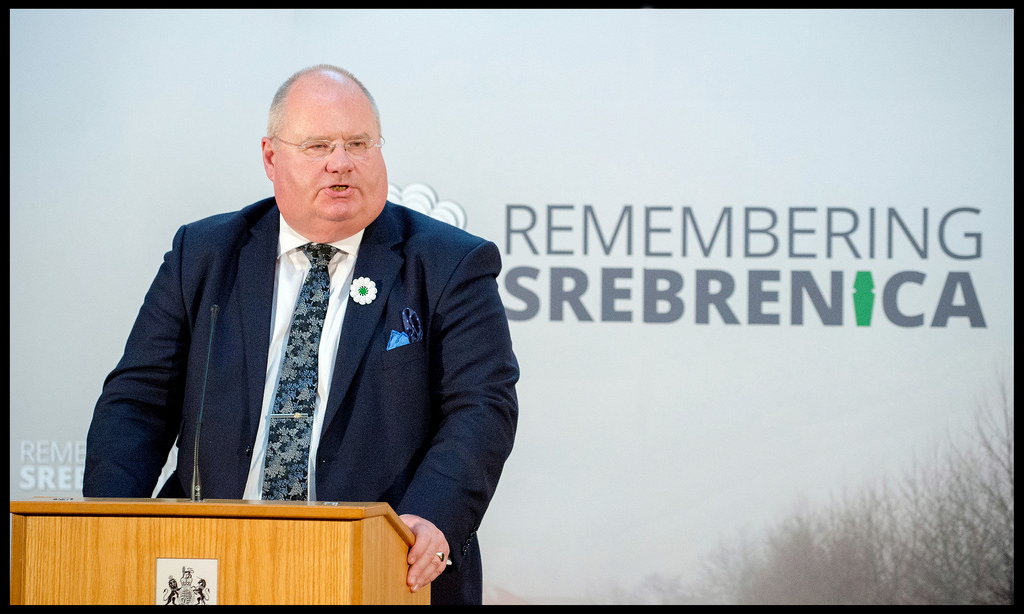
As from time to time has been the case, Western sources have again disclosed some information about Srebrenica in July 1995, which until recently was kept confidential and therefore not available to the public. The source of this particular batch of documents is the UK Department of Defense. The documents that have finally been declassified contains very interesting assessments and reports that take on even greater significance when cross-checked against data which are already known. The document that has attracted the most attention is a letter from a Ministry of Defense official under the date of July 11, 1995, sent to Roderick Lyne, private secretary to the then Prime Minister John Major. The purpose of the letter was to brief Major through his private secretary on developments in the Srebrenica area in order to enable the Prime Minister to handle expected parliamentary questions on that subject.

A definitive judgment on these until quite recently inaccessible documents (they were released by the National Archive of the United Kingdom on December 31, 2019) must await thorough examination. Both the subject matter and everything we know from these and other official sources suggests the conclusion that these are issues too important to be left to very selective and often shallow media interpretations.
But even if we were to confine ourselves to the fragments with which the general public has now been acquainted, some significant and, for the official Srebrenica narrative, rather unfavorable conclusions may even now be drawn.
First and foremost, we see here a report emanating from the British Ministry of Defense, dated July 11, 1995, which matter of factly informs the Prime Minister that at that particular moment British intelligence services lacked knowledge of any intention on the part of the Republika Srpska Army to conquer Srebrenica and place the enclave under its control. (Bosnian Serb army forces did enter Srebrenica on that very day, but that was widely acknowledged to have been an opportunistic move, no resistance having been encountered.) This British assessment is of great importance because of the implications that emanate from it.
According to the “facts” alleged by the Hague Tribunal in its numerous judgments, the “genocide” is supposed to have begun only two days later, on 13 July. Why is this chronology important?
Because for “genocide” to have occurred in the legal sense of the term, even of a relatively small group of 8,000 people (if we compare that to the scope of the extermination of Armenians in the Ottoman Empire, Jews under the Nazis, or Serbs in the Nazi-aligned Croation state during World War II), presupposes the existence of specific intent, as well as adequate logistical preparation.
To that end, the Hague Tribunal has unpersuasively construed meetings held at the Fontana Hotel in nearby Bratunac on 12 July to bolster its conclusions (see Krstic Trial Judgment, paragraphs 126-134). In its comments, the Tribunal itself accepts that these meetings were held shortly before the alleged genocidal events, in fact only a day before a crime of such serious magnitude was supposed to have begun, but at the same time it acknowledges that there is no “concrete evidence” of the existence of a genocidal plan. Furthermore, the only direct perpetrator of the “genocide” to have been brought before that court, the mildly punished Drazen Erdemovic, who turned Prosecution witness, when cross-examined by defendant Radovan Karadzic admitted freely that neither he nor his colleagues from the 10th Sabotage Detachment execution squad were motivated by the intent to exterminate Muslims when taking part in the execution of war prisoners at Branjevo. As for logistics, since the intent evidently could not have been formed until the eve of the “genocide”, the issue is practically moot. Since no evidence of logistics to carry out such a large-scale killing operation was discovered, there are no specific allegations or details in ICTY judgments on this important issue.
A review of the documents already publicly available for some time makes it crystal clear that the “sensational disclosures” from the British archives must already have been known to anyone with a serious interest in these issues.

The Hague Tribunal’s long-time chief investigator, Jean-Rene Ruez, said much the same thing as the recently declassified British documents when he testified before the French Parliamentary Commission on Srebrenica in 2001. The British Defense Ministry’s assessment subsequently proved to be essentially correct, but since it was drawn up contemporaneously with the events to which it refers, it did not necessarily have to be. However, Ruez’s assessment is retrospective, made five years after the event, with the benefit of insight into the relevant documentation, and it therefore carries more weight. A very precise sequence of events, which virtually rules out the possibility that the official version of the event could be accurate, was presented by ICTY military prosecutor Richard Butler at the “Pelemis and Peric” trial before the Bosnia and Herzegovina War Crimes Court in Sarajevo in 2010. Therefore, far from constituting a sensation, British MoD documents are important pieces of the mosaic that do not disclose anything basically new. They do, however, round out a picture that was already familiar.
Another important detail that the British documents do not reveal, but certainly do confirm, is the refusal of members of the 28th Division of the Army of Bosnia-Herzegovina, whose troop strength in July 1995 was about 5,000, to engage in natural and normal conduct in the situation in which they found themselves (also here, footnote 28). The armed outfit in question did virtually nothing to counter “one company and four tanks” (a direct quotation from the British MoD document) of the Bosnian Serb Army that was approaching Srebrenica from the south side of the enclave. To journalists, this may appear as a sensation, but for those who have studied these matters in the context of the Bosnian war — it definitely is not.
Foreign observers who happened to be in the immediate vicinity or who were following the events on the ground in some official capacity have shed light on this mystery. For example, Portuguese General Martins Branco, Deputy Commander of the UN Observation Mission at the time of the events in question, made the following observation in his memoir, “The War in the Balkans,” published in 2017:
“The topography of the Srebrenica region, as well as Eastern Bosnia as a whole, is very hilly. The virgin, densely forested landscapes and deep ditches make it difficult to move combat vehicles and facilitate infantry operations. The numerical ratio of forces, when considered in relation to the terrain properties, which undoubtedly favors the defenders, suggests that the ARBiH forces had more than enough manpower to defend themselves. However, they failed to do so.”
Other observers made similar assertions as Martins Branco (here, pp. 47-48). So once again the British documents did not reveal anything fundamentally new, but the fact that they have been made public is nevertheless helpful because one can never go too far stressing the startling fact that in Srebrenica there was no resistance and that the armed and much more numerous “men and boys” withdrew to the mountains, leaving their womenfolk and elderly unprotected in the face of an “aggressor” who by that time in their eyes had already acquired a genocidal reputation.
Finally, the question must be raised: why did they act that way? Was it to take the opportunity to lure the Serb forces into a strategic trap (remember General Morillon’s testimony at The Hague, where he used precisely such language to describe the situation), hoping the Serbs would slaughter several thousand refugees in Potocari? That certainly would have satisfied the terms of Izetbegovic’s and Clinton’s secret convention, which envisioned exactly such a scenario in order to ensure the political preconditions for a US intervention in the conflict.
It is almost always the case when new files concerning Srebrenica are opened, whether the result is really new data or just a confirmation of already known facts, that not only do these disclosures in no way help the official narrative, but on the contrary they systematically undermine it. It is not surprising therefore for such information to have been kept under lock and key for decades precisely so as not to disturb the prevailing, concocted narrative in the expectation that buying time (and criminalizing “genocide denial”) would assist the narrative in taking hold.
The Karl Rovian way the process of rearranging reality now unfolds was recently explained by Craig Murray, a former British ambassador, in a remarkable article, “The Terrifying Rise of the Zombie State Narrative”. The ruling establishment, Murray claims, has learnt one important lesson from the collapse of the official lies about the non-existent Iraqi weapons of mass destruction: “Never to admit they lied, never to admit they were wrong.”
And the same goes now for all their monumental lies, from the pretext for invading Iraq to Srebrenica, and more recently the political crisis engendered by the cold-blooded assassination at Baghdad airport on January 3. The security services, Murray writes, understand “that in future they just have to brazen it out.” If a hypothetical situation like the mythical Iraqi weapons were to recur today “and the security services decided to brazen it out” by asserting deliberately the false claim that the armaments were in fact found, “there is not a mainstream media outlet that would contradict them.“
The rebuttable or easily refuted claims that are blatantly disseminated and parroted, and believed by millions who blindly take them at face value even though evidence refuting them is close at hand, Murray christens “zombie narratives.” Srebrenica is undoubtedly one of the prominent illustrations of Murray’s thesis.
The “declassification” of the British documents is therefore no evidence of Western transparency or democratic will to keep the public informed. It is proof, rather, of a perfidious damage-control tactic. As we have seen, some of the major “disclosures” in the British documents have long been in the public domain and have gradually been seeping into the public discourse. Extending the embargo would accomplish nothing, but the removal of the secrecy mark should impress the simpleminded who may imagine that this is evidence of regrettably belated, but still highly commendable “transparency” of the Western system.
Those who think this way have already forgotten the farce about finally making public the remaining, most sensitive documents about the assassination of John Kennedy. In the 1990s, Congress explicitly ordered that by 2017 everything must be disclosed, even the last scrap of paper. Yet, under a Presidential directive countermanding Congressional instructions, 2017 has come and gone but the most compromising documents remain locked away for several additional decades, for the reasons of “national security” to which Murray has alluded. Locked away and unpublished documents on Srebrenica surely also abound in the secret files of “all the usual suspects,” as Captain Louis Renault picturesquely put in the movie “Casablanca.”
The availability of these British Srebrenica documents — assuming Ambassador Murray is correct — may in some circles achieve a favorable propaganda effect for the UK, but in relation to Srebrenica, a wall of blatantly imposed lies will not permit them to change or meaningfully challenge anything. Tactical damage control operations should not be confused with permission to touch the core of a protected zombie narrative.
If in 2015 the general public were unaware of these “sensational” documents kept in the British Defense Ministry safe, the British government certainly were. Yet, that did not prevent them from attempting to push through in the UN Security Council a resolution chastising the Serbian nation for genocide in Srebrenica. The resolution failed only thanks to the veto placed by the Russian Federation. And as we now learn, British government sources, in their own contemporaneous and confidential report, had frankly stated that their misleading resolution alleging genocide in Srebrenica was to do with an attack undertaken by a local commander, not by the Bosnian Serb military and political leadership in Pale, and therefore even less probably so by the Serbian leadership in Belgrade.

Originally published on 2020-01-13
About the author: Stephen Karganovic is a President of the Srebrenica Historical Project
Source: Strategic Culture Foundation
Origins of images: Facebook, Twitter, Wikimedia, Wikipedia, Flickr, Google, Imageinjection, Public Domain & Pinterest.
Read our Disclaimer/Legal Statement!
Donate to Support Us
We would like to ask you to consider a small donation to help our team keep working. We accept no advertising and rely only on you, our readers, to keep us digging the truth on history, global politics, and international relations.